Read the article below. Interactive reading tools are available when scripts load.
Classic
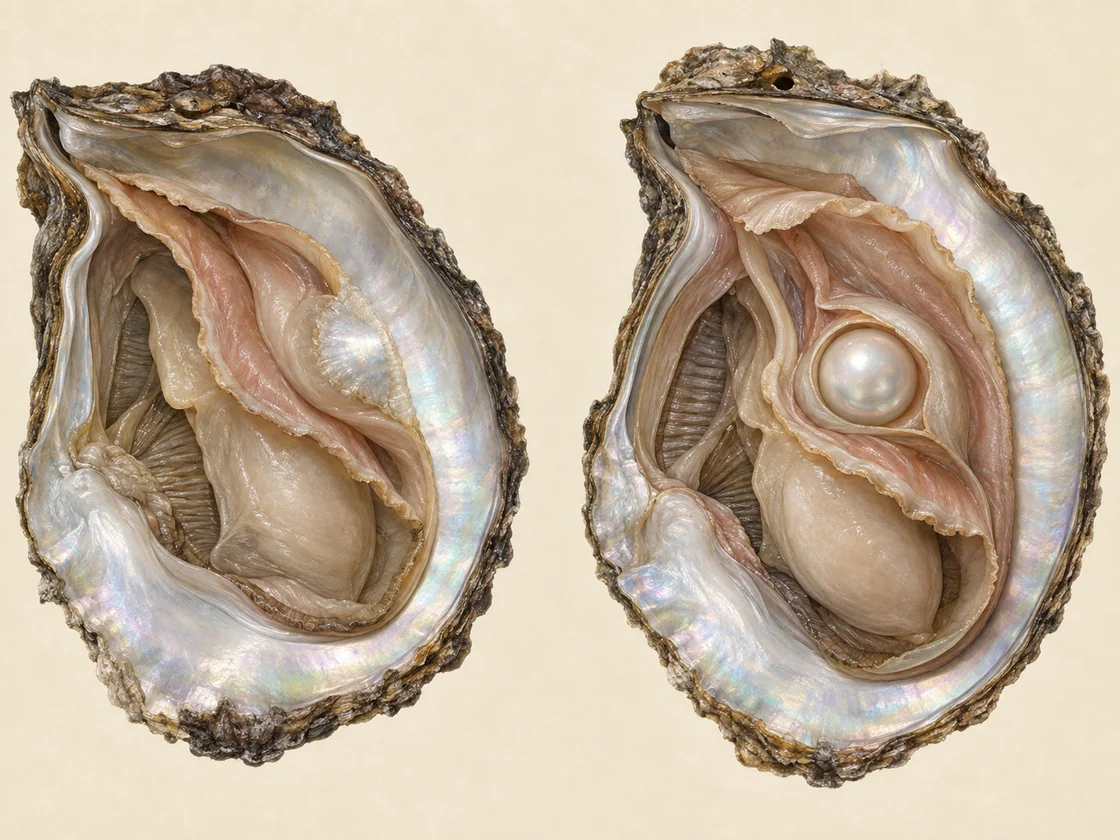
Producing a pearl free of its oyster’s shell required a nacre-secreting sac inside the living animal. It was a different problem from coating a form against the shell. Work on mantle tissue—the tissue that secretes shell material—opened routes to that internal pearl sac.
After the half-pearl harvest, Mikimoto expanded his farms and obtained patent protection. Official local accounts differ on the Tatoku Island date: a Mie history places the farm's creation in 1893, while a Toba chronology uses 1896. The difference may reflect separate stages of acquisition, establishment, or expansion; until the underlying records are checked, the narrative should say that Tatoku became a major site by the mid-1890s.
One attractive half pearl proved possibility, not a reliable yield. Expansion forced Mikimoto's organization to turn improvisation into routines: maintain oyster stocks, monitor water, repeat interventions, sort uneven results, and coordinate access to larger coastal grounds. A larger farm increased production capacity while also increasing exposure to disease, storms, harmful blooms, and debt.
Oyster management occurred on a biological clock. Stock had to reach appropriate condition; intervention had to avoid excessive mortality; recovery and growth required monitoring; harvest could not simply be accelerated to meet a cash crisis. Variability meant that two apparently similar oysters might yield different surfaces, colors, or no usable pearl. Sorting converted biological diversity into commercial grades, but it also produced waste and losses hidden by photographs of perfect products. Workers made scale possible. Divers and boat crews handled oysters and moved stock; farm attendants observed water and equipment; skilled operators performed delicate interventions; sorters and craftspeople prepared outputs. The founder’s name organized ownership and brand, not every hand movement. A product history that restores labor does not deny Mikimoto’s coordination—it explains what coordination meant.
Patent no. 2670, granted in 1896 for cultured pearls, offered a legal asset. A patent could help attract capital, deter copying of a claimed method, and support publicity. It did not make oysters behave consistently, establish that every technique was exclusively Mikimoto’s, or end later disputes. Legal protection and production competence were different sources of advantage. Sales mattered at this stage because half pearls had to finance continued work. Jewelry design could accommodate attached forms, allowing partial technology to create a real market while spherical research continued. This is an important innovation pattern: an intermediate product can support development rather than waiting for a perfect final invention.
Sales now became part of the production problem. Mikimoto opened a Tokyo sales base in 1899 and moved onto Ginza's main commercial street in 1902. Half pearls had to finance continued spherical-pearl research, and urban buyers had to be taught why a cultured pearl was genuine nacre rather than a glass imitation. Ojima remained the 1893 breakthrough site; Tatoku belonged to farm expansion; Tokyo and Ginza supplied retail reach. Keeping those places separate makes the growth of the enterprise visible.
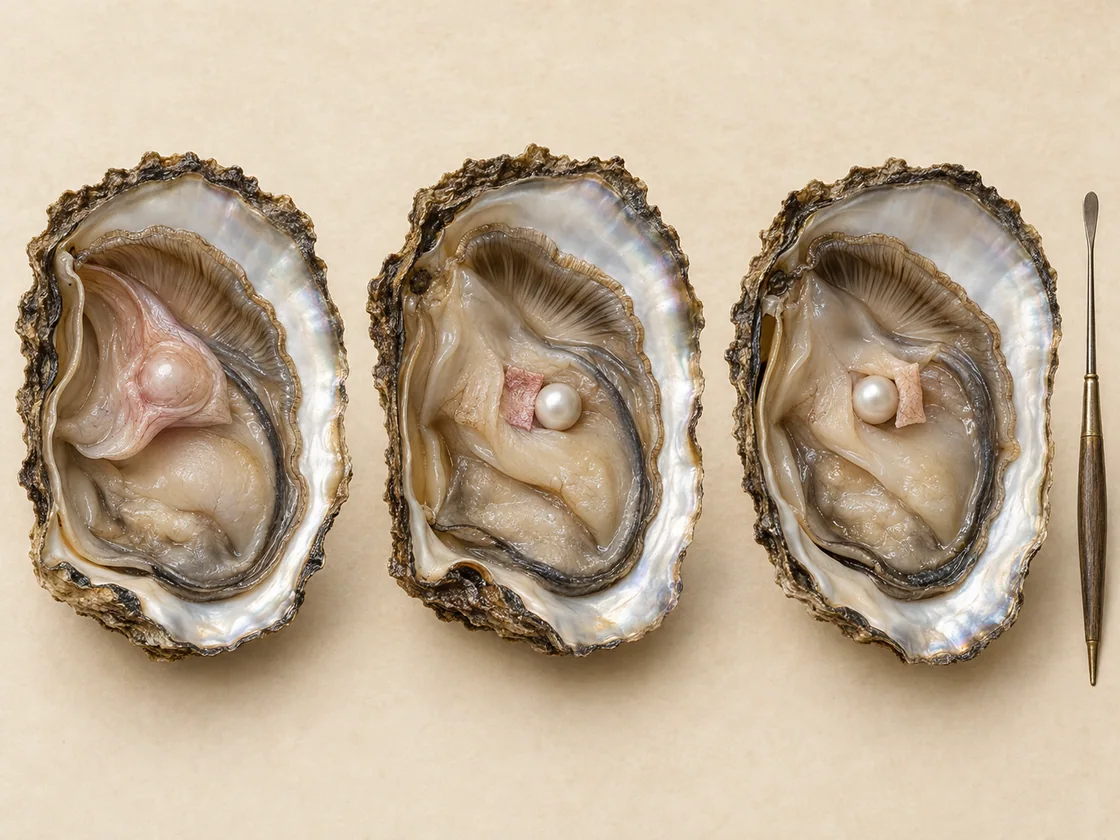
Mikimoto’s farm recovered spherical pearls in 1905 and pursued a method of forming a sac and inserting a nucleus. Nishikawa Tōkichi worked on transplanting small pieces of mantle tissue. Mise Tatsuhei devised a needle that introduced a small nucleus together with tissue. Related biological principles therefore led to different procedures and instruments.
The Japan Pearl Promotion Society’s 2020 technical review places distinct patent applications by Mikimoto, Nishikawa and Mise in 1907. Application, grant and reliable commercial production were separate milestones: some of Nishikawa’s grants came years later. Early techniques could yield pearls without yet doing so efficiently enough for an industry.
Nishikawa’s research connected university marine biology with Mikimoto’s enterprise; he also married Mikimoto’s daughter in 1903. Mise worked on a separate experimental line. Their contributions cannot be collapsed into a single founder’s discovery or one patent. Later improvements to transplantation and farm operation made the experimental results reproducible at larger scale.
The move from shell-attached half pearls to free spherical pearls was not a second version of the same procedure. A nucleus and a small piece of living mantle tissue had to be placed so that a pearl sac could form around the nucleus. The oyster then had to survive long enough to cover it with nacre. Placement, tissue condition, aftercare, water quality, and time all affected the result.
Several experimenters worked on this problem. Tatsuhei Mise developed insertion techniques and filed patent claims in 1907. Tōkichi Nishikawa, a fisheries researcher who became Mikimoto's son-in-law and conducted research at the Mikimoto farm, filed related claims in the same year. Mikimoto and workers at his farms also tested techniques for producing free pearls. Their work belonged to a competitive field in which ideas, family relationships, facilities, and legal claims overlapped.
Patent chronologies often confuse filing with grant, and the available secondary accounts do not agree on how every number maps to a particular method. The Japan Patent Office records Mikimoto receiving protection in 1908, while Nishikawa's related grants came later. Until the original patent records are reconciled, the text should not attach a disputed number or method description to one decisive “round-pearl patent.”
Patent records answer a legal question: who claimed a specified method at a particular time. They do not by themselves reveal the first private experiment or every person's contribution at a farm. Nor does later commercial success settle technical priority. Mikimoto's distinctive achievement was to connect long experimentation with oyster stocks, farms, capital, quality control, retail, and promotion. That combination helped turn cultured pearls into an industry, but it did not make Mise and Nishikawa merely assistants in a single inventor's story.
Mikimoto opened a Tokyo sales base in 1899 and moved onto Ginza’s main commercial stage by 1902. Production remained rooted in Ise-Shima, while the shop addressed urban consumers, jewelers, media, and international visitors. Retail, design, grading, display, and explanation were necessary to make cultured pearls a trusted luxury.
Why sell in Ginza if the pearl came from Toba and Ago Bay? Luxury value is not completed at harvest. Buyers need to see, compare, authenticate, imagine use, and associate the object with a reliable seller. Ginza concentrated affluent customers, modern retail display, press attention, travelers, and proximity to national commercial networks. It performed a function the farm could not. Mie’s historical record distinguishes an 1899 Tokyo sales shop from the 1902 move onto Ginza’s main street. That sequence corrects the convenient phrase “he opened Ginza in 1899.” A business may establish a metropolitan presence before obtaining the location later central to brand memory. Precise phases prevent a famous address from erasing earlier retail work.
The shop also confronted category uncertainty. Natural-pearl value rested partly on rarity and the story of accidental discovery. Cultured pearls were genuine nacre made by living oysters under human intervention, but customers could hear “artificial” as “imitation.” Glass beads and other substitutes made the distinction commercially dangerous. Retail staff and exhibitions had to teach consumers why cultivation did not make the material fake. Branding answered an information problem. A recognizable Mikimoto name could promise that sorting, matching, workmanship, and return to a known seller stood behind the product. That promise required quality systems. If uneven or misleading goods carried the same name, publicity would magnify disappointment. The brand was therefore not only decoration; it was an institution for concentrating trust and liability.
Design and craft retained separate agency. Pearls became wearable through drilling, setting, metalwork, matching, and aesthetic choice. Mikimoto could direct a house and commission products, but jewelers and artisans made the objects. A cultured pearl industry joined aquaculture to decorative arts. The store connected those production worlds to consumers. Urban success also changed the relation to place. Toba supplied origin authenticity and technical narrative; Tokyo supplied prestige and circulation. Neither should consume the other. International possibility entered through Tokyo before a full overseas network existed. Foreign residents, visitors, exporters, and exhibitions could encounter the product. Suspicion and competition remained, and spherical supply was still developing.
Mikimoto did not merely carry an established natural luxury to market. His organization had to explain a new production method, defend authenticity, grade biological variation, and create desire. Ginza converted technical proof into something consumers could trust, wear, and discuss. The 1902 shop should not be illustrated with a later flagship facade unless the image is clearly dated.
Mikimoto's greatest achievement was not the isolated invention of “the cultured pearl.” It was the construction of a system that could produce pearls repeatedly, select and grade them, protect particular processes, persuade buyers that cultivation did not mean imitation, and sell the result as modern luxury. This required biological experimentation, farm management, skilled intervention, capital, retail theater and publicity. His organization gave cultured pearls a scale and market presence that no single successful oyster could create.
That success changed both the pearl trade and the coastal communities supporting it. Cultured supply reduced the market's dependence on rare natural finds and eventually made pearl jewelry available far beyond its earlier clientele. It also rested on contested inventive credit, intensive marine labor and managed coastal environments. Mise, Nishikawa, Ume, women divers, farm workers and scientific advisers belong inside the history, not outside a “Pearl King” biography. Mikimoto remains historically significant because he integrated their scattered forms of knowledge and work into a durable industry and global brand—not because he alone discovered every method the industry used.