Read the article below. Interactive reading tools are available when scripts load.
Quick
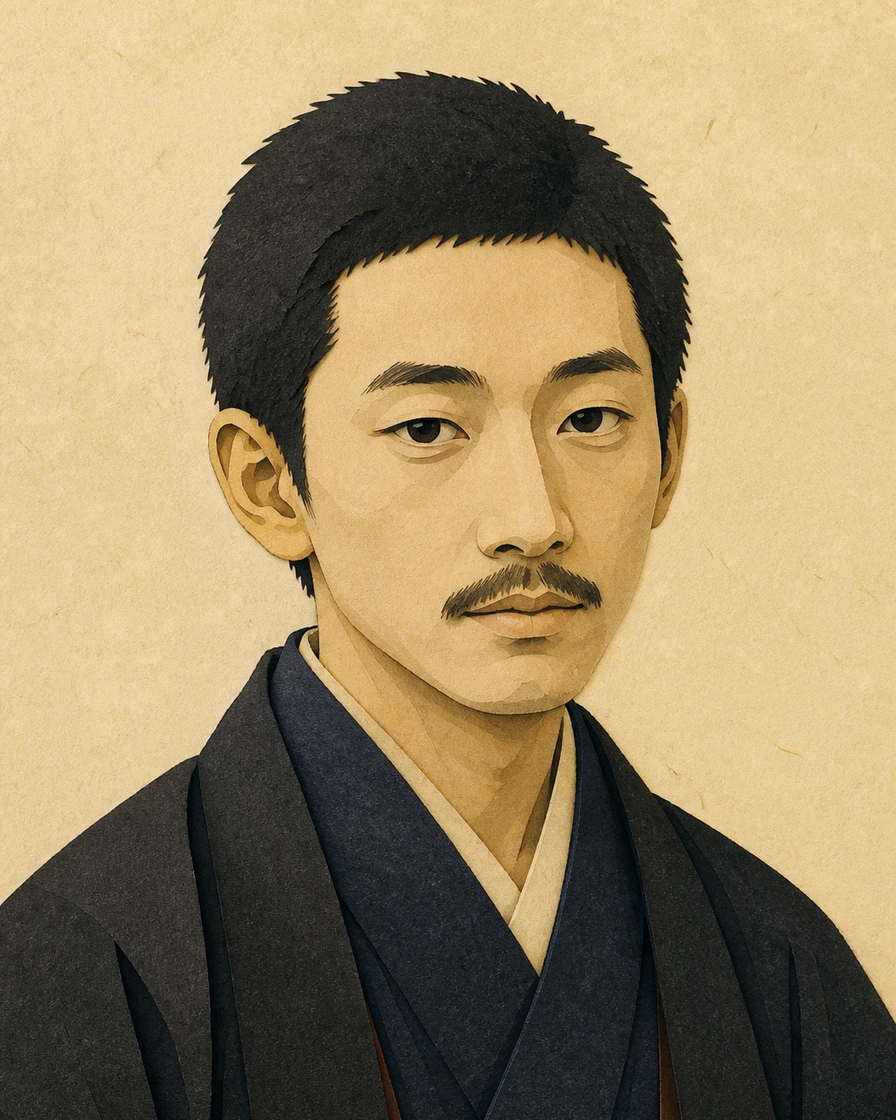
Masaoka Tsunenori, later known as Shiki, was born in Matsuyama on Shikoku on 14 October 1867. His father was a lower-ranking samurai serving the local lord. The Meiji government abolished the domains in 1871, during his childhood. Family literacy helped prepare him for new schools, but inherited samurai status no longer guaranteed an occupation. [1][8]
Shiki studied Chinese texts with his grandfather Ōhara Kanzan and continued classical composition alongside modern schooling. He entered Matsuyama Middle School in 1880 and circulated writing among friends. In 1883 he moved to Tokyo for further study. The capital offered advanced schools, while the preparation and relationships acquired at home continued to matter.
Shiki entered the university preparatory school in 1884 and the Imperial University’s College of Letters in 1890. Fellow student Natsume Sōseki became an important friend. Newspaper writing increasingly attracted him, and he joined Nippon in December 1892. Formal university withdrawal followed in 1893; he did not complete a degree.
Shiki became an enthusiastic baseball player while studying in Tokyo. He took a bat and ball to Matsuyama in 1889 and taught students there. In 1896 he explained the game in a Nippon series. His childhood name Noboru supplied a written pun on ‘base ball,’ not the origin of the sport’s modern Japanese name. His playing and writing helped popularize a game introduced before him.
After a serious episode of coughing blood in 1889, he adopted the literary name Shiki. It refers to the lesser cuckoo, traditionally associated with crying blood. Tuberculosis and later spinal disease increasingly restricted his movement. They also made writing dependent on continued income and the household care supplied by his mother and sister Ritsu.
Shiki joined Nippon in December 1892 and formally withdrew from university in 1893. The newspaper gave him paid work and a recurring audience for criticism. He published haiku discussions, then extended his reform to tanka, a verse form of thirty-one Japanese sound units. Leading editor Kuga Katsunan's politically engaged nationalist paper supported this literary work without making it separate from the public affairs of Meiji Japan.
Shiki’s newspaper criticism reassessed Matsuo Bashō, the celebrated earlier poet, and attacked mechanical imitation of revered models. He helped establish haiku as an independent short poem derived from the opening verse of a linked sequence. His judgments concerned individual works, not the rejection of everything Bashō wrote. Contributors could test his standards through examples and selection in print.
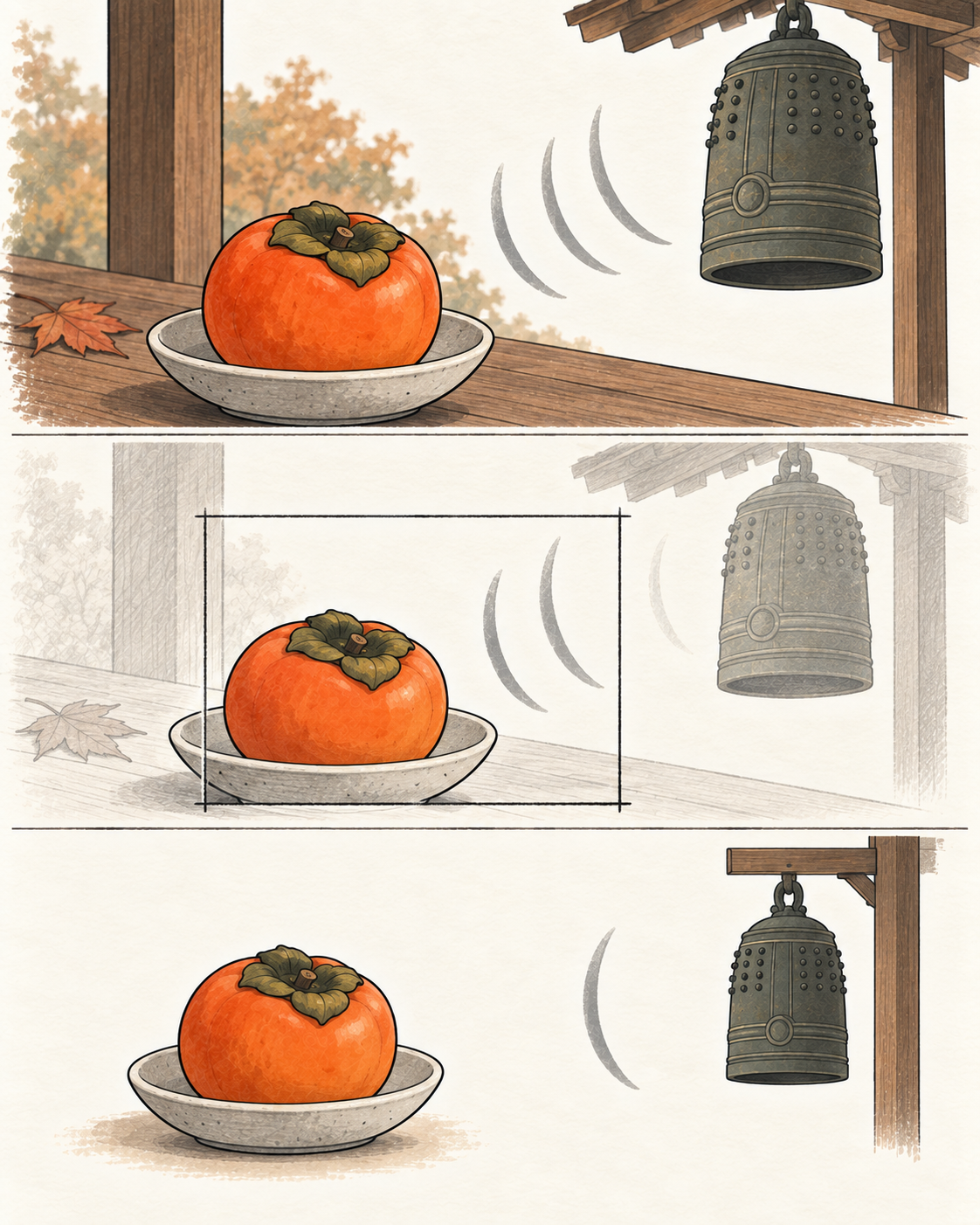
Shasei means 'sketching from life': composing through close observation rather than stock phrases. Shiki's poem brings eating a persimmon together with Hōryū-ji's bell, at a Buddhist temple near Nara. A taste and sound carry the encounter without spelling out every feeling. The poem is not an exact travel transcript: later interpretations differ between a temple-side occasion and a recasting of bell sounds heard near Tōdai-ji, another Buddhist temple in Nara. Observation still required selecting a place and words.
Shiki went to China as a correspondent in April 1895, near the end of the First Sino-Japanese War between Japan and Qing China. Much of the major fighting was over, limiting his reporting opportunity. On the return voyage in May he suffered a severe hemorrhage and entered hospital in Kobe. Recovery then brought him back to Matsuyama.
In Matsuyama in 1895, Shiki spent fifty-two days at Gudabutsuan with Sōseki, then a teacher at the local middle school. Shiki stayed downstairs and Sōseki upstairs. Local poets gathered to compose and discuss verse with them. The shared lodging connected Shiki’s newspaper criticism to a particular group of friends working in his home city.
Shiki selected and classified verse, while friends organized journals and meetings. Yanagihara Kyokudō founded Hototogisu in Matsuyama in 1897; editing passed to disciple Takahama Kyoshi in 1898. Fellow disciple Kawahigashi Hekigotō helped shape the circle. From 1896 postal Ten-Poem Collections let participants submit ten poems on a topic and mark one another's choices. A coordinator circulated the manuscript, which went to the highest scorer. This gave literary judgment a shared procedure beyond one critic.
In February 1898 Shiki began publishing Letters to a Tanka Poet in Nippon. He challenged conventional waka, classical Japanese verse, and drew on the Man’yōshū, an eighth-century poetry anthology. Its language offered resources for a modern argument about tanka. Meetings at his Negishi home gave the reform a setting in which other poets could test and develop it. In one autumn-moon poem, Shiki praised the opening's feeling but criticized the ending's qualification—that autumn was not the speaker's alone—as redundant reasoning. He judged what a line contributed, not only the model's prestige.
Tuberculosis and spinal disease increasingly confined Shiki to bed in Tokyo’s Negishi district. His mother and Ritsu supplied household and nursing care. Visitors and correspondence kept him involved in literary work outside the room. He continued judging poems and writing under severe pain, though there were times when pain prevented work. The continuing authorship depended on support, not solitary endurance.
A Drop of Ink began as a newspaper series in January 1901. Shiki started the diary Notes Written Lying Down that September, then the newspaper series A Six-Foot Sickbed in May 1902. Tohoku University Library describes the diary as not intended for publication. They made bodily limitation and everyday life literary subjects, but addressed different audiences. Their vivid first-person accounts are authored experiences, not transparent clinical measurements.
Shiki died on 19 September 1902, aged thirty-four. His tanka collection appeared in 1904. Disciple Takahama Kyoshi developed prose sketches through Hototogisu and published Sōseki's I Am a Cat in 1905. Fellow disciple Kawahigashi Hekigotō visited regional poets during two journeys in 1906–1911 and reported to Japan and the Japanese. By 1912 Kyoshi was returning to haiku with seasonal subjects and seventeen sound units. The successors developed different practices rather than a doctrine fixed at Shiki's death.
Classic
Masaoka Shiki was born in Matsuyama, on the island of Shikoku, on 14 October 1867 by the Gregorian calendar. His personal name was Tsunenori. His father served in the lower samurai ranks of Matsuyama domain, a lord’s territory under the Tokugawa government. That world changed during his childhood. The Meiji government abolished the domains in 1871, and hereditary samurai status ceased to guarantee a stipend or an occupation. His mother and, later, his sister Ritsu sustained the household in which he studied and wrote. [1][8]
His father died in 1872, leaving Tsunenori to inherit the household while still a child. His mother, Yae, was the daughter of the Confucian scholar Ōhara Kanzan. Study with his grandfather gave him access to Chinese texts and composition. Matsuyama’s schools and friends supplied further opportunities. Tokyo would later widen his audience, but his literary education had begun in the provincial city where his family lived.
As a child he studied Chinese texts with Ōhara Kanzan; after his grandfather’s death, a local teacher continued his instruction. Shiki began composing Chinese poetry and circulating writing among friends. He entered Matsuyama Middle School in 1880. Classical composition and the new school system belonged to the same youth, rather than to separate lives divided by the Restoration. [8]
He left for Tokyo in 1883, carrying preparation acquired in Matsuyama. Advanced schools and publishers were concentrated in the capital, while letters and friendships kept him connected to home. The move offered an ambitious student a larger setting in which to test his writing; it did not erase the region that had trained him. [8]
In Tokyo Shiki studied at Kyōritsu School, then entered the university preparatory school in 1884 and the Imperial University’s College of Letters in 1890. These schools brought him into contact with students who shared his literary interests, including Natsume Sōseki. He did not finish a university degree. Newspaper writing increasingly claimed his attention, and he formally withdrew in 1893 after joining Nippon the previous December. [3][8]
Newspapers offered a public different from the university classroom. Their recurring columns brought literary judgments into the same daily print as political affairs. Shiki and Sōseki were still students testing their abilities, not the paired monuments of later literary history. Writing increasingly became a possible occupation, though maintaining a life in Tokyo still required support from the relationships through which they had arrived.
A postcard from Sōseki in June 1892 urged him to seek permission for another examination opportunity. Shiki did not take the supplementary examination and failed the year’s assessment. He later recalled in A Drop of Ink that preparing for examinations made haiku arise so insistently that study was neglected. The later recollection gives the episode a literary voice; the postcard shows a friend trying to keep the student’s options open.
Shiki encountered baseball while studying in Tokyo and became an enthusiastic player. The game had reached Japan through earlier teachers and students. Its novelty brought him into a practice learned through rules and repeated play. He also used his familiar childhood name Noboru in a written pun on ‘base ball.’ That personal usage belongs to his literary aliases, rather than explaining the origin of the sport’s modern Japanese name. [2]
In 1889 he took a bat and ball back to Matsuyama and taught students there. The equipment made his enthusiasm shareable in a particular place. Playing gave the young writer companionship and bodily experience that would later contrast with confinement. At the time it was an active interest alongside study and composition, not merely a scene of future loss. [2]
In 1896 he explained baseball’s rules and equipment in Shōra Gyokueki, a series in Nippon. Readers could encounter the game beyond the students who played it. He also made baseball a subject for short verse, giving a new imported pastime a place in established forms of composition. Playing, explanation and poetry were distinct ways in which his enthusiasm reached other people. [2]
A serious episode of coughing blood in 1889 became associated with his adoption of the name Shiki. The name refers to the lesser cuckoo, whose cry was linked with blood in Chinese and Japanese literary tradition. He gave frightening bodily experience a form familiar to educated readers. Lung disease and later spinal tuberculosis increasingly restricted his movement, while his mother and Ritsu helped sustain daily life and writing. [8]
Illness affected his livelihood as well as his body. Medical care and reduced mobility increased dependence on the household and on continued newspaper income. Pain could interrupt concentration and prevent work; it did not consistently sharpen creativity. The blood-associated name later encouraged biographers to read symptoms as foreshadowing, though the literary image and the course of the disease are different kinds of evidence. In 1897 a Red Cross nurse came to the Negishi household for about a month with financial help from his uncle. Treatment and paid assistance supplemented family care without removing the growing limits on movement. Work continued through people able to visit the room and carry manuscripts beyond it. [8]
Shiki joined Nippon in December 1892, before his formal university withdrawal in 1893. He had already begun Dassai Shooku Haiwa, discussions of haiku, in the paper that June. Haiku was emerging as an independent short poem from the opening verse of linked composition. The newspaper gave his criticism a recurring audience and eventually paid work. Contributors could see poems alongside his judgments and test their own verse through submission. [1][8]
Kuga Katsunan, the paper’s leading editor, supplied an institution willing to give Shiki space and income. The literary work took place inside a politically engaged nationalist newspaper, not outside contemporary public affairs. Employment did not make every literary judgment an expression of Kuga’s politics, but it connected Shiki’s criticism to the paper that published and supported it.
The newspaper reached beyond a local poetry circle, though publication in Tokyo did not make its audience universal. Correspondence and discussion in regional groups carried the argument further. Shiki’s own continuing ties with Matsuyama were part of that movement between the capital’s print and local literary practice.
Haiku developed from hokku, the opening verse of a linked sequence. Shiki helped establish that short poem as an independent modern form, but inherited a substantial tradition. Matsuo Bashō, the celebrated seventeenth-century poet, was central to it. Shiki could admire particular Bashō poems while attacking the treatment of every attributed work as beyond criticism. Evaluating individual poems was different from rejecting the earlier poet’s whole achievement. [1]
His standards remained arguments about taste. Close detail and freshness challenged established practice, whose teachers and circles had purposes of their own. Newspaper selection made disagreement visible: readers saw poems alongside judgments, and contributors could revise through repeated submission. The critic’s authority depended on choices that others could accept or contest.
Haikai Taiyō, an outline of haiku composition, began as a serial in 1895 and appeared in book form in 1899. It gathered practical questions about writing and judgment into a form readers could return to. The sequence from columns to a book shows how criticism became teaching beyond the immediate occasion of a newspaper installment.
Shasei, commonly translated as ‘sketching from life,’ made close observation a starting point for composition. The approach is associated with Shiki’s contact with the painter Nakamura Fusetsu and with contemporary ideas from visual art. Looking did not supply a finished poem. The writer still selected a detail and language, making an observed encounter part of the act of composition. [8]
Seasonal words and inherited forms remained available to the observing writer. A particular scene could acquire meaning through conventions as well as through new detail. Shiki developed the method across short verse and prose, including tanka, a poem of thirty-one Japanese sound units, or morae. Applying observation to a form did not remove the work of arranging words within it.
Historical disagreement · Where did Shiki’s persimmon-and-bell poem begin?
A familiar Shiki poem brings eating a persimmon together with the sound of a bell at Hōryū-ji, a Buddhist temple near Nara. The ordinary act and the named place become a compressed encounter. It makes the relation between particulars visible without explaining every feeling for the reader. That is an artistic example, not proof that a poem reproduces an event exactly as it happened. Toyonaka City Library compares a temple-side interpretation with the theory that the poem recast an experience of hearing Tōdai-ji's bell near a Nara inn.
The poem's named scene and the event behind it need not be identical. [13]
The First Sino-Japanese War of 1894–1895 pitted Japan against Qing China over influence in Korea and was fought in Korea, China and surrounding seas. Shiki went to China as a newspaper correspondent in April 1895, near the war’s end. Much of the major fighting had already occurred. His assignment therefore gave him a limited reporting opportunity, not a comprehensive eyewitness position over the war’s course or its effects on Korean and Chinese populations. [8]
On the voyage home in May, he suffered a severe hemorrhage and was admitted to hospital in Kobe. Recovery took him through further convalescence and back to Matsuyama. The journey marked a deterioration in his health without establishing the beginning of every later symptom. Newspaper ambition and imperial expansion had taken the writer abroad; illness then interrupted the work he had hoped to do there. [8]
During recovery in Matsuyama in 1895, Shiki stayed for fifty-two days with Natsume Sōseki at the lodging called Gudabutsuan. Sōseki was then teaching at Matsuyama Middle School. Shiki occupied the lower floor and Sōseki the upper. Local poets gathered around them, connecting Shiki’s newspaper criticism to composition and discussion among friends in his home city. [8]
Shiki's work of classification made earlier poems available for comparison. His collection Najimi-shū brought writing by acquaintances into a manuscript organized by authors and seasons. It connected the circle he knew to the comparative reading behind his public judgments. The manuscript was a different object from the handmade poem cards and later postal meeting collections.
Yanagihara Kyokudō founded Hototogisu in Matsuyama in 1897, with Shiki selecting submitted haiku. Publication moved to Tokyo in 1898. A specialist journal could sustain discussion among contributors differently from a daily newspaper’s recurring columns. The Matsuyama foundation and later Tokyo development connect regional initiative to the wider print through which the reform spread. [4][8][9]
A handmade haiku card set shows a different kind of collaboration. Shiki selected one poem from each of a hundred poets. His disciple Kawahigashi Hekigotō later recalled that Shiki’s mother and Ritsu made the cards from medicine-bag paper, and he wrote the verses on them around 1894–1895. Family work helped turn literary selection into a physical object. The recollection dates the making approximately rather than recording every step contemporaneously.
The postal Ten-Poem Collections offered a repeatable form of judging new work from 1896. Participants composed ten poems on an agreed subject; a coordinator copied them into a manuscript circulated by mail. Members marked their selections, and the highest-scoring participant received the original. Judgments could be compared across the group, not only announced by Shiki. One 1897 collection deliberately invited poems exceeding the usual sound count, showing experimentation within the shared circle. [5]
In February 1898, Nippon began printing Shiki’s Uta Yomi ni Atauru Sho, commonly called Letters to a Tanka Poet. The public series attacked conventional practice in waka, classical Japanese verse, and sought new resources in the Man’yōshū, an eighth-century poetry anthology. Shiki contrasted its language and range of subjects with recent poetic conventions he opposed. Turning to older poetry served a modern argument, rather than a wish to restore the ancient society that had produced it. His fourth letter examines a much-admired autumn poem: moonlight brings innumerable sorrows, followed by the qualification that autumn does not belong to the speaker alone. Shiki praises the opening's ease but treats the ending as redundant reasoning. The objection turns on what the words do to a feeling, rather than the age or prestige of the model. [1][7][8]
The Negishi Tanka Society gave the argument a place for composition and judgment among poets. The poet Itō Sachio and others would develop work and institutions of their own. Shasei did not demand abandoning verse form, and a preference for direct language could itself become a convention. [1]
Confinement transferred much of daily life’s physical work to other people. Ritsu nursed him, and their mother sustained the household. Visitors brought conversation and manuscripts, while correspondence reached beyond Negishi. Shiki’s room remained a place of literary activity because others could cross the distance between an immobile writer and the people engaging with his work. [8]
His subjects narrowed toward things available from the room, including food and flowers. That attention did not make pain harmless: it could interrupt sleep and stop writing. Within those constraints he still made choices and judged new work. The combination of authorship and dependence distinguishes the sickroom from a picture of either complete isolation or effortless creative triumph. [8]
A Drop of Ink began appearing in Nippon in January 1901. That September Shiki began Notes Written Lying Down, a diary not intended for publication, according to Tohoku University Library's account. A Six-Foot Sickbed followed as a newspaper series in May 1902. These were distinct works with different audiences. The newspaper pieces addressed readers beyond the room; the diary recorded meals, poems and drawings with a different intended audience. [8][9][10]
These accounts convey bodily limitation through incidents and language chosen by the writer. Their vividness does not make them transparent medical charts. [9]
On 18 September 1902, Shiki wrote three final haiku while lying down, with Ritsu holding a paper-covered drawing board for him. He died the following day in Tokyo, aged thirty-four. The final manuscript brings writing and family care together in one documented act. Those who survived him then preserved the papers and continued the journals through which his work had reached readers. [1][12]
Take no Sato Uta, his tanka collection, appeared posthumously in 1904. His reputation would often center on haiku, although the later work had also renewed the longer verse form. Takahama Kyoshi, a disciple from Matsuyama, continued Hototogisu after taking over its editing in 1898. He developed prose sketches from observation, published Sōseki's I Am a Cat in 1905 and wrote fiction himself. His route through the journal extended the teaching beyond short verse. [4][6][11]
Kawahigashi Hekigotō took a more itinerant route to literary exchange. He traveled among regional poets in 1906–1907 and again in 1909–1911, sending reports to Nippon oyobi Nihonjin, or Japan and the Japanese. The first journey appeared in book form as Three Thousand Ri in 1910. Editing a Tokyo journal and visiting dispersed groups gave the successors different ways to develop the practice Shiki had taught; neither was simply repeating his final instructions. [6][11]
By 1912 Kyoshi was returning to haiku and defending observation within seventeen Japanese sound units and a seasonal subject, as the National Diet Library's profile records. The different paths had outlived the teacher. Shiki's influence survived in works, selection practices and groups that others could change, not as a doctrine settled by his death.