Read the article below. Interactive reading tools are available when scripts load.
Quick
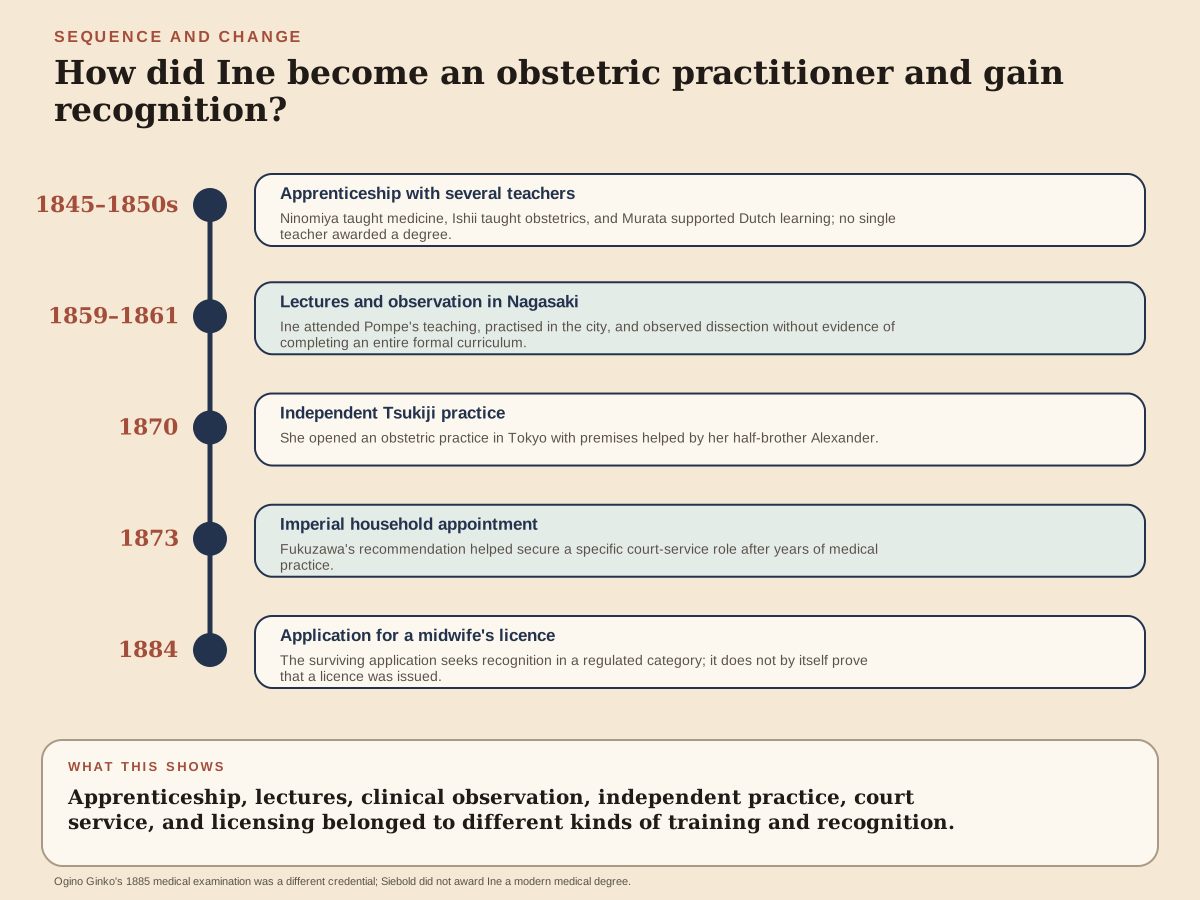
Kusumoto Ine was born in Nagasaki in 1827 to the physician Philipp Franz von Siebold and Taki, her Japanese mother. Siebold left Japan in 1829; Ine grew up with Taki while retaining connections to his former pupils. In 1845 she travelled to learn from Ninomiya Keisaku in Iyo, on Shikoku, before moving on to study obstetrics—the care of pregnancy and childbirth—with Ishii Sōken in Bizen, in present-day Okayama Prefecture. [2][3][4]
Taki's letter describing the journey provides a firmer starting point than the older story of five years of study beginning in 1840. Her father's name helped open connections, but her medical training took place through the teaching of several practitioners. [3][4]
Ine learned obstetrics from Ishii and later returned to Ninomiya for further medical study. Murata Zōroku, later known as Ōmura Masujirō, helped her study Western knowledge through Dutch-language learning in the same regional network. These were private relationships with physicians, before a modern medical degree supplied a standard pathway into practice. [1][5][6]
In 1852 she bore her daughter, Takako. Takako later told the historian Koga Jūjirō that Ishii had raped Ine; this is her daughter's account, recorded decades afterward. Ine continued studying while raising a child and returned to Ninomiya in 1854. Her subsequent work took her back to Nagasaki, where Dutch medical teaching was expanding. [5][10][11]
Siebold returned to Japan in 1859, and Ine encountered the teaching of J. L. C. Pompe van Meerdervoort, a Dutch physician in Nagasaki. By 1861 she was practising there and attending his lectures. That year the Yōjōsho, a hospital linked to a medical school, opened. She also observed anatomical dissection; her access to this instruction does not establish a completed medical-school course. [1][2][6]
Her father departed again in 1862, the year Ninomiya died. Further Dutch teachers included A. F. Bauduin and K. W. Mansvelt. In 1869 she helped care for the wounded Ōmura Masujirō in Osaka alongside Bauduin. Private mentorship had led into medical practice and contact with hospital medicine. [2][5][9][11]
Ine opened an obstetric practice in Tokyo's Tsukiji district in 1870. Her half-brother Alexander von Siebold helped arrange premises, and Fukuzawa Yukichi recommended her for court service. In 1873 she was appointed to attend Hamuro Mitsuko, a pregnant woman in the imperial household. This brought her work into the court, through a recommendation that survives among the family's papers. [1][2][9]
Ine continued her Tsukiji practice until returning to Nagasaki in 1877. Her next professional record belongs to a system increasingly concerned with formal registration. [1][2][7]
In 1884 Ine applied for a midwife's licence. The surviving application documents that request, rather than a physician's examination success. In 1885 Ogino Ginko became the first woman to pass the Meiji government's medical licensing examination. Women had practised medicine before that milestone: the National Diet Library calls Ine Japan's first female practitioner specifically of Western obstetrics. [1][2][7][8]
Ine returned to Tokyo in 1889 and practised there again. A will dated 1891 survives among the family papers. She died in Tokyo in 1903 and was buried at Kōtaiji in Nagasaki. Her work spanned private apprenticeship, urban obstetric practice and court service, with different kinds of recognition at each stage. [2][9][10][11][14]
Classic
Kusumoto Ine was born in Nagasaki in 1827, the daughter of Taki and Philipp Franz von Siebold. Her father was a physician attached to the Dutch trading establishment on Dejima, the Dutch trading post in the port. At Narutaki, he taught Japanese pupils Western medicine. That association gave Ine a name within a medical network, although her own education would depend on other practitioners. Siebold left Japan in 1829, and she grew up with her mother. [1][2][4]
A small object records the family's connection across that separation: a Dutch grammar book published in 1827, catalogued with Siebold's gift inscription to Ine dated December 1830. It survives among the family materials now held in Nagasaki. A book addressed to a young child preserves a continuing family connection, but supplies no timetable of lessons. The teaching that can be traced more securely begins with a journey. [2]
Historical disagreement · When did Ine first study with Ninomiya?
In 1845 Ine travelled to Iyo, on Shikoku, to study with Ninomiya Keisaku, one of Siebold's former pupils. She then went to Bizen, in present-day Okayama Prefecture, for instruction in obstetrics, the care of pregnancy and childbirth, from Ishii Sōken. A letter from Taki, preserved in Dutch translation dated November 1845, reports the first journey. In a 2016 study of previously unpublished family letters, Ishiyama Yoshikazu used it to place Ine's first visit to Ninomiya in that year.
The date revises the familiar account of a five-year stay beginning in 1840; Seiyo City's newer biography follows the revised sequence. [3][4]
Taki also described her daughter's learning in calligraphy, the three-stringed shamisen lute and sewing. Those accomplishments belonged beside the medical ambition described in the same letter. The mother's account preserves both kinds of education, rather than a childhood wholly devoted to medicine. For Ine, the next stage required leaving that household and moving between teachers, each offering a different part of the knowledge she sought. [3]
Ine's obstetric studies with Ishii Sōken in Bizen extended beyond her initial visit. Her later career account, as summarized in Seiyo City's longer biography, described more than six years of study with him. The distinction between these teachers mattered: Ninomiya supplied medical instruction, while Ishii taught obstetrics. Learning was attached to individual practitioners and their working environments, rather than to one institution awarding a standard medical degree. [1][11]
Historical disagreement · How should the account of Ine and Ishii be read?
In 1852 Ine gave birth to Takako. This episode has often been absorbed into a simple story of teacher and pupil becoming a couple, but her daughter's testimony gives a different account. In an interview recorded by the historian Koga Jūjirō in 1923, Takako said that Ishii had raped Ine. Matsuda Makoto reproduces that testimony through a later publication of the interview.
It is an allegation transmitted by the daughter many decades after the event, rather than a surviving contemporary statement by Ine. Her testimony contradicts biographies that describe a consensual union. [10]
Ine continued her medical education after becoming a mother. In 1854 she returned to Ninomiya in the Iyo region. She also studied Dutch learning with Murata Zōroku, the physician later known as Ōmura Masujirō. Dutch learning meant access to Western knowledge through Dutch-language study, an important skill in the medical networks of the period. The surviving educational biographies distinguish these subjects rather than presenting her father's pupils as interchangeable tutors. [1][5]
Motherhood and medical work thus developed within overlapping relationships. Takako remained part of Ine's later household, while Ninomiya and Murata connected her to further learning. The cost of dependence on a teacher appears with particular force in Takako's account of Ishii. By the later 1850s Ine's work had taken her back to Nagasaki, where medicine could also be learned through organized lectures and clinical teaching. [5][10][11]
Siebold returned to Japan in 1859, allowing Kusumoto Ine a reunion with her father after three decades. In Nagasaki she studied with J. L. C. Pompe van Meerdervoort, a Dutch physician whose teaching had begun in 1857. By 1861 she was practising in the city and attending his lectures. That year the Yōjōsho opened: a hospital with an attached medical school. The port that had supplied contacts for private apprenticeship was acquiring a setting where classroom instruction and the treatment of patients could be connected more systematically. [1][2][6]
Pompe's teaching joined medical subjects to the sciences that supported them. Anatomy and physiology were taught alongside physics, chemistry and pathology, with clinical instruction at the patient's bedside. Language shaped how this knowledge travelled. Japanese pupils proficient in Dutch helped explain lessons to fellow students who could not follow them directly. The system therefore relied on Japanese learners and intermediaries as well as the foreign teacher. [6]
Ine is named in Nagasaki University's history among observers of anatomical dissection. Watching dissection offered access to bodily structures that could not be learned through a language lesson alone. Her documented attendance and observation, however, do not demonstrate completion of the entire curriculum. [1][6]
The people who supported this learning changed. Siebold left Japan again in 1862. Her former teacher Ninomiya died that same year. Pompe also departed in 1862, and A. F. Bauduin succeeded him; K. W. Mansvelt followed in 1866. Ine's contact with Dutch medicine continued through these later teachers rather than ending with the two men most closely associated with her early life. [2][5][6][11]
During the 1860s, her mother, Taki, died. [15] In 1869 the medical network also placed Ine in a concrete episode of care: in Osaka she assisted in attending the wounded Ōmura Masujirō, her former Dutch-learning teacher, alongside Bauduin. Ōmura died after the attack that had injured him. [10] Ine's participation identifies medical work she performed beyond her own obstetric practice, without assigning her sole responsibility for the treatment. In the following year she established a new practice in Tokyo. [9][11]
In 1870 Ine opened an obstetric practice in Tsukiji, a district of Tokyo. This was a move from Nagasaki's teaching and medical networks into work under her own name in the capital. Her half-brother Alexander von Siebold, then an interpreter connected to the British legation, helped arrange premises. Family connections contributed something practical: a place from which to see patients. [1][9]
A different recommendation opened the court. Fukuzawa Yukichi supported her appointment in 1873 to attend Hamuro Mitsuko, a pregnant woman in the imperial household. Among the surviving family documents is Fukuzawa's recommendation of Ine, as well as a group of papers concerning her Imperial Household Ministry service. The appointment is therefore attached to identifiable paperwork as well as to the later biographies. [2][9]
These connections did not do the medical work for her. Ine had already studied with several physicians and practised in Nagasaki; in Tsukiji she offered obstetric care. Recommendation and training performed different functions. One helped secure premises and a particular appointment, while the other supplied the knowledge on which her practice depended. The court service was a significant recognition of her work, with a reach defined by that appointment. [1][5][9]
Ine maintained her Tsukiji practice until 1877, when she returned to Nagasaki. The later application she made there would describe her experience for a different authority, concerned with permission to practise as a midwife. [1][2][7]
Ine's return to Nagasaki in 1877 coincided with a loss in her daughter's household: Takako's husband, Mise Shūzō, died that year. Ine's career continued through further moves, but the next surviving professional document gives a particularly clear date. On 20 November 1884 she applied for a midwife's licence. The application is now catalogued among the Siebold family materials, alongside her earlier court-service papers. [2][10]
Medical regulation had begun to reshape this profession before her return. The 1874 Isei, a medical administration code, set out a framework for medical services and practitioners. A study of midwives' education by Takahashi Miyako uses Ine's 1884 career account and application among its examples. It identifies several paths into the occupation, including study with physicians or other midwives and transmission within a household. The new administrative categories were being applied to people whose training had followed varied local arrangements. [7]
What does “first female doctor” mean?
The National Diet Library calls her Japan's first female practitioner of Western obstetrics. Ogino Ginko's different priority was achieved in 1885, when she became the first woman to pass the Meiji government's medical licensing examination; access for women had been permitted in 1884. Ine had worked before that examination route opened.
Her midwife application records a request for recognition within another professional category, and cannot by itself establish that a licence was issued. [1][2][8]
In 1889 Ine moved back to Tokyo and resumed practice. A will dated August 1891 survives among the family papers, though its catalogue entry does not disclose her dispositions. She died in Tokyo in 1903 and was buried at Kōtaiji in Nagasaki. Her late practice continued a career that had begun in private apprenticeships, long before women could enter the public medical examination. [2][9][10][11][14]
The Nagasaki collection preserved by the Kusumoto, Yoneyama and Kō families now holds a grammar book, letters, recommendation, court papers, application and will together. Their survival brings her household and professional life into the same history. The resulting portrait is of a woman who learned from several teachers, treated patients in two cities and obtained a court appointment, while negotiating changing categories of medical authority. [1][2][9]