Read the article below. Interactive reading tools are available when scripts load.
Classic
Dejima was a controlled interface rather than an open border. Siebold could treat patients, teach selected students and collect information because Dutch trade and Japanese official supervision created a narrow institutional route. His research was therefore collaborative from the beginning, but collaboration did not erase restrictions on travel, maps or the export of strategic information.
Siebold had arrived at Dejima in 1823 as physician to the Dutch trading post. He taught medicine and natural history at Narutaki, gathered specimens and books, and asked Japanese students to prepare reports about the country. His work depended on Japanese collaborators and on a regulated trading system that permitted exchange while restricting foreign access.
Siebold gave medical instruction outside the daily routine of the trading post. Narutaki, on Nagasaki’s outskirts, became a place where students gathered and he visited to lecture. Japanese physicians Mima Junzō and Kō Ryōsai helped lead instruction. An institutional account of his clinical work describes the use of obstetric forceps and belladonna to dilate the pupil for eye procedures. Patients, instruments and demonstrations gave learners something different from reading a translated description of treatment. These accounts do not supply a comprehensive measure of his clinical outcomes.
The language work belonged substantially to Japanese collaborators. Inabe Ichigorō joined herb-collecting excursions and taught students Dutch. In the account of his 1826 court journey later printed in Nippon, Siebold named several Japanese interpreters as the language teachers who enabled detailed study. His 1841 discussion of Japanese scholarship also credited interpreters with revising a Dutch-Japanese dictionary after the factory head Hendrik Doeff had left Japan. Their knowledge had a history preceding Siebold’s arrival.
Students contributed to the research enterprise as well as receiving instruction. Siebold required essays in Dutch on Japanese subjects; material supplied by Takano Chōei and others later entered Nippon. Kō Ryōsai compiled pharmacological teaching, while Japanese scholars translated medical works. The relation between teacher and student therefore included practical demonstration, translation and the production of information for European publication. The physicians carrying this learning onward did work that a visiting lecturer could not undertake for them.
Collecting required another set of hands. Siebold acquired ordinary utensils, prints and other objects through gifts and commissioned work, engaged local artists, and paid hunters for animals. In 1825 the Dutch administration assigned Heinrich Bürger, an apothecary, and the artist C. H. de Villeneuve to assist. Bürger’s specimens and subsequent shipments helped sustain the European project after Siebold had left. Dried plants and preserved animals could travel; identifying, drawing and classifying them required people working at different stages.
The medicines circulating around this work also belonged to the early nineteenth century. Nagasaki’s pharmaceutical history lists purgatives to empty the bowels, emetics to induce vomiting, and mercury preparations among the therapies associated with Siebold. It leaves the original purpose of some imported medicines—clinical use or personal trade—uncertain. These materials locate his practice within contemporary pharmacology, rather than making every treatment an example of medicine as practised today.
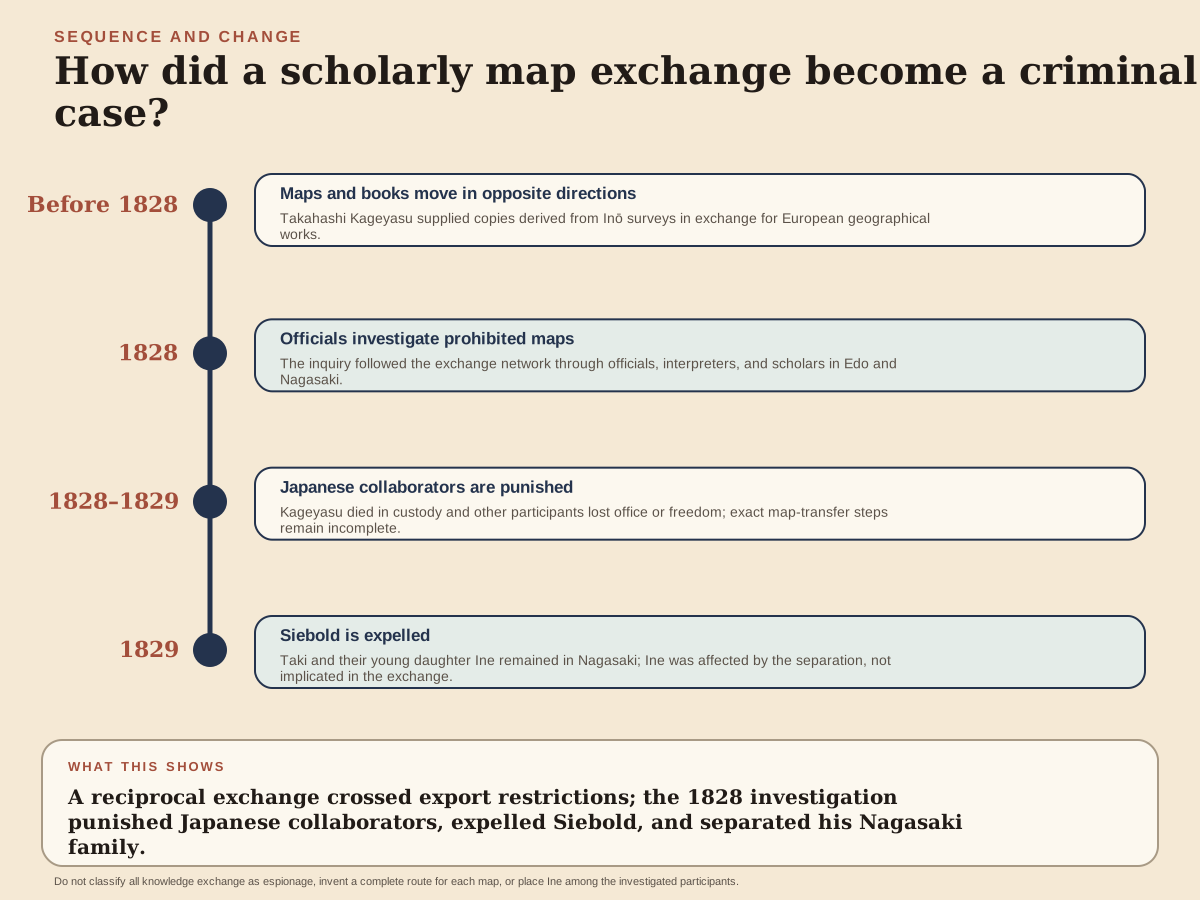
The case turned on objects in transit. Copies derived from Inō Tadataka's survey work had passed through Takahashi Kageyasu to Siebold, while European geographical books moved in the other direction. Once officials treated the Japanese maps as prohibited exports, an intellectual exchange became a criminal investigation reaching translators, scholars and officials connected to it.
As he prepared to leave in 1828, officials found that his collections included maps and other materials treated as prohibited exports. Astronomer Takahashi Kageyasu had supplied copies connected with Inō Tadataka's surveys in exchange for European geographical works. The investigation spread through that network; more than fifty people were punished, and Takahashi died in custody before the sentence against him was carried out.
Siebold was expelled in 1829 and forbidden to return. Kusumoto Taki and their young daughter Ine remained in Nagasaki. Ine was an affected child, not an actor in the map exchange or investigation. The separation nonetheless shaped the family and the medical network through which she later trained. Siebold returned only in 1859, after Japan's treaty-port opening had altered the legal setting of foreign residence.
In 1826 Siebold accompanied the Dutch factory head on the required visit to the court of the shogun, Japan’s military ruler, at Edo, now called Tokyo. Travel through Japan allowed meetings unavailable within Nagasaki. At Atsuta, near present-day Nagoya, he met the botanical scholar Mizutani Toyobumi and Mizutani’s pupil Itō Keisuke. Mizutani brought a plant album already organized according to Linnaean classification, the system of naming and grouping plants associated with Carl Linnaeus. Itō subsequently studied at Nagasaki and exchanged annotated plant names and pressed specimens with Siebold. Japanese participants were bringing their own accumulated knowledge to these encounters.
Geographical exchange proved more dangerous. Takahashi Kageyasu, a shogunal official responsible for books and astronomical work, supplied Japanese maps in return for foreign geographical publications, including Krusenstern’s account of a world voyage. The National Diet Library’s description connects Kageyasu’s interest to the need for information about the wider world as foreign ships approached Japanese coasts. European books and Japanese maps could serve different national purposes even within the same exchange.
The investigation of prohibited maps in 1828 reached both Edo and Nagasaki. The surviving documentation does not establish every step by which every map travelled. Isabel Tanaka-van Daalen’s study of Inabe shows an interpreter participating in the transfer, while distinguishing judicial statements, later biographies and Siebold’s own accounts. Judicial language treated unauthorized transmission as an offence; a collecting physician’s account presented an endangered scholarly circle.
The punishments were concrete. Kageyasu died in prison before the death sentence was pronounced. Inabe received lasting confinement and died in 1840. Other interpreters lost offices or freedom, and sanctions affected family members. Siebold was expelled in 1829. His diary described a promise to help endangered collaborators, and he later arranged financial assistance; these actions did not secure their release.
Siebold left Japan under an expulsion order in 1829. Takahashi Kageyasu died in custody, and the authorities punished a much wider circle. Taki and Ine remained in Nagasaki. No source makes the child Ine a participant in the exchange; her place in the event is the family consequence produced by expulsion.
In Leiden, in the Netherlands, the materials accumulated in Japan became an extended publishing and collecting enterprise. Siebold made a collection available to visitors in the early 1830s, and Dutch state acquisition helped establish a public institutional home for its objects. The apothecary Heinrich Bürger continued sending material from Japan. The enterprise was sustained by work across the distance between a Japanese trading post and European collections, rather than ending when Siebold’s first visit ended.
Nippon ranged across geography, history, language, religion, art, government and economic life. Its material combined Siebold’s observations with earlier Japanese and European writings and essays by Japanese students. The first edition appeared in instalments beginning in 1832; the National Diet Library dates its published sequence through 1851 and notes additional parts printed but not publicly issued. The book’s wide reach depended on compilation. A reader encountering Japan through it was receiving material selected and reorganized from many contributors, not an uninterrupted eyewitness diary.
Natural history required specialized authorship. Coenraad Jacob Temminck, Hermann Schlegel and Willem de Haan prepared Fauna Japonica, issued from 1833 to 1850, using collections associated with Siebold and Bürger. For Flora Japonica, Siebold worked with Joseph Gerhard Zuccarini. The Bavarian botanical collection’s history identifies Zuccarini as the specialist who classified the plants and wrote the descriptions; duplicate specimens in Munich helped support that work. Many botanical plates drew on paintings by the Japanese artist Kawahara Keiga. Collection, representation and scientific description were distinct contributions to the resulting books.
Language scholarship followed a comparable collaborative pattern. Bibliotheca Japonica, published from 1833 to 1841, involved the language scholar Johann Joseph Hoffmann and the lithographer Kuo Cheng-Chang. Ko, also known as Guo Chengzhang, worked on lithography and helped Hoffmann learn Chinese and Malay, according to Leiden University’s recent historical research. Ko’s language knowledge supported Hoffmann’s learning as well as the making of books.
Live plants followed a different path from books and museum specimens. Siebold cultivated Japanese plants in Europe, adding horticultural work to the uses of his collections. His political employment also continued: he advised the Dutch colonial ministry about Japan. In 1845 he married Helene von Gagern, with whom he had another family, and later lived at Boppard and Bonn on the Rhine. These European decades contained a household, cultivation, institutional negotiation and publication work. They were also preparation for a renewed role in Japan once treaty changes allowed his return.
Ine's obstetric studies with Ishii Sōken in Bizen extended beyond her initial visit. Her later career account, as summarized in Seiyo City's longer biography, described more than six years of study with him. The distinction between these teachers mattered: Ninomiya supplied medical instruction, while Ishii taught obstetrics. Learning was attached to individual practitioners and their working environments, rather than to one institution awarding a standard medical degree.
The affair did not stop European study of Japan or Japanese engagement with Western medicine. Siebold published from the materials he had gathered, former students continued to work, and Ine later entered medical practice through Japanese teachers and professional networks. The event therefore joins knowledge transfer to surveillance, punishment and family disruption rather than presenting exchange as an uncomplicated opening.
The incident shows how late-Edo knowledge exchange operated through people who crossed official boundaries without escaping state control. Maps, botanical specimens and medical teaching could serve scholarship and state interests, yet the same materials became evidence when they moved through prohibited channels.
Its consequences were unequal. Siebold was expelled, Japanese collaborators faced imprisonment and severe sentences, and his Nagasaki family absorbed a long separation. Linking Ine to the event records that consequence while preserving the distinction between an acting participant and a child whose later life unfolded in its aftermath.