Read the article below. Interactive reading tools are available when scripts load.
Quick
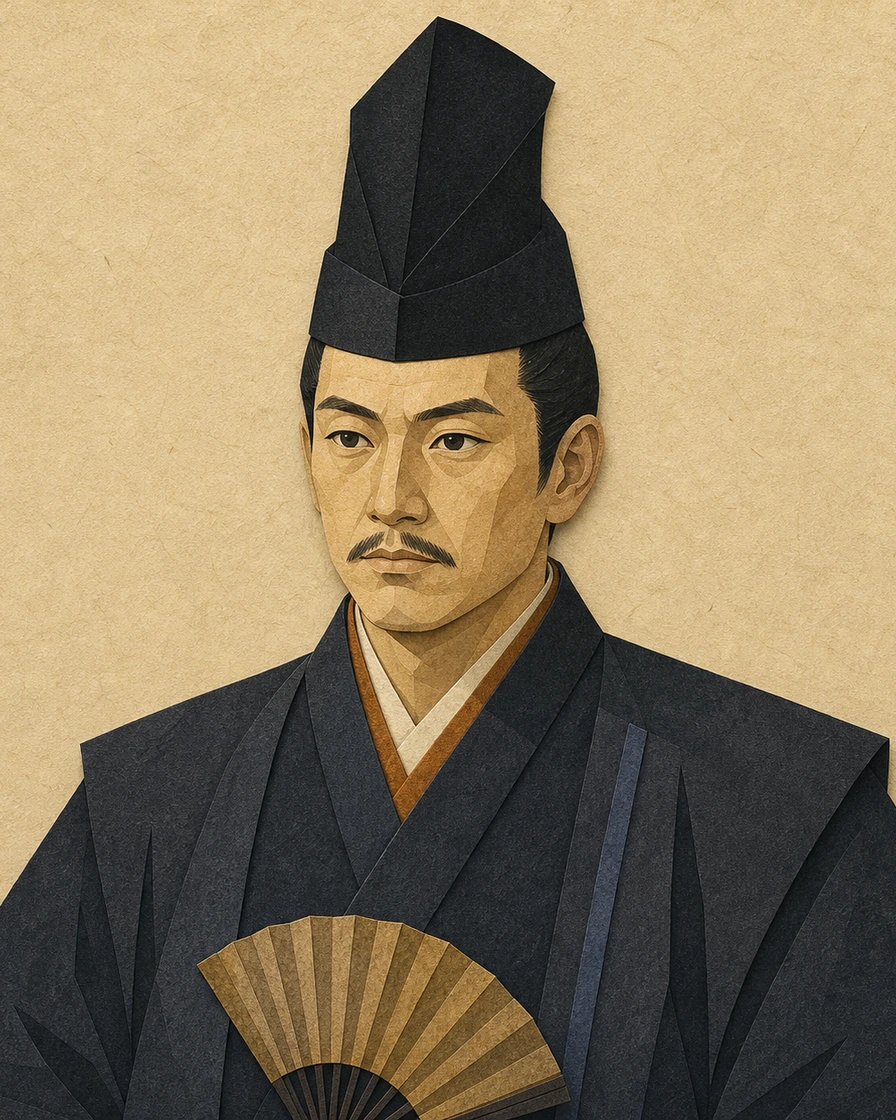
Ikeda Terumasa was born in 1565, the second son of Ikeda Tsuneoki, a prominent retainer of Oda Nobunaga, the military lord expanding across central Japan. His father's service supplied land, rank and trained followers, while making family security depend on Nobunaga's fortunes. Elder brother Motosuke stood ahead of him in the expected succession. Terumasa grew up as a younger son learning to serve within a senior command household. [3][5]
Tsuneoki served Nobunaga across campaigns and gained major responsibility, including positions in Settsu, the province around present-day Osaka. Terumasa grew within this senior-retainer environment. In 1580 he first fought at Hanakuma in Settsu alongside his father and brother, putting household training into campaign service. His opportunities were exceptional, but family prestige could not guarantee safety. Until 1584, Tsuneoki and elder brother Motosuke remained ahead of Terumasa in leadership, so his role was that of a developing family commander rather than an independent daimyō (a territorial warrior lord). [5]
In 1582 Oda commander Akechi Mitsuhide attacked Nobunaga at the Kyoto temple Honnō-ji, and Nobunaga and his heir died. Hashiba Hideyoshi, another Oda commander and later the ruler known as Toyotomi Hideyoshi, defeated Mitsuhide and gained leverage as the dead ruler's avenger. Tsuneoki aligned the Ikeda with Hideyoshi through the struggle over Oda succession. The house needed a new source of protection and confirmation for its existing grants; Terumasa served within his father's decision. [3][5]
During the 1584 Komaki-Nagakute campaign, Tsuneoki and elder son Motosuke fought for Hideyoshi against Tokugawa Ieyasu, the major lord of Mikawa and neighboring provinces, and died in the failed Mikawa operation. Terumasa survived and became the central Ikeda heir. Later battle stories narrate tactical decisions and last moments dramatically; the deaths and succession consequence are firmer than every scene. The event did not merely cause personal grief. It removed two leadership levels, exposed retainers and dependents, and forced Hideyoshi to decide whether the damaged house remained useful. [3][5]
After the deaths of Tsuneoki and Motosuke, Terumasa continued serving Hideyoshi and became lord of Gifu Castle in Mino, central Japan, in 1585. He held it until 1590. The Ikeda house survived because a recognized successor remained, retainers continued to function, and Hideyoshi valued their service. This was not recovery through courage alone. It required compliance with Toyotomi military and court obligations, succession management, and a new relationship to the ruler under whose campaign the family had suffered. Defeat became a dependency that could still produce advancement. [5]
After the 1590 Odawara campaign and national territorial redistribution, Terumasa received Yoshida Castle in eastern Mikawa with an assessment around 152,000 koku (a unit of assessed rice-producing capacity). Yoshida stood on the Tōkaidō route between central and eastern Japan and had been a military position under earlier regional rulers. Terumasa expanded the castle and town rather than founding the strategic place from nothing. The grant rewarded Toyotomi service while placing a trusted Hideyoshi lord in former Tokugawa territory on the road connecting the eastern and western political centers. [6]
Terumasa married Tokuhime, Ieyasu's daughter, in the 1590s, commonly dated to 1594. She had previously married Hōjō Ujinao and was widowed after the Hōjō defeat. The remarriage connected the Ikeda to a major lord while both still served within Hideyoshi's hierarchy. Their children were Ieyasu's grandchildren, creating a lasting channel of access and a strong family stake in his future security. [5][8]
After Hideyoshi's death in 1598, rivalry fractured the government protecting his young heir. Terumasa joined Ieyasu's eastern coalition in 1600. His Tokugawa marriage and Yoshida's position on a major route made the alignment useful to both houses. It required troops and supplies while exposing his family to defeat. Capturing western-held Gifu would turn his declared allegiance into valuable campaign service. [5]
Terumasa returned to his former seat at Gifu as an attacker. He joined Fukushima Masanori and other eastern commanders in the assault on Gifu Castle, held for the western coalition by Oda Hidenobu, Nobunaga's grandson. The capture removed a fortified obstacle before Sekigahara. Rapid success helped eastern movement through Mino and strengthened the coalition's position. After the capture, Terumasa and Fukushima issued an order prohibiting troop violence and arson at nearby Saraki village. [3][4][5]
After eastern victory, Ieyasu transferred Terumasa from Yoshida to Himeji with holdings conventionally described around 520,000 koku. The grant rewarded eastern service and family connection, but it also deployed a trusted son-in-law at the Sanyō road westward from the Kyoto–Osaka region. Himeji controlled roads and access toward the Inland Sea. A huge grant was therefore an assignment carrying surveillance, defense, administration, and construction obligations—not simply personal wealth or proof that Ieyasu trusted every powerful relative without reservation. [1][2][7]
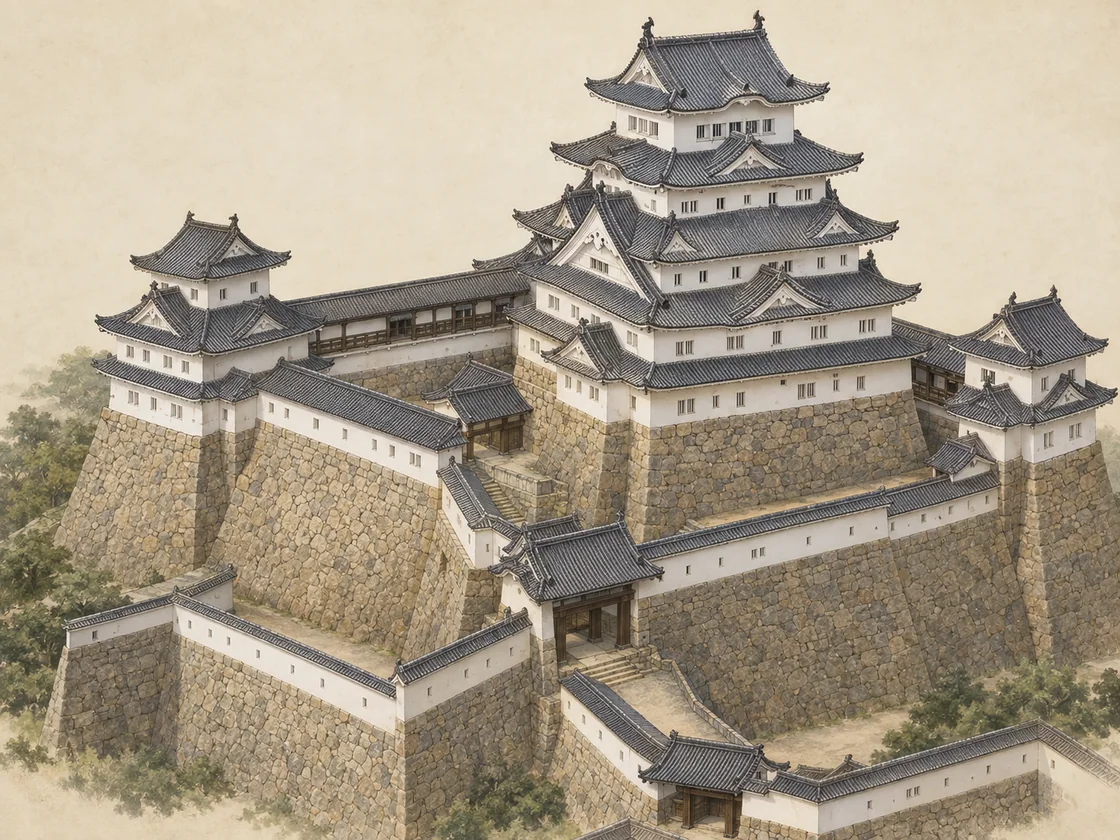
Terumasa began Himeji's great reconstruction in 1601; the main keep complex was completed in 1609. Its main tower and three smaller towers were connected by corridor-like turrets, with gates and winding approaches organizing defense. He authorized the scale and resources, while specialist builders and mobilized labor carried out the work. Much of this core survives. Later western-bailey buildings belong to the Honda phase rather than his project. [1][2][7]
Himeji's reconstruction extended beyond towers. Defensive moats and roads connected the castle to warrior districts and commerce. Supplies and revenue from Harima sustained it as a governing center. Terumasa's administration directed the reordering, but officials depended on established residents and newcomers to sustain commerce, craft work and daily urban life. The town grew from older settlement rather than a blank plan. Official Himeji chronology notes that the broader castle form continued developing under Honda Tadamasa after 1617, so Terumasa's death did not finish the city. [1][2][5]
The Ikeda's strength extended beyond Himeji through grants to Terumasa's sons. His son Ikeda Tadatsugu received Bizen, west of Harima, in 1603, and another son, Ikeda Tadao, received Awaji, an island in the Inland Sea, in 1610. Both were Tokuhime's sons and Ieyasu's grandsons. Separate grants gave the heirs recognized positions while tying the family's network to Tokugawa authority. Succession still required shogunal recognition, even for close kin of the ruling house. [2][5][8]
Terumasa died in 1613, four years after the keep complex was completed. His eldest son, Ikeda Toshitaka, succeeded at Himeji, but later succession changes took the Ikeda away. Honda Tadamasa entered in 1617 and enlarged the western bailey. Terumasa's buildings remained a strategic asset whose use and upkeep passed to a new house under shogunal direction. [1][2][5]
Later houses maintained and altered Himeji. The Meiji state used it for the army, removing some structures while preservation advocates sought repair. Colonel Nakamura Shigeto petitioned for funds in 1878. Major repairs followed in 1910–1911, and the city opened the principal castle area with Himeyama Park in 1912. Terumasa's core survived through these successor decisions and maintenance, not as an untouched building from 1609. [1][2][7]
Classic
Ikeda Terumasa was born in 1565, the second son of Ikeda Tsuneoki, a prominent retainer of Oda Nobunaga, the military lord expanding his authority across central Japan. His father belonged to the military network through which Nobunaga expanded from Owari in central Japan. Service gave the Ikeda access to land, trained followers and recognized rank, while exposing them to the ruler's wars. Terumasa's elder brother, Motosuke, stood ahead of him in the expected succession. He began as a younger son within a powerful household, rather than as its principal commander. [3][5]
The household trained its sons through military service and administration. Senior retainers supplied experience, while relatives and attendants sustained the family behind the commanders. Branch kin and followers held their own claims through Tsuneoki's leadership. The sons' advancement therefore depended on a service organization whose survival affected many households below the principal line.
Nobunaga's expansion enlarged Tsuneoki's opportunities but did not secure the family's future. A dangerous command could remove a leader or an expected heir, and a change at the center could unsettle grants made in the Oda ruler's name. Terumasa's later rise would follow both kinds of crisis. The household assets available to him were substantial, but they rested on continued recognition by a living superior.
Tsuneoki received commands and territorial grants from Nobunaga, then assigned responsibilities within his own household. His service brought him into Settsu, the province around present-day Osaka, close to major ports and the route to Kyoto. Holding such positions required garrisons and revenue as well as campaigning. Terumasa first fought at Hanakuma in Settsu in 1580 alongside his father and elder brother. An Okayama University exhibition catalogue identifies this first campaign in the Ikeda family's copy of Ōta Gyūichi's account of Nobunaga. He entered warfare within his father's command rather than as an independent lord. [5]
Motosuke could expect succession while Terumasa developed a separate role. Younger sons might receive units, castles, marriages, or branch positions. Their advancement depended on the principal line's needs and on superior grants. Later inheritance after catastrophe should not be treated as an ordinary promotion. The Oda regime's expansion also carried violence for which its retainers shared responsibility. Campaigns against rival lords and religious communities affected combatants and civilians. Terumasa's training benefited from conquest. Tsuneoki's personal relationship with Nobunaga mattered but should not be romanticized as private friendship detached from office. Access, trust, kin-like service traditions, and repeated performance could create closeness while remaining deeply unequal.
Nobunaga could reward Tsuneoki with important positions and send him on dangerous operations. By 1582 the Ikeda possessed troops, territorial ties and an expected line of succession. Terumasa's knowledge of wider policy came through reports and household service. He had growing responsibilities, but Tsuneoki and Motosuke remained the senior figures when the Oda center suddenly collapsed. [5]
In 1582 Oda commander Akechi Mitsuhide attacked Nobunaga at Honnō-ji, a Kyoto temple, and Nobunaga and his heir Nobutada died. Hashiba Hideyoshi, another Oda commander and later the ruler known as Toyotomi Hideyoshi, returned from his western campaign and defeated Mitsuhide. His position as Nobunaga's avenger gave him leverage in the succession struggle. Tsuneoki aligned the Ikeda with Hideyoshi, committing his sons and followers through the existing household chain. Terumasa served within that decision rather than choosing as an independent lord. [3][5]
Existing grants were vulnerable. Land held through Nobunaga required confirmation by whatever authority succeeded him. Retainers below the Ikeda expected continued reward. Castles needed supplies and garrisons. A purely moral language of “loyalty to Nobunaga” could not answer which living claimant could issue valid orders and protect the house. The Ikeda's alliance with Hideyoshi therefore mixed continuity and opportunity. Supporting the man who avenged Nobunaga could be presented as loyalty to the Oda project while also advancing Hideyoshi's new power. Historical actors did not need to choose between sincere continuity and strategic interest; both could operate in one decision. Communication and place mattered. Terumasa did not witness every Kyoto event. Messengers, letters, and reports mediated knowledge. Later military tales supply vivid immediacy that should not be mistaken for a complete real-time record.
Hideyoshi's victory did not immediately settle the claims of Oda heirs and other senior retainers. Tsuneoki's choice supplied the Ikeda with a prospective source of protection and territorial confirmation, while requiring further service against competing coalitions. Terumasa's position remained bound to his father's alignment. The household had survived the collapse of Nobunaga's authority, but its new protector was still fighting to make his predominance secure.
In 1584 Hideyoshi fought the coalition of Oda Nobukatsu, Nobunaga's son, and Tokugawa Ieyasu, the major lord of Mikawa and neighboring provinces, in the Komaki-Nagakute campaign. Tsuneoki and Motosuke joined an advance toward Mikawa, where the Tokugawa response inflicted a severe defeat. Both died. Terumasa survived, leaving him as the principal surviving son around whom the Ikeda could regroup. Retainers needed command and the family's grants required confirmation. Hideyoshi's recognition made succession effective within the coalition the house had supported. [3][5]
Hideyoshi had reason to preserve a house whose leaders had died in his service. Continued support kept experienced followers available and showed that defeat need not erase the position of an obedient ally. The Ikeda had lost disastrously in one operation, while the wider political settlement still allowed Hideyoshi to extend his authority. Terumasa's succession turned that unequal relationship into the basis of recovery.
The failed Mikawa advance exposed the danger of movement against an opponent able to intercept it. The deaths removed the two senior Ikeda commanders at once. The survivors had to preserve men and service relationships under Terumasa's command. Widows, children and branch kin also depended on the new head's ability to secure the house's position.
Terumasa's survival supplied a successor; Hideyoshi's patronage supplied recognition and continued opportunity. Together they kept the Ikeda within the expanding Toyotomi coalition. The new head now had to demonstrate that the organization which had lost Tsuneoki and Motosuke could still perform the service expected of it.
In 1585 Terumasa became lord of Gifu Castle in Mino, the central province north of the Tōkaidō route. He held it until 1590, serving in Hideyoshi's campaigns, including the 1587 attack on the Shimazu of Kyushu. His succession had left him an organization whose security still depended on Hideyoshi. Retainers who had served his father needed confirmation. Motosuke's dependents and descendants had claims. Military units needed commanders and revenue. Household women managed mourning, residence, children, and alliances. Rebuilding was collective even though formal leadership centered on Terumasa. Hideyoshi's recognition converted biological succession into political tenure. A warlord house did not preserve land merely because a son existed. Superior approval, documents, service, and the absence of successful rivals mattered. Terumasa's acceptance of Hideyoshi's order was therefore the legal and military basis of recovery. Campaigns, castle duties, court ranks, and ceremonial attendance integrated regional lords into a new hierarchy. Terumasa learned that survival required being legible at the center as well as effective in a province. [5]
Nobunaga's household model expanded into Toyotomi coalition government. The term “defeated house” needs qualification. The Ikeda lost two leaders in an unsuccessful operation, but they had fought within Hideyoshi's coalition, not against the superior who now rewarded Terumasa. Their sacrifice could support claims for continued favor. Defeat on the field did not equal rebellion against the regime. Recovery also carried coercive responsibility. Toyotomi expansion mobilized retainers and resources against other houses and communities. Terumasa benefited from the redistribution created by those campaigns. Rank and territory were not personal wealth alone. Assessments supported stipends, garrisons, travel, construction, and the lord's household. New income created new obligations and new people affected by Ikeda decisions. [5]
The house grew by absorbing and reorganizing networks rather than by restoring an unchanged pre-1584 unit. By 1590 Terumasa had become a reliable Toyotomi daimyō, a territorial warrior lord, ready for a strategically important Tōkaidō grant. The same regime that had exposed his family to fatal campaign risk now supplied the structure through which he advanced. Recovery changed the composition of the house. New followers could enter as grants expanded; older retainers might gain or lose precedence; administrators became more important as revenue grew. “The Ikeda” was therefore not an unchanged band surviving from Tsuneoki. Corporate identity persisted through personnel and territorial transformation. Court rank and name usage also signaled integration. Titles connected daimyō to imperial-derived status distributed through the warrior regime, but formal rank did not map perfectly onto military command.
Continued service brought obligations as well as rank. Attendance, construction and mobilization drew on the communities whose produce supported the house. Hideyoshi's favor could be maintained only through performance. By 1590 Terumasa's reliability would bring a larger assignment on a major route through former Tokugawa territory.
After the 1590 Odawara campaign, Hideyoshi transferred Ieyasu to the Kantō, the eastern region around Edo, and redistributed former Tokugawa territory. Terumasa received Yoshida in eastern Mikawa, at present-day Toyohashi. Its position on the Tōkaidō route between the eastern and central regions made it valuable for transport and defense. The grant was assessed at about 152,000 koku, a unit expressing estimated rice-producing capacity. It supported a substantial military household while carrying the costs of service, travel and government. [6]
Terumasa expanded Yoshida Castle and reorganized its town. The site already had a history of regional conflict, with local service and property ties formed under earlier rulers. Incoming Ikeda followers had to govern alongside people who knew the district. The road kept Yoshida connected to military and commercial movement, making this a visible position within Hideyoshi's settlement rather than a secluded reward. [6]
The transfer required an Ikeda household to move into a district with its own personnel and claims. Terumasa's officials had to sustain revenue and service while accommodating useful local expertise. Governing a castle town at the intersection of road and regional transport gave the house experience that would later be applied on a larger scale at Himeji.
Hideyoshi placed allied lords in former Tokugawa territory to keep the route politically organized after Ieyasu's move east. Terumasa benefited from this settlement while serving its wider purposes. Yoshida continued to change under later lords after his departure in 1600. Its surviving remains therefore incorporate work beyond the Ikeda decade.
Terumasa married Tokuhime, a daughter of Ieyasu, in the 1590s, commonly dated to 1594. She had previously been married to Hōjō Ujinao, whose house was defeated at Odawara and who died afterward. Her remarriage joined the Ikeda to the largest lord beneath Hideyoshi. Both households nevertheless continued within the Toyotomi hierarchy. The bond created access through family ties before any Tokugawa supremacy had been established. [5][8]
If Ieyasu prospered, the Ikeda could benefit from kin access. If he rebelled or lost, the marriage could expose Terumasa to suspicion and confiscation. It made later alignment more coherent while increasing dependence on one coalition. Marriage diplomacy also relied on women's labor. Tokuhime's attendants managed residence and communication. Other Ikeda women and prior children occupied household positions that could become tense when a politically powerful wife arrived.
Tokuhime brought experience of defeat, widowhood and relocation from her Hōjō marriage. Her new household contained children and relationships from more than one union. The maternal lines mattered politically because her children were Ieyasu's grandchildren. Remarriage created a lasting dynastic connection while leaving distinct claims within the Ikeda family.
After Hideyoshi's death in 1598, the Toyotomi succession crisis confronted Terumasa with overlapping identities. He joined Ieyasu's eastern coalition in 1600. He had risen through Hideyoshi's recognition. He was Ieyasu's son-in-law. He governed a strategic castle in a former Tokugawa region. His retainers and family required a settlement capable of preserving their land. No single label—Toyotomi man, Tokugawa relative, or opportunist—fully explains the alignment. Ieyasu offered the strongest individual resource base and a coalition of military lords dissatisfied with aspects of the post-Hideyoshi order. The western side invoked Toyotomi continuity and brought major houses and administrators together. Both could mobilize armies. The outcome depended on movement, fortresses, defections, communication, and regional wars beyond the final field. Terumasa's Tōkaidō position made inaction difficult. The road would carry eastern forces west and expose Yoshida to whichever coalition controlled it. [5]
A lord at a strategic node could not remain privately undecided while armies moved. He had to provide men, supplies, passage, and an intelligible allegiance. Marriage made eastern alignment rational but not automatic. Kin obligations mattered because Ieyasu's victory would protect Tokuhime's children and Ikeda status. Yet a defeated Ieyasu could not honor future rewards. The decision placed house survival at genuine risk. The regional campaigns retained causes and consequences distinct from the central battle. At most, he could expect reward proportional to useful service if the eastern coalition won. The exact allocation of Himeji depended on Ieyasu's postwar strategic design. An announced alignment creates obligation; attacking a difficult western position demonstrates it.
This is why subsequent Gifu service mattered to reward. Eastern alignment also did not erase Terumasa's earlier Toyotomi identity. Coalition members could claim to protect Toyotomi Hideyori, Hideyoshi's young son, while opposing particular administrators. Later Tokugawa supremacy simplified these mixed justifications, but the 1600 actor operated before that simplification. Regional war meant that news of success or defeat could change decisions at different speeds.
In 1600 Terumasa joined Fukushima Masanori, lord of Kiyosu, and other eastern commanders in attacking Gifu Castle. It was held by Oda Hidenobu, Nobunaga's grandson, for the western coalition. Terumasa had himself governed Gifu from 1585 to 1590; he returned as an attacker after its place in the national alignment had changed. The eastern army needed to remove this fortified obstacle before concentrating for the larger campaign. Commanders led separate contingents, supported by local knowledge and supplies. [3][4][5]
Gifu fell before the main Sekigahara confrontation, and Hidenobu surrendered. The following day, Terumasa and Fukushima issued a prohibition against violence and arson at Saraki village. A surviving copy records their names and the date in the traditional eighth month of 1600. The order shows their responsibility for controlling troops after victory; it does not establish that every threatened act occurred or that the entire town had burned.
Oda Hidenobu's descent from Nobunaga supplied symbolic standing without restoring the command network of his grandfather's lifetime. Terumasa's service against him showed how former Oda relationships had been reorganized under Hideyoshi and Ieyasu. Securing the castle also required decisions about its surviving defenders. These fell within coalition and superior policy, beyond the achievement of an individual commander at the breach.
The assault also consumed time and ammunition before the larger confrontation. Rapid success was valuable because a prolonged siege might have delayed concentration or exposed eastern columns. Strategic importance came from timing as much as symbolic ownership of Gifu.
Postwar redistribution turned battlefield coalition into territorial order. Ieyasu confirmed allies, punished or transferred opponents, and placed trusted houses at strategic nodes. Terumasa's reward must be read inside this national map rather than as a private gift from father-in-law to son-in-law. Himeji's location mattered. The Sanyō route ran westward from the Kinai, the region around Kyoto and Osaka, through Harima, the province containing Himeji. Sea traffic along the Inland Sea supplied another connection to western domains. A strong castle there could monitor movement, support shogunal campaigns, and protect the western approach to Osaka and Kyoto. The assignment made Terumasa a gatekeeper. The 520,000-koku scale signaled major rank, but exact domain aggregates can vary with components and date. Assessment did not equal free personal income. Retainer stipends, castle rebuilding, town works, travel, households, and military readiness consumed resources. [1][2][7]
The grant required Ikeda followers to move from Yoshida while Harima residents encountered a new lord. Local warriors and communities brought claims formed under earlier administrations. Terumasa had to sustain a larger service organization and reorganize collection across the province. Kinship made him useful to Ieyasu, but a domain of this size still required oversight. In 1600 he received an older castle site; reconstruction began the next year.
Harima itself was more than a corridor. Agricultural districts, ports, temples, local lords, and older administrative centers supplied resources and constraints. Calling Himeji a western gate describes shogunal strategy but should not reduce the province to space between Kyoto and other domains. The size of the grant also required internal distribution. Terumasa did not directly collect every assessed unit; retainers received holdings or stipends and officials administered districts. Transfer from Yoshida produced a provenance boundary. Works begun there continued under successors, while Ikeda expertise and personnel moved west.
Terumasa's Tokugawa marriage and Himeji's western location made the grant useful to Ieyasu's security. The Hyogo Prefectural Museum of History offers a further interpretation: appointing a former Toyotomi retainer may also have taken the surviving Toyotomi center at Osaka into account. Guarding a route and accommodating older loyalties were compatible possibilities. Neither interpretation proves a private intention recorded by Terumasa himself. His assignment still required government of communities with differing wartime associations. [2][7]
Himeji's official chronology begins long before Terumasa. Accounts trace early fortification to the Akamatsu family. Later Kodera and Kuroda connections, and Hideyoshi's three-story keep established a castle tradition on the hill. Kinoshita Iesada, Hideyoshi's relative and the preceding castle lord, then governed for sixteen years. The 1601 project was transformative precisely because it reworked an existing strategic center. “Five stories, seven floors” and “five stories, six floors plus a basement” can describe the same main keep through different counting conventions. Exterior roof tiers do not map simply onto usable interior levels. The construction period from 1601 to 1609 required sustained domain finance. Stone and timber had to reach the hill, while workshops supplied tiles, plaster and metal fittings. The labor force also needed provisions throughout years of building. Specialists coordinated measurements and structural joinery. Agricultural communities and townspeople bore assessments and work demands. [1][2]
The keep complex placed the main tower and three smaller towers at the corners of an interconnected arrangement, linked by corridor-like turrets. Gates and walls divided the approaches, while steep, winding routes exposed attackers to defenders above them. Store turrets helped support occupation during a siege. Terumasa authorized the resources and scale; skilled builders resolved the timber structure and joinery. The defensive arrangement made a political assignment visible in a coordinated architectural system. [1][7]
The great reconstruction reached its core completion in 1609. White plaster gave the wooden buildings a unified appearance and provided a protective surface that required renewal. Roofs, joinery and structural supports also needed maintenance. The finished complex therefore created a continuing obligation for the lord and his successors, rather than an asset that could be left unchanged once construction ended.
The keep complex also contained residence, storage, circulation, and defensive functions that changed over time. The absence of a major siege is historically meaningful. Himeji's deterrent position and stable Tokugawa order may have contributed to nonuse in battle, but no counterfactual proves the design alone prevented attack. Architecture expressed and supported a political settlement; it did not independently create peace.
A keep without revenue and population would be a costly shell. Himeji needed a town able to supply food, weapons, building repair, transport, administration, and household consumption. The castle's defensive rings and the town's economic routes therefore belonged to one territorial system. Warrior districts organized rank and readiness. Residence size and proximity to the castle expressed service position. Merchants and craftspeople clustered where regulation and customers made exchange possible. Temples could be relocated to shape edges, firebreaks, ritual life, and burial. Such ordering affected existing property holders and was not a neutral geometric exercise. Roads had dual functions. The Sanyō corridor connected long-distance movement, while internal streets could direct traffic around moats and gates. Markets benefited from travelers and domain demand. [1][5]
Surveillance and prosperity could coexist: the same strategic location that made Himeji militarily useful also made it commercially connected. Water and fire risk were constant. Water supply and drainage served households, while wells and access routes also helped protect the castle against fire. Later systems may be attributed loosely to the founder, but each requires phasing. Urban infrastructure is especially vulnerable to founder inflation because maintenance and replacement leave fewer memorable names than a great keep. Residents possessed agency within constraint. Merchants petitioned and adapted; artisans transmitted knowledge; laborers negotiated or endured obligations; temples maintained congregations; farming communities supported the urban population. Their collective work does not negate lordly planning. The broader finished appearance of Himeji included post-Terumasa construction. When Honda Tadamasa entered in 1617, western bailey work associated with his family changed the complex. [1]
Senhime, Ieyasu's granddaughter and the widow of Toyotomi Hideyori, married Tadamasa's son Honda Tadatoki in 1616. The western-bailey buildings associated with their new household belong to the Honda phase, not to Terumasa or Tokuhime. This distinction is crucial for later public interpretation. Terumasa’s life ended in 1613 with a functioning but still evolving early-modern center. Castle-town records also reflect authority asymmetry. Official plans and tax registers show what rulers sought to organize more readily than how every resident experienced the change. A polished plan is evidence of administration, not proof of frictionless implementation. Markets required standards, credit, dispute handling, and protection. Merchants could gain privilege while being confined to designated locations or duties. Craftspeople serving the castle might receive patronage and face compulsory demand. [2]
Urban growth redistributed opportunity as well as burden. The castle and town were also gendered spaces. Samurai wives, servants, artisans' households, vendors, and religious women contributed to residence and economy despite limited visibility in military narrative. In the early castle town, workshops, household traffic and deliveries connected the walls to a busy settlement. Food supply connected town to countryside. Food, fuel and building materials moved through regulated routes, while waste and disease posed governance problems. These ordinary flows explain durability better than walls alone.
Early Tokugawa order used marriage and territorial distribution alongside military victory. A powerful house could be made safer by connecting its heirs to the ruling family, separating responsibilities among sons, and requiring confirmation at each succession. The Ikeda illustrate incorporation rather than a simple contrast between “outside” and “hereditary” lords. Terumasa's career crossed regime categories. His father served Nobunaga; he rose under Hideyoshi; he joined Ieyasu in 1600; and his wife was Ieyasu's daughter. Calling him merely a Toyotomi outsider or a Tokugawa insider flattens chronological change. Status was relational and could differ by question. Tokuhime's position supplied more than a genealogical line. Her communication with the Tokugawa house, management of children and attendants, and status within Himeji shaped the family network.
In 1603 Terumasa's second son, Ikeda Tadatsugu, received a grant assessed at more than 280,000 koku in Bizen, west of Harima. His third son, Ikeda Tadao, received Awaji, an island in the Inland Sea, in 1610. Both were sons of Tokuhime and grandsons of Ieyasu. These grants extended Ikeda strength beyond the Himeji domain while giving separate heirs recognized positions within Tokugawa rule. Their territories were not simply one estate personally administered by Terumasa. [2][5][8]
Later Ikeda transfers to Tottori and Okayama belonged to successor history. Genealogies distinguish Terumasa’s children and collateral branches, but they do not preserve every private household negotiation or turn later outcomes into a plan completed during his lifetime. [5]
The alliance gave the Tokugawa government both a trusted western connection and a household whose concentrated resources required supervision. Marriage, divided grants, transfers and succession recognition managed that tension over time; Tokuhime retained her own position within the alliance.
Terumasa died in 1613, four years after the completion of Himeji's main keep complex. His eldest son, Ikeda Toshitaka, succeeded at Himeji with a reduced grant. The new head and surviving family operated under continuing Tokugawa recognition. The castle's political function endured, but its principal Ikeda relationship would not remain fixed. In 1617 Honda Tadamasa entered Himeji and added major western-bailey works associated with his family. [1][2][5]
Completion of the keep had not ended government work. The domain still supplied revenue, labor and military obligations, while the household managed succession and relations with the shogunate. Terumasa had also participated in the Tokugawa government's castle projects, including Edo and Sunpu. His final years combined the upkeep of Himeji with service beyond it.
Tokuhime survived Terumasa and retained her connections to Ieyasu and their children. Household authority passed to a new head, and later succession brought another round of shogunal decisions about territory. Himeji's buildings could outlast the family that reconstructed them because the government could reassign the castle and the obligation to maintain it. The Ikeda's descendants carried the family network into new domains.
The castle survived because different actors repeatedly chose or managed not to destroy it. Later lords maintained and altered structures. The Meiji state reused the site for military purposes, changing its fabric and urban surroundings. Officers and advocates argued for preservation when castles across Japan faced demolition. Survival was historical action, not an inherent quality of beautiful architecture. Himeji official chronology identifies thirteen ruling families and forty-eight lords across the wider history. That sequence makes sole-builder memory untenable. Terumasa's 1601–1609 core is exceptional, but Honda work after 1617 and centuries of repair belong to the visible complex. The Meiji transition transformed feudal center into state property and military installation. Some samurai residences and structures were demolished or replaced. [1][2][7]
In 1878 Colonel Nakamura Shigeto petitioned for repair funds for Himeji and Nagoya castles. His intervention illustrates the divided role of the army: military use altered the site, while individual officers also argued to preserve exceptional structures.
Himeji's white-plastered buildings gave it the name White Heron Castle, a later public image rather than evidence of Terumasa's naming intent. In 1908 a preservation association bearing that castle name petitioned for repairs. The founder's reputation now depended on efforts to preserve buildings inherited from several ruling houses.
Military occupation made preservation a contested matter. The buildings were useful but costly, and some were demolished or altered. Advocates sought repair for the surviving keep complex. The 1910–1911 work stabilized a castle increasingly valued as historical architecture. In 1912 the city received permission to use the principal castle area without charge and opened it with Himeyama Park. Public heritage emerged from these later institutional choices. [2]