Read the article below. Interactive reading tools are available when scripts load.
Quick
Prince Naka no Ōe, later Emperor Tenji, was born in 626 to Emperor Jomei and the future Empress Kōgyoku. At Asuka, the royal court shared power with influential families. In 645, the prince and Nakatomi no Kamatari organized the killing of Soga no Iruka inside the palace. Iruka's father, Soga no Emishi, died soon afterward. Kōgyoku abdicated to her brother, who became Emperor Kōtoku, and Naka no Ōe became crown prince. The prince gained a central political role through a coalition and a violent removal of rivals. The detailed account comes from the Nihon shoki, a court chronicle compiled in 720, rather than an eyewitness transcript. [1][3]
Under Emperor Kōtoku, the court moved to Naniwa, near present-day Osaka. The Nihon shoki describes reform orders intended to reorganize land, households and official authority. They record the court's ambitions, but the later chronicle's administrative language cannot establish that the subsequent legal system was already complete in 646. A wooden tag dated 665 uses an earlier district designation alongside evidence of household organization. [3][8]
In 653, Naka no Ōe returned to Asuka with his mother and other royal family members while Kōtoku stayed at Naniwa. After Kōtoku died in 654, the prince's mother resumed rule as Empress Saimei in 655. Her reign supplied the setting for the next great undertaking: armed support for a Korean ally. [3][5]
The Man’yōshū, an eighth-century anthology of Japanese poetry, also preserves a poem attributed to him, addressed to Kagami no Ōkimi. This is a small trace of literary activity alongside his political career. [11]
Tang China and Silla defeated Baekje, a kingdom in southwestern Korea, in 660. Baekje restoration leaders sought help from the Yamato court and the return of Prince Buyeo Pung, who was in Japan. Saimei traveled to northern Kyushu during the preparations but died there in 661. Naka no Ōe continued to direct government and sent military aid. [4][5]
Baekje's leaders were pursuing the restoration of their own kingdom. Their movement also suffered internal conflict. In 663, the allied fleet was defeated by Tang forces at Baekgang, and the restoration failed. The consequences reached Japan through returning forces and people displaced from Baekje; the court's attention turned toward defense. [4][5]
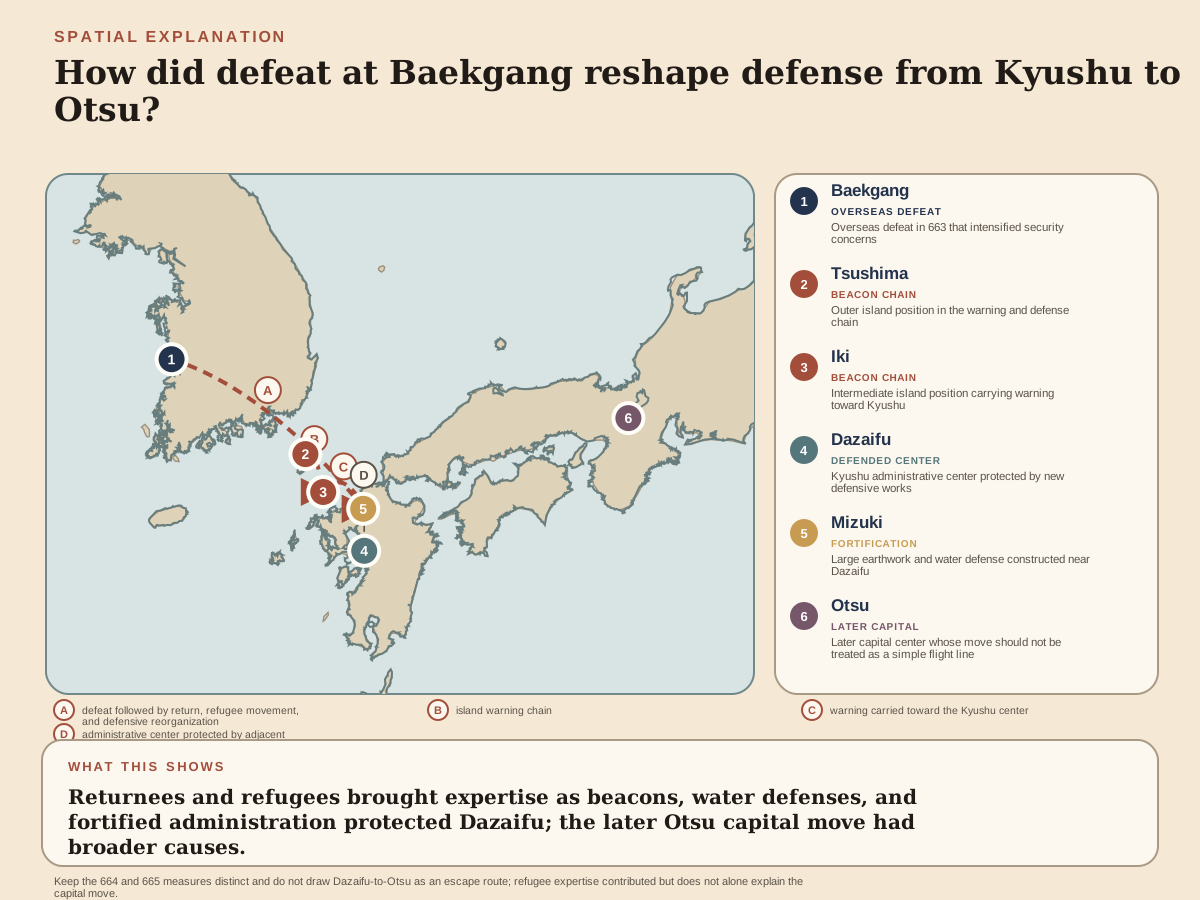
After the defeat in Korea, Naka no Ōe's government placed guards and signal beacons along the western approaches. At Mizuki in northern Kyushu, a great embankment and moat formed part of the defensive preparations. Baekje specialists helped construct the nearby Ōno and Kii mountain fortresses in 665. These works show how the court used knowledge brought by people from the defeated kingdom. [5][9]
In 667, the prince moved the capital to Ōtsu, beside Lake Biwa in central Japan. From this inland capital he continued to govern. The surviving chronicle associates these years with further defensive building and the settlement of people from Baekje. [2][5]
The main account of the Nihon shoki dates Naka no Ōe's formal accession as Emperor Tenji to 668, after years in which he had already directed government. His younger brother, Prince Ōama, remained an important royal figure. In 669, Tenji honored his old collaborator Kamatari with the Fujiwara surname shortly before Kamatari died. [1][5]
Household registers were compiled in 670. Registration gave government a way to organize information about the people under its authority; the brief entry does not describe the operation of every later legal institution. The expansion of administrative work also left a separate question unresolved: which member of the royal family would command the allegiance needed to succeed Tenji? [5][8]
In 671, Tenji appointed his son, Prince Ōtomo, daijō daijin, the chief minister of the court. Other leading offices went to established ministers. The chronicle also records the award of court ranks to learned men from Baekje, and the use of a water clock to mark hours with bells and drums. Tenji's government relied on a court of officials and specialists; the clock was not an invention that can simply be attributed to him personally. [5]
As Tenji became gravely ill, Ōama withdrew to Yoshino after taking religious vows. Tenji died in the chronicle's year 671, leaving Ōtomo at the center of the Ōtsu government. The brother's withdrawal had not removed him from the struggle that followed. [5][6][7]
In 672, Prince Ōama left Yoshino, assembled supporters and fought the Ōtsu court in the Jinshin War, a conflict over royal succession. Ōtomo's side was defeated, and he died by suicide. Ōama subsequently took the throne as Emperor Tenmu at Asuka. Tenji's administrative measures had not given his son an uncontested succession. [6][7]
Ōtomo received the posthumous imperial name Kōbun in 1870; whether he had formally acceded in 672 remains a distinct historical question. Modern excavations at Nishikori, beginning in 1974, identified buildings associated with the Ōtsu palace. The site helps recover Tenji's short-lived capital, while the succession story still depends heavily on texts preserved under the victorious dynasty. [7][10]
Classic
In 645, Prince Naka no Ōe helped organize the killing of Soga no Iruka at the royal palace in Asuka. The future Emperor Tenji was still a prince. His mother, Empress Kōgyoku, occupied the throne; his father, Emperor Jomei, had died in 641. Born in 626, Naka no Ōe entered politics from within the royal family, at a court where powerful families supplied ministers, marriage partners and competing claims to authority. [1][3]
Nakatomi no Kamatari, a court official who opposed Iruka, became the prince's essential collaborator. Their coalition also drew in Soga no Kurayamada no Ishikawa Maro, a member of the wider Soga family. The attack exposed divisions within the Soga family as well as conflict between powerful houses. [3]
The Nihon shoki places the attack during a ceremony at which memorials associated with the Korean kingdoms were to be read. Kurayamada no Ishikawa Maro had a role in the ceremony, while armed men were positioned for the assault. In the chronicle's account, Naka no Ōe himself took part in the killing when the designated attackers hesitated. Iruka died in the palace; his father, Soga no Emishi, died the following day. These are events described by a court history completed in 720. Its detailed speeches and descriptions of hesitation were written down long afterward. [3]
The succession after the coup did not immediately put Naka no Ōe on the throne. Kōgyoku abdicated, and her brother became Emperor Kōtoku. Naka no Ōe became crown prince. Kamatari and other participants gained positions in the new government. The prince's achievement was a new place at the center of royal decision-making, made possible by collaboration and assassination. The work of governing that followed belonged to the new court, with Kōtoku as its reigning sovereign. [3]
Emperor Kōtoku's court moved from Asuka to Naniwa, near present-day Osaka, after the coup. As crown prince, Naka no Ōe held a major position within the government. The Nihon shoki describes orders in 646 concerning land, households, territorial administration and public obligations. These are the measures later grouped under the Taika Reforms, named for the era that began in 645. [3]
The orders provide evidence of a claim to greater royal authority over resources and people. They do not establish that one proclamation instantly produced the administrative system known from later law codes. The chronicle was written after that later system had developed, and its wording requires comparison with evidence from the seventh century itself. [3][8]
One such piece of evidence is a wooden tag excavated at the Ishigami site in Asuka. Dated 665, it identifies a unit in Mino Province using hyō, an early district designation, and refers to a grouping of fifty households. Ichi Hiroki's account of the document explains its importance for territorial and household organization before the subsequent province–district–village system. He also identifies the later terminology in the chronicle's account of the 646 orders. The tag supports a history of developing administration; it cannot by itself certify the prince's personal authorship of each reform or the implementation of every item in the edict. [8]
The prince also appears in a different kind of court record. The Man’yōshū, an eighth-century anthology of Japanese poetry, attributes a poem addressed to Kagami no Ōkimi to him. It expresses a wish to keep seeing the woman's house across a separation. The poem's language does not establish a marriage between them, and its exact date is uncertain. Its attribution preserves a literary activity alongside his political career. [11]
The court's political cohesion also had limits. In 653, Naka no Ōe sought a return to the Yamato region, according to the chronicle. Kōtoku refused to move. The prince nevertheless went back to Asuka with his mother, the empress consort and other members of the royal household; officials followed. Kōtoku remained at Naniwa. The episode makes visible the royal and official following that could give a crown prince practical power apart from the reigning sovereign. [3]
When Kōtoku became ill in 654, the prince and members of the royal family went to Naniwa. The emperor died, and in 655 Naka no Ōe's mother took the throne for a second time, as Empress Saimei. The prince's authority had grown within successive courts, while his mother once again held the sovereign title. Their government soon faced a crisis beyond the Japanese archipelago. [3][5]
In 660, Tang China and Silla defeated Baekje, the kingdom in southwestern Korea with which the Yamato court maintained close relations. Baekje's king was taken prisoner. Restoration leaders, including Boksin and the monk Dochim, continued resistance and sought assistance from Yamato. They also requested the return of Prince Buyeo Pung, a Baekje royal who was in Japan. Their aim was to restore their own kingdom after its capital and king had been lost. [4]
Empress Saimei traveled to northern Kyushu in 661 as her government prepared support for the restoration. She died there that year. Naka no Ōe continued to direct government from the western region and organized the intervention. The Nihon shoki records supplies of weapons and grain, the return of the Baekje prince and subsequent military expeditions. The undertaking used the court's ability to gather men and resources for service overseas, well before Naka no Ōe's formal accession as Tenji. [5]
The alliance did not give him control over Baekje's internal politics. The restoration movement was weakened by conflict among its leaders. The Korean historical account describes Dochim's death and Pung's execution of Boksin amid accusations of disloyalty. Yamato aid was being sent into a struggle whose participants had their own royal and military interests, and whose divisions could not be resolved by supplies from abroad. [4]
In 663, the allied fleet was defeated by Tang forces at Baekgang, the river-mouth battlefield also known in Japanese history as Hakusukinoe. The Nihon shoki describes attacks that failed against the Tang fleet, followed by the collapse of the allied formation. Pung fled toward Goguryeo, the kingdom to the north. The Baekje restoration failed, and people associated with the defeated movement left for Japan. [4][5]
For Naka no Ōe, the defeat brought an abrupt limit to the court's intervention on the peninsula. Baekje could no longer serve as a restored allied kingdom. Men, households and knowledge moved instead from the defeated kingdom into Japan. The court's next recorded measures were directed toward guarding the approaches to the archipelago. [5]
In 664, Naka no Ōe's government established guards and signal beacons on Tsushima, Iki and in northern Kyushu, along the routes facing Korea. The Nihon shoki also records the building of Mizuki, a large defensive embankment in the region of the future Dazaifu government center. Its earthwork and moat were part of the preparations made after the defeat at Baekgang. The scale of the surviving work gives substance to what might otherwise remain a short entry in a royal chronicle. [5][9]
The next year's fortifications required specialized knowledge. The chronicle names Baekje officials who helped construct the Ōno and Kii mountain fortresses. These were people from the kingdom whose restoration the court had unsuccessfully supported. Their role shows the practical value of the overseas relationship after its military purpose had failed: builders and officials could contribute to the defense and administration of their new hosts. [5]
The arrivals from Baekje included more than fortress builders. The chronicle describes the settlement of groups of displaced people and, in later entries, the award of court ranks to men learned in medicine, military affairs and the Chinese classics. Naka no Ōe's court worked through these specialists and the officials who incorporated them into the court. The specialists carried that knowledge across the sea; the court awarded ranks and provided new places to live. [5]
In 667, the capital moved to Ōtsu on the southwestern shore of Lake Biwa, in central Japan. The move placed the court farther inland, away from the Kyushu base used during the Baekje intervention. The chronicle records dissatisfaction accompanying the transfer; it does not offer a complete, independently verified explanation of Naka no Ōe's private calculation. Defense provides a material part of the setting, while the precise balance of military, geographical and court-political motives remains harder to establish. [2][5]
Ōtsu became the center from which the prince would formally reign. The move did not end the continuing organization of defenses or the incorporation of Baekje people. It gave those activities a new royal headquarters, whose buildings would survive for only a short time as an active capital. [5][10]
The main account of the Nihon shoki dates Naka no Ōe's formal accession to 668. He is known as Emperor Tenji. The same chronicle preserves an alternative accession date in 667, so both dates are preserved in the same work. The preceding military and administrative undertakings began while he was directing government after Saimei’s death in 661. [5]
His younger brother, Prince Ōama, remained a significant figure. The chronicle describes Ōama with titles that identify him as a potential successor and an important member of the royal house. The two brothers also shared a close family connection through Ōama's wife, Princess Uno, a daughter of Tenji. Such ties did not remove competition among royal candidates. [1][6]
In 669, Kamatari, the collaborator from the coup of 645, became gravely ill. The chronicle describes Tenji's visit and the grant of high rank and the Fujiwara surname shortly before Kamatari's death. The honor belonged to the end of a long political relationship. The later Fujiwara family's dominance would be the work of descendants and subsequent royal marriages; it was not an achievement already completed by the dying Kamatari or by Tenji. [5]
The court compiled household registers in 670. This gave administrative form to the effort to identify and organize people under royal authority. The brief chronicle entry does not preserve a complete account of registration in every locality, and later legal practice cannot simply be read backward into it. Read beside the wooden document dated 665, the registers form part of a continuing growth in territorial and household administration. [5][8]
These years joined formal kingship, honors for an old collaborator and an expanding administrative project. They also left several powerful royal figures inside the same system. Registers could record households; they could not determine which candidate would retain the ministers, regional support and armed force required to inherit the throne. The question became urgent during Tenji's final illness. [5][6]
In 671, Tenji appointed his son, Prince Ōtomo, daijō daijin: chief minister of the royal court. Soga no Akaye and Nakatomi no Kane held the senior offices conventionally translated as minister of the left and minister of the right. Ōtomo's elevation placed him at the center of government while his father was still alive. Ōtomo’s position was therefore part of the succession’s political setting, although the office alone did not determine who would next reign. [5][7]
The same year's entries show other ways in which the court exercised authority. Men from Baekje, identified as learned in military affairs, medicine and the classics, received court ranks, and a water clock was used to announce hours with bells and drums. The chronicle links an earlier water-clock construction to Naka no Ōe's government as well. These entries establish court sponsorship and use; they do not establish that Tenji personally invented the technology. The measuring of time depended on equipment, attendants and a system for making its signals audible. [5]
As Tenji's health failed, Ōama withdrew from the political center. The Nihon shoki portrays a bedside offer of the succession, Ōama's refusal, his taking of religious vows and his departure for Yoshino. It also supplies calculations and warnings around these events. Those passages were preserved under the dynasty descended from the eventual winner, Ōama, and cannot securely establish everything either brother privately intended. The withdrawal itself is central to the sequence: a powerful royal brother left the court, but remained alive and able to attract supporters. [6]
The Nihon shoki records Tenji’s death in the twelfth lunar month of his tenth regnal year, conventionally numbered 671. This narrative follows that dating without supplying a converted modern month and day. Ōtomo and the senior ministers administered the Ōtsu court after the emperor's death. The next struggle would decide whether that government could withstand the challenge from Yoshino. [5][7]
In 672, Prince Ōama left Yoshino and gathered forces against the Ōtsu court. This became the Jinshin War, named for the cyclical year in which the succession conflict occurred. The Nihon shoki follows his movement eastward, the securing of support around Mino and the fighting against the court associated with Prince Ōtomo. It gives a detailed military narrative from the side whose victory established the next dynasty. [6]
The Ōtsu forces were defeated. In the chronicle's account, Ōtomo fled after the final fighting and died by suicide at a place called Yamazaki. The precise location is disputed. Ōama returned to the Asuka region and subsequently acceded as Emperor Tenmu. For Tenji's own career, the war is a consequence after death: the court he had headed and the son he had advanced did not retain the throne. [6][7]
The status of that son became a separate question in later historical writing. The Kaifūsō described Ōtomo as an heir, while later works treated him as having acceded. In 1870, the Meiji government bestowed the posthumous name Emperor Kōbun and added him to the imperial succession. The title records a nineteenth-century act of recognition. Whether he had formally acceded in 672 remains a question about earlier evidence, not something that the later designation can settle by itself. [7]
Tenji's capital also had an afterlife beyond the written succession narrative. Excavations at Nishikori beginning in 1974 identified remains of the Ōtsu palace, including an arrangement of court buildings comparable with other seventh-century royal centers. These findings give physical evidence for the court's presence beside Lake Biwa. They cannot reconstruct the private decisions that brought it there or resolve the competing royal claims. [10]
Tenji's career can therefore be followed through several different kinds of evidence: the court chronicle's account of the coup, war and official measures; an administrative wooden document; defensive remains; and the excavated palace. Together they illuminate a ruler who gained power through a court coalition, undertook a failed intervention overseas and helped expand the resources of government. His death and the Jinshin War expose the continuing fragility of royal succession within that expanding state. [3][5][6][8][9][10]