Read the article below. Interactive reading tools are available when scripts load.
Quick
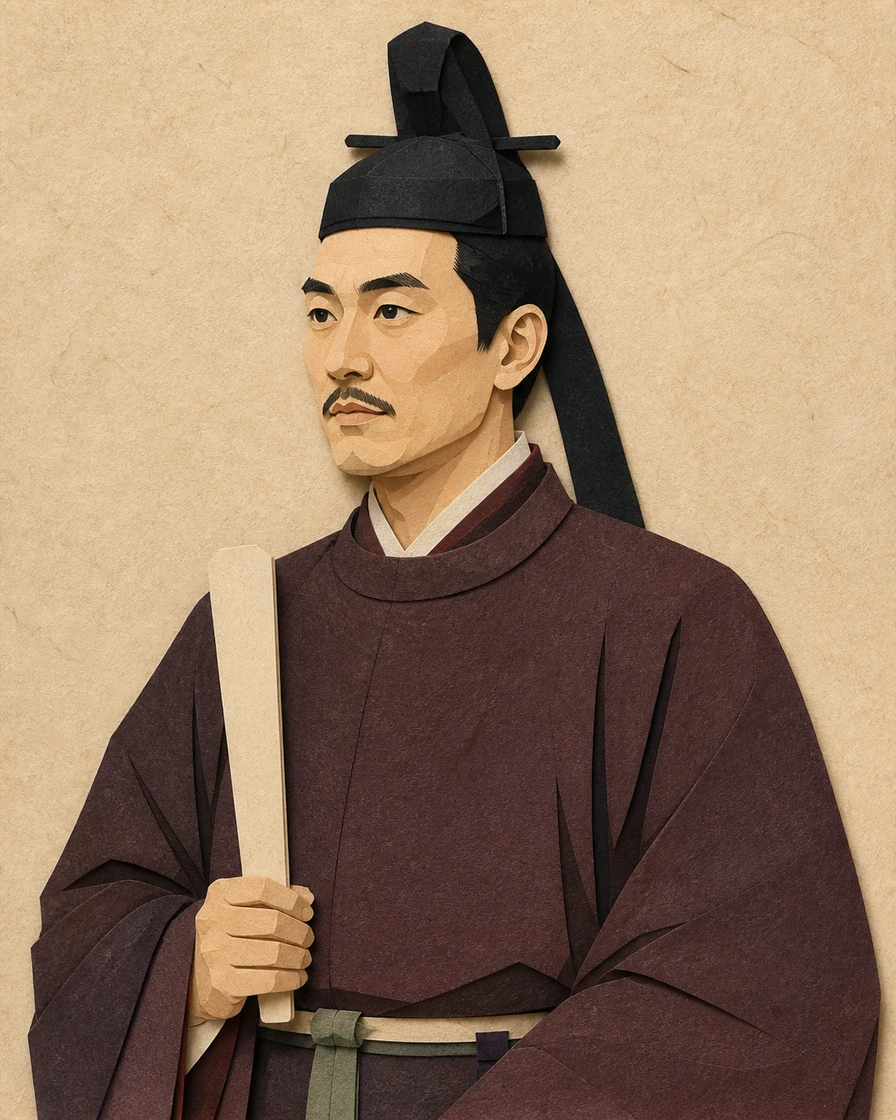
The future Emperor Saga was born Prince Kamino in 786, a son of Emperor Kammu and Fujiwara no Otomuro. His elder brother Ate was ahead of him in the succession; his younger half-brother Ōtomo would later become Emperor Junna. Kamino was born while the court occupied Nagaoka and was about eight when it moved to Heian-kyō, the new capital at Kyoto, in 794. His royal standing gave him access to court formation; his later writing would become a public distinction. The city later associated with his cultural reign was still being built, and his own path to the throne remained uncertain. [11]
After Kammu died in 806, Ate became Emperor Heizei and Kamino became crown prince. Heizei abdicated in 809, with illness among the recorded circumstances, and Kamino succeeded him as Saga. The retired emperor retained officials, family allies and an interest in the future of his son, Prince Takaoka, appointed crown prince under Saga. Fujiwara no Kusuko, a court woman close to Heizei, and her brother Nakanari were important members of this network. Transferring the throne left two royal households capable of influencing government. [11]
Saga became emperor in 809, fifteen years after the court entered Heian-kyō. He inherited a government already retrenching from the expense of capital construction and northern war. In 810 the Chamberlains’ Office—a group of close aides handling confidential imperial documents—took shape, with Fujiwara no Fuyutsugu and Kose no Notari among its leading officials. It emerged before the September confrontation with Heizei. Saga’s accession also opened new opportunities for the Buddhist monk Kūkai, who had returned from Tang China in 806.
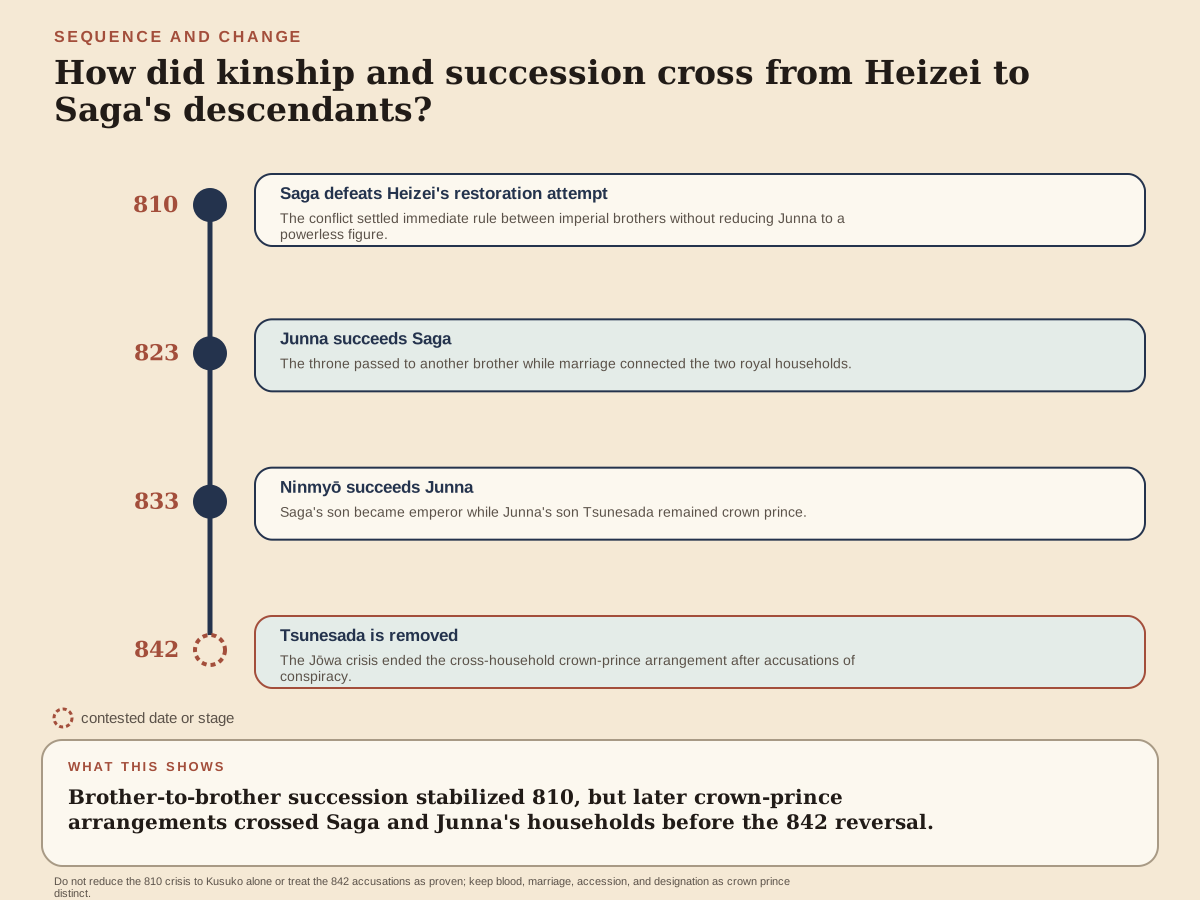
In 810 retired Emperor Heizei's center challenged Saga's government and sought to restore political direction toward Heijō-kyō. Kusuko and Nakanari were central, but Heizei acted as a retired sovereign with his own succession interests. Saga's side moved quickly through appointments, guards and control of strategic routes. Imperial commander Sakanoue no Tamuramaro and other officials made orders operational. Nakanari was executed; Kusuko died by suicide; Heizei entered Buddhist life; Prince Takaoka lost the crown-prince position. The crisis ended before becoming a prolonged field war. The familiar name Kusuko Incident can obscure Heizei's own role. The failed return reinforced Heian-kyō's place as the seat of government. Saga still needed experienced officials and a workable arrangement for future retirement; he had defeated one rival royal center, not ended retired emperors' influence forever. Documentary service and capital policing also developed over time, rather than emerging complete from this crisis.
Kūkai returned from Tang China in 806 with an esoteric Buddhist transmission, learned through initiation and ritual training as well as texts. Court permission was needed before he could establish himself in capital religious life. Saga's support opened opportunities to teach and perform rites; in 816 the court allowed a center on Mount Kōya. This gave material scope to teaching developed by the monk and his Chinese teachers. [1][2][3][5]
Saichō had traveled with the same 804 embassy, on a different ship and for shorter study. His Mount Hiei community drew on Chinese Tiantai, Japan's Tendai tradition, centered on the Lotus Sutra and Buddhahood for all people. His exchanges and later disagreements with Kūkai concerned training and transmission. The court supported these projects without writing their doctrines.
Saga's reign gave its name to a celebrated Kōnin cultural moment. Court poetry in literary Chinese, calligraphy and Buddhist learning received high-level support. The Ryōunshū, presented in 814, was an imperial anthology but not a notebook written by the emperor. Compilers, poets, scribes, paper makers, and archivists made it possible. Consorts and palace women shaped patronage, household access, education, and cultural memory even when official catalogs record them unevenly. Monks and envoys connected the court to knowledge developed beyond Japan. Saga's achievement was to make cultivation politically valuable. It remained an elite culture supported by revenue and labor drawn from a society whose access to education was sharply unequal.
Saga's government sponsored the organization of rites, procedures, legal supplements, poetry, and official knowledge. These projects made precedent easier to retrieve and helped a young capital operate through repeatable written forms. The Dairishiki, commissioned from Fujiwara no Fuyutsugu and other officials and submitted in 821, organized palace ceremonial procedure. The Kōninshiki likewise belonged to collaborative legal-administrative compilation. Imperial sponsorship determined priorities and gave texts authority. Compilers compared records, resolved inconsistency, selected precedent, and depended on scribes and archives. Written order did not make government automatic. Documents still needed interpretation, copying, delivery, enforcement, and revision when actual conditions changed. [8]
Saichō sought a separate ordination system on Mount Hiei. His Tendai community emphasized the Lotus Sutra's promise of Buddhahood for all, bodhisattva vows to help others and twelve years of mountain training. Nara institutions defended existing disciplinary standards and authority. The formal state authorization was issued in 822, seven days after Saichō's death; an institutional account distinguishes an earlier imperial decision from that document. Disciples now had to make the system work. The following year Saga abdicated to Junna. [2][6]
Saga was remembered as one of the early Heian Three Brushes with Kūkai and Tachibana no Hayanari. The grouping is an art-historical frame, not evidence that the three lived inside a formal competition or official academy bearing that title. Saga's surviving calligraphic reputation has strong foundations, including the certificate he wrote in 823 for Kōjō, Saichō's disciple, on receiving bodhisattva ordination at Mount Hiei. The document, preserved at Enryakuji, followed the system's formal authorization in 822. Individual attributions still require object-level judgment because copying, transmission, repair, and prestigious naming complicate old works. Imperial calligraphy joined aesthetic skill to office. A sovereign's writing could authorize, honor, correspond, and shape court taste. The later grouping brought together writing from three distinct careers. [6][10]
In 823 Saga assigned Tō-ji to Kūkai for the development of an esoteric Buddhist institution in the capital. Tō-ji was not an empty site or a new private temple. It had been founded as part of Heian-kyō's state-temple plan. The grant redirected an existing public institution, giving Kūkai a durable capital base. Buildings, images, ritual space, estates, training, and administrative rights still required years of work. The lecture hall was completed in 839, after Kūkai's death in 835. Its program therefore records collective and successor labor rather than a single finished act by either monk or emperor. [4]
Saga abdicated in 823 in favor of his younger half-brother, Prince Ōtomo, who became Emperor Junna. Saga was about thirty-seven and remained a powerful retired emperor. The transfer helped structure succession after the violence of 810. In 833 Junna abdicated to Saga's son Masara, Emperor Ninmyō, and Junna's son Tsunesada became crown prince. Tsunesada's mother Masako was Saga's daughter. The arrangement linked both royal households. Saga's continued authority should not be called mature insei (government conducted by a retired sovereign). Later retired-emperor government developed more formal households and instruments. In 823 influence still operated through rank, kinship, residence, officials, resources, and personal prestige. [11]
Saga had a very large royal household, conventionally described as about fifty children, though exact totals vary by genealogy. Their mothers, ranks, marriages, careers, religious lives, and survival were unequal. Some sons received the surname Minamoto and entered aristocratic rather than princely status. This reduced the number of full princes supported by the royal institution, managed succession risk, and created new office-bearing lineages such as the Saga Genji, Minamoto branches descended from Saga. Saga's later residence at Saga-in near Ōsawa Pond became a powerful cultural memory. The site was converted into Daikakuji in 876, decades after his death. Household policy therefore joined intimate kinship to public finance and future political structure. The household story cannot be told only through the sons who became emperor or famous courtiers. [5][7]
Saga died in 842, two years after Junna. Soon afterward, the Jōwa Incident brought a reported accusation that members of Crown Prince Tsunesada's circle planned to take him east and gather support. Tsunesada was removed and Tachibana no Hayanari and others were punished, benefiting Ninmyō's direct succession and Fujiwara no Yoshifusa. Historian Hiraoka Jōkai reads the alleged plan as political mobilization against Fujiwara influence; Kyoto's local account describes Hayanari as wrongfully exiled. Saga's death changed the balance, but investigation and punishment were decisions of the surviving court. [9][10][11][12][13]
Saga's reign helped make Heian-kyō a durable political and cultural center. His government stabilized the throne after 810, strengthened written administration, patronized Kūkai and Saichō's institutional world, and tied sovereign cultivation to calligraphy and literary compilation. His legacy also traveled through things he did not finish or directly create. Tō-ji developed across later labor; Saichō's ordination system survived through disciples; Saga-in became Daikakuji only in 876; Minamoto lineages formed careers and genealogies beyond his household. [2][4][5][7]
Later art history remembered Saga with Kūkai and Hayanari as the Three Brushes. Later political history also remembered the purges of 810 and 842. Through 1912, Saga's importance lies in durable institutions and contested reception, not a claim that one cultivated emperor created a uniformly peaceful Heian age.
Classic
Prince Kamino, the future Emperor Saga, was born in 786 to Emperor Kammu and Fujiwara no Otomuro. The court was then at Nagaoka, where construction and the aftermath of Tanetsugu's assassination and Sawara's death shaped royal life. Kamino belonged to the household formed by these events, not to the generation making those decisions. His elder brother Ate, the future Emperor Heizei, stood ahead of him in the recognized succession. Maternal rank and family connections affected princes' prospects as well as their order of birth. [11]
Kamino's younger half-brother Ōtomo, the future Emperor Junna, also belonged to the royal family. In 794 Kammu moved the court to Heian-kyō, the new capital that became Kyoto. Kamino was about eight. Royal residences moved into a city whose streets and buildings still required work. Later descriptions of Saga's cultivated court can obscure how recently that setting had been established. His adult reputation would rest partly on writing in literary Chinese and calligraphy, skills valued in court service. His writing later served both cultivated display and the practical work of issuing commands and recognizing status. [11]
Palace women and household workers maintained the residences in which royal children grew up. Writing also required materials and people who copied and preserved documents. Cultural distinction would become one way for Kamino to exercise authority, but it did not secure his succession in childhood. Kammu's retrenchment in 805 left an adult political inheritance: war and capital building had imposed costs that even a forceful emperor's court had reconsidered.
After Kammu died in 806, Ate became Emperor Heizei and Kamino became crown prince. Heizei's brief reign faced inherited financial and succession problems. When he abdicated in 809, illness was among the recorded circumstances, and Kamino succeeded as Saga. The transfer did not dissolve Heizei's household. Officials had obeyed him, families had built prospects around his rule and his son, Prince Takaoka, became crown prince under the new emperor. Brotherly succession thus left a possible future in Heizei's direct line. [11]
The recorded illness does not establish a modern clinical diagnosis. Retired status preserved honor and resources. Residence outside the reigning emperor's immediate household allowed a separate courtly environment to continue. Fujiwara no Kusuko, a palace woman close to Heizei, retained political importance. Her brother Nakanari held office and cultivated relationships with officials and provinces. Gendered narrative later made Kusuko an erotic corrupter whose ambition controlled a passive man. That simplification relieves Heizei of sovereign agency. The opposite correction would also be false. Kusuko and Nakanari were not irrelevant scapegoats; evidence supports their central organizational and family role. [11]
Saga had his own supporters. Crown-prince service, maternal connections, officials who anticipated his accession, and those seeking opportunity under a new ruler formed another network. The question was not merely affection between brothers. Appointment, command of guards, access to documents, provincial governorships, routes, and crown-prince designation gave household tension state consequences. Early Heian abdication lacked the later institutional apparatus associated with mature cloistered government. No established retired-emperor office automatically allocated jurisdictions between two centers. That absence did not mean retired rulers were powerless. It meant influence operated through households, persons, lands, offices, religious acts, and proximity without stable constitutional division. Saga's challenge was therefore temporal. He needed to make the new reign effective before Heizei's old network could redefine abdication as reversible.
Takaoka's appointment as heir offered continuity between the brothers' households. It did not decide which household's commands would prevail if the retired ruler and reigning emperor disagreed. The conflict of 810 would turn that question into an immediate struggle over offices and the location of government.
Heian-kyō in 809 was no temporary camp, but it was not an ancient self-maintaining capital. Its buildings, roads, water, markets, and households required continual administration. Kammu's government had ended one phase of capital construction and accepted retrenchment in 805. Saga inherited the lesson that visible ambition could exhaust productive households. Northern defense and frontier administration did not disappear. Castles, districts, garrisons, settlers, and provincial supply continued to consume attention after major campaigning slowed. Tax grain and labor moved through officials whose reports might be late, self-protective, or incomplete. A sovereign's command depended on the reliability of information. The ritsuryō (the court-centered legal and administrative order based on penal and administrative codes) ministries preserved formal competence. New needs did not automatically abolish them, and Saga did not replace the entire system with a personal household.
Closer service around the emperor could nevertheless solve problems of speed and trust. The Chamberlains' Office, close aides handling confidential imperial documents, became a channel for transmission and access. Its creation in 810 preceded the September confrontation. The office is better understood within growing tension and the practical limits of formal procedure. When two royal networks competed, control of authenticated communication became urgent. Fujiwara no Fuyutsugu and Kose no Notari were not extensions of Saga's mind. Their appointments gave living officials capacity to filter, carry, record, and act. This delegation created power and risk. A closer aide could accelerate decision, but concentrated access could marginalize other offices and favor a particular coalition.
Palace women and lower-ranked attendants also moved documents and people through physical court space. Guards needed authenticated orders and confidence about which ruler's command was valid. Documentary and military control reinforced each other. Provincial governors mattered because a rival center might seek resources outside the capital. Appointments to strategic provinces had succession consequences beyond routine personnel management. Saga also needed ritual legitimacy. Accession, festivals, Buddhist relationships, ancestral rites, and household order made a new reign socially recognizable. The young capital itself became a political stake. If government could be moved back to Heijō, Saga's association with Heian-kyō might look provisional. Urban residents faced these elite choices materially. A capital transfer would relocate offices and households, with renewed demands for building and transport.
The Chamberlains’ Office supplemented the ministries rather than replacing them. Saga placed trusted aides close to the flow of documents at a time when his brother still commanded loyalty elsewhere. His accession also opened new possibilities for the Buddhist monk Kūkai, who had returned from Tang China in 806.
In 810 retired Emperor Heizei sought to move the political center back toward Heijō-kyō at Nara. The challenge threatened which ruler controlled offices and provincial resources, as well as the location of government. Kusuko had access and influence; her brother Fujiwara no Nakanari held office and connections to other officials. Heizei remained an active ruler pursuing his own interests, including those of Prince Takaoka. Later accounts concentrating responsibility in Kusuko's sexuality reduce a conflict between royal households to the ambition of one woman. Her organizational role and Heizei's sovereign agency both matter.
Kusuko could pursue family restoration, patronage, and policy inside constraints different from those facing male officials. Saga's response began with personnel. Removing or transferring rival-aligned guards and governors reduced the capacity of Heizei's orders to become force. He placed trusted officials at key posts. Appointment could be a military act when a post controlled guards or a route to provincial allies. Routes mattered. Roads and crossings around Uji and Yamazaki connected royal intention to provincial support. Sealing movement could prevent a rival household from reaching allies. This strategy helps explain why the crisis ended without a great decisive battle. Sakanoue no Tamuramaro, an imperial military commander, supplied credibility, but he did not single-handedly save Saga. Fuyutsugu, guard officers, messengers, governors, and local administrators formed the response network.
Messages had to be authenticated. A provincial official facing two prestigious sources of command needed to know which order carried enforceable authority. Saga's side won the race to make its commands operational. That success later appears as legitimacy, but contemporaries experienced a rapidly changing field of risk. Punishment classified the defeated network. Nakanari's execution made the crisis exceptional in a court where formal capital punishment had become unusual. Heizei's ordination transformed status but did not retrospectively remove responsibility. Prince Takaoka's displacement showed that succession was at the core. A defeated political center lost not only present offices but a projected dynastic future. Families and lower officials bore consequences through removal, stigma, lost income, and fear even when they had not designed the challenge. Afterward, the government retained officials whose administrative experience remained useful. Having served Heizei while he was emperor did not make every officeholder a committed organizer of the attempted restoration. Fuyutsugu's service strengthened his position close to Saga, while the succession would next turn toward Ōtomo. A victory over one retired household had not abolished the possibility of influential royal retirement. Documentary service and capital policing continued to develop beyond the immediate settlement; the crisis did not create every instrument of control in a single year.
Rapid isolation prevented a prolonged war and secured Saga’s reign. It did not make the settlement bloodless. Nakanari’s execution, Kusuko’s suicide and Takaoka’s removal ended a political network and the succession it had hoped to protect.
Kūkai had returned from Tang China in 806 with texts and ritual learning before Saga became emperor. His entry into capital religious life required permission and recognition from the court. Under Saga he gained opportunities to teach and perform esoteric Buddhist rites, practices conveyed through initiation and trained ritual performance as well as books. In 816 the court permitted him to establish a religious center on Mount Kōya. Patronage supplied a place and resources for work he had developed outside the emperor's household. Saga also gained religious protection and a cultivated relationship with a learned monk. [3][5]
Calligraphy joined the exchange. Saga and Kūkai both possessed reputations as writers, yet shared admiration did not collapse their social positions or purposes. Kūkai's writing served teaching and ritual as well as correspondence and administration. Saga used it as a sovereign whose brush could distribute favor and embody cultivated rule. Saichō complicates any simple partnership story. He traveled with the same embassy in 804, but on a different ship and with a shorter study assignment. His Mount Hiei community drew on Chinese Tiantai, Japan's Tendai tradition, centered on the Lotus Sutra and the possibility of Buddhahood for all people. He sought materials and initiation from Kūkai while pursuing his own teaching program. Their cooperation was real. So was later disagreement about training, textual loans, initiation, and what counted as adequate transmission. Saga did not compose those doctrinal positions. Court patronage created opportunities and pressures without determining every conclusion reached by monks. [1][2]
Artisans were equally necessary. Images and mandalas, diagrams organizing Buddhist figures and their relationships, required artisans; manuscripts needed copying and teaching. Students turned personal instruction into succession. Their memory, discipline, disagreement, and later institutional leadership determined whether teaching survived its first charismatic carrier. Officials handled permissions and resources. A religious grant that appears as one imperial decision depended on administrative performance. Foreign knowledge was never transferred intact like a sealed box. Translation and local teaching changed how imported learning was used. Saga's importance therefore lies neither in passive decoration nor intellectual ownership. He recognized value, opened high-level access, and repeatedly put state resources behind particular relationships. Those choices redistributed religious opportunity.
Kūkai gained opportunities to teach and establish a community, but court access brought obligations: rites, correspondence and institutional management demanded his time. Saga’s patronage was consequential because it gave a religious project developed elsewhere a place within capital life.
Kōnin culture, named for the reign era beginning in 810, gathers court poetry, calligraphy and Buddhist learning around Saga. The label describes a field of work rather than an emperor's personal collection of achievements. His sponsorship nevertheless mattered. A sovereign establishes which abilities earn audience, office, gifts, preservation, and public association with civilized rule. Literary Chinese connected Japanese courtiers to a prestigious transregional archive. Mastery signaled education and access as much as private artistic feeling. The Ryōunshū of 814 displayed poetry within an imperial frame. Its compilation required selection: some writers entered the record while other compositions disappeared. Editors and compilers shaped the image of the age through ordering and attribution.
Scribes made legible copies; paper and ink workers supplied material; archives sustained survival. Court poets navigated more than aesthetics. A poem could display rank competence, gratitude, learned allusion, political alignment, or readiness for office. Palace women influenced household access and patronage and participated in correspondence and ritual. The surviving record is uneven. Tachibana no Kachiko, Saga's empress and the mother of the future Emperor Ninmyō, maintained religious patronage and a household whose succession interests continued beyond her husband's reign. Kūkai and Saichō brought different forms of foreign study into the capital's religious competition. Their knowledge was not manufactured by court taste, though patronage influenced which parts gained visibility.
Foreign learning also depended on travel. Envoys and interpreters linked the court with people outside Japan, while sailors carried the risk of crossing the sea. Artisans produced the images and instruments used in ritual. Written texts could preserve a composition, but performers had to maintain its practice. Provincial revenue and household labor supported the materials and time devoted to these arts. Court cultivation created valuable works within a society whose access to such training remained unequal.
Chinese literary cultivation offered courtiers a shared language of learning and public distinction. Saga’s support gave that learning prestige at the throne. The anthology and associated works preserve the choices of compilers and poets, as well as the preferences of their imperial patron.
A court survives through memory, but institutional memory is difficult. Officials retire, die, move office, protect family knowledge, and disagree about what earlier practice meant. Ceremony magnifies the problem. Ceremonies required participants to agree on timing, rank and procedure. The Dairishiki answered that problem by organizing palace procedure. Fujiwara no Fuyutsugu, Yoshimine no Yasuyo and other officials compiled it under imperial commission; the work was submitted in 821. Calling it Saga's work can be legitimate in the sense of reign and sponsorship. Calling him its sole writer removes the officials who examined precedent and composed usable rules. Compilation is intellectual labor. It requires deciding which records are authoritative, how exceptions fit general procedure, and whether conflicting practices can be reconciled. The Kōninshiki addressed legal and administrative supplementation within the continuing ritsuryō order. [8]
It did not replace the entire inherited code with one emperor's inventions. New regulations accumulate because old forms meet conditions they did not anticipate. Compilers make that accumulation searchable and reduce contradiction without abolishing judgment. Poetry anthologies served a different function but used related technologies of selection and copying. Genealogy organized the royal and aristocratic field. It could clarify rank and descent while also defining which branches appeared central or marginal. Ritual manuals preserved procedures, legal collections organized precedents and anthologies selected a cultural canon. What a compiler omitted could disappear from later understanding even when it had mattered to contemporaries. Scribes made multiple texts operational.
Their disciplined copying allowed one decision or procedure to circulate without requiring its author to travel. Archives supplied the raw material and the possibility of correction. Loss and selective access altered what compilers could know. Provincial government revealed limits. A carefully written central rule still encountered distance and local conditions. Officials interpreted. Interpretation could adapt a rule responsibly or conceal extraction behind technical language. Saga's court valued the image of a ruler whose cultivated mind ordered the brush and the state. Collaborative compilation made that image materially credible. Fuyutsugu's role again shows that service created political capital. Expertise near the sovereign strengthened an official and his family, not only an abstract administration.
Saga chose projects and attached imperial authority to their results; Fuyutsugu and other officials assembled the usable texts. A ceremony or precedent could thus be consulted beyond the memory of the officials who had first performed it. Later rulers inherited a written repertoire they could follow or amend.
Saichō petitioned for an ordination system centered on Mount Hiei. His Tendai teaching emphasized the Lotus Sutra's path to Buddhahood for all people. He proposed Mahayana bodhisattva vows, directed toward saving others as well as one's own enlightenment, and twelve years of training on the mountain. The established ordination centers conferred full monastic status under a different disciplinary system. Requiring Hiei students to pass through those centers left Saichō's community dependent on institutions whose teaching and priorities differed. Nara clergy defended recognized standards and their authority; the dispute concerned doctrine and training as well as control. [2]
The formal state document authorizing Hiei's separate ordination was issued in 822, seven days after Saichō's death. The Tendai denomination's history distinguishes that document from an earlier imperial decision, which it places shortly before his death. These are stages of authorization, not separate foundations. Disciples had to turn the permission into a functioning institution. Saga's abdication in 823 was a later transition; the formal approval was not deferred to Junna's reign. [2][6]
Saichō's disciples carried forward the training he had proposed. Saichō's exchanges and disagreements with Kūkai affected the religious field, but this ordination campaign concerned a distinct pathway for Hiei monks. Recognition joined a new training program to the court's expectations of religious service. Authorization reshaped Japanese Buddhism beyond the immediate needs of Saga's household. Approval also did not settle all future conflict. Recognition left further questions about training and resources. Later Tendai success makes Saichō's request appear destined. At the time, the court faced a genuine choice among competing definitions of valid monastic formation.
Permission changed how the community could reproduce itself. Monks trained on Mount Hiei could receive ordination through its own system rather than depend on the older centers. Saichō’s disciples inherited both that opening and the work of maintaining the training he had proposed.
The title Three Brushes gives memory a memorable triangle: emperor Saga, monk Kūkai, and courtier Tachibana no Hayanari. It encourages comparison of line, form, rhythm, learning, and transmission. It does not prove the three accepted a fixed collective identity in their lifetimes. Later connoisseurship often organizes scattered works by schools, masters, and exemplary groups. Such categories can reveal reception while falsifying contemporary social structure if read backward. Saga's position was unique because his brush belonged to the sovereign. A written certificate or inscription could combine personal execution with institutional force. In 823 Saga wrote the ordination certificate for Kōjō, a disciple of Saichō who received bodhisattva ordination on Mount Hiei. Preserved at Enryakuji, it connects an imperial autograph with the new system formally authorized in 822. A certificate was not merely art made for detached viewing. It changed status, authenticated recognition, and entered an institutional archive. [6][10]
Its material existence depended on prepared paper, ink, brushes, scribes or attendants, seals, storage, and the recipient's community. Imperial hand did not eliminate those contributors. Kūkai's writing occupied different but overlapping worlds. Monastic transmission, letters, ritual, education, and public inscription gave his calligraphy purposes not reducible to court imitation. Hayanari was a high official and calligrapher with a political life that would end under accusation in the 842 crisis. His later fame cannot be treated as proof about that prosecution. Their writing and political lives did not follow one shared career. Attribution presents another problem. Prestigious names increase an object's value, while copies preserve forms after originals disappear. Repair, remounting, incomplete provenance, later inscription, and stylistic judgment can create different degrees of certainty. A surviving autograph and a copy carrying a prestigious name do not offer the same kind of evidence.
Securely contextualized documents, historical reputation, and sustained reception together support Saga's importance. Calligraphy also carried a political theory of cultivation. Control of the brush could signify disciplined body, learned mind, and fitness to order written government. That theory privileged those trained in elite models. Many people who made administration work used writing without entering the canon of beautiful hands. Copyists provide the crucial contrast. Their accuracy transmitted texts and orders, but fidelity often made individual style less visible and names less likely to survive. The emperor's expressive hand became collectible because office magnified it. An anonymous clerk's disciplined hand could be more operationally important on an ordinary day. Saga's court helped attach artistic prestige to governing literacy. This link strengthened the cultural image of early Heian monarchy.
The certificate joins calligraphy to an act of recognition. Kōjō and his community preserved writing that mattered to monastic status before it became an admired historical object.
Heian-kyō's planners had positioned eastern and western temples near the capital entrance. Their role connected Buddhist protection to the spatial order of the state. Tō-ji therefore possessed a history before Kūkai. Land, unfinished or functioning structures, administrative claims, workers, and ritual expectation already attached to the site. The 823 decision was still transformative. It placed a major capital institution under Kūkai's direction for an esoteric program and limited competing monastic use. Access to a temple inside the capital gave what individual reputation could not: a capital base for training and ritual, with a claim on continuing support. Saga exercised selection at the highest level. He allocated an inherited public resource to a specific religious project whose Tang connections and court usefulness he valued. [4]
That choice benefited Kūkai but also constrained him. A capital temple brought maintenance, discipline, funding, ceremonial expectations, and accountability. No imperial order could instantly produce the visual and architectural system later visitors associate with Tō-ji. Construction required builders and materials; images required sculptors and workshops. Monks needed instruction and succession rules. Estate managers and officials needed to secure revenue. Artisans required materials, food, lodging, and organized workshops. The original lecture hall was a long construction project. Completion in 839 came four years after Kūkai's death. The hall standing today is a reconstruction of 1491, not that original building. The hall's famous arrangement can be associated with his program without being reduced to his solitary hand. Disciples, sculptors, planners, patrons, and later administrators carried work across the break in personal leadership. [4]
Saga likewise did not remain reigning emperor throughout construction. His 823 abdication transferred the throne to Junna while he retained status and influence. The grant and abdication were separate actions in the same year. Junna's government and later courts mattered because long construction needs continuing permission and resources. Institutional durability exceeded the initiating sovereign. Tō-ji also redistributed Buddhist competition. A privileged capital base could amplify one transmission while narrowing equivalent opportunity for others. That inequality is part of patronage, not a reason to deny the temple's cultural achievement. State support always selects among possible recipients. The physical site also outlasted the original political meanings.
The grant connected Kūkai’s program with an existing capital institution. Its lecture hall, completed after his death, shows how far the project depended on successors. Saga’s allocation mattered because it gave that continuing work a durable site and recognized authority.
Abdication could manage succession before illness or death made it urgent. It allowed a ruler to shape transfer while retaining the capacity to support the new reign. Saga had learned in 810 that retired status could preserve enough authority to destabilize a reigning emperor. His own retirement therefore carried an unavoidable precedent. The difference did not lie in a constitutional ban. It lay in relationship, preparation, succession arrangement, and whether two households issued competing commands. Prince Ōtomo was Saga's younger half-brother and Kammu's son. His accession as Junna continued the brotherly sequence without restoring Heizei's defeated line. This choice did not remove Saga's children. Prince Masara stood in the next generation and later became Emperor Ninmyō. Junna's son Tsunesada later acquired a claim in the next generation. [11]
The arrangement attempted to distribute expectation between connected royal lines. Such balance could reduce immediate fear while storing future ambiguity. Every named successor created a household whose fortunes depended on the sequence being honored. Saga remained influential through prestige, family, former officials, residences, wealth, and access. People who had advanced during his reign did not forget the source of their position. He could advise, patronize, intervene, and shape marriage or office without possessing the reigning title. That is real retired power. It is still misleading to import mature insei (government conducted by a retired sovereign) backward. Later retired rulers developed more recognizable administrative mechanisms and sometimes dominated reigning emperors across extended periods. Saga's 823 retirement belonged to an earlier institutional environment. Personal authority and household networks mattered more than a standardized retired government.
Junna governed as sovereign even while Saga retained influence. Describing him as Saga's placeholder converts a reigning emperor into a puppet without sufficient evidence. Officials served both continuity and the new ruler. Their choices determined whether Saga's advice remained counsel or became command. Consorts and mothers mattered because generational succession was embodied in household relations. Their children, residences, and kin networks carried competing futures. The abdication also changed Saga's public role. He could pursue patronage and residence projects with fewer daily burdens while remaining inside political calculation. In 833 Junna abdicated to Saga's son Masara, who became Emperor Ninmyō. Junna's son Tsunesada became crown prince. Tsunesada's mother, Princess Masako, was Saga's daughter, so the new heir joined the two households through both parents. [11]
Junna’s accession avoided a repetition of the crisis of 810. Saga, still only about thirty-seven in 823, remained present through the reigns of Junna and Ninmyō. This cooperation depended heavily on his personal standing; the struggle after his death would expose its limits.
A large household advertised dynastic vitality, but every recognized child required status decisions. Residence, attendants, education, ceremony, marriage, land, and office carried material cost. Children did not enter a neutral list. Their mother's rank and kin, the emperor's recognition, sex, age, health, and political opportunity shaped different futures. Tachibana no Kachiko possessed her own family network and later religious importance. Her son Masara became Emperor Ninmyō, while her household and religious patronage continued after Saga's death. Other consorts and mothers are less visible in broad narratives, yet they organized residences, care, marriage connections, and claims for children. Women attendants and household administrators sustained residences whose children had very different prospects. The household is conventionally described as having about fifty children, an approximate total. [7]
Genealogies differ, and later lineage interests can affect inclusion. The structural fact is secure: the household was too large for every son to remain a prince with equivalent rank and public support. Granting the surname Minamoto moved some descendants outside immediate princely status while preserving prestigious imperial ancestry. A new surname changed legal status and routes to office while weakening or closing a claim to the throne. For the state, the policy narrowed the field of princes who might become rival centers. It also reduced some costs associated with full royal status. For the recipient, it could open an aristocratic career while formally closing or weakening a route to the throne. Minamoto no Tōru later became a famous Saga son and a powerful cultural figure. [7]
His prominence should not make him representative of every sibling. Daughters carried political and religious relations through marriage, celibate office, patronage, or household alliances, yet often receive thinner narrative treatment. Some children died young or left little recoverable record. A thinner record leaves less of their individual lives recoverable, even where their family position mattered. Saga's retired residence at Saga-in gave the household a spatial center near Ōsawa Pond. Landscape, ceremony, leisure, patronage, and administration met there. Later memory associated the setting with refined imperial culture. The material environment still depended on household workers and local management of land and water. Daikakuji belongs to the site's afterlife, not Saga's completed personal foundation. Conversion in 876 occurred long after his death. [5]
The Minamoto surname marked a boundary between imperial descent and princely status. Saga’s descendants could use their ancestry within aristocratic careers, but lineage alone did not give each child the same offices, income or influence. Household decisions reshaped the wider court long after his reign.
Saga died in 842. His younger half-brother Junna had died in 840, leaving Crown Prince Tsunesada without his father's living protection. Soon after Saga's death, accusations against Tsunesada's circle led to the crisis known as the Jōwa Incident. The reported plan was to take the crown prince east from the capital and gather support. The charge implicated Tachibana no Hayanari and Tomo no Kowamine; it does not by itself establish that a rebellion was underway. Tsunesada lost his position, while Ninmyō's direct line and Fujiwara no Yoshifusa benefited. The emperor and his officials still made the decisions about investigation and punishment. [11][13]
Historical disagreement · How should the Jōwa Incident be understood?
Empress Tachibana no Kachiko remained a senior figure: she was Saga's widow and Emperor Ninmyō's mother. Tsunesada represented the earlier arrangement linking Junna's son with Saga's descendants. Removing him changed that future. Historian Hiraoka Jōkai interprets the reported eastward plan as political mobilization against Fujiwara influence. Kyoto's local account of Hayanari instead describes him as wrongfully exiled.
The latter is a commemorative judgment, not evidence that every accusation has been independently disproved. These readings should remain distinct from the court's official classification of a plot. [9][10][12]
Hayanari died while being sent toward exile. Punishment also reached families and officials whose careers depended on the displaced heir. Saga's earlier succession choices had shaped the field, but the response after his death belonged to people still able to act. His personal standing had helped sustain cooperation. Its disappearance exposed how vulnerable that arrangement was to changing loyalties and fears at court.
Saga’s death removed one of the strongest supports for the earlier succession arrangement. Tsunesada’s subsequent removal broke that balance. The accusations and punishments were decisions taken by the surviving court, whose preferred future now displaced the one Saga had helped arrange.
Heian-kyō did not endure because a single ruler declared it eternal. Saga's victory in 810 removed a serious attempt to redirect political center toward Heijō. That victory increased the investment of ministries, households, temples, markets, and memory in the newer capital. Later generations made Kyoto durable through continuous rebuilding and use. Written government carried another part of the legacy. Compilations of procedure, legal supplements, genealogy, and poetry gave later officials structured access to Saga-era selections. Texts did not preserve themselves. Copyists, archivists, temple communities, aristocratic houses, collectors, and modern institutions decided what survived. Tō-ji turned an 823 allocation into a religious and visual institution that outlived Kūkai, Saga, and the political needs of their century. Enryakuji and Tendai institutions carried Saichō's program through recognition, conflict, expansion, and later transformation. [2][4]
Saga's court was a gate in that history, not its sole author. Daikakuji converted Saga's former residential association into temple memory decades after his death. The later foundation kept his name active while adding meanings he never personally governed. The Saga Genji extended imperial descent into aristocratic lineages. Their careers demonstrate how household management could reshape the state's social architecture. Calligraphy created a different survival. Preservation and interpretation of autographs and copies by temple communities and connoisseurs helped make the ruler's practiced hand an art-historical exemplar. The canon honored skill while compressing a broad field of scribes and artisans into famous names. Later commemorations selected particular achievements from a much more contested reign. Saga's cultural reputation also benefited from contrast. [5][7]
The controlled elegance associated with his court looked especially attractive against narratives of frontier war, succession violence, or later disorder. Yet 810 belongs inside the same reign as poetry and calligraphy. Nakanari's execution, Kusuko's suicide, displaced heirs, punished kin, and stronger enforcement formed part of stabilization. The 842 Jōwa Incident followed Saga's death, not his command. It still exposed a weakness in succession balance held together by personal authority. Calling the age peaceful erases how courts produce order: appointments and exclusion, backed by taxation, policing and force. Calling it only oppressive would erase genuine institutional creativity and the choices of cultural and religious actors who used patronage for purposes beyond the throne. Saga's biography therefore resists moral compression.
Saga helped secure Heian-kyō and gave written administration and cultural patronage lasting institutional forms. The same government used punishment to settle succession. His reputation as a cultivated ruler is strongest when read alongside those political choices, rather than as evidence that elegance made the court peaceful.