Read the article below. Interactive reading tools are available when scripts load.
Quick
In 789, forces resisting an imperial expedition defeated troops advancing along the Kitakami River toward Isawa, in present-day Iwate Prefecture. The court’s report names Aterui as the leader whose residence the soldiers approached. It is the first surviving glimpse of him, not a record of his childhood or rise to leadership. [1][2]
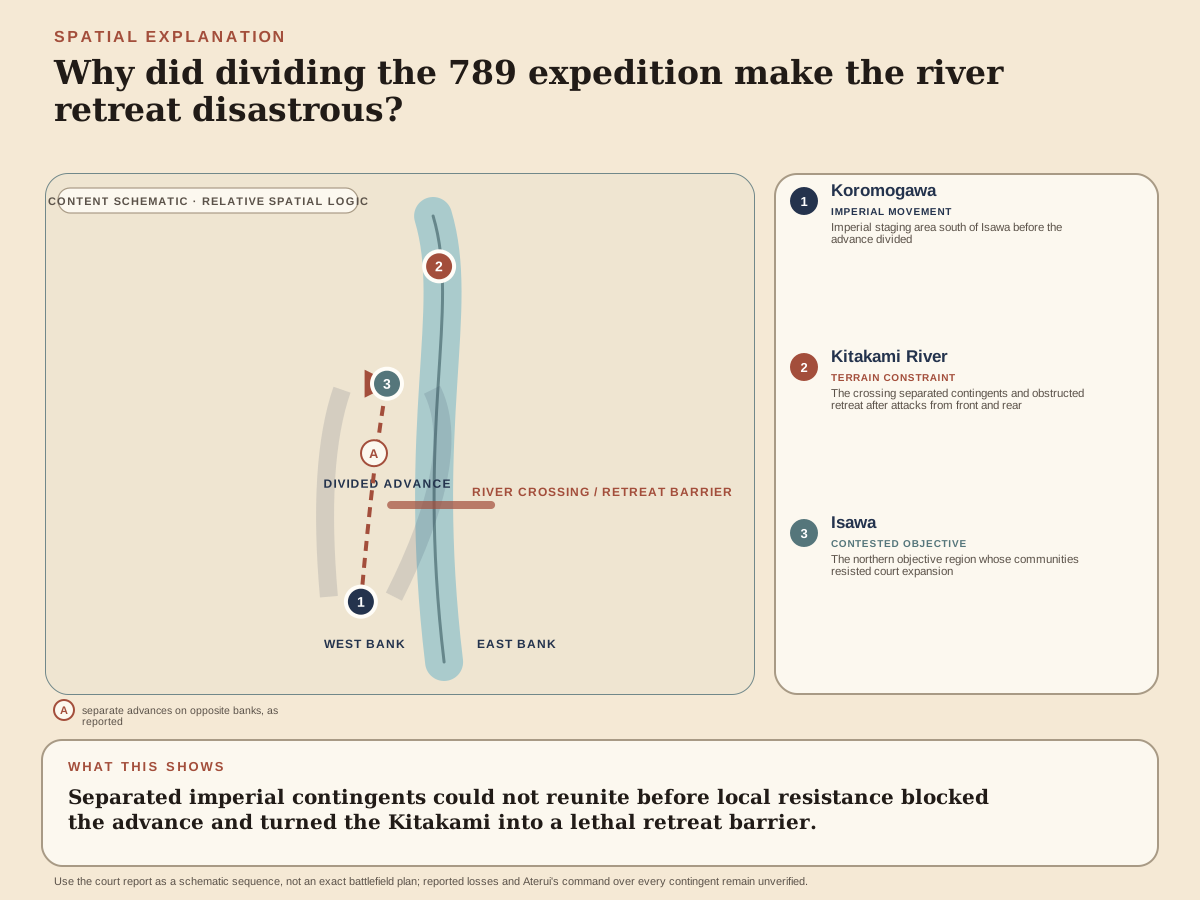
The expedition was commanded by Ki no Kosami. Its advance separated troops along the river’s banks, with a planned meeting farther north; opposing forces blocked the advance and the retreat. Many imperial soldiers drowned. The engagement shows why the expedition’s large overall strength did not guarantee that its separated contingents could prevail. Aterui’s wider community was designated Emishi by the court, a political label that cannot fully describe its members’ own identity. [2][6]
Further expeditions followed the defeat of 789. Ōtomo no Otomaro commanded the 794 expedition, with Sakanoue no Tamuramaro taking a leading role. Tamuramaro led another campaign in 801 and returned in 802 to build Isawa fort. These operations created a continuing government presence in the territory where Aterui had resisted. The details of Aterui’s actions during the intervening years are sparsely recorded. [1]
Aterui and another leader, More, surrendered to Tamuramaro in 802 with more than five hundred people. The fort was still being built. Their surrender is recorded, but their own explanation is not: exhaustion, negotiation and a personal promise of safety cannot be turned into certain statements of Aterui’s intention. The two leaders were taken to the capital for a decision about their future. [1][3]
At the capital, the commanders proposed sending Aterui and More back to persuade other Emishi to submit. Tamuramaro’s request recognized that their local influence could still be useful. Senior councillors disagreed, arguing that release would allow renewed resistance. The surviving account preserves the government’s competing proposals; it does not preserve Aterui’s answer. [1][3]
The proposal was rejected. Aterui and More were executed in Kawachi Province in 802. The chronicle’s place name has different transmitted readings, and its identification with a particular site in modern Hirakata remains uncertain. A defeated leader’s death and a general provincial location are more securely established than a precise grave or execution spot. [3][7]
Isawa fort continued after Aterui’s death as a center of military government. Its enclosure contained a ceremonial compound and offices supplying food. It remained active into the later tenth century. Continued administration, rather than the death of two leaders alone, made the court’s presence durable. [4]
Aterui’s last proceedings survive in the Nihon Kiryaku, a later compilation preserving material from an earlier official history whose relevant part was lost. That transmission kept both the commanders’ proposal and the councillors’ rejection in view. It also left the story overwhelmingly in the words of the conquering government. No surviving Emishi account fills in Aterui’s family, private negotiations or final thoughts. [1][3][5]
Classic
In 789, an imperial army advancing into the Isawa region suffered a severe defeat along the Kitakami River. The report brings Aterui into view as the leader whose residence the troops approached. Isawa lay in the fertile river basin around present-day Ōshū, Iwate Prefecture. The court sought to bring this territory under its authority; Aterui belonged to the forces that resisted that expansion. His birth, family and route to leadership are unknown. [1][2]
What does the name Emishi establish?
The designation Emishi placed him within a category created by the court. Aizawa Shūtarō’s study distinguishes that political concept from the separate question of the cultures and communities to which its members belonged. It identified people beyond the state’s effective rule in the eastern and northern margins.
The category does not establish a single shared political organization, Aterui’s own name for his community or a direct identification with a modern ethnic group. The records identify his resistance more clearly than his ancestry. [6]
Ki no Kosami commanded the expedition. Its large body of troops assembled at Taga fort before advancing to the Koromo River, south of Isawa. The army divided into front, middle and rear forces. When an advance was finally made, the middle and rear forces contributed two thousand men each to cross the Kitakami and advance along its left bank, while the front force moved along the other bank. The intended meeting farther north depended on separated contingents reaching the same area. The city history distinguishes those advancing groups from the much larger expedition as a whole. [1][2]
According to the report as presented in the Hirosaki city history, troops approaching Aterui’s residence first encountered some three hundred opponents who then withdrew. The imperial advance burned villages on its route. A further force blocked its front, while another appeared behind it; retreat toward the river became disastrous. The report counted 1,036 drowned imperial soldiers. These are reported figures, not a count independently recoverable from a battlefield. They nevertheless make the river’s role in the defeat clear. [2]
Hirosaki’s account interprets the initial withdrawal as a decoy. The described movements support an explanation based on local forces interrupting the expedition’s advance and escape, rather than total army size alone. The report names Aterui as a leader without recording his spoken orders or establishing his control of every contingent. Further court expeditions would return to the same region. [1][2]
The court sent another expedition in 794 under Ōtomo no Otomaro, with Sakanoue no Tamuramaro taking a leading role. A further campaign followed in 801 under Tamuramaro. These later campaigns changed the government’s position in the region where Aterui had resisted. The notices leave a gap in Aterui’s own movements between the fighting of 789 and the surrender of 802. [1]
In 802, Tamuramaro began building Isawa fort. The change from an expedition to a fortified administrative presence mattered. A campaign could depart; a fort established a place for continuing military and political operations. The Hirosaki city history records four thousand people sent from ten provinces to Isawa. This movement of population accompanied the construction, rather than being an achievement attributable to Aterui. It increased the means by which the court could hold territory after its army’s advance. [1][8]
The fort was functioning before every detail of its construction was complete. A lacquer-preserved paper document records the arrival of a communication from the Tamatsukuri military unit in the sixth month of 802. The history explains how discarded paper used to cover lacquer containers could survive because lacquer protected it from decay. This material witness establishes an operating channel of military paperwork at the fort. [8]
During construction, Aterui and More surrendered with more than five hundred people. The surviving account presents two named leaders and a group arriving together. It does not establish that the entire Emishi population submitted, nor does it identify every person in the group as a combatant. Their surrender made their leadership a question for the government: could the same local influence that had supported resistance now assist submission elsewhere? [1][3]
Why did Aterui surrender?
The surrender’s circumstances have encouraged explanations based on losses, damaged livelihoods or negotiations with Tamuramaro.
Aterui left no surviving statement choosing among those explanations. There is also no securely documented personal guarantee of safety to quote. The action that can be followed is the surrender itself and the subsequent transfer of the two leaders to the capital. Their fate was then decided beyond Isawa. [1][3]
The court’s account of Aterui’s execution also records an argument about releasing him. After Tamuramaro brought Aterui and More to the capital, the commanders proposed allowing them to return to the northeast and persuade other Emishi to submit. Senior councillors rejected that course. The decision concerned the future use of two leaders who had already surrendered, not simply what to do with opponents still fighting. [1][3]
The proposal assumed that their influence could continue to matter under new circumstances. Returning them could give the government intermediaries capable of approaching other local people. The councillors’ objection described the same influence as a danger: release, they argued, would leave an opportunity for renewed resistance. Both proposals treated the two men as capable of affecting other communities. They differed over whether the state should use that capacity or eliminate the risk it presented. [3]
The language of the rejection was openly hostile. The chronicle attributed an animal nature and an inconstant heart to the surrendered leaders, then compared their release to nurturing a tiger and leaving future trouble. Those descriptions belong to the councillors’ argument as transmitted by the court record. They are not evidence that Aterui or More possessed the alleged innate qualities. Aizawa’s analysis of Emishi as a political category helps distinguish the government’s classification from the people being classified. [3][6]
The commanders’ request was refused. Aterui and More were executed in Kawachi Province in 802. Tamuramaro’s recommendation did not determine the outcome. The decision required authority beyond the commander who accepted their surrender. The account preserves the proposal and rejection; it leaves Aterui’s own words, understanding of the surrender and final response unrecorded. [1][3]
Where were Aterui and More executed?
The place name is less secure than the province. The Aomori edition prints a place name read as Moriyama, while other transmitted readings have supported Ueyama or Sugiyama identifications.
Hirakata City’s historical column explains that the association with modern Uyama remains unconfirmed. Kawachi Province provides the secure general location in this record. An exact modern mound or memorial cannot by itself settle where the two leaders died. [3][7]
The fortified presence at Isawa continued after Aterui’s death. Ōshū City describes an enclosure roughly 670 meters on each side, bounded by rammed-earth walls. Within it stood a ceremonial compound and offices concerned with food supply. The military headquarters known as the chinjufu operated there, and the site remained active into the later tenth century. These facilities made the government’s presence more durable than a single expedition or an execution. [4]
The broader region’s people did not simply vanish from the subsequent history. Research presented by Morioka’s archaeological museum identifies ninth- and tenth-century settlements, warehouses and buildings associated with local elites in the Shiwa area farther north. The museum interprets these as evidence that local influential groups incorporated government technologies and administrative forms. The settlements document continued local life beyond Aterui’s death, rather than a traceable descent from him or a known fate for his surrendered followers. [9]
Aterui’s final proceedings survived through another kind of continuity. The Nihon Kiryaku excerpted earlier official histories, including material now missing from the Nihon Kōki. Aomori Prefecture identifies the execution notice as such a surviving excerpt. The later compilation retained the commanders’ request and the councillors’ rejection in the same short account. Its compiler and exact date are uncertain; the text transmits the court’s account of Aterui. [3][5]
The resulting record preserves a striking asymmetry. The conquered leader is named; the government’s reasons for refusing his return are recorded; his private explanation is absent. Fort remains and administrative documents supply evidence for the continuing state presence, while the transmitted notice fixes the fatal decision. Together they keep Aterui within the history of resistance and incorporation, without supplying the missing personal life. [1][3][4][8]