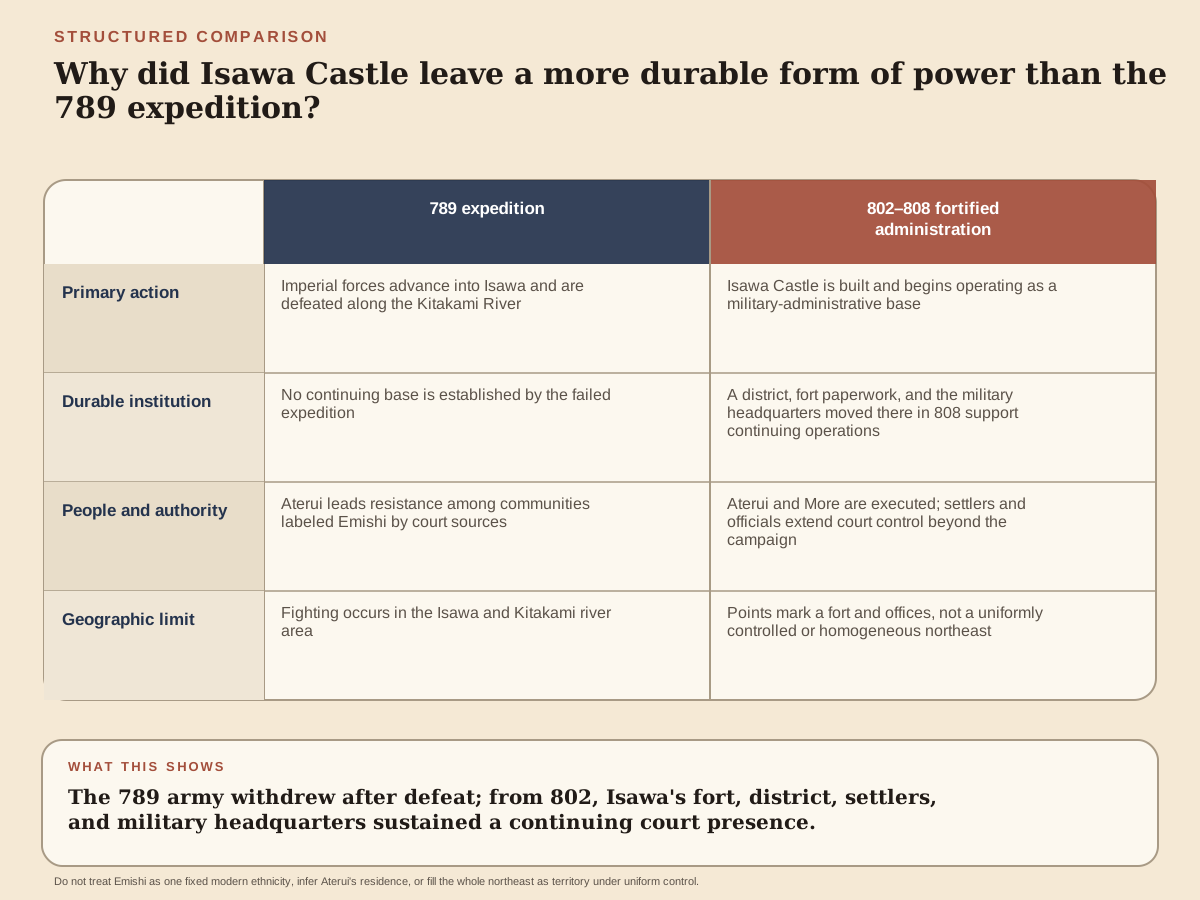
In 789, forces led by Aterui defeated an expedition commanded by Ki no Kosami in the Isawa region of northeastern Japan. Aterui was a leader among people whom court sources called Emishi, a category used for northern groups outside or at the edge of imperial administration. Their resistance challenged the court's attempt to extend its military and administrative reach.
In 789, an imperial army advancing into the Isawa region suffered a severe defeat along the Kitakami River. The report brings Aterui into view as the leader whose residence the troops approached. Isawa lay in the fertile river basin around present-day Ōshū, Iwate Prefecture. The court sought to bring this territory under its authority; Aterui belonged to the forces that resisted that expansion. His birth, family and route to leadership are unknown.
The designation Emishi placed him within a category created by the court. Aizawa Shūtarō’s study distinguishes that political concept from the separate question of the cultures and communities to which its members belonged. It identified people beyond the state’s effective rule in the eastern and northern margins. The category does not establish a single shared political organization, Aterui’s own name for his community or a direct identification with a modern ethnic group. The records identify his resistance more clearly than his ancestry.
Ki no Kosami commanded the expedition. Its large body of troops assembled at Taga fort before advancing to the Koromo River, south of Isawa. The army divided into front, middle and rear forces. When an advance was finally made, the middle and rear forces contributed two thousand men each to cross the Kitakami and advance along its left bank, while the front force moved along the other bank. The intended meeting farther north depended on separated contingents reaching the same area. The city history distinguishes those advancing groups from the much larger expedition as a whole.
According to the report as presented in the Hirosaki city history, troops approaching Aterui’s residence first encountered some three hundred opponents who then withdrew. The imperial advance burned villages on its route. A further force blocked its front, while another appeared behind it; retreat toward the river became disastrous. The report counted 1,036 drowned imperial soldiers. These are reported figures, not a count independently recoverable from a battlefield. They nevertheless make the river’s role in the defeat clear.
Hirosaki’s account interprets the initial withdrawal as a decoy. The described movements support an explanation based on local forces interrupting the expedition’s advance and escape, rather than total army size alone. The report names Aterui as a leader without recording his spoken orders or establishing his control of every contingent. Further court expeditions would return to the same region.
Sakanoue no Tamuramaro was born in 758 into a family already serving the imperial court. His father, Sakanoue no Karitamaro, held military and aristocratic office. The family offered a route into service at a time when armed command and civil rank belonged to the same aristocratic order. Palace guards served the sovereign; provincial forces answered governors and appointed commanders. Tamuramaro would become powerful through imperial appointment, rather than by ruling a domain of his own.
Kanmu's government sent further expeditions. Sakanoue no Tamuramaro, appointed seii taishōgun in 797, conducted the campaign of 801 and built Isawa Castle in 802. Aterui and More surrendered that year. They were taken south and executed, despite a proposal to preserve their lives and use their influence among local people. The court's decision ended their personal leadership rather than simply converting them into provincial officials.
Isawa subsequently became an administrative district, and the military headquarters was moved to its castle in 808. These institutions carried control beyond the campaign itself. Most written evidence about Aterui comes from the court that defeated and executed him. It preserves named resistance and surrender, but not a complete biography, private conversations, or the full identities of all the northern communities involved.
The court sent another expedition in 794 under Ōtomo no Otomaro, with Sakanoue no Tamuramaro taking a leading role. A further campaign followed in 801 under Tamuramaro. These later campaigns changed the government’s position in the region where Aterui had resisted. The notices leave a gap in Aterui’s own movements between the fighting of 789 and the surrender of 802.
In 802, Tamuramaro began building Isawa fort. The change from an expedition to a fortified administrative presence mattered. A campaign could depart; a fort established a place for continuing military and political operations. The Hirosaki city history records four thousand people sent from ten provinces to Isawa. This movement of population accompanied the construction, rather than being an achievement attributable to Aterui. It increased the means by which the court could hold territory after its army’s advance.
The fort was functioning before every detail of its construction was complete. A lacquer-preserved paper document records the arrival of a communication from the Tamatsukuri military unit in the sixth month of 802. The history explains how discarded paper used to cover lacquer containers could survive because lacquer protected it from decay. This material witness establishes an operating channel of military paperwork at the fort.
During construction, Aterui and More surrendered with more than five hundred people. The surviving account presents two named leaders and a group arriving together. It does not establish that the entire Emishi population submitted, nor does it identify every person in the group as a combatant. Their surrender made their leadership a question for the government: could the same local influence that had supported resistance now assist submission elsewhere?
The surrender’s circumstances have encouraged explanations based on losses, damaged livelihoods or negotiations with Tamuramaro. Aterui left no surviving statement choosing among those explanations. There is also no securely documented personal guarantee of safety to quote. The action that can be followed is the surrender itself and the subsequent transfer of the two leaders to the capital. Their fate was then decided beyond Isawa.
In 789 a court expedition under Ki no Kosami was defeated in the Isawa region, in present-day Iwate Prefecture. Aterui appears in the court record as a leader associated with the resisting force. The defeat checked a major imperial mobilization and left Kammu's government with an unresolved military problem. Tamuramaro was not the commander of this expedition; the event matters to his career because the court continued to seek control of the same region.
The encounter took place in river country where moving a large force was difficult. Numbers alone could not ensure effective movement or a secure advance. That setting helps explain the operational demands later commanders faced. It does not establish which particular changes Tamuramaro made to crossings, intelligence or supply. Those improvements cannot be reconstructed simply by listing what any successful army would have needed.
Sakanoue no Tamuramaro was a major court commander in campaigns against northeastern resistance. The 801 campaign, Isawa Castle and the surrender of Aterui show how military advance was converted into forts, administration and the forced incorporation of people and land.
His unsuccessful plea for clemency also shows that command did not equal control of court policy. Later temple traditions and warrior tales transformed Tamuramaro into a model conqueror and loyal retainer. That reception was influential, but it must remain distinct from the limited contemporary record of his campaigns and offices.
The court’s account of Aterui’s execution also records an argument about releasing him. After Tamuramaro brought Aterui and More to the capital, the commanders proposed allowing them to return to the northeast and persuade other Emishi to submit. Senior councillors rejected that course. The decision concerned the future use of two leaders who had already surrendered, not simply what to do with opponents still fighting.