Read the article below. Interactive reading tools are available when scripts load.
Classic
Rennyo established an Osaka religious base in the late fifteenth century. After the destruction of Yamashina Honganji in 1532, the headquarters moved to Osaka. A fortified settlement developed around the temple, with waterways connecting it to Kyoto and the Inland Sea.
Honganji linked resident clerics, lay associations and military supporters across several provinces. Contributions and correspondence connected its central leadership to local communities. The people reached by this network did not all have the same military role or relationship with neighboring rulers.
Nobunaga’s advance in the central provinces brought demands for payments and departure from Ishiyama. Kennyo rejected the loss of the headquarters and called adherents to resist in 1570. Regional allies could also benefit from pressure on Nobunaga’s forces.
The location gave the defenders access to shipping as well as defensive terrain. The contest therefore involved surrounding routes, regional support and supply into the fortified settlement. An army attacking Osaka had to address resources arriving from beyond its landward positions.
Regional affiliation did not produce identical leagues. In the Kiso delta, Ganshōji supplied a religious center for the Nagashima communities, whose control challenged Nobunaga's advance through northern Ise. In Echizen, local uprisings overturned an Oda-backed settlement and Honganji's Shimotsuma Raishō became a leading authority. Clerics, local leaders and armed followers entered these struggles through different provincial circumstances. Kennyo's call reached organizations that already existed; it did not give every believer the same orders or military task.
Their destruction carried costs beyond the removal of commanders. The Mie prefectural history describes the 1574 Nagashima siege ending in attacks on departing boats and the burning of enclosed men and women. In 1575, Oda forces broke the Echizen defenses and pursued opponents across the province. The older texts give large death totals that cannot be treated as an exact census. Severe violence against these communities is nevertheless part of the context of Ishiyama's continuing resistance, rather than an incidental step toward unification.
The opening struggle extended into provincial leagues and alliances. Nobunaga fought resistance in Nagashima and Echizen as well as around Osaka. Negotiated pauses repeatedly interrupted fighting; the decade was a sequence of campaigns rather than a single uninterrupted assault.
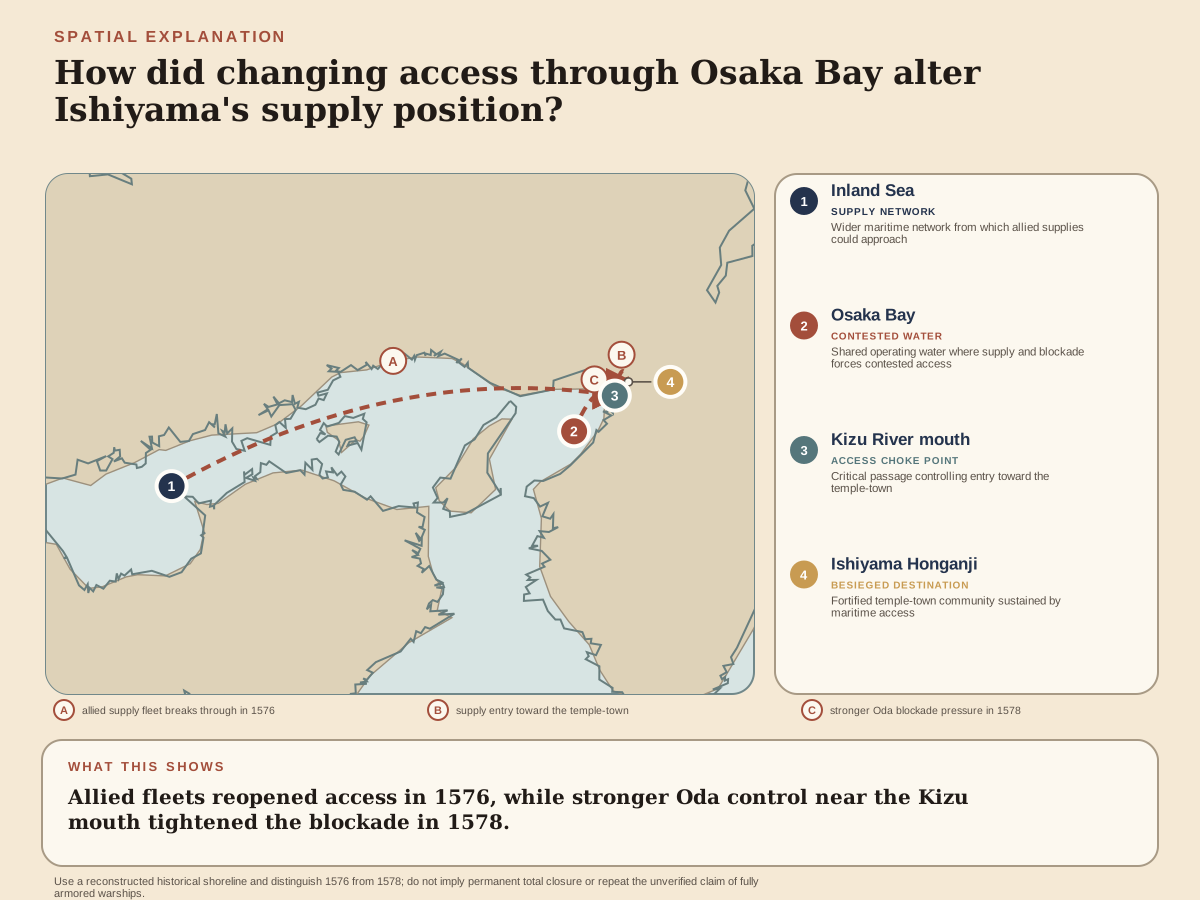
In 1576, Oda forces established stronger positions around Ishiyama. Defenders drew support from Saika fighters and western maritime allies. At Kizugawaguchi, western ships broke through the Oda fleet. Gyūichi’s account describes fire arrows and incendiary pots setting opposing vessels alight, followed by delivery of provisions.
Nobunaga ordered Kuki Yoshitaka to construct six large ships, with another under Takigawa command. Gyūichi describes their heavy guns driving off smaller attackers on the voyage toward Osaka. In 1578, they reached Sakai and were deployed to block maritime access.
A renewed naval battle in the eleventh Japanese month of 1578 ended in Oda victory. The account describes Kuki’s ships firing at a leading enemy vessel and breaking the opposing approach. These operations made replenishing Ishiyama harder. The familiar label “ironclad” goes beyond what this account establishes about their construction.
The conflict also depended on unstable land alliances. Araki Murashige’s resistance in Settsu opened another Oda campaign in 1578. Securing positions around Osaka required dealing with nearby defections as well as the defenders inside Honganji.
In 1580, imperial envoys and military intermediaries negotiated departure. Gyūichi records discussion among temple officers and an oath confirming evacuation. The agreement translated military pressure into a schedule for leaving, rather than an Oda storming of the central temple.
The first naval battle linked offshore fighting to the landward positions. Gyūichi names western maritime commanders from Noshima and Kurushima and describes attacks near Honganji's outlets while Oda troops intervened from Tennōji. Provisions passed into Osaka after the defending fleet burned and broke. Honganji's ability to endure depended on that successful delivery, rather than on its walls supplying all the resources needed inside.
The larger Oda ships also required a route to the blockade. The chronicle follows them from the Kumano coast, past attacks by smaller vessels, to Sakai, and then to positions guarding Osaka's maritime access. Their heavy guns, commanders and protected deployment explain the adaptation more securely than an unverified picture of universally invulnerable iron plating. The two Kizugawaguchi engagements had opposite outcomes: relief succeeded in 1576, while Oda victory in 1578 increased the difficulty of repeating it.
The provincial defeats reduced organized alternatives without eliminating all support. The Fukui prefectural history explicitly records continued assistance from Echizen adherents after the 1575 suppression. Ishiyama's position therefore worsened through particular lost bases and blocked routes, with remaining connections still able to matter. It was not a network that disappeared everywhere at a single date.
Kennyo left Osaka in the fourth Japanese month of 1580 with his wife, officers and the sacred image of Shinran. Boats from the Kii side assisted the departure. The headquarters moved to Sagimori, preserving the image around which central worship and leadership were organized.
Kyōnyo remained with supporters who resisted immediate departure. His decision divided the leadership’s response to the settlement. In the eighth month, he also withdrew, with court and Oda representatives involved in the transfer.
The complex burned during the transition. The site passed out of Honganji’s control, but the fire’s responsibility cannot be securely assigned from the material used here. Evacuation, transfer and destruction are distinct parts of the ending.
Nobunaga gained the former independent Osaka base. Honganji retained leadership and communities outside it. Moving the sacred image and officers allowed the institution to continue from new locations after losing its fortified headquarters.
Court mediation worked through named representatives and temple deliberation. Gyūichi records discussion among Honganji officers, confirmation by an oath and an intended evacuation deadline. The court supplied a channel through which military pressure could become an agreed departure. It did not command the surrounding Oda forces, and negotiation did not remove the threat that had brought the officers to consider withdrawal.
The disagreement over staying also involved households. The chronicle says people from Saika and Awaji who had wives and children there feared the consequences of leaving, and supported the younger leader's continued occupation. This is an Oda-centered account of their concerns, rather than a statement from every resident. It nevertheless gives the division a concrete local setting: leaving a headquarters could also mean abandoning the place where families had lived. Kennyo's departure, Kyōnyo's later withdrawal, the site transfer and the fire must therefore remain separate stages.
Honganji subsequently moved to Kaizuka, Tenma and finally Kyoto. Hideyoshi granted the Kyoto site in 1591. These successive relocations show an institution adapting through new grants and relationships with the rulers who controlled the available land.
Later succession decisions deepened the division between Kennyo’s sons. Hideyoshi recognized Junnyo in 1593, and Ieyasu granted Kyōnyo a separate Kyoto site in 1602. Those later actions helped establish western and eastern Honganji; the institutions were not already fixed camps throughout the Ishiyama war.
Hideyoshi began Osaka Castle in the former temple area in 1583. Subsequent Toyotomi and Tokugawa construction altered the terrain and buildings. The connection between temple and castle lies in successive control of a strategic location, not survival of an unchanged complex.
The military struggle demonstrated the importance of maintaining or interrupting maritime provisions for a fortified headquarters. Regional contributors, fighters and shipping sustained resistance; a combination of naval pressure and negotiated evacuation ended it. The surviving communities and later temple grants trace consequences beyond the battlefield.
Relocation involved rebuilding relationships as well as carrying an image. The temple chronology records the grant of a measured site at Tenma in 1585, then land at Shichijō-Horikawa in Kyoto in 1591. It also records Osaka adherents establishing another hall and its subsequent movement to Tsumura as the city's plots were reorganized. These actions trace religious organization persisting through new urban arrangements after the military headquarters had gone.
The castle inherited access to Osaka's waterways and central-province routes, rather than an unchanged temple community or ownership. Honganji's followers continued elsewhere, and later grants and succession decisions produced different institutions. The war's consequences thus include a changed strategic site, households displaced by evacuation and violence, and organizations surviving under new patrons. A story of heroic faith or inevitable unification would leave those distinct outcomes unexplained.