Read the article below. Interactive reading tools are available when scripts load.
Quick
The government’s 1881 promise to open a national assembly in 1890 set a deadline for deciding how it would work. Itō Hirobumi studied European institutions from 1882, and officials including Inoue Kowashi, Itō Miyoji and Kaneko Kentarō developed successive drafts. A newly established Privy Council reviewed the text under Itō’s chairmanship, with the emperor attending its deliberations.
The constitution was promulgated on February 11, 1889. It located governing authority in the emperor, who appointed officials, commanded the armed forces and declared war or made treaties. Ministers advised him and countersigned state acts. The text also required Diet consent for legislation and annual budgets. The Diet comprised a House of Peers and an elected House of Representatives; neither was given the power to appoint the Cabinet.
Subjects received protections for property, legal process and other rights, but speech and association operated within statutory limits. Religious freedom was conditional on public order and subjects’ duties. The accompanying electoral law restricted the lower-house vote to men aged at least twenty-five who met residence and direct-national-tax requirements. The first election on July 1, 1890, filled 300 seats; eligible voters amounted to roughly one percent of the population.
The constitution became operative on November 29, 1890, when the Diet opened. Opposition representatives challenged expenditure in its first budget. Negotiation secured passage after divisions among them. Their consent mattered, but constitutional safeguards limited their leverage: certain existing expenditures could not be cut without government agreement, and failure to pass a budget allowed the previous year’s budget to continue. The new system gave parliamentary debate a regular institutional place while keeping executive appointment, military command and much political participation outside the elected chamber’s control.
The Cabinet had already replaced the Dajōkan executive in December 1885. Before the Diet opened, the Education Rescript of October 30, 1890, linked family virtues, study and public duty to loyalty to the imperial house. Distributed to schools for ceremonial reading, it supplied moral instruction alongside the constitution's legal institutions. It did not amend the constitution or give pupils and other excluded subjects a parliamentary vote.
Classic
The promise of an assembly arose from disputes over participation in government. Petitions and political associations pressed for elected representation, while senior officials disagreed over its timing and the relationship between ministers and legislators. The October 1881 imperial rescript promised an assembly for 1890 but reserved the design of its powers to imperial decision.
Itō Hirobumi’s European mission began in 1882. Its remit extended beyond constitutional wording to parliamentary chambers, cabinets, courts, imperial institutions and local administration. Lectures and consultations in Germany and Austria supplied models for maintaining a monarch’s authority alongside representative institutions.
Administrative preparation preceded the constitution. In December 1885 the Dajōkan system gave way to a Cabinet, with Itō as prime minister. The Cabinet Powers document placed that executive directly under the emperor and gave its chairman powers to coordinate departments and seek explanations of their work.
Drafting required several officials and revisions. Inoue Kowashi and Hermann Roesler prepared preliminary texts. During the summer of 1887, Itō, Inoue, Itō Miyoji and Kaneko Kentarō worked on the draft associated with Itō’s Natsushima residence. Further revisions produced a clean copy in March 1888. The eventual constitution was the product of this administrative drafting process, not a vote by an elected constituent assembly.
There were competing proposals outside that official drafting circle. In 1880 the League for Establishing a National Assembly asked its participating organizations to prepare constitutional drafts. Ueki Emori's proposal for the Risshisha assigned legislative authority to the people, protected local autonomy and recognized resistance when rights were violated. It was a proposal, not the constitution eventually enacted. Ōkuma Shigenobu advocated an earlier assembly and a system informed by British parliamentary government. The 1881 dispute, intensified by the proposed disposal of Hokkaido government property, ended with his removal. The assembly promise therefore followed both popular demands and a split within the leadership; it did not settle whose constitutional design would prevail.
The Cabinet's creation in 1885 and the later council review were distinct steps. Ministries already had work to coordinate before the constitution defined the Diet's place. The drafting circle then prepared rules for an assembly whose members had not yet been elected. The resulting distribution of powers came through official revision and imperial approval, while the alternative proposals remained outside the enactment process.
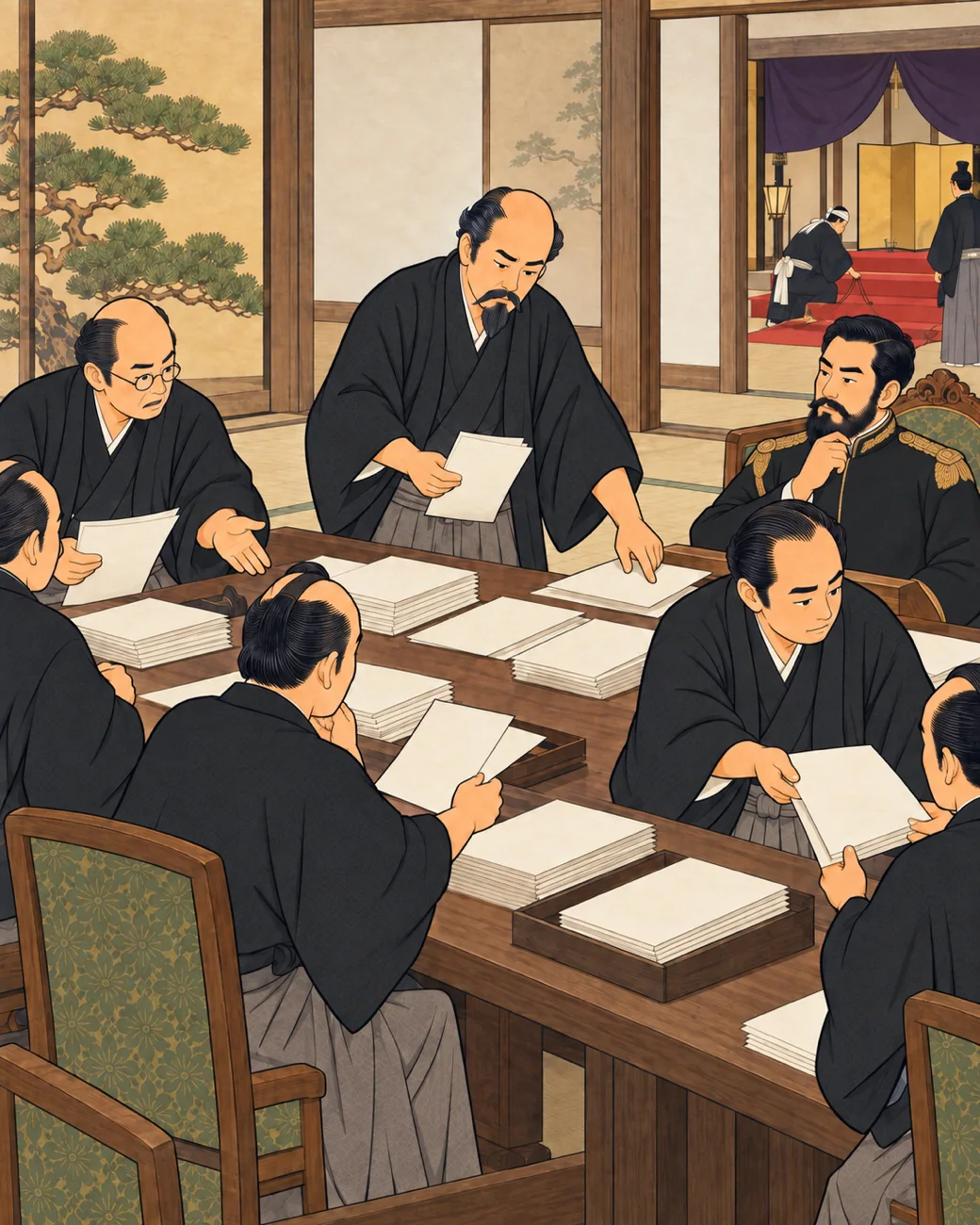
The Privy Council was established in 1888, with Itō Hirobumi as its first president, to review the constitution and related laws. Its deliberations passed through three stages. The emperor attended most meetings; Inoue and Itō Miyoji participated in the documentary and explanatory work. Drafts and meeting records preserve the revisions preceding promulgation.
On February 11, 1889, the emperor promulgated the constitution. Its introductory declaration presented it as an exercise of inherited imperial authority and named the opening of the assembly in 1890 as its operative starting point. Prime Minister Kuroda Kiyotaka and the other signatories countersigned the document. Promulgation therefore preceded the first election and parliamentary session.
The constitution set out specific powers. Articles 4–7 placed governing authority in the emperor, required Diet participation in legislation and authorized him to summon the Diet or dissolve its lower house. Articles 11–13 assigned military command, force organization, war, peace and treaties to imperial authority. Emergency ordinances substituting for laws during parliamentary recess had to be presented at the next session.
The two chambers had different foundations. The House of Peers included imperial-family members, nobles and imperially appointed members under its separate ordinance. Some noble ranks and high taxpayers elected members within their own groups. The House of Representatives was publicly elected under a separate law. Ordinary legislation required the two-house Diet’s consent, and each chamber could introduce bills.
The electoral law issued with the constitution required voters to be male Japanese subjects aged at least twenty-five, resident under its rules and paying at least fifteen yen in direct national taxes. Income-tax qualifications also had a longer qualifying period. Women and men below the threshold could not vote. Candidates faced an age threshold of thirty. On July 1, 1890, elections selected 300 representatives from this restricted electorate.
The first Diet was summoned on November 25 and formally opened on November 29, 1890, making the constitution operative. Ministers could speak in its chambers. Debate and petitions now had a recurring parliamentary venue, but an electoral majority did not itself appoint the prime minister or dismiss ministers through a constitutionally required confidence vote.
A different imperial document followed before the Diet opened. On September 26, 1890, Education Minister Yoshikawa Akimasa submitted a proposed education rescript to the Cabinet. Yamagata Aritomo, Yoshikawa, Motoda Nagazane and Inoue Kowashi took part in revisions. A final draft was ready on October 20 and received imperial approval on October 24. On October 30 the emperor called the prime minister and education minister and handed the signed and sealed rescript to Yoshikawa. Unlike the constitution and ministerially countersigned state acts, it bore no ministerial countersignature. Copies were then distributed to schools, with instructions for ceremonial reading. Constitutional promulgation, electoral qualification, the education rescript and the opening session were separate acts within the creation of the new order.
The constitution created a framework that officials had to use in legislation, administration and adjudication. Article 55 required ministers to advise the emperor, bear responsibility and countersign state acts. Courts exercised judicial authority in his name according to law, with statutory qualifications and protections for judges. The constitution did not explicitly define a Cabinet or prime minister; executive organization also depended on separate rules.
The elected chamber acquired a consequential budget role. Annual revenues and expenditures required Diet consent, with budgets submitted first to the House of Representatives. In the first session, opposition representatives sought reductions. An emergency motion to obtain government agreement divided their side, and negotiations led to budget passage. The chamber could obstruct or alter spending proposals even while ministers claimed to stand outside party politics.
That leverage had legal limits. Article 67 protected expenditures grounded in imperial prerogatives, existing laws or government obligations from reduction without government consent. Article 71 required the government to continue the previous budget if a new one failed. Refusal of a budget therefore did not automatically stop all administration or force a change of ministry.
Rights likewise had defined boundaries. Speech, publication, assembly and association were guaranteed within the limits of law, leaving statutory restrictions in place. Religious freedom was conditioned on public order and subjects’ obligations. Taxation and military service were duties. Most people remained outside the electorate, even though the new laws and budgets affected their lives.
The education rescript addressed conduct rather than parliamentary powers. It joined filial piety, harmony among siblings and spouses, trust among friends and study to public duty and loyalty to the imperial house. It called on subjects to support the imperial state in an emergency. These prescriptions did not create another elected chamber or amend the constitution's rights clauses. They placed a moral account of imperial service alongside the legal framework in which ministers, judges and representatives worked. A subject could be bound by taxes, military service and school instruction while having no lower-house vote.
The constitution made elected deliberation a continuing part of national government. Bills, budgets, questions and petitions brought ministers and representatives into repeated encounters. The first budget dispute exposed the practical need to negotiate votes, despite Kuroda’s declared policy of governing outside parties.
Different institutions retained separate routes to imperial authority. Ministers advised and countersigned; the Privy Council answered imperial consultations; military command belonged to the emperor. The elected chamber’s participation in legislation did not give it control over all these functions. Article 11 stated supreme command, but the later uses and political consequences of that power depended on additional institutions and decisions.
The surviving drafts, corrected clean copy, council records and promulgation prints document different parts of the event. A ceremonial print shows how promulgation was publicly represented; it does not replace the revised draft or operative legal clauses as evidence of how powers were allocated. The date of the ceremony and the date of legal operation remain distinct.
The text preserved existing laws unless they contradicted the constitution and required a special imperial-initiated procedure for constitutional amendment. Parliamentary government could consequently develop through elections, statutes and executive practice within a framework that retained imperial sovereignty. Its creation supplied institutions for participation while reserving important powers and excluding most subjects from the first national vote.
School distribution gave the rescript a different reach from the first election. Ceremonial recitation carried its account of family conduct and imperial loyalty into education, including the lives of children who could not participate in parliamentary government. Teachers were required to communicate a prescribed text; representatives instead argued over bills and expenditure under constitutional procedures. The institutions operated together, but moral instruction and a parliamentary vote were different forms of participation and obligation.
The new legal order also belonged to a continuing diplomatic effort. Building courts, laws and constitutional institutions helped Japan argue for revision of the unequal treaties. Agreement with Britain in 1894 came through subsequent negotiations, rather than automatically with promulgation in 1889. Recognition abroad did not widen the original electorate at home. The first budget dispute likewise showed that the constitutional text needed repeated decisions by officials and legislators: protected expenditure, amendment rules and reserved imperial powers framed those decisions without making every parliamentary vote meaningless.
Itagaki Taisuke turned the dispute over participation in government into organized public pressure. His petitions, associations and later party building helped convert elite disagreement into a movement that demanded a national assembly, linking this constitutional settlement to the earlier Freedom and People’s Rights campaign.
Dissolving the Liberal Party fragmented responsibility. Networks remained, but no central institution could authorize or restrain everyone who claimed the movement's inheritance. Former members entered publishing, local politics, new coalitions, and clandestine plans. Ōi Kentarō's Osaka Incident group sought to intervene in Korea through an armed project associated with Korean reform. The plan belonged to its organizers and failed under police action. Treating it as Itagaki's secret policy would erase Ōi's agency and Korea's independent political struggle. The Three Great Issues movement in 1887 rebuilt cooperation around concrete demands. Activists criticized treaty revision compromise, sought reduction of the land tax, and defended speech and assembly. These questions joined international sovereignty, household burden, and political method. Gotō Shōjirō played a prominent organizing role.