Read the article below. Interactive reading tools are available when scripts load.
Quick
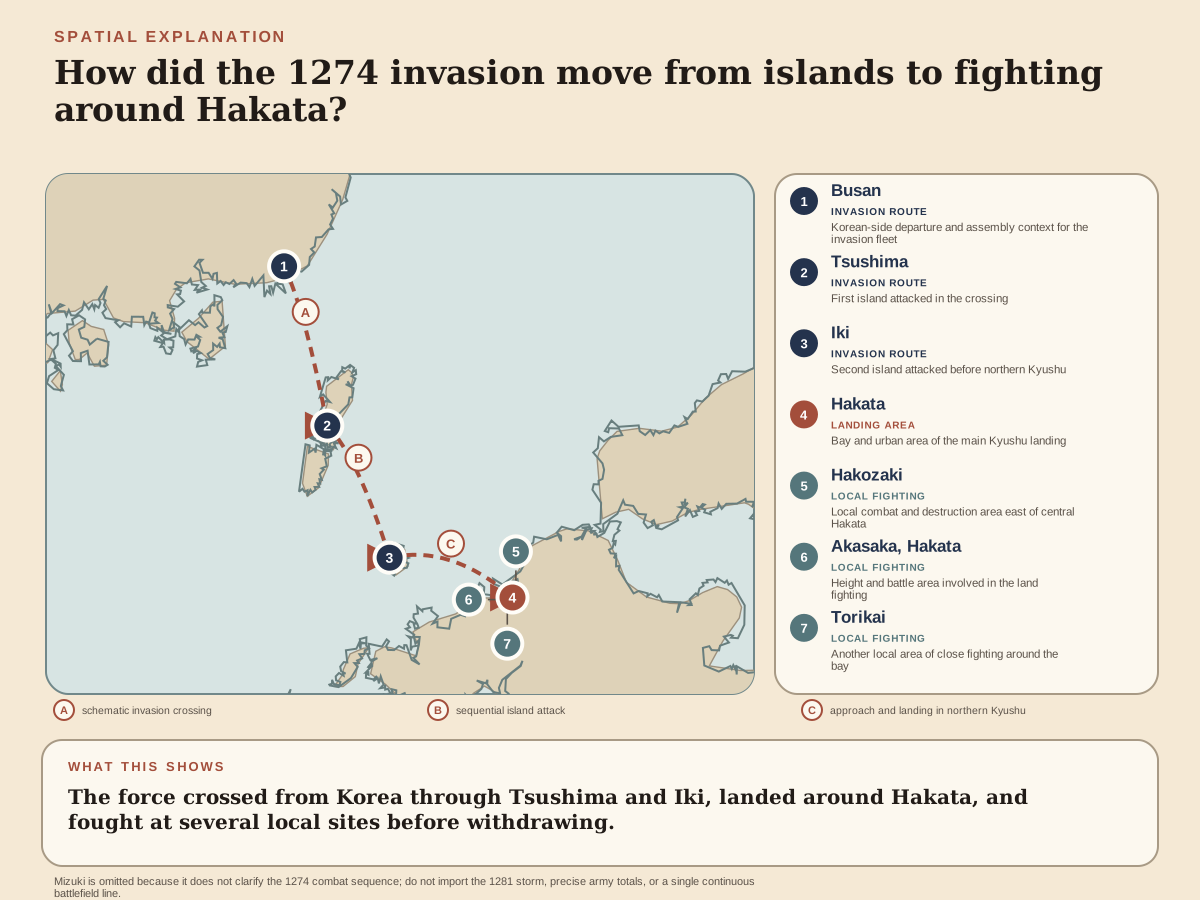
In autumn 1274, a Mongol-led fleet attacked Japan through Tsushima and Iki before reaching Hakata Bay in northern Kyushu. Kublai Khan had sent repeated demands for relations with Japan, but the Kamakura shogunate refused to send formal replies. His forces included Mongol, Chinese and Korean troops, with ships and support from the Korean kingdom of Goryeo.
The shogunate was Japan’s warrior government, centered at Kamakura. Its regent, Hōjō Tokimune, directed the political response, while Kyushu commanders organized resistance on the ground. After overcoming island defenses, the invaders landed around Hakata. Their close formations and arrows made the fighting difficult for the defenders, who were forced back toward Mizuki, an inland defensive position.
The warrior Takezaki Suenaga’s illustrated account follows his advance from the Hakozaki area through Hakata toward the fighting around Akasaka and the Torigai tidal flats. It describes Suenaga and his companions wounded under fire before Shiraishi Michiyasu arrived with reinforcements. The regional commander Shōni Kagesuke also appears. This participant’s account records service and recognition; later changes to the scroll limit how its scenes can reconstruct the campaign.
The invading troops returned to their ships and the fleet withdrew without securing a lasting foothold. Historian Thomas Conlan suggests that the Mongols took advantage of favorable winds to return to the continent. The destructive storm of 1281 belongs to the second invasion.
Withdrawal did not end the emergency. The shogunate maintained preparations, and in 1276 warriors built a stone barrier along Hakata Bay. Service also required recognition: Suenaga received the Kaitōgō estate in 1276 for his part in the first invasion.
The first attack changed the work expected of the shogunate and its warriors. Coastal construction and guard duties continued in the years before a second invasion arrived in 1281.
Classic
The invasion grew out of Kublai Khan’s attempts to bring Japan into relations that acknowledged his authority. A Mongol letter reached Japan in 1268. Further embassies followed, but the Kamakura shogunate refused to send formal replies. Diplomatic pressure continued alongside preparations for an expedition across the sea.
Goryeo, the kingdom on the Korean peninsula, had come under Mongol domination. It supplied ships, troops and maritime support for the attack. The expedition included Mongol, Chinese and Korean forces, so the familiar name “Mongol invasion” describes its leading power rather than the identity of every soldier or sailor.
Japan’s political response involved different centers of authority. The imperial court remained in Kyoto, while the warrior government at Kamakura organized military obligations. Hōjō Tokimune became the shogunate’s regent in 1268 and directed its response to the overseas threat. Regional commanders would organize resistance in Kyushu.
The likely approach placed northern Kyushu and the islands between Japan and Korea at risk. Regional commanders and warriors had to prepare around that geography. Tsushima and Iki lay along the expedition’s route, while Hakata Bay offered places to land on the mainland. The islands’ position meant that their inhabitants would face the first attacks before the larger body of mainland defenders.
Hakata’s defenders faced a bay with several possible landing places. Their response depended on regional commanders assembling warriors near the coast; the stone wall was built only after the campaign, in 1276.
The letter reached Japanese authorities through several institutions. Kublai's government sent documents to Goryeo in 1266, directing its king to guide envoys to Japan. Goryeo's representatives brought the letter to Dazaifu in 1268; it passed to Kamakura and then to the court. Its appeal for relations carried a threat of force if Japan refused. The absence of a reply consequently left a political demand unanswered, rather than merely a text untranslated.
Preparing an invasion took longer than sending a demand. Goryeo was ordered to provide an expedition's ships and soldiers under Mongol domination. Troops and maritime support had to be assembled before an army could cross to the islands. On the Japanese side, Kamakura required retainers with holdings in Kyushu to undertake defense there before 1274. The court and religious institutions performed protective rites while the warrior government organized armed service. Material preparation and prayer were concurrent responses to the overseas threat.
The expedition sailed from the Korean peninsula in autumn 1274. It attacked Tsushima and then Iki, overcame resistance and continued toward northern Kyushu. The island battles opened the route to mainland landings around Hakata Bay.
The invaders landed around Hakata Bay and fought across the coastal approaches and nearby ground, including Akasaka and the Torigai tidal flats. Their troops fought in close formations, using arrows; Japanese defenders were forced to withdraw toward Mizuki, an inland defensive position. The invaders also returned to their vessels.
Takezaki Suenaga, a warrior from Higo in Kyushu, took part in the fighting. The Mōko Shūrai Ekotoba, the illustrated account he later commissioned, traces his progress from the Hakozaki area through Hakata toward Akasaka and Torigai. It depicts Shōni Kagesuke, a regional commander, among the Japanese forces. In its account of fighting at Torigai, Suenaga and companions were wounded and horses struck by arrows. Shiraishi Michiyasu, a warrior from Hizen, came forward with reinforcements, and the opposing troops withdrew toward their position at Sohara. The episode records cooperation among regional warriors under fire.
The scroll is also a claim to recognition. Its images and captions make Suenaga’s service visible, and its later history includes changes to the order and content of scenes. It preserves a participant’s account of selected encounters, shaped by the effort to have his service acknowledged.
The campaign ended when the fleet departed without establishing a durable mainland base. Thomas Conlan suggests that the Mongols took advantage of favorable winds to return to the continent. The destructive storm of 1281 belongs to the later campaign.
The attacks on Tsushima and Iki fell on the fifth and fourteenth days of the tenth month in the Japanese calendar recorded for the campaign. Their resistance preceded the concentration of warriors around Hakata; the mainland fighting therefore did not protect island communities from the expedition's initial violence. The invading force then had to turn these successive landings into a position from which it could sustain operations inland. Its eventual departure left that objective unrealized.
The illustrated tradition also depicts an explosive device between Suenaga and the attackers. The National Archives identifies it as teppō in its discussion of a copy of the scroll. This depicts a weapon used in the invasion tradition, but the scroll's altered scenes cannot establish every encounter's equipment or sequence. Its account of wounded men, horses struck by arrows and arriving reinforcements is more specific than a division between solitary Japanese duels and uniformly coordinated continental troops. The defenders shown there depended on assistance from other warriors under pressure.
Return to the ships was a further movement after the fighting, not itself the departure for the continent. Holding a mainland base would have required troops to remain supplied beyond their landing points. Conlan's favorable-wind explanation addresses the fleet's return voyage; it does not turn every earlier military decision into a consequence of weather. The failure to establish a durable position and the conditions for sailing home belong to successive parts of the withdrawal.
The invading force withdrew, and neither Hakata nor the inland approaches became a lasting base for Mongol rule. Japan had avoided conquest in this expedition. That outcome did not undo losses on Tsushima and Iki or make the coast safe from another fleet.
The shogunate therefore continued to require military preparation. In 1276, warriors built the Genkō Bōrui, a stone barrier around Hakata Bay. Work was assigned through territorial obligations, and guard service continued. The wall’s remaining sections preserve evidence of a response to the first attack, rather than a structure that stopped its initial landings.
Rewards formed another part of the aftermath. Warriors needed their service recognized by commanders and government. Suenaga’s later documents record that he received the Kaitōgō estate in 1276 as a reward for the first invasion. His case gives a concrete result to the pursuit of recognition described in his scroll.
Defending Japan did not bring conquered overseas estates into the shogunate’s possession. Rewards had to come from resources available at home, as Suenaga’s grant illustrates. Continued guard duties and new construction imposed further demands after the immediate fighting ended.
Preparations were tested in 1281, when a larger second expedition arrived. The first campaign’s outcome was therefore provisional in the sense that defense had to continue. Its withdrawal was real; the expectation of renewed attack made it the beginning of sustained coastal obligations as well.
The continuing defense acquired institutional support as well as stonework. Across the invasion period, lands were assigned to temples and shrines so that religious specialists could continue protective rites. A grant in central Hakata also supported the shugo's role in directing defense. Conlan interprets such grants to institutions and offices as a way of sustaining duties beyond the service of particular individuals. These arrangements developed alongside warriors' guard obligations; protection involved continuing income and organization as well as claims about a battle already won.
Suenaga's reward and the coastal wall addressed different needs. An estate grant acknowledged an individual's recorded service. Territorial sections of construction assigned work needed for another invasion, while guard duties required continuing attendance. No overseas conquest supplied new estates for those obligations. The government consequently had to recognize completed service and maintain future readiness from domestic resources, with households and landholders supporting work that did not end when the first fleet sailed away.
The first invasion gave the Kamakura shogunate an immediate test of overseas defense. Orders issued from its political center had to become service by regional commanders and warriors on a distant coast. The 1276 wall and continuing guard obligations made that response last beyond the brief campaign.
Suenaga’s scroll and estate documents preserve another consequence: defense had to be documented and rewarded. The visual account presents his actions as worthy of recognition, while his later landholding supplies evidence of a grant. Together they connect combat to the government’s relationship with a warrior who had served it.
Later remembrance joined the invasions under the idea of kamikaze, or divine wind. That religious explanation gave the campaigns a shared place in accounts of Japan’s protection. Their military circumstances differed: the second expedition in 1281 confronted the coastal wall built after 1274 and suffered a destructive storm.
The remaining Hakata wall sections preserve the intervening defensive work. Landholders were assigned construction in territorial sections, and warriors continued to guard the coast. The stonework records obligations that persisted after the first fleet withdrew.
Coastal construction, prolonged service and claims for recognition made the practical demands of defense last after the fleet had gone. The attack of 1281 tested those preparations. The first invasion’s legacy can be followed through that intervening work, as well as through its later images and religious remembrance.
Religious records preserved their own account of success. The Hachiman Gudōkun, compiled after the invasions, linked victory to prayers and the power of shrines and temples. It also recorded violence on Tsushima and Iki. That combination shows why the religious account cannot be treated only as a later weather story: it preserved claims about protection and encounters beyond the mainland warrior's selected scenes. Its chronology and purposes differ from Suenaga's claim for recognition.
The wall had another afterlife. Some sections were buried in sand or dismantled; archaeological investigation began at Imazu in 1913, and the remains received national historical-site designation in 1931. Excavations and preservation work in 1968–71 helped produce the sections visible today. Those remains record medieval construction, while their present display also reflects modern recovery and conservation. Together with estate documents, illustrated accounts and temple records, they preserve combat, subsequent obligations and later remembrance at different scales.