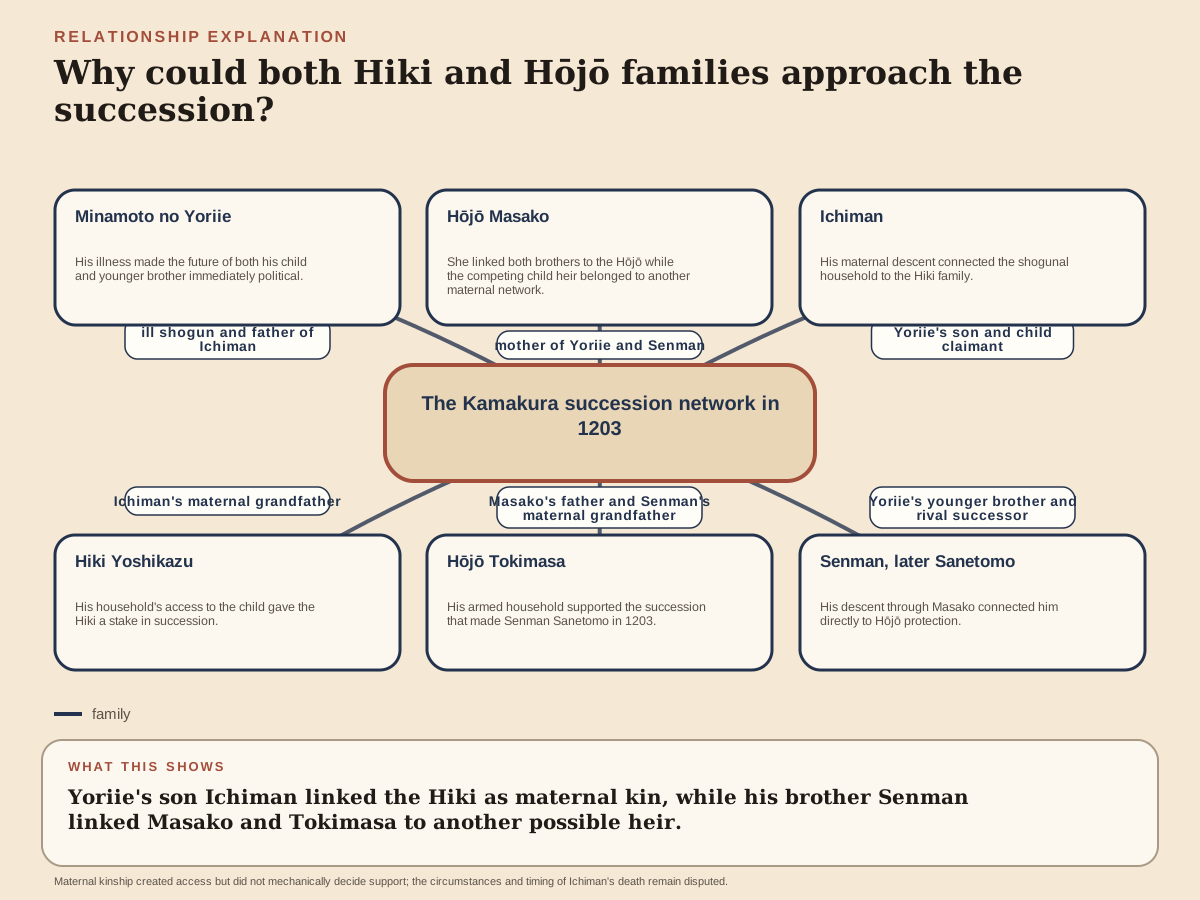
Yoriie’s serious illness in 1203 made succession a pressing question. His son Ichiman connected the shogunal household to Hiki Yoshikazu, the child’s maternal grandfather. Yoriie’s younger brother Senman connected it to Hōjō Tokimasa through their mother Masako. These relatives controlled armed followers and access to the competing young heirs.
Tokimasa’s life began in 1138 in a household associated with Hōjō in Izu, the peninsula southwest of the later Kamakura base. The name Hōjō identified a locality as well as the family that would become famous. Its members belonged to the provincial official community, conducting local affairs within a territorial administration whose senior appointments came from outside the province. A warrior household in this position joined service, local connections and the ability to assemble armed men. Tokimasa entered the rising of 1180 with a base from which to act, although his earlier life is much less fully recorded than the events that followed.
Yoritomo was a Minamoto exile living in Izu. Tokimasa’s daughter Masako married him there. Reference biographies connect Tokimasa with oversight of the exile, but the politically consequential fact is that the relationship became one of marriage and support. Through Masako, the Hōjō became relatives of the household around which Yoritomo would assemble followers. The arrangement joined the exile’s family name to people with connections in the province where he lived.
In 1180 Yoritomo raised forces against the Taira, and Tokimasa helped attack Yamaki Kanetaka, the deputy of Izu’s governor. The target belonged to the local official order in which the Hōjō had operated. The rising consequently carried the household beyond its existing service relationships into armed opposition. Tokimasa’s sons Munetoki and Yoshitoki joined the undertaking. Fatherhood and marriage supplied participants and connections; they also placed several members of the same household at risk in one campaign.
The position later held by Hōjō regents was still decades away. At the beginning of the rising, Tokimasa was supporting a son-in-law who needed sufficient forces and allies to survive. The Hōjō’s resources formed one part of that undertaking rather than a government already secure in its authority. Success would require connections beyond Izu, and the next battle demonstrated the cost of proceeding before a stronger coalition had gathered. The household’s place in Japanese history grew out of this exposed commitment, followed by the work of recovery after defeat.
In the ninth month, Tokimasa summoned Yoshikazu to his residence, where the Hiki leader was killed. An armed attack destroyed the Hiki’s position and Ichiman was also killed. The surviving narratives differ over the circumstances and timing of the child’s death. Azuma Kagami’s reported secret discussions and allocation of blame require particular caution: it was compiled in a political world dominated by the victorious Hōjō.
Yoriie recovered sufficiently to survive the immediate illness, but he lost office and the support of his son’s maternal household. He was sent to Shuzenji in Izu and died there in 1204; the temple’s account describes his assassination by men sent by the Hōjō. Senman received the name Sanetomo and succeeded in 1203. Tokimasa’s role in the new government grew, with his grandson occupying the shogunal position.
The change was achieved through killing and forced removal within a closely connected succession network. Ichiman’s descent did not protect him when his maternal relatives lost the armed contest. Masako’s younger son gained the position while her elder son and a grandson were removed and died. Those outcomes can be stated without assigning private motives or treating the victors’ account of a conspiracy as an established command transcript.
The rising of 1180 soon met a force it could not overcome at Ishibashiyama in Sagami. Yoritomo’s defeat scattered his supporters and made escape an immediate necessity. Tokimasa’s elder son Munetoki was killed after the battle, while his younger son Yoshitoki survived. Tokimasa and Yoshitoki escaped by sea toward Awa, on the opposite side of the bay. The political connection formed through Masako’s marriage had now cost the household a son. The coalition’s later growth would proceed with that loss already part of its history.
Yoritomo sent Tokimasa into Kai, an inland province west of the Kantō plain, to approach Takeda Nobuyoshi and associated warriors. These men had their own local positions and belonged to Minamoto networks distinct from Yoritomo’s immediate household. Tokimasa’s assignment was to connect their armed strength with the force being rebuilt around Yoritomo. He returned with allies from Kai and Shinano. The recruitment enlarged the field of action available after Ishibashiyama: the Hōjō family’s initial commitment had become a contribution to an alliance extending across several provinces.
At Fujikawa in Suruga, the strengthened coalition forced the Taira expedition led by Koremori to retreat. The result joined the actions of newly recruited allies with those of Yoritomo’s other supporters. Tokimasa’s place in the account rests on bringing forces into that combination. The victory helped secure Yoritomo’s growing position in the east, where Kamakura became his governing base. Subsequent western campaigns against the Taira were conducted by other commanders; Tokimasa stayed near the regime’s center. The work required to sustain a rising continued through different participants after its immediate battlefield recovery.
By 1185 the Taira had been defeated, and Yoritomo’s government faced a struggle with his own brother Yoshitsune. Tokimasa had gained experience inside the household and coalition directing affairs from Kamakura. His usefulness could now be expressed through a delegation to Kyoto, where the court’s authorization remained necessary to claims made across provincial and estate boundaries. Recruiting warriors and negotiating with the court involved different resources, but both required acting on behalf of Yoritomo. The man who had helped restore a defeated army would next carry its government’s demands into the capital.
Tokimasa’s delegation to Kyoto in 1185 followed the confrontation between Yoritomo and Yoshitsune. The pursuit of Yoshitsune and his ally Yukiie supplied the immediate purpose for demands on the court. Acting for Yoritomo, Tokimasa sought authorization to organize warriors and draw on resources beyond Kamakura’s eastern base. The court and the retired sovereign Go-Shirakawa possessed authority over an order already divided among provincial administrations and estates held by powerful houses and temples. Permission consequently mattered wherever military action pressed upon rights and revenues claimed within that order.
One influential reconstruction identifies province-wide steward offices, called kuni jitō, created to supervise land and collect military grain. The proposed levy reached estates and public lands rather than relying solely on one commander’s property. Local officials and armed men could be drawn into the organization established through these powers. The arrangement joined pursuit to supplies and administrative reach: an army’s movement required food, while authority to obtain it brought the warrior government into local land relations. The historical debate concerns whether these offices existed in precisely this form, what other steward appointments were authorized and how far the permission extended.