Read the article below. Interactive reading tools are available when scripts load.
Quick
The defeat of the Taira left Yoritomo with a strong eastern coalition, but the court, provincial governments and estate proprietors still held authority beyond Kamakura. Later in 1185, Yoshitsune and Yukiie obtained authorization against Yoritomo, then fled after their position in Kyoto collapsed. Their pursuit brought Yoritomo’s agents into negotiations over security and the costs of sending troops west.
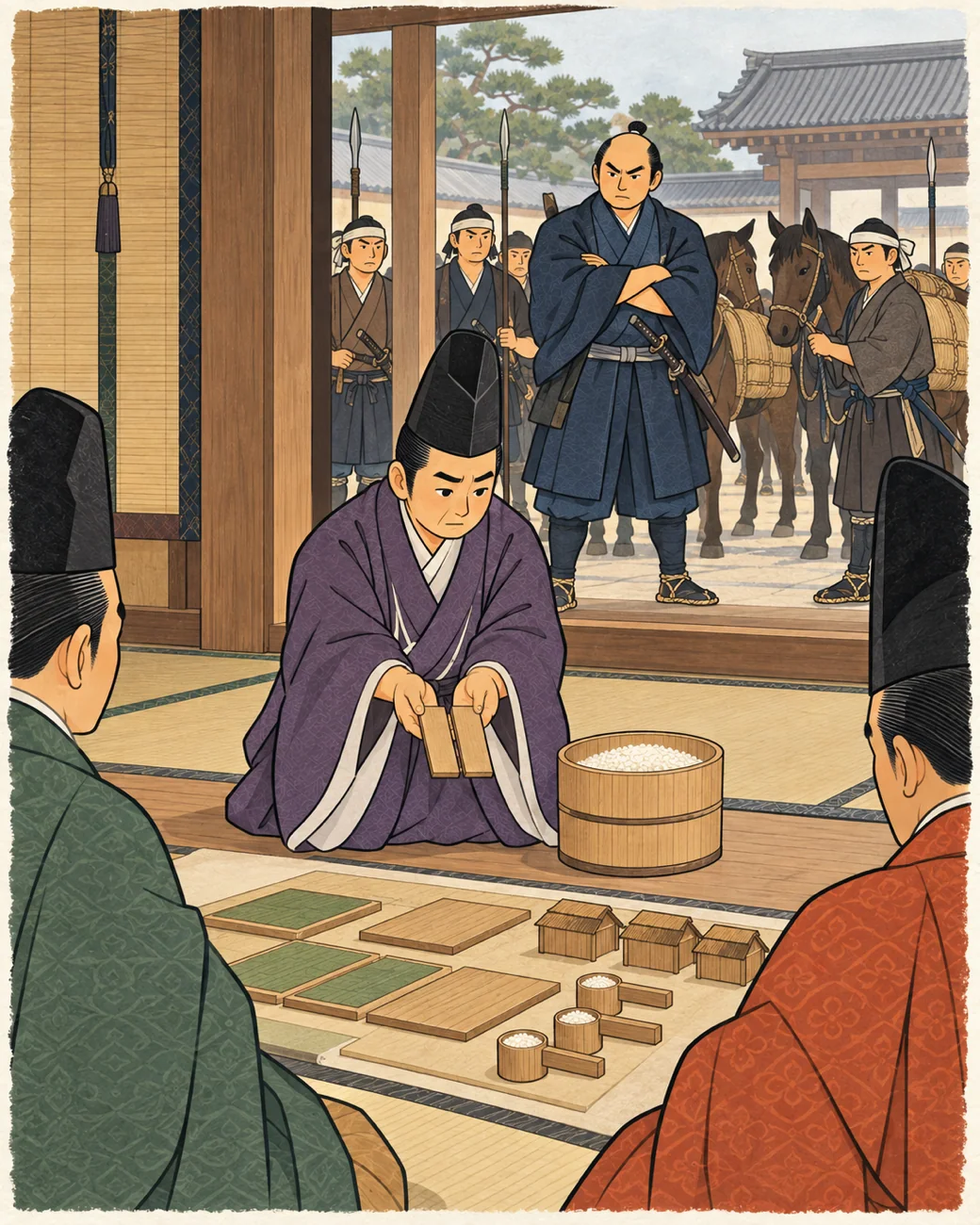
Azuma Kagami attributes a proposal for provincial and estate agents to the administrator later known as Ōe no Hiromoto. Yoritomo sent Hōjō Tokimasa to Kyoto with troops. On the twenty-eighth day of the eleventh month, Tokimasa requested appointment authority and a provisions levy of five shō of rice, measured by volume, per tan, a unit of field area, across private estates and public holdings. The following day’s entry records acceptance through the court intermediary Fujiwara no Tsunefusa.
This authorization gave Kamakura a recognized route into western policing and land administration, but its earliest offices were not identical in every respect with the later system of shugo, provincial military governors, and jitō, land stewards. Scholars disagree over whether the province-wide arrangements constituted a separate kuni-jitō office, with province-wide responsibilities. The rice collection also met resistance. In 1186 Tokimasa relinquished the disputed seven-province responsibilities, and broad collection and interference with existing holdings were curtailed.
Stewards on confiscated or specifically granted holdings remained an important way to reward service and maintain Kamakura connections outside the east. They operated beside older proprietors and officials, with obligations to preserve established payments. Later victories, especially the Jōkyū War of 1221, brought further appointments in the west. The Bunji settlement expanded recognized authority; its practical reach depended on subsequent orders, grants and disputes.
Classic
By the end of the Genpei War, Yoritomo commanded eastern retainers whose holdings and military service connected them to Kamakura. Kyoto remained the source of imperial appointments, while public lands and private estates had administrators and proprietors with their own claims. Extending the eastern coalition required recognition within that existing order.
The conflict with Yoshitsune and Yukiie supplied an immediate occasion. They sought an order against Yoritomo in Kyoto, but their support failed and they fled in the eleventh month of 1185. The court then authorized their pursuit. Searching for fugitives could require armed agents across several provinces, together with provisions and transport.
Azuma Kagami attributes a proposal for provincial and estate appointments to the administrator later known as Ōe no Hiromoto. Repeatedly sending eastern warriors into distant districts, the attributed argument runs, burdened both those warriors and the provinces. Appointed agents would offer an enduring channel for pursuit and security.
The proposal entered a world of overlapping rights. A military claimant’s access to an estate could affect a proprietor’s receipts and the work of local officials. The grant therefore concerned who could collect, command and intervene on land already governed by other authorities. Its terms would be tested as soon as agents made demands locally.
Retainers sought confirmation of inherited holdings or new positions gained through service. Yoritomo, in turn, required military attendance and obedience. Land administration could support a warrior's capacity to serve, but a grant of a local office did not convey every right belonging to an estate proprietor or provincial government. The reward-and-service relationship connected Kamakura to existing revenues and obligations whose limits still had to be determined.
Yoritomo sent Hōjō Tokimasa to Kyoto with an armed following. Tokimasa arrived during the pursuit crisis and worked through Fujiwara no Tsunefusa, an intermediary at court. The mission combined pressure from troops with requests that could be answered through court authority.
Azuma Kagami places the central request on the twenty-eighth day of the eleventh month. It concerned provincial and estate appointments and provisions rice at five shō of rice, a volume measure, per tan, a unit of field area, regardless of whether the land belonged to a private estate or public administration. The next day’s entry records the court’s acceptance, conveyed to Tokimasa by Tsunefusa.
The size and breadth of the collection mattered. It attached a military demand to cultivated acreage across holdings whose existing payments supported other authorities. Agents’ interventions in assessment and control could thus go beyond the immediate act of searching for fugitives. The authorization did not supply a new official in every locality at once.
Yoritomo’s letter of the sixth day of the twelfth month defended the wider role of his agents but also required established taxes, public duties and payments to estate proprietors to continue. That qualification left agents operating alongside existing fiscal claims. Resistance and restrictions followed in 1186, when Tokimasa gave up the disputed responsibilities associated with seven provinces and broad military collection was stopped.
Communication extended the demands on local resources. The same compilation's entry for the twenty-ninth day records Yoritomo ordering the use of relay horses and provisions along the route from Izu and Suruga toward Ōmi for his messengers to Kyoto. The mission was supported through movement, supplies and commands reaching holdings on the road. An authorization negotiated in the capital could consequently affect people supplying transport far from the fugitives' last known location.
The lasting provincial and estate roles operated at different levels. A shugo mobilized guard service and pursued rebels and killers, duties later defined in the warrior code. A jitō administered a particular holding, received the income attached to that office, and remained responsible for payments due to the proprietor. Civil governors and estate authorities continued to act. These distinctions describe the developing system; they do not resolve the disputed identity of every province-wide arrangement in 1185.
The court had recognized a wider role for Yoritomo’s military network in pursuit, provisions and appointments. He could use that recognition in granting responsibilities to followers outside the east. The new authority nevertheless depended on documents, particular holdings and the ability to secure cooperation or enforce an order locally.
The 1186 restrictions limited the most expansive intervention. They protected existing estates and public holdings from general military encroachment while leaving appointments on confiscated Taira lands and other authorized properties as a major route for Kamakura stewards. The initial rice levy should therefore be understood as a short-lived extension during a security crisis.
The earliest offices remain an interpretive problem. The traditional reconstruction calls the province-wide role kuni-jitō, distinguishing it from stewards on individual estates. Takeshige Santa’s 1991 study instead identifies pursuit and confiscated-property functions and argues against a separate office of that name. Later shugo and jitō categories give useful descriptions of the lasting system, but they do not settle every 1185 appointment.
Landholders continued to confront layered claims. A Kamakura steward’s grant could coexist with a proprietor’s entitlement to payment and a cultivator’s use of fields. Documents stating duties and limits became essential when an agent demanded more than a grant allowed. The relationship between military service and land administration thus developed through both rewards and contested enforcement.
The rights within one estate concerned different activities. A proprietor could be entitled to payments, a steward to income and administration attached to a granted office, and cultivators to the use of fields subject to obligations. None of these claims necessarily removed the others. Collecting for military service could collide with collecting for an older proprietor, and disputes arose when an agent treated an assigned function as control over the whole holding.
For cultivators, enforcement could mean demands from more than one superior. Providing labor or supplies to an armed agent might take time from cultivation and from obligations to the estate lord. A recognized military office offered a channel for security and command, but it also placed an armed claimant close to production. The authorization itself cannot establish that every locality gained protection or suffered the same additional burden.
Provincial security agents and estate stewards became continuing connections between Kamakura and distant warrior households. A retainer could hold an authorized local position while remaining obliged to serve the lord in Kamakura. This helped sustain military authority outside the leader’s immediate residence.
Later expansion occurred in stages. Confiscations after the Jōkyū War of 1221 brought many more eastern retainers into western holdings. That further wave changed the distribution of steward appointments decades after the Bunji negotiations, rather than merely implementing national coverage completed in 1185.
The resulting disputes concerned inherited holdings, boundaries, payments and service. Kamakura developed ways to hear such claims while estate and court jurisdictions continued. The Goseibai Shikimoku of 1232 later set out rules for warrior adjudication within this accumulated body of obligations and precedent.
The Bunji authorization consequently matters as a negotiated expansion with identifiable limits and reversals. Tokimasa’s mission, the acreage-based levy, the letter preserving older payments and the restrictions of 1186 show authority being requested, exercised and revised. The surviving documents and their later interpretations leave a more specific history than a single founding date can express.
The later code made some limits explicit. Article 3 of the Goseibai Shikimoku confined shugo to guard-service mobilization and pursuit of rebellion and killing, criticizing their interference in civil government and estate income. Article 5 required stewards to account for withheld payments to proprietors and to repay amounts wrongfully used. These rules addressed the conduct of appointed agents, showing how military authority had generated questions of jurisdiction and fiscal responsibility. A prohibition records the desired rule, rather than universal compliance with it.
A later complaint from Ategawa estate in Kii shows the human stakes of overlapping demands. In 1275, cultivators petitioned their proprietor against the Yuasa steward's party, saying that its labor demands prevented them from delivering timber owed to the estate lord. They also reported threats of mutilation. The petition made one superior's demands an explanation for failure to meet another's. It supplies a particular group's claim in a later dispute, rather than a description of every estate in 1185 or independent proof that all threatened injuries were carried out.