Read the article below. Interactive reading tools are available when scripts load.
Classic
Fujiwara no Shōshi, the daughter of minister of the left Michinaga, entered Emperor Ichijō’s household in 999. He already had an empress, Teishi, whose father Michitaka had died and whose brothers Korechika and Takaie had been punished in the court struggle of 996.
In 995 epidemic and serial death transformed the court. Michitaka died; Michikane succeeded to leading authority but died almost immediately. Offices and household expectations that appeared settled became vacant within months.
Disease affected bodies across ranks, but the archive gives disproportionate attention to deaths that vacated high office. Michitaka's death removed the leader of a household linked to Teishi and Korechika. It did not erase their network immediately. Michikane's succession appeared to continue brotherly control. His death after an exceptionally brief tenure reopened the question before institutions could stabilize around him. For bereaved households, these were personal losses. For government, they were abrupt changes in document access, appointment authority, residence, and imperial kinship.
Physicians, nurses, monks, onmyō specialists, servants, and burial workers faced the epidemic through different practices and unequal exposure. Michinaga did benefit. Benefit does not establish causation or prove that he foresaw the sequence. He still required support. Senshi's royal-maternal position helped make her brother a plausible holder of responsibilities left open. Calling her a tool would erase a senior woman judging her own household, son, and political future.
Ichijō's choice also mattered. An emperor surrounded by maternal relatives could select among them, even when each option carried pressure. Korechika possessed his father's legacy and his sister Teishi's access. His claim was not irrational or already defeated. The contest involved which documents Michinaga could review, which appointments he influenced, and which rank translated emergency responsibility into lasting precedence. Institutional ambiguity may have served Ichijō by avoiding immediate total commitment. It also prolonged rivalry.
The struggle turned sharply in early 996. Korechika and his brother Takaie went at night against Retired Emperor Kazan after mistaking his visit to a woman's residence for a rival courtship. Members of their party shot arrows; one reportedly struck Kazan's sleeve. The investigation also drew in other charges, including an illicit esoteric rite. Korechika was sent toward Dazaifu as its provisional governor-general and Takaie was demoted to a provincial post. The scandal did not need to have been designed by Michinaga for him to use its consequences.
Fujiwara no Shōshi was born in 988, the eldest daughter of Fujiwara no Michinaga and Minamoto no Rinshi. Her parents' household stood among the great aristocratic residences of Heian-kyō, the capital now called Kyoto. Rinshi was the daughter of the senior minister Minamoto no Masanobu; her family's residence and standing contributed to the circumstances in which Shōshi grew up. Shōshi's maternal family thus supplied resources alongside those of her father. The surviving accounts offer much firmer detail about Shōshi's entry into court than about her childhood lessons or personal wishes.
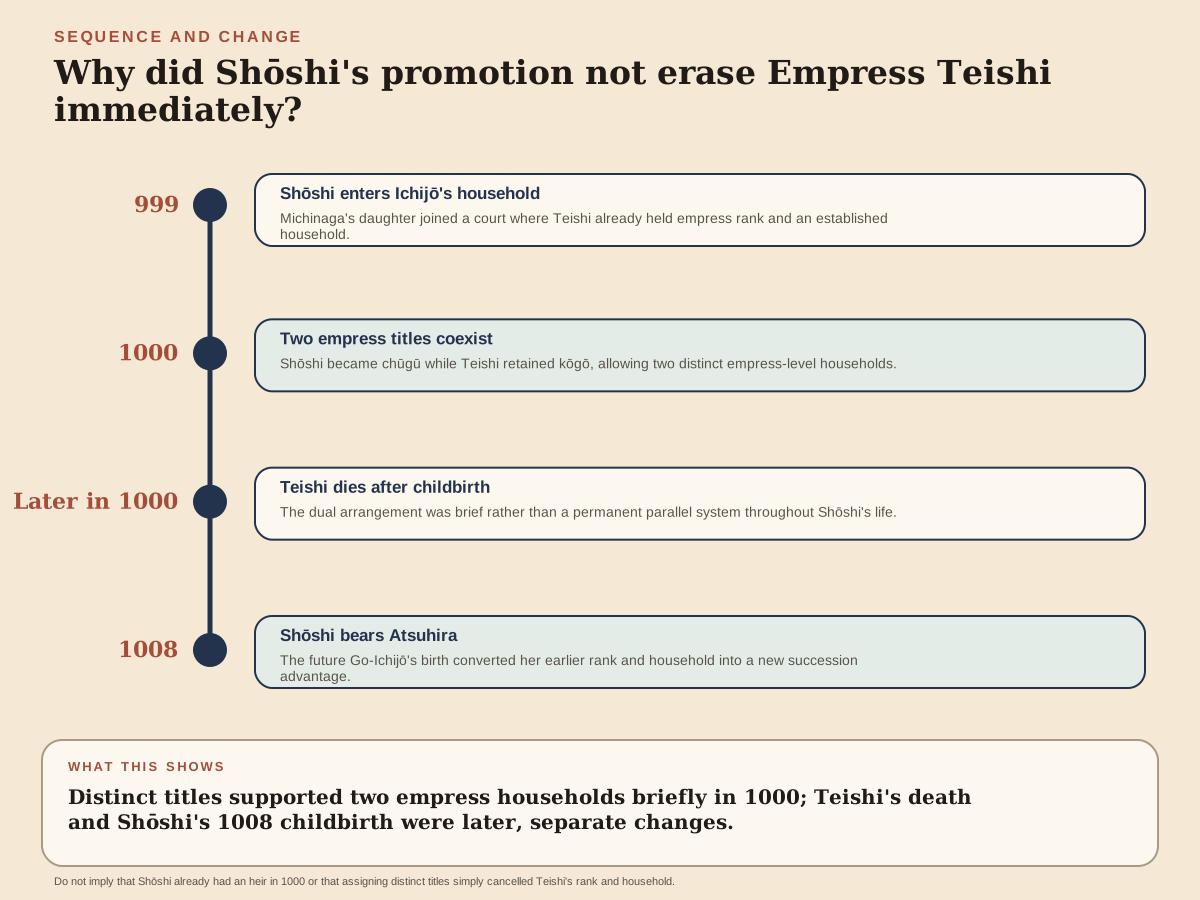
In 1000 Shōshi became chūgū. Teishi was styled kōgō; both titles now designated empresses married to the same reigning emperor. Assigning separate titles and household administrations made room for Shōshi without simply deleting Teishi’s position. Teishi died following childbirth later that Japanese calendar year, so the two women did not maintain parallel households throughout Shōshi’s long life.
Shōshi’s establishment gave Michinaga a closer connection to the imperial household. Attendants, residences and ceremonial business sustained that connection between formal appointments. It took until 1008 for Shōshi to bear Atsuhira, the future Go-Ichijō. The appointment of 1000 secured her rank and household; the later birth and accession were separate steps in her family’s growing influence.
Michinaga became the court's strongest aristocratic figure without normally serving as kanpaku, the chief adviser to an adult emperor. His authority rested instead on ministerial rank, the nairan right to review documents before imperial inspection, influence over appointments, and the households of his sister and daughters.
Formal titles allocated recognized functions, but early eleventh-century power also depended on controlling movement between institutions. Documentary review let Michinaga see and influence business before or as it reached imperial decision. Information advantage could matter more daily than a grand title. High ministerial rank placed him in appointment, ceremony, precedent, and dispute. Clients expected that proximity to him could change careers. Senshi's status near Ichijō provided another route. Later, daughters' consort households created additional centers joined to Michinaga's residence and resources.
Estate income paid for gifts, rituals, buildings, staff, clothing, and hospitality. Local production became political capacity through managers and transport. Scribes and messengers made access operational. No noble could personally carry every document or monitor every province. Officials such as Sanesuke retained independent standing. Their diaries show a court with observation, criticism, procedural memory, and interests not swallowed by Michinaga. Ichijō also retained agency. Maternal and marital relatives shaped options without automatically dictating every imperial decision.
Michinaga's power was strongest when others anticipated his response. A request could be adjusted before reaching him, making control less visible than a formal veto. This influence required maintenance. Ceremonies, visits, gifts, marriages, conflict mediation, and personnel decisions continually renewed relations. Household staff managed access. Women attendants, clerks, guards, and stewards determined who physically reached a consort or minister. The autograph diary provides extraordinary evidence because Michinaga himself recorded routine and exceptional matters on calendrical sheets.
Corrections, omissions, compressed phrasing, and uneven survival reveal a working document rather than polished memoir. Authorship gives direct proximity but not omniscience. Michinaga did not record every opponent's thought, every worker's burden, or every conversation. The diary also differs from later narrative works that shaped his personality and golden-age image. Each source genre answers different questions. Its conventional title can mislead readers into assuming he was the kanpaku whose diary it must be. Office history requires independent checking.
Michinaga's daughter Shōshi entered Emperor Ichijō's court in 999 and became chūgū in 1000. Ichijō already had Teishi as an imperial consort of empress rank.
Imperial consorts held rank, residence, attendants, ritual presence, and potential motherhood of heirs. Their households were political institutions. Teishi entered court through Michitaka's family strategy and maintained a cultural world even after her brothers' position weakened. Removing her casually would affect Ichijō, established rank, her children, attendants, and the legitimacy of earlier arrangements. Michinaga wanted Shōshi near the emperor at the highest possible status. A lower place would limit attention, patronage, and the future weight of any child.
The 1000 adjustment used distinct titles to support two empress-level consorts. Legal and ceremonial language made political competition administratively possible. This was not Michinaga owning two women around one emperor. It was a sovereign household reorganized through the interests of several families. Ichijō's personal relations mattered. Later readers often contrast affection for Teishi with political obligation toward Shōshi, but private feeling cannot substitute for full institutional analysis. Shōshi entered very young and developed over decades. Her later authority should not be erased by freezing her as the adolescent daughter introduced by her father.
Rinshi, as Shōshi's mother, helped supply residence, women, materials, and family management. Maternal labor made the consort household credible. Court women served as educators, writers, intermediaries, and managers of access. Their kin connections could strengthen the residence and bring information. Textiles, screens, furnishings, paper, gifts, food, and ceremony required producers whose work displayed household rank. Competition could stimulate cultural patronage, but culture was not only propaganda. Women wrote and read works with meanings beyond Michinaga's immediate succession goal.
The political purpose still mattered. A daughter who bore a future emperor could make her father maternal grandfather and potential regent. Before birth, however, the plan remained exposed to biology. A consort could have daughters, lose pregnancies, die, or have no child. Teishi's own children also affected succession. The later victory of Shōshi's line should not be projected backward into 999. The arrangement changed hierarchy rather than eliminating conflict. Which household received visits, resources, appointments, and symbolic precedence remained contested.
During the first years of the new century, Shōshi's household gathered women whose literary work would outlast the buildings in which they served. Murasaki Shikibu, the author of The Tale of Genji, was serving there by 1008; the exact beginning of her service remains uncertain. Izumi Shikibu and Ise no Taifu also belonged to Shōshi's literary circle. Such women were attendants with obligations at court as well as writers. Their talent was an ingredient in the household's standing, while its resources provided opportunities for their work to circulate.
Recruitment and support were shared undertakings. Moroi Ayako's study traces Michinaga's provision of cultural resources and Rinshi's attention to relationships among the women. The adolescent Shōshi did not independently assemble every part of the establishment. As she matured, however, examples of her own participation become visible. Poems associated with Izumi Shikibu and Ise no Taifu show Shōshi requesting poetry and passing it between members of the circle. A patron could help create an exchange without composing every contribution herself.
Michinaga brought the regent house's existing methods of rule to their greatest concentration. He did not invent Fujiwara marriage politics, nor did he replace the emperor with a private dictatorship. His distinctive achievement was to combine maternal kinship, ministerial rank, advance review of documents, appointments, estate income and several active women's households so effectively that his family could guide imperial succession across generations. His career shows how Heian government operated through access and relationship as well as formal office.
That concentration had effects well beyond court appointments. The resources gathered around Michinaga supported monumental Buddhist construction, elaborate ritual and one of the best-documented literary communities in Japanese history. They also depended on estate production, household labor and marriages whose costs were borne by people often treated as background. Under Yorimichi, regent-house predominance continued for decades, but the accession of Emperor Go-Sanjō in 1068 and the later growth of retired-emperor government exposed its limits. Michinaga is therefore significant as the clearest example of Heian aristocratic power at its peak—and of why even that power remained personal, distributed and vulnerable to changes in birth and succession.
Murasaki's importance rests above all on The Tale of Genji, an extended work of vernacular fiction that follows desire, status, memory and loss across a court society and into another generation. It is often promoted as “the world's first novel,” but that modern title depends on how the novel is defined and is not necessary to establish the work's scale or originality. Genji made sustained narrative out of shifting points of view, social constraint and the consequences of intimate choices. It is evidence of a writer interpreting her world, not a direct record of what named historical people did.
Her career also reveals the conditions that made women's writing central to Heian literary history. Exclusion from most formal office did not mean exclusion from education, politics or cultural production; court households gave women roles as authors, readers, correspondents and brokers of reputation. At the same time, preservation favored a small elite and depended on generations of copying, commentary and selection.
Historical disagreement · Did another author write the later Genji?
Yosano Akiko proposed Murasaki’s daughter Daini no Sanmi as author from Wakana onward, citing changes in narrative and poetry. This was broader than the older question about the final ten Uji chapters. As a Kanagawa Prefectural Library account explains, Ikeda Kikan and Tamagami Takuya could recognize a structural break without accepting a different author.
Xu, Zhu and Sun’s 2025 quantitative study found stylistic consistency between chapters 43–54 and chapters 1–42, supporting single authorship. Its tested division is not identical to Yosano’s Wakana boundary or to the ten Uji chapters.
Stylistic evidence supports an interpretation; it does not recover a missing autograph or settle every stage of copying. These debates do not displace the work’s conventional attribution to Murasaki.
Her historical significance lies in both individual authorship and the manuscript and household culture that allowed one woman's fiction to reshape Japanese literature.