Read the article below. Interactive reading tools are available when scripts load.
Quick
Fujiwara no Shōshi was born in 988 into an aristocratic household in Heian-kyō, present-day Kyoto. Her father was Fujiwara no Michinaga; her mother, Minamoto no Rinshi, brought the standing and residential resources of another prominent family. In 999 Shōshi entered Emperor Ichijō's household as a consort, with poems supplied by senior courtiers decorating the screens prepared for her arrival. [1]
Ichijō already had an empress, Shōshi's cousin Teishi, and a son born to her that year. In 1000 Shōshi became chūgū, while Teishi was designated kōgō: the two titles allowed both women to hold empress status. Michinaga's position at court supported his daughter's establishment, but Shōshi's promotion did not settle who would inherit the throne. Her household also had to develop a cultural and social place within the palace. [1][2]
Shōshi's attendants included writers such as Izumi Shikibu, Ise no Taifu and Murasaki Shikibu, the author of The Tale of Genji. Murasaki was serving there by 1008, although the exact beginning of her service is uncertain. Michinaga and Rinshi helped support this community; Shōshi participated herself by requesting poems and sharing them between its women. [2][3]
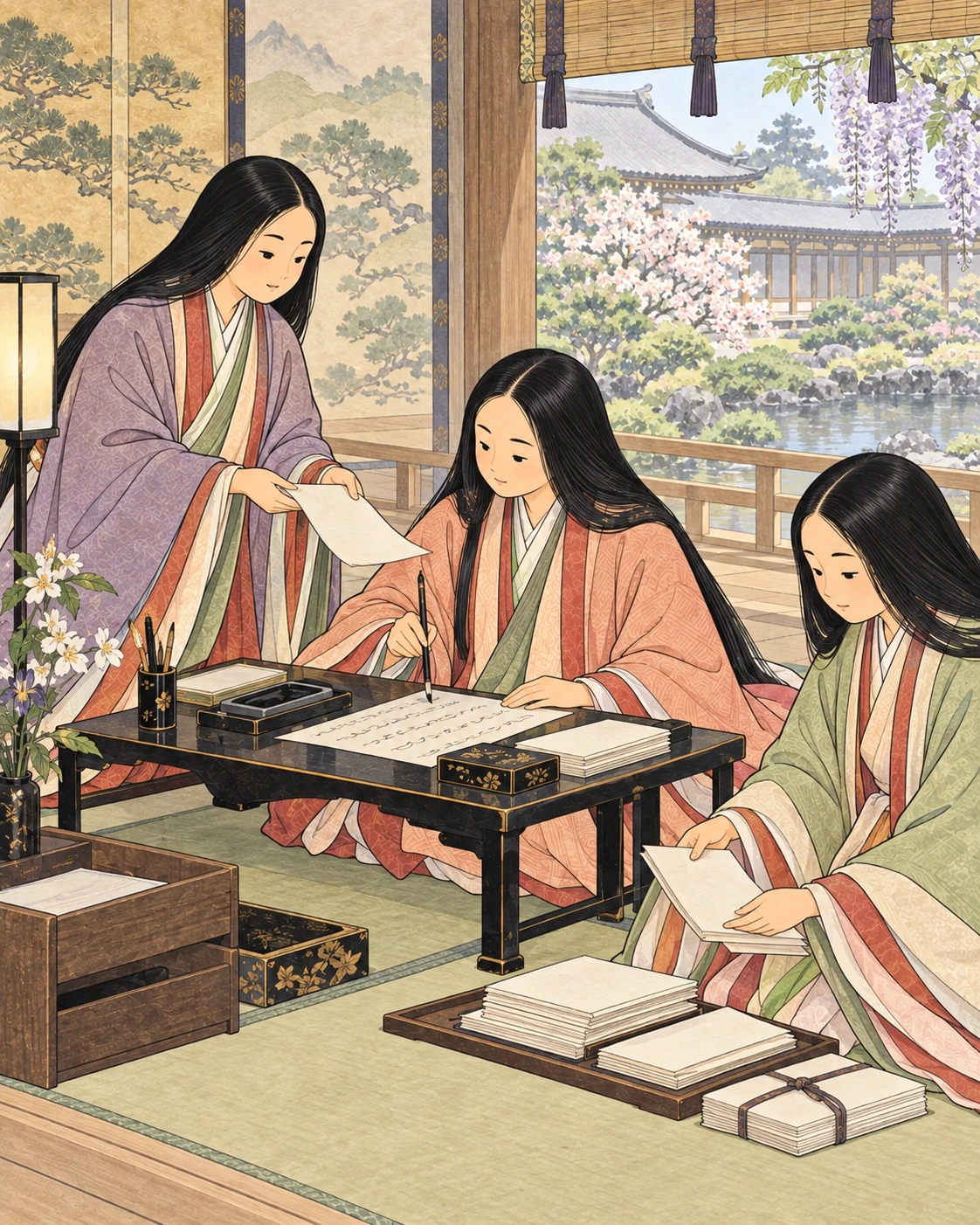
She also asked Murasaki to teach her Chinese literature privately. They read Bai Juyi's New Ballads, a work admired in court society. In 1008, as Shōshi prepared to return to the palace after childbirth, her attendants copied and assembled books. Murasaki describes Shōshi distributing writing materials, with Michinaga providing paper, brushes and ink. [3][5]
These activities gave writers a place to work and brought manuscripts into circulation. The authorship of Genji remained Murasaki's; Shōshi's contribution lay in learning, exchange and patronage. [2][3]
Shōshi bore Atsuhira in 1008 and Atsunaga in 1009. When Ichijō abdicated and died in 1011, Emperor Sanjō succeeded him, while Atsuhira became crown prince. Shōshi received the title of empress dowager in 1012. Sanjō's abdication brought her elder son to the throne as Go-Ichijō in 1016; after another prince withdrew as heir in 1017, her younger son became crown prince. [1]
Michinaga served as sesshō, the regent assisting a ruler before adulthood, then handed that office to Shōshi's brother Yorimichi. The emperor's mother had a distinct part in government. Commands in her name decided important matters concerning the regency and court honors, and she ascended the imperial dais with her son at his enthronement. [1]
Go-Ichijō came of age in 1018, when Shōshi became grand empress dowager. Consultation with her continued beyond the period of his childhood. [1]
In 1025 Shōshi's sister Kishi died shortly after bearing Chikahito to Crown Prince Atsunaga, Shōshi's younger son. The infant's fifty-day and hundred-day ceremonies took place in the grand empress dowager's household. Her establishment helped sustain the future emperor after his birth mother's death; that does not mean Shōshi performed every task of nursing herself. [1][6]
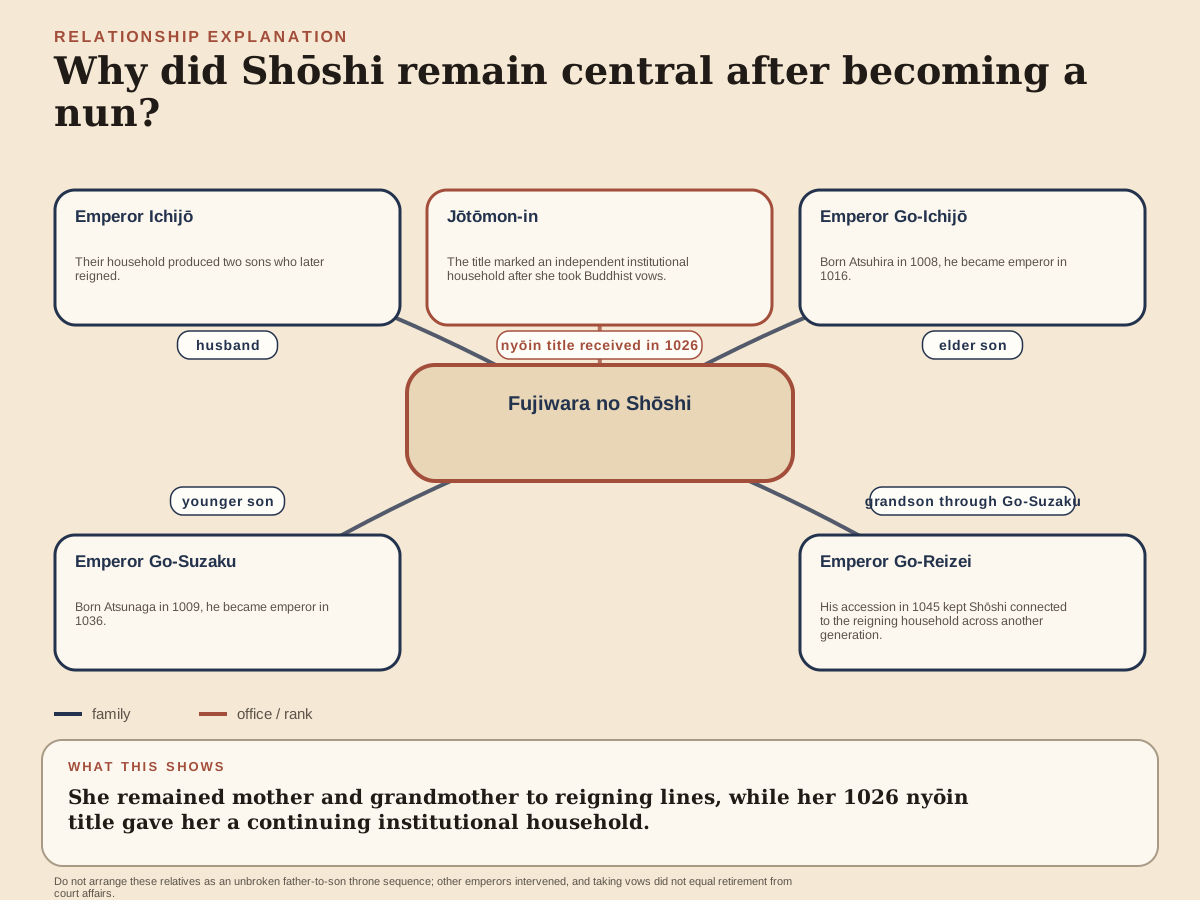
Shōshi took the tonsure in 1026 and received the title Jōtōmon-in. As a nyoin, a titled imperial woman with her own establishment, she retained a recognized place in court affairs while becoming a Buddhist nun. She attended Chikahito's first-trousers ceremony in 1027 and a dedication at her father's Hōjōji temple complex. Michinaga died that year. Shōshi's household continued, linking another generation of princes with the court and its religious institutions. [1][6][7]
In 1030 Shōshi established Tōhokuin within Hōjōji as a hall for continuous walking meditation devoted to Amida, the Buddha associated with rebirth in the Pure Land. In 1031 she joined a project organized by the monk Kakuchō at Yokawa on Mount Hiei, copying the Lotus Sutra, a major Buddhist scripture, according to ritual requirements. Her Japanese prayer text was deposited there; it survives in a later copy, and the deposit did not constitute the scripture's later burial. [8]
That year she also visited Iwashimizu Hachimangū, Sumiyoshi Shrine and Shitennōji, traveling from the capital toward present-day Osaka with her brothers Yorimichi and Norimichi. Governors were ordered to supply transport, provisions and accommodation. The court minister Sanesuke criticized the extravagance in his diary. Religious patronage drew on substantial resources and could provoke objection. Later in 1031 a residence fire forced Shōshi to take refuge at Hōjōji and move to Yorimichi's residence. [9]
In 1032 devotion to Amida at Tōhokuin was followed by a chrysanthemum poetry match proposed by Shōshi's half-brother Yorimune, a senior courtier. Participants supplied poems in ten competing pairs, and Yorimichi attended. Religious observance and literature shared the space of Shōshi's establishment. [10]
Younger women continued its work. Murasaki's daughter Daini no Sanmi, already in Shōshi's service by 1023, later became a nurse to her grandson. The circle also left material that the scholar Ikeda Naotaka interprets as contributing to the continuation of Eiga monogatari, a narrative history; this does not establish Shōshi as its author or commissioner. [2][4]
Go-Ichijō died in 1036. Shōshi's younger son succeeded as Go-Suzaku, then died in 1045. She outlived both sons. Chikahito, cared for by her establishment as an infant, became Emperor Go-Reizei, renewing her connection to the throne. [1][11]
During Go-Reizei's reign, formal imperial visits recognized Shōshi's standing. Tōhokuin's history records a visit in 1050, destruction by fire in 1058 and rebuilding dedicated in 1061. Her religious establishment required renewal in her old age. [1][12]
Her family also faced the succession to the office of kanpaku, the senior adviser to an adult emperor. Later anecdotes place Shōshi in discussion of Yorimichi yielding to his brother Norimichi before Yorimichi's son Morozane succeeded. A modern study interprets the stories as evidence of a negotiated arrangement, delayed until 1068. They do not verify the words of a family conversation. [13]
Shōshi died at Hōjōji's Amida Hall in 1074, the year Yorimichi also died. She was cremated at Ōtani; the destination of her ashes is unclear. After her death, Tōhokuin's history continued through relocation and rebuilding. Her household's literary activity survives separately in works and accounts produced by its members. [11][2][12]
Classic
Fujiwara no Shōshi was born in 988, the eldest daughter of Fujiwara no Michinaga and Minamoto no Rinshi. Her parents' household stood among the great aristocratic residences of Heian-kyō, the capital now called Kyoto. Rinshi was the daughter of the senior minister Minamoto no Masanobu; her family's residence and standing contributed to the circumstances in which Shōshi grew up. Shōshi's maternal family thus supplied resources alongside those of her father. The surviving accounts offer much firmer detail about Shōshi's entry into court than about her childhood lessons or personal wishes. [1]
In 999, after the coming-of-age ceremony that marked an aristocratic girl's transition to adult status, she entered Emperor Ichijō's household as a consort. Michinaga, by then minister of the left, asked senior courtiers to supply poems for the screens prepared for her arrival. Their writing furnished the new household with objects of distinction and publicly associated its establishment with men of rank. Literature was part of the occasion's political work before Shōshi had acquired the authority she would exercise much later. [1]
Ichijō already had an empress, Fujiwara no Teishi, the daughter of Michinaga's deceased elder brother Michitaka. Teishi had borne the emperor a son, Atsuyasu, in 999. When Shōshi received the title chūgū in 1000, Teishi was designated kōgō. Both titles carried empress status: the rearrangement allowed two empresses to coexist rather than simply removing the earlier consort. It placed two branches of the same extended family near the throne, with different resources behind them. Teishi's father was dead; Shōshi's father held a powerful position at court. [1]
The arrangement also left an existing imperial son whose place could not be erased by Shōshi's promotion. Marriage and rank created an opportunity for Michinaga's daughter, but succession still depended on children, surviving relatives and later decisions. Shōshi's arrival belongs to that unfinished situation. Her subsequent household would need to sustain a place in the emperor's life through its attendants, ceremonies and cultural activity; an empress title did not perform those daily tasks by itself. [1][2]
During the first years of the new century, Shōshi's household gathered women whose literary work would outlast the buildings in which they served. Murasaki Shikibu, the author of The Tale of Genji, was serving there by 1008; the exact beginning of her service remains uncertain. Izumi Shikibu and Ise no Taifu also belonged to Shōshi's literary circle. Such women were attendants with obligations at court as well as writers. Their talent was an ingredient in the household's standing, while its resources provided opportunities for their work to circulate. [2][3]
Recruitment and support were shared undertakings. Moroi Ayako's study traces Michinaga's provision of cultural resources and Rinshi's attention to relationships among the women. The adolescent Shōshi did not independently assemble every part of the establishment. As she matured, however, examples of her own participation become visible. Poems associated with Izumi Shikibu and Ise no Taifu show Shōshi requesting poetry and passing it between members of the circle. A patron could help create an exchange without composing every contribution herself. [2]
Shōshi also studied Chinese literature with Murasaki. The diary describes instruction conducted privately, against the author's concern about displaying Chinese learning among the court women. The work they read was Bai Juyi's New Ballads, contained in his collected writings. These were texts admired in aristocratic society, not an unfamiliar literature imported solely for Shōshi. Her request placed a learned attendant in the role of teacher and made the empress a reader actively seeking instruction. [3][5]
The preparation for Shōshi's return to the palace after her first son's birth in 1008 provides a particularly tangible account of book production. Murasaki describes arranging paper and letters, sending works to be copied, and assembling books. Shōshi distributed writing materials to her women. Michinaga supplied fine paper, brushes and ink, while Rinshi's contribution to the copying enterprise is examined in Moroi's study. The finished manuscripts required coordination, skilled handwriting and materials as well as an author's composition. [2][3]
Murasaki's diary brings those activities unusually close, but it is her account of service, relationships and court occasions. Its praise or criticism cannot disclose everything Shōshi thought. Nor does manuscript work transfer authorship of Genji to the empress or her parents. Shōshi's contribution is more specific: she learned, requested, distributed and sustained a setting in which writers could exchange and reproduce texts. In 1008 that setting acquired an additional responsibility when it became the household of a newborn imperial prince. [2][3]
Shōshi gave birth to Atsuhira in 1008 at Michinaga's Tsuchimikado residence. Ichijō visited to celebrate the birth. A second son, Atsunaga, followed in 1009. These were consequential additions to the imperial family: Michinaga now had grandsons who could succeed, and Shōshi had become their mother. Pregnancy, delivery and infant care were the bodily and household conditions of that political advantage, rather than accomplishments performed by the grandfather alone. [1]
The succession took several stages. When illness led Ichijō to abdicate in 1011, another adult ruler, Emperor Sanjō, succeeded him, while Atsuhira became crown prince. Ichijō died that year. Shōshi became empress dowager in 1012. Sanjō's abdication in 1016 brought her elder son to the throne as Emperor Go-Ichijō. Sanjō's son Atsuakira initially occupied the position of crown prince; after his withdrawal in 1017, Shōshi's younger son Atsunaga became heir. Neither child's birth had settled this entire sequence in advance. [1]
The elder boy's accession changed Shōshi's capacity to act. A sesshō, or regent, assisted a ruler who had not reached adulthood: Michinaga took that office in 1016, then passed it to Shōshi's brother Yorimichi in 1017. Yet the regent was not the only person close to the child emperor. Political business took place at the mother-empress's residence, and commands issued in her name, known as boko ryōji, decided important matters involving the regency. [1]
Furuse Natsuko identifies examples concerning Michinaga's honors and position, including his appointment as grand minister of state, and the installation of Shōshi's sister Ishi as empress. Decisions affecting the regent himself could require authority beyond his own office. Shōshi's maternal relationship to the emperor supplied a distinct channel through which the throne was supported. At Go-Ichijō's enthronement she ascended the imperial dais with him; the regent's ceremonial location was different. Such arrangements made the relationship visible as well as administratively useful. [1]
Go-Ichijō's coming of age in 1018 altered the immediate need for maternal assistance. Shōshi received the senior title of grand empress dowager that year. Furuse nevertheless finds continued consultation concerning the imperial advisers and appointments after the emperor's adulthood. Her authority had developed through motherhood, but it was not exhausted by the regency of one small child. The following decade would enlarge her responsibility for another generation of the imperial family. [1]
By the 1020s Shōshi was grand empress dowager at Kyoto's imperial court. In 1021, Shōshi's younger sister Fujiwara no Kishi became a consort of Crown Prince Atsunaga, Shōshi's younger son. Kishi bore Chikahito in 1025 and died shortly after the delivery. The loss left Shōshi both the grandmother and the maternal aunt of the infant who would become Emperor Go-Reizei. It also deprived the child of his birth mother before the household ceremonies that welcomed him into imperial life had been completed. [1][6]
The Historiographical Institute's account of the documentary chronology places Chikahito's fifty-day and hundred-day celebrations in the grand empress dowager's household. The infant had contracted the eruptive illness circulating in the capital, and an earlier bathing ceremony had been stopped. These details make the care setting concrete. Shōshi's establishment provided a place in which attendants and court personnel could protect and ceremonially present the child; they do not establish that she personally performed the work of a wet nurse. [6]
In 1026 Shōshi took the tonsure and received the title Jōtōmon-in. She was now a nyoin, a titled imperial woman with her own establishment and standing that could receive formal visits from the emperor. Becoming a Buddhist nun therefore accompanied a change in court status rather than the disappearance of her household from public affairs. In 1027 she attended Chikahito's first-trousers ceremony, an occasion marking another stage of the young prince's upbringing. [1][6][7]
That same year Shōshi and her sister Kenshi attended the dedication of the Śākyamuni Hall at Hōjōji, the great temple complex Michinaga had established on the eastern side of the capital. Michinaga died in 1027. The father who had brought resources and courtiers to Shōshi's first imperial household was gone, while the daughter remained a senior figure linking reigning and future emperors, Fujiwara officeholders and a community of religious practitioners. [1][7]
Her next projects were undertaken from that changed position. They drew on the family religious landscape, but they also attached particular buildings, journeys and texts to Jōtōmon-in herself. Shōshi remained active for nearly half a century after Michinaga's death. [1][4]
In 1030 Shōshi established Tōhokuin, the northeastern precinct of Hōjōji, as a hall for continuous walking meditation. The dedication involved Keimyō, a senior monk of the Tendai Buddhist establishment centered on Mount Hiei. Monks practiced devotion to Amida, the Buddha associated with rebirth in the Pure Land, while the institution gave Shōshi's religious patronage a durable place within her father's temple complex. A building supplied the setting; continued ritual required clerics, scriptures and material support. [8]
The following year she participated in a different religious undertaking at Yokawa, a monastic area on Mount Hiei northeast of the capital. The monk Kakuchō organized ritual copying of the Lotus Sutra, a foundational Buddhist scripture. Shōshi copied the text according to the prescribed practice and assisted with its container, while Keimyō's authorization connected the project to the monastic hierarchy. The enterprise combined the labor and resources of a powerful imperial nun with the initiative and ritual expertise of clerics. [8]
Shōshi's prayer text was deposited at Yokawa in 1031. Written in Japanese using kana, the phonetic script, it expresses aspirations for rebirth in the Pure Land and for the aid of living beings into the distant Buddhist future. The wording survives through a later copy in the compilation Mon'yōki, rather than through a verified autograph. It is a particular religious statement attributed to Shōshi; its devotional language does not give unrestricted access to her private experience. Kamikawa Michio's study also distinguishes this arrangement from the scripture's much later burial: the deposit did not mean that burial had already occurred during her lifetime. [8][9]
In the same year Shōshi traveled to Iwashimizu Hachimangū south of the capital, then to Sumiyoshi Shrine and Shitennōji in Settsu, the region around present-day Osaka. Her brothers Yorimichi and Norimichi accompanied her. Provincial governors were ordered to provide boats, provisions and temporary accommodation for the traveling establishment. Fujiwara no Sanesuke, a senior court minister, criticized its extravagance in his diary, Shōyūki. [1][9]
The religious journey thus also exposed how many people and goods a nyoin could command. Its display had costs borne beyond the immediate family. Sanesuke's criticism preserves an objection from within the governing elite; it is not a neutral account of every participant's intention. He did not accompany the party, and the detailed itinerary is reconstructed chiefly from the narrative history Eiga monogatari. The distinction matters when the journey's splendor is made to stand for either unquestioned prestige or universally condemned excess. [9]
Later in 1031 fire destroyed Shōshi's Kyōgoku residence. She took refuge at Hōjōji and then moved to Yorimichi's Kayanoin residence. Even this powerful household depended on buildings that could be lost and on relatives able to accommodate its people. In the following year, religious observance and poetry would meet at Tōhokuin, carrying the establishment's cultural activity into its new phase. [9][10]
In 1032 a period of devotion to Amida at Tōhokuin was followed by a chrysanthemum poetry match. Flowers growing before the hall attracted the interest of attendants and courtiers, and Fujiwara no Yorimune, a senior courtier and Shōshi's half-brother, proposed the contest. The women and men of the establishment supplied the occasion's participants; Yorimichi attended, and the poems were arranged in ten competing pairs. Shōshi's religious precinct had become a setting for collective literary activity. [10]
The match account is thought to have been written by a woman who participated. Its text survives in manuscript collections and fragments, giving a view of the women as recorders as well as performers. The event is associated with Shōshi's patronage, but its documented initiative belongs to Yorimune. Distinguishing those contributions allows the household to emerge as a working group, with different people supplying proposals, poems, readings and remembrance. [10]
The circle also renewed itself through younger women. Among those who had joined earlier was Murasaki's daughter, the poet known as Daini no Sanmi. Moroi places her in Shōshi's service no later than 1023; she subsequently served as a nurse to Go-Reizei. Her career connected literary skill with service to the next imperial generation. The community did not simply preserve the membership visible in Murasaki's diary. It could carry relationships and forms of work from mothers to daughters while changing around its aging patron. [2]
Ikeda Naotaka's research likewise emphasizes continued activities after Michinaga's death. He argues that historical recording within Shōshi's circle supplied important material for the continuation of Eiga monogatari. This is an interpretation of how the later narrative acquired its information, not proof that Shōshi herself wrote or commissioned the work. Together with the surviving poems and match account, it points to more than one route through which members of the household could leave traces of their lives. [4]
Personal losses continued alongside that activity. Go-Ichijō died in 1036; Atsunaga succeeded as Go-Suzaku, then died in 1045. Both sons had reached the throne, and both died before their mother. Chikahito, the grandson whose early ceremonies had taken place in her household, became Go-Reizei. Shōshi's position now rested on a relationship cultivated over the child's upbringing as well as on the memory and rank of an emperor's mother. The same establishment that supported poetry had helped sustain continuity across those deaths. [1][11]
Shōshi remained a senior presence during her grandson Go-Reizei's reign. The emperor's formal visits recognized her status as Jōtōmon-in; they also brought the imperial household to the woman whose establishment had cared for him after Kishi's death. The temple's history records his visit to Tōhokuin in 1050. Rinshi died in 1053, removing another long-lived member of the household's founding generation. [1][11][12]
Tōhokuin itself required renewal. Its institutional history dates the destruction of the Hōjōji complex by fire to 1058 and the rebuilt precinct's dedication to 1061. Those dates belong to the temple's account of its past. The rebuilt precinct continued during Shōshi's old age, and the temple history records another imperial visit in 1064. Its history involved replacement of buildings as well as continuity of religious use. [12]
The succession to the Fujiwara's chief advisory office also involved Shōshi. A kanpaku was the senior adviser serving an adult emperor, a role Yorimichi had held for many years. Accounts preserved in the later anecdotal collection Kojidan and a related version place Shōshi within discussion of whether Yorimichi should yield to his brother Norimichi before Yorimichi's son Morozane succeeded. In a modern reexamination, the historian 海上貴彦 infers an agreement among the siblings during 1058–1065, followed by delay because Go-Reizei continued to depend on Yorimichi. The transfer took place in 1068. That reconstruction rests partly on retrospective stories; it does not verify the words of a family conversation. [13]
It nevertheless concerns a question much later than Michinaga's career: how brothers and a son could share succession to an office tied closely to the throne. Shōshi's place in these accounts accords with the continued consultation identified by Furuse, while the changing occupants and the emperor's involvement expose limits to any one relative's control. The imperial and Fujiwara establishments remained connected without reducing every decision to an automatic family inheritance. [1][13]
Yorimichi died in 1074. Shōshi died later in the same year, at Hōjōji's Amida Hall. Kurihara Hiromu's study places her cremation at Ōtani on the eastern hills and finds the subsequent destination of her ashes unclear. Eiga monogatari describes Norimichi choosing to mourn and accompany his sister's funeral despite an imperial instruction linked to an approaching court rite. That is the narrative's account of the surviving brother's response, not Shōshi's final voice. [11]
After her death, her religious precinct acquired its own history of destruction, movement and rebuilding. The present Tōhokuin dates its relocation to 1693; its site and fabric therefore cannot be treated as the unchanged setting of Shōshi's life. Her literary household survives through a different inheritance, dispersed among works made by its women and narratives that remembered its occasions. Those separate survivals preserve a household that served emperors, writers and Buddhist practitioners across Shōshi's long life. [2][4][12]