Read the article below. Interactive reading tools are available when scripts load.
Quick
The Hōgen War grew from disputes within the imperial and Fujiwara families. Go-Shirakawa had become emperor in 1155, while his elder brother, retired emperor Sutoku, retained supporters. Fujiwara no Tadamichi and his younger brother Yorinaga also competed for influence. The death of retired emperor Toba, father of the two sovereigns, in the seventh month of 1156 removed a powerful figure who had helped contain these disputes.
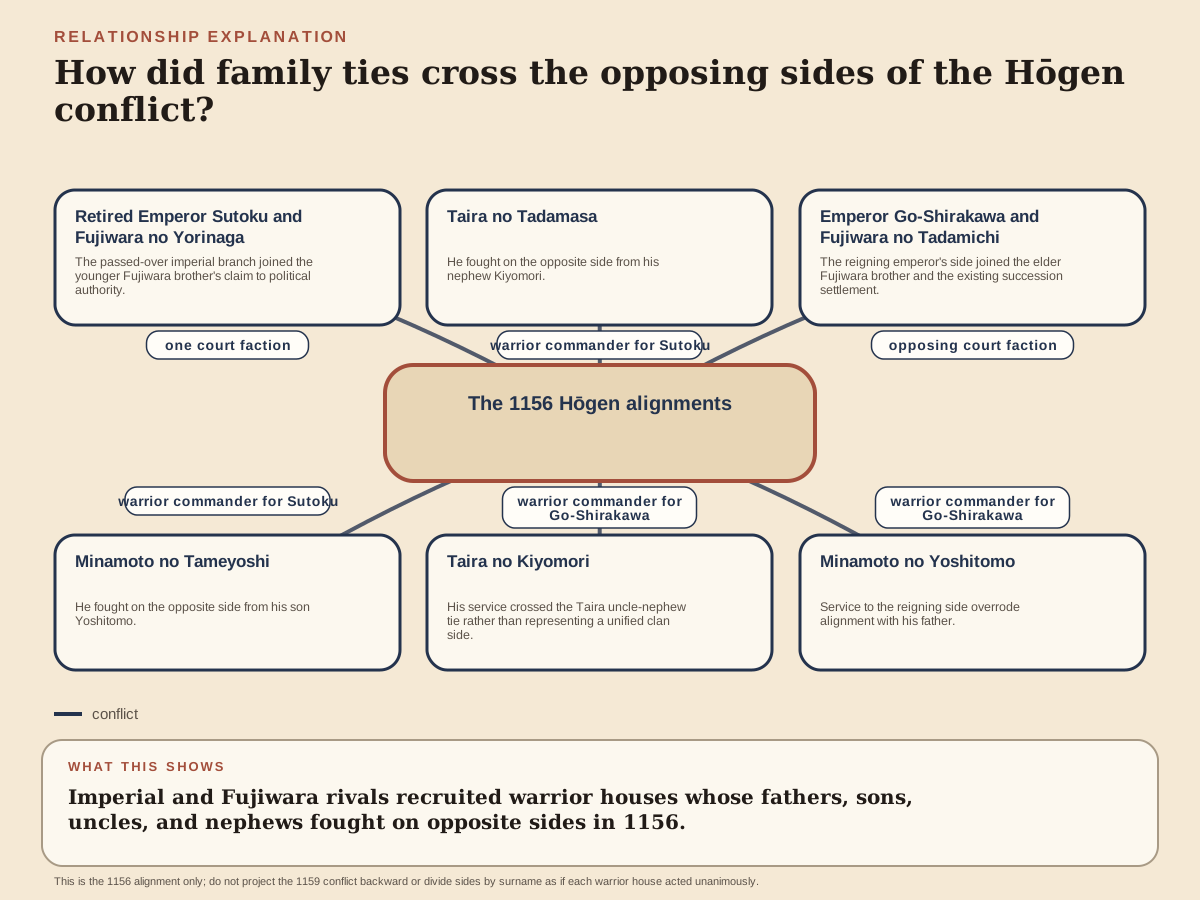
Sutoku and Yorinaga gathered at the Shirakawa Northern Palace with warriors including Minamoto no Tameyoshi and Taira no Tadamasa. Go-Shirakawa’s supporters included Tadamichi, Taira no Kiyomori and Tameyoshi’s son Yoshitomo. Kinship crossed the battle lines: Yoshitomo opposed his father, and Kiyomori opposed his uncle Tadamasa.
On the eleventh day of the seventh month, Go-Shirakawa’s side attacked before dawn. Fighting and fire broke up the northern-palace defense, and the defeated leaders fled. Yorinaga died from his wounds; Sutoku was subsequently exiled to Sanuki. Defeated warriors, including Tameyoshi and Tadamasa, were executed. The court adviser Shinzei supported this severe settlement, which drew members of the victorious warrior families into the punishment of their relatives.
The victory secured Go-Shirakawa’s position and brought Kiyomori and Yoshitomo greater standing. Their forces had decided a dispute among court leaders, while appointments and rewards still came from that court. Their alliance did not last: they fought on different sides in the Heiji conflict of 1159. Later war tales and Jien’s account gave Hōgen a prominent place in the history of warrior power, but a warrior government separate from Kyoto had yet to emerge.
Classic
Go-Shirakawa’s accession in 1155 did not settle the place of his elder brother Sutoku, a former emperor whose political prospects depended on the succession and on supporters at court. Their father, retired emperor Toba, continued to wield substantial influence until his death in the seventh month of 1156.
Another division ran through the Fujiwara leadership. Tadamichi and his younger brother Yorinaga competed for authority, with their father Tadazane supporting Yorinaga. The imperial and Fujiwara disputes became connected: Sutoku’s faction gathered around Yorinaga, while the reigning emperor’s side included Tadamichi.
Both factions could call on armed households. Sutoku and Yorinaga’s commanders included Minamoto no Tameyoshi and Taira no Tadamasa; Go-Shirakawa’s included Minamoto no Yoshitomo and Taira no Kiyomori. Yoshitomo was Tameyoshi’s son, and Kiyomori was Tadamasa’s nephew. The opposing forces therefore contained close relatives as well as competitors for office.
The Shirakawa Northern Palace, northeast of the established city center, became Sutoku’s headquarters. Its earlier use as a retired sovereign’s residence made it a place where a claimant could gather supporters. The dispute moved toward combat through the assembly of troops around identifiable court leaders and residences.
The dispute concerned a concrete succession. When Emperor Konoe died in 1155, Go-Shirakawa took the throne and his son Morihito became crown prince. Sutoku's son Shigehito was passed over. Choosing both a ruler and an heir favored one branch of Toba's descendants beyond the immediate reign. Toba's death removed the retired sovereign who had helped arrange that succession, leaving the rival households to defend their positions.
The commanders already worked within this political society. Guarding imperial residences, holding provincial offices and serving aristocratic households gave warriors connections through which court leaders could summon armed support. Neither Minamoto nor Taira formed a single party. The patrons and obligations of individual branches mattered more in this confrontation than membership in either lineage.
After Toba’s death, the rival forces gathered around two imperial residences. Go-Shirakawa's supporters, including Kiyomori and Yoshitomo, assembled at the Takamatsu Palace. Sutoku's headquarters at the Shirakawa Northern Palace had more recently served Princess Jōsaimon-in, after its earlier use by a retired sovereign. The factions turned buildings belonging to court households into bases for military action. Go-Shirakawa’s faction prepared an attack rather than waiting for that force to expand. The important command decision was to strike the opposing headquarters before dawn on the eleventh day of the seventh month.
Kiyomori and Yoshitomo’s troops took part in the assault. Resistance around the palace gave way as fighting and fire disrupted the defense. The residence burned, depriving Sutoku’s party of the place where its leaders and armed followers had concentrated.
The defeat dispersed the faction. Sutoku escaped the immediate fighting but lost the military support needed to challenge the reigning emperor. Yorinaga, wounded during the collapse, died after fleeing. Their followers had to seek refuge, surrender or face pursuit; holding a court title no longer protected the defeated party.
Punishment followed the fighting. Sutoku was sent into exile in Sanuki. Warrior leaders including Tameyoshi and Tadamasa were put to death, with Shinzei, the influential court adviser also known as Fujiwara no Michinori, supporting executions. The victorious Minamoto and Taira branches became involved in punishing relatives from the defeated branches. Later Hōgen narratives supplied dramatic arguments and speeches about these decisions; they were composed after the event.
Attacking a concentrated headquarters produced a rapid result, but the commanders did not acquire sovereign authority by burning it. Shinzei and the victorious court directed the settlement, while military households supplied both the force that defeated the opposition and personnel involved in its punishment. Later war tales enlarged the commanders' advice and family anguish into dramatic scenes. Their speeches cannot establish exactly what was said in the councils before the attack.
Go-Shirakawa’s party retained the throne and could distribute offices and rewards from a position strengthened by victory. Sutoku’s exile removed him from the immediate political arena in Kyoto. Yorinaga’s death ended the younger Fujiwara brother’s challenge, and Tadazane also lost influence through association with the defeated faction.
Kiyomori and Yoshitomo gained standing through military service to the winners. They had each defeated a rival branch of their own extended family. Their success increased the importance of armed supporters in court politics, although the court continued to confer the offices and status they sought.
Executions made the settlement especially severe. In central court disputes, exile and demotion had long been more usual political punishments. The deaths of Tameyoshi, Tadamasa and other defeated fighters reduced the possibility of bringing those leaders back into a later coalition. Families lost relatives, while the northern-palace neighborhood had experienced fighting and destruction.
The victorious coalition remained dependent on agreement among its members. Rewards and access to the sovereign continued to be contested. Hōgen settled this confrontation in 1156; it left Kiyomori, Yoshitomo and court advisers competing within the same political world, from which the Heiji conflict arose three years later.
The executions also departed from a long pattern in central political settlements. Histories compare their return with the execution of Fujiwara no Nakanari in the Kusuko conflict of 810. This comparison concerns the central court's handling of defeated political opponents; it does not mean that nobody had been killed elsewhere in Japan in the intervening centuries. Shinzei supported the severe penalties after Hōgen, and the victorious warrior branches were charged with punishment that included their own relatives. The settlement removed defeated leaders while making family divisions irreversible.
Sutoku survived the battle and died in Sanuki in 1164. His exclusion from Kyoto had a different afterlife. After deaths among members of the imperial circle in 1176 and the great Kyoto fire of 1177, fear of his angry spirit became part of the court's response to calamity. Memorial observances for Sutoku and Yorinaga followed, and the name Sutoku replaced the exile-associated designation Sanuki-in. These actions reveal how later rulers treated the defeated dead; they are not evidence that a spirit caused the disasters.
Hōgen showed that court succession and Fujiwara leadership could be decided through coordinated attacks on a rival residence. Armed households supplied the force, while sovereigns and aristocratic leaders supplied the claims to legitimate rule. This combination gave successful commanders stronger positions in the pursuit of court office.
The relationship changed again in 1159. Kiyomori and Yoshitomo, allies in Hōgen, became opponents in Heiji. Kiyomori’s later ascendancy followed this second victory and further work through offices and family alliances. Hōgen alone did not create Taira dominance or Yoritomo’s later Kamakura government.
Accounts written afterward made the conflict a turning point in a longer story. Jien’s Gukanshō associated this period with the rise of a warrior world, while Hōgen monogatari developed scenes of loyalty, filial obligation and punishment. Those works help explain how the conflict was remembered; their retrospective judgments differ from a record of what each participant knew in 1156.
The northern palace also left a trace in Kyoto’s historical geography. Its destruction locates the war in a court residential district, rather than on an anonymous battlefield. The remembered site connects the succession dispute to the buildings that housed its leaders and the fire that helped end their defense.
Go-Shirakawa himself demonstrates the court's continued capacity to act. In 1158 he abdicated to Morihito, Emperor Nijō, and remained politically active as a retired ruler until his death in 1192. His authority faced opposition and interruption, including from Kiyomori. The position secured in 1156 provided a starting point for this longer career, rather than immunity from the military households on which he had depended.
Jien, the author of Gukanshō, was Tadamichi's son and wrote long after his father's victory. His account interpreted changes in government from within an aristocratic and Buddhist understanding of history. Hōgen monogatari, composed in the early Kamakura period, gave divided families and Sutoku's fate a different literary form. Reading those accounts beside the court's later memorial actions distinguishes battlefield defeat, subsequent political management of the dead, and stories composed to explain their suffering.