Read the article below. Interactive reading tools are available when scripts load.
Classic
Prince Takahito became Emperor Go-Sanjō in 1068, succeeding his half-brother Go-Reizei. His mother was Princess Teishi, a daughter of Emperor Sanjō, rather than a daughter of the contemporary Fujiwara regent house. Fujiwara no Yorimichi therefore lacked the relationship of maternal grandfather through which his family had often supported and influenced young emperors.
Prince Takahito, the future Emperor Go-Sanjō, was born in 1034 as the second son of Emperor Go-Suzaku. His mother was Princess Teishi, a daughter of Emperor Sanjō. Recent emperors had close maternal relationships to the leading Fujiwara regent household. Takahito's mother belonged to the imperial family, giving him a different relationship to that household and its ministers.
The difference did not remove Fujiwara kinship from his background. Teishi's mother was Kenshi, a daughter of Fujiwara no Michinaga. The maternal family therefore crossed the supposed division between imperial and Fujiwara interests. What was weaker was the immediate relationship that could make a reigning emperor's maternal grandfather or uncle the head of his supporting political household. This distinction helps explain room for later imperial initiative without turning royal ancestry into isolation.
Go-Suzaku's death in 1045 placed Takahito's older half-brother on the throne as Go-Reizei and made Takahito crown prince. The designation is associated with his father's provision for the succession. Fujiwara no Yorimichi opposed it. His own daughter, and the daughter of his brother Norimichi, entered Go-Reizei's household, where the birth of a successor might have changed the future of the throne.
Takahito maintained his position while that possibility remained open. The crown-prince title gave his household recognized standing, but the eventual accession lay more than two decades ahead. Sources establish the designation and the ministerial relationships more clearly than they establish the child's response to them. The long interval matters: Go-Sanjō's accession emerged from a succession that endured through family and institutional changes.
As Michinaga's power grew, Yorimichi advanced through court appointments toward leadership of his father's house. Promotion placed him before the officials with whom he would eventually work. Rank established precedence at ceremonies; office gave him a place in the handling of government business. Other Fujiwara branches retained their own resources and ambitions, so being Michinaga's preferred son did not put every noble at his command.
The decisive opening came through Yorimichi's elder sister Shōshi, an imperial consort and the mother of Go-Ichijō. When her young son became emperor in 1016, Michinaga took the regency. A regent, or sesshō, conducted government on behalf of a child sovereign. The family relationship made Michinaga especially well placed to perform that role, while Shōshi's own position as emperor's mother gave her household continuing importance at court.
In 1069 the new reign issued an estate-regulation order. An office reviewed estate documents; surviving records attest its work in 1070, while its exact foundation date remains debated. Landlords and provincial officials were required to supply evidence for claims to lands and exemptions. The review addressed unauthorized new estates and claims that impaired provincial administration; it did not abolish every estate or remove all Fujiwara property.
Go-Sanjō used documentary inquiry and advisers to act on disputed revenue beyond Yorimichi’s immediate household. His accession changed the relationship between the throne and its leading relatives, while the estate review gave that change an administrative procedure rather than leaving it a matter of imperial pedigree alone.
During his years as crown prince, Takahito formed relationships that would outlast the wait for the throne. Fujiwara no Shigeko became his consort in 1046. She was a daughter of Kinnari and an adopted daughter of Yoshinobu, a Fujiwara noble outside Yorimichi's immediate leadership. Their children included Sadahito, born in 1053 and later Emperor Shirakawa, and four daughters. Family life preceded the policies for which Go-Sanjō became known.
Shigeko died in 1062, before her husband's accession. Princess Kaoruko, daughter of Emperor Go-Ichijō, had become another consort in 1051. She received the title chūgū, an empress rank, in 1069. Takahito's household thus included Fujiwara and imperial relationships with different courses and futures. His maternal position outside the leading regent line did not make his marriages free of aristocratic connections.
Learning also supplied people and practices for government. Ōe no Masafusa became the crown prince's scholar in 1067. A recent edition of Minamoto no Toshifusa's diary identifies that office and his entry into chamberlain service after Go-Sanjō's accession. The transition connected scholarly work to direct service near the emperor. It gives a specific institutional course to the broader description of Go-Sanjō as a ruler who valued learning.
The same diary's survival imposes limits. Its entries are known through selected copies and excerpts, and the edition notes that detailed accounts of Go-Reizei's death and Go-Sanjō's accession are absent from the surviving section. A record may establish relationships and administrative routines without giving a full scene of the transfer. Go-Reizei died childless in 1068, and Takahito acceded. Existing advisers and household ties now operated around a reigning sovereign.
Go-Sanjō continued to use Fujiwara ministers, including Norimichi as kanpaku, the leading minister governing with an adult emperor. He also relied on Minamoto no Morofusa and Masafusa. Imperial initiative grew through selecting and directing people within the court, where the regent family retained office and resources. The next year's estate review would make that initiative visible in a new procedure.
In 1069 Go-Sanjō directed a policy toward disputes over estates and provincial public land. The earlier decades had already seen repeated regulations and boundary investigations. Provincial governments needed revenue and asserted claims against privileged estates; estate holders appealed for exemptions and recognition. The emperor entered a field of contested rights that one new order could not simply erase.
The regulation is commonly reconstructed through four criteria: estates newly established after 1045; public fields absorbed into estates; estates lacking a fixed account of their parcels; and older holdings whose documents were unclear or whose privileges obstructed provincial administration. These criteria brought age, boundaries, proof and public obligations into the review. An estate's powerful patron was not, by itself, the whole legal question.
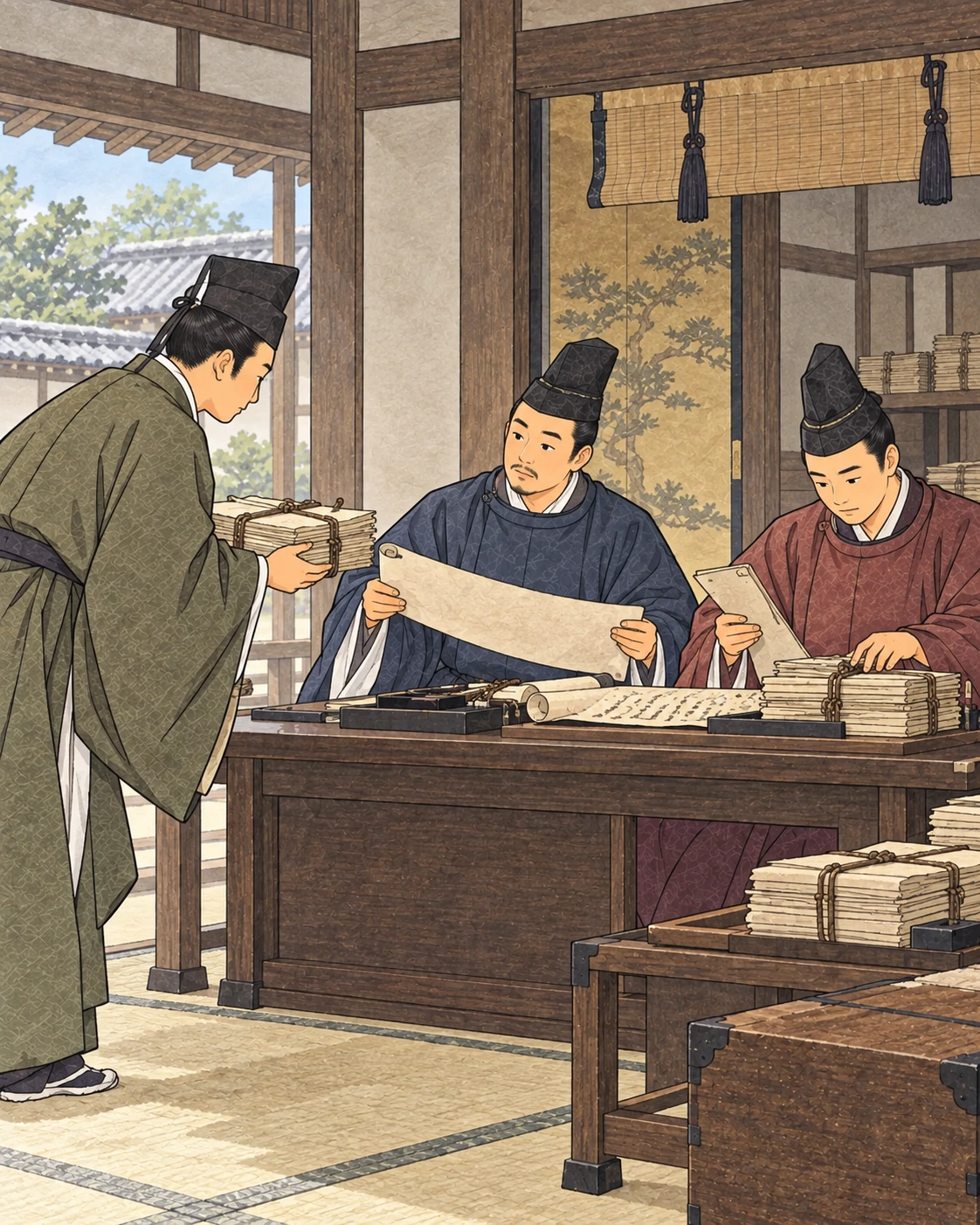
Later in 1069 a central record office, the Kiroku Shōen Kenkeijo, was established. Estate holders and provincial governments had to submit evidence to it. Officials examined the documents, and central decisions determined whether individual estates would continue or be stopped. Provincial government became a party whose claims could be judged alongside those of a temple or aristocratic holder. The procedure changed who could decide a dispute, as well as what documents were needed.
Historical disagreement · Did the Fujiwara comply with estate scrutiny?
A policy of scrutiny could confirm privileges. Holders whose evidence supported their claims acquired recognized standing, while other claims were rejected. Accounts that describe the leading Fujiwara household refusing to submit documents coexist with scholarly judgments that it ultimately followed the policy. Kuroita Nobuo's reference biography regards the measure as substantially effective.
The evidence does not support making every estate a confiscated possession.
Effectiveness also has more than one scale. Shimomukai Tatsuhiko emphasizes the authority acquired by the decisions while noting that subsequent disputes reopened questions they were meant to fix. From the record office's operation one can establish a stronger central procedure; from continuing conflict one sees its limits. The reign helped shape the distinction between estates and public land through judgment and documentation, while leaving a contested system for successors.
South of Kyoto, the Uji villa stood beside a river and on routes toward Nara. Yorimichi received it from his father Michinaga. It offered a residence away from the immediate traffic of the palace without severing connections to the capital. Buildings, gardens and managed water already formed a site that could be adapted to a new purpose.
Residence there depended on continuing work. Food and materials had to arrive; buildings and gardens needed care. The river belonged to that practical geography as well as to the view. The later temple would occupy an inherited, maintained landscape rather than begin on an empty stretch of scenery.
Fujiwara no Yorimichi prolonged regental rule at its height and strain while his patronage of Byōdō-in left an exceptionally visible expression of aristocratic wealth and Pure Land devotion. Office and imperial marriage sustained his house for decades, but the accession of Go-Sanjō exposed limits to that system.
The Amida Hall joined estate income, workshop skill, sculpture, painting, architecture and ritual. Its survival makes Yorimichi unusually visible, yet it also demonstrates collective production and later preservation. His significance lies in both the durability of regent-house power and the religious monument through which its resources can still be studied.
Go-Sanjō's administration also addressed the flow of provisions to court offices. In the sixth month of Japan’s traditional calendar in 1069, the government required reports of annual needs. Important expenses that had been supplied through orders issued as occasions arose were assigned more permanent provincial sources. Shimomukai describes this as a wider application of an existing allocation mechanism. The policy gave recurring needs an identified claim on supply, connecting reform to the requirements of operating institutions.