Read the article below. Interactive reading tools are available when scripts load.
Quick
Around 1831, the publisher Nishimura Eijudō began issuing Hokusai’s Fugaku sanjūrokkei, or Thirty-six Views of Mount Fuji. The designs appeared over several years. Their success led to ten additional prints, bringing the complete series to forty-six.
Fuji’s appearance changes with the viewpoint, season and time of day. In the Great Wave design, boats and a towering foreground wave dwarf the distant mountain. In the Red Fuji design, the mountain itself dominates, with its reddish slope set against sky and cloud. These distinct arrangements hold the series together through a repeated subject.
Imported Prussian blue gave the prints a strong additional color resource. Hokusai combined it with contrasting shapes and perspectives, making the familiar mountain visible through both close human activity and broader landscape. The publishing sequence joined his designs to a commercially distributed print series; its title records the initial plan, rather than the final number of works.
Shunrō and Sōri announced affiliations with schools. Around 1798, after passing Sōri to a pupil, the artist began using Hokusai Tokimasa. Taito belonged to much of his teaching and drawing-manual work. Iitsu, adopted around 1820–1822, appears on his celebrated Fuji prints. In 1834 he used Manji and the phrase Gakyō Rōjin, the old man devoted or ‘mad’ for painting, as he published the illustrated book One Hundred Views of Mount Fuji. Its black-and-white pages extended his investigation of the mountain beyond the color-print series. Names sometimes overlapped, so these phases have no perfectly sharp boundaries.
Classic
Around 1831, the publisher Nishimura Eijudō began issuing Hokusai’s Fugaku sanjūrokkei, or Thirty-six Views of Mount Fuji. The designs appeared over several years. Their success led to ten additional prints, bringing the complete series to forty-six.
In 1794 Hokusai left the Katsukawa school and took the name Sōri, associated with an Edo branch of Rinpa, a decorative painting tradition. The familiar account says he was expelled for studying the rival chapterō painting school's methods. The cause of his departure is less secure than the change of affiliation itself. Sōri offered a recognized identity in another artistic network, particularly useful for the poetry prints and books that now occupied more of his time.
Hokusai studied other visual traditions, including chapterō, the painting school long associated with elite patrons, and Chinese models. European-derived perspective and shading also reached Japanese artists through imported or copied images. Uki-e, perspective pictures using such spatial effects, already had a place in Edo's market. He did not need to travel abroad to encounter these methods, though their adoption required adapting them to a new page or print.
The Sōri phase connected him closely with kyōka, comic or witty verse practiced in poetry circles. These groups commissioned illustrated books and privately sponsored prints. Money for fine paper and careful printing could sustain experiments too costly for a routine shop sheet. The new affiliation thus supplied both subjects and customers while Hokusai developed a recognizable manner of his own.
His commissions show a widening practice: he could adapt a style to a poetry book, a privately commissioned print, or another publisher's needs. In 1798 he passed the Sōri name to a pupil and began using Hokusai Tokimasa. The move gave him greater latitude to present his work independently, while his livelihood continued to depend on the connections established during these years.
Fuji’s appearance changes with the viewpoint, season and time of day. In the Great Wave design, boats and a towering foreground wave dwarf the distant mountain. In the Red Fuji design, the mountain itself dominates, with its reddish slope set against sky and cloud. These distinct arrangements hold the series together through a repeated subject.
Imported Prussian blue gave the prints a strong additional color resource. Hokusai combined it with contrasting shapes and perspectives, making the familiar mountain visible through both close human activity and broader landscape. The publishing sequence joined his designs to a commercially distributed print series; its title records the initial plan, rather than the final number of works.
Shunrō and Sōri announced affiliations with schools. Around 1798, after passing Sōri to a pupil, the artist began using Hokusai Tokimasa. Taito belonged to much of his teaching and drawing-manual work. Iitsu, adopted around 1820–1822, appears on his celebrated Fuji prints. In 1834 he used Manji and the phrase Gakyō Rōjin, the old man devoted or ‘mad’ for painting, as he published the illustrated book One Hundred Views of Mount Fuji. Its black-and-white pages extended his investigation of the mountain beyond the color-print series. Names sometimes overlapped, so these phases have no perfectly sharp boundaries.
An art name could pass to another person. Relinquishing Sōri let Hokusai announce a new phase while sustaining a pupil's lineage. Earlier designs could still circulate with the old signature, since publishers continued to print their blocks. Contemporary customers thus encountered changing names within one working career, rather than one permanent identity on every product.
These conventions make attribution more demanding. A work signed Sōri may belong to another holder of the name, and a later impression of Hokusai's design may retain a signature from an earlier phase. Style, paper, printing and documentary evidence have to be considered together. The signature identifies the designer's claim; it does not name every person who made the sheet.
The names outlined here span several decades; the following work belonged to overlapping phases rather than sharply separated careers. Taito's drawing books and Iitsu's landscapes used skills and publishing relationships acquired under earlier signatures.
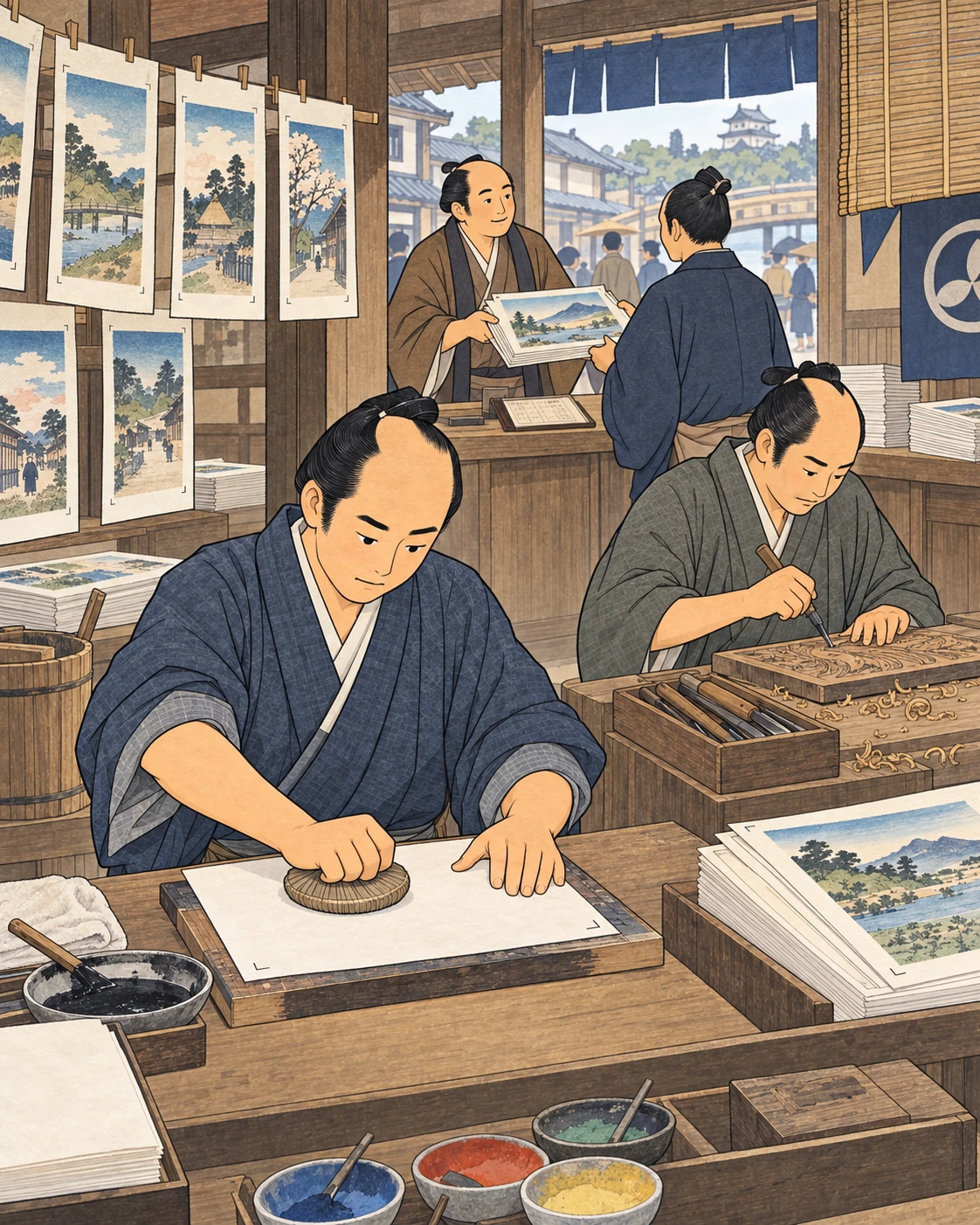
A publisher, or hanmoto, financed the making and sale of a woodblock print. Paper, carved blocks and skilled printing had to be paid for before enough sheets could be sold to recover the cost. Hokusai prepared the design. A carver pasted the drawing face down on wood and cut through it to form the principal lines, usually destroying the paper original in the process. Separate blocks carried the colors. The printer dampened each sheet, aligned it against registration marks, applied pigment to the blocks, and rubbed the paper against them in sequence. Every stage could alter how the drawn image finally appeared.
Printing pressure and moisture affected the color transferred to paper. A skilled printer could produce gradation across sky or water; poor registration displaced color from its outline. These effects were part of the picture, not a neutral copying process. Publishers coordinated the work and bore the cost. Nishimuraya Yohachi, who later issued the Fuji series, could commission more designs if sales justified extending it.
Publishing also faced censorship and changing restrictions on subjects or luxury. After sale began, the object continued to change: repeated printing wore the blocks, and later runs could use different colors or fewer costly effects. An early and a late impression of the same design can therefore preserve different stages of production. Neither is simply a photograph of Hokusai's paper drawing.
The carvers and printers frequently remain unnamed, although their skill is visible in the finished sheets. The blocks were reusable assets largely controlled by the publisher, who could order more impressions while demand lasted. Hokusai supplied the design; the publisher's workshop determined how often, and in what condition, customers could buy it.
Katsushika Hokusai expanded the subjects and visual possibilities of commercial print through illustrated books, drawing manuals and landscape series. Thirty-Six Views of Mount Fuji joined technical experiment, urban publishing and familiar geography in images that could circulate widely within Japan.
His Fuji series made the mountain a recurring presence in varied views of Japanese work and travel. These designs, and the drawing models of Hokusai Manga, also offered later artists new ways to organize space and movement. Their European reception helped make Hokusai a major figure in Japonisme, the adaptation of Japanese art abroad. That reach was unusually wide for work first made within Edo's commercial publishing world.
In 1778 Hokusai joined Katsukawa Shunshō, a leading designer of actor prints, and received the art name Shunrō. Sharing part of his teacher's name announced membership in the Katsukawa school. That affiliation could help a young designer find publishers and customers. Shunshō's specialty drew on kabuki, the commercial theater known for its stylized acting and elaborate costumes. Audiences recognized performers and favorite roles; an actor print needed to preserve those identities within a familiar pose and composition.