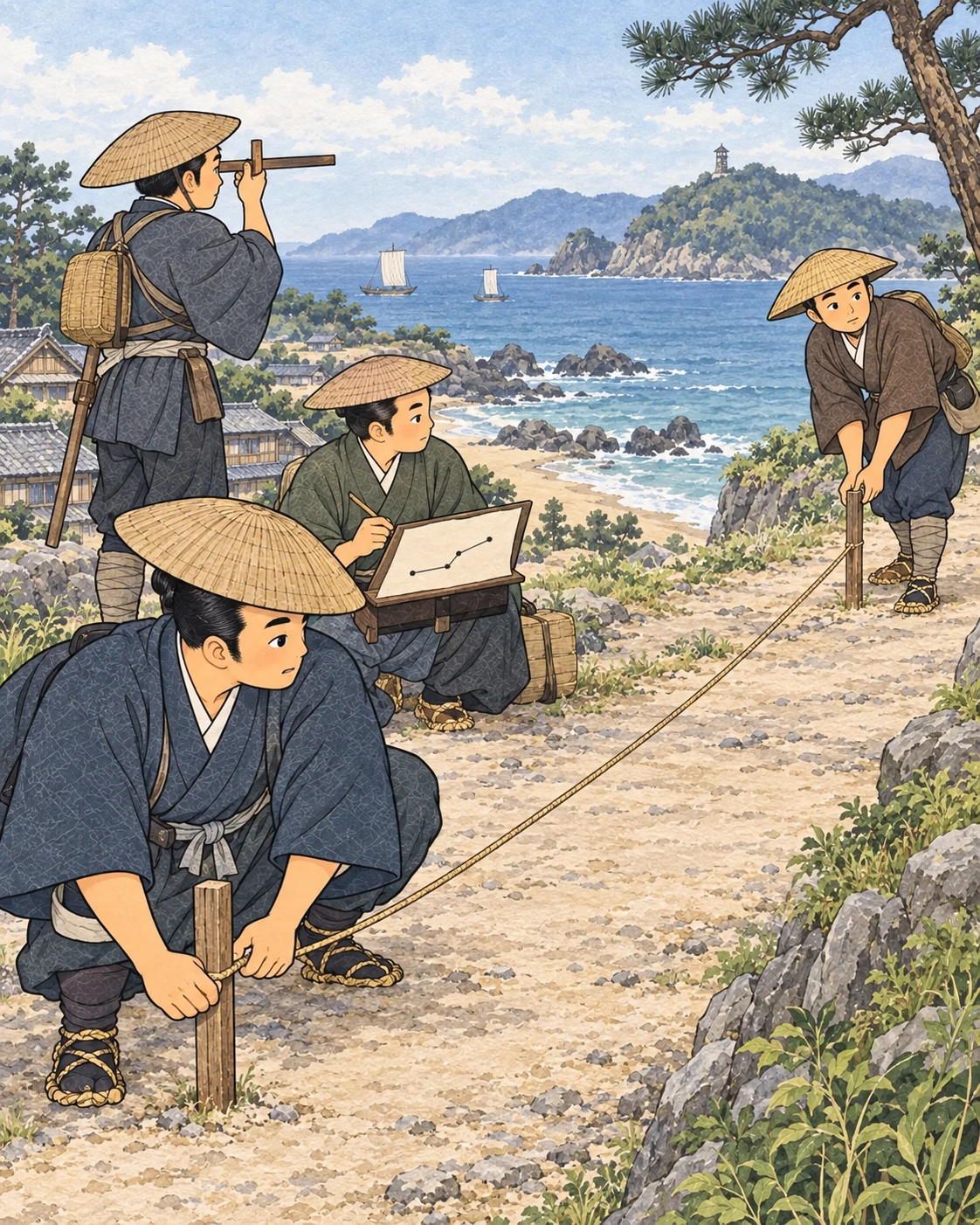
Inō’s parties measured routes in consecutive sections. Each length was recorded together with its direction, so the sections could be connected on a drawing. This traverse method followed roads and coastlines that people could physically survey; it was different from treating the whole country as one measured triangle network.
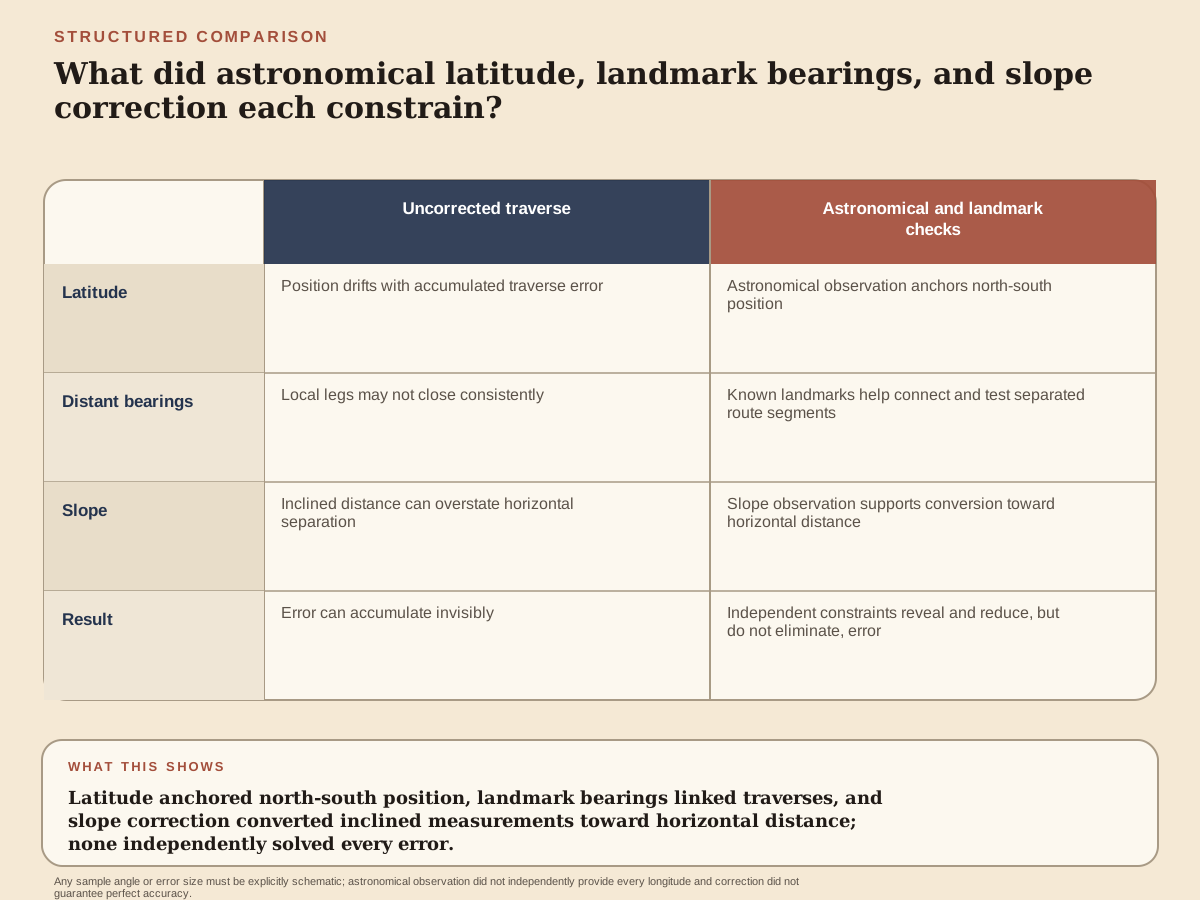
Field observations checked the accumulating route. A quadrant supplied astronomical latitude from the sky, and bearings toward distant mountains or other landmarks helped relate separate positions. Slope measurements allowed inclined lengths to be converted into their horizontal equivalents. These procedures reduced errors that would otherwise accumulate as one short section followed another.
The surveys continued from 1800 to 1816, with growing government involvement after the early work. Inō did not personally accompany every later party: the ninth survey, to the Izu islands, proceeded without him. Field records then required drawing and compilation. The map’s achievement depended on this repeated work by parties and office staff, as well as Inō’s planning and calculation.
Question: Why was a younger government astronomer more important than Tadataka's decades of practical experience?
Experience transfers selectively. Tadataka knew accounts, weights, routes, labor, and negotiation. Astronomical measurement required a different error culture. An observation had to be timed, an angle read, an instrument adjusted, a table consulted, and a calculation compared with theory. Confidence earned in commerce could become dangerous if it replaced instruction.
Takahashi Yoshitoki worked in the shogunate's astronomical office, the Tenmongata. The office's responsibilities included calendars, a domain in which an error affected ritual dates, agriculture, and government authority. Calendar reform demanded observation and engagement with technical knowledge transmitted from China and Europe.
Yoshitoki's generation did not simply import “Western science” whole. Texts traveled through languages and institutions. Concepts were translated, compared with inherited astronomy, recalculated, and fitted to available instruments. Knowledge production was East Asian and collaborative.
Hazama Shigetomi and instrument-making networks form part of this ecology. Precision depended on metal, wood, scales, sighting devices, and craft. A quadrant could embody mathematical design, but a poorly divided arc or unstable mounting would corrupt readings. Artisans belong in the scientific graph.