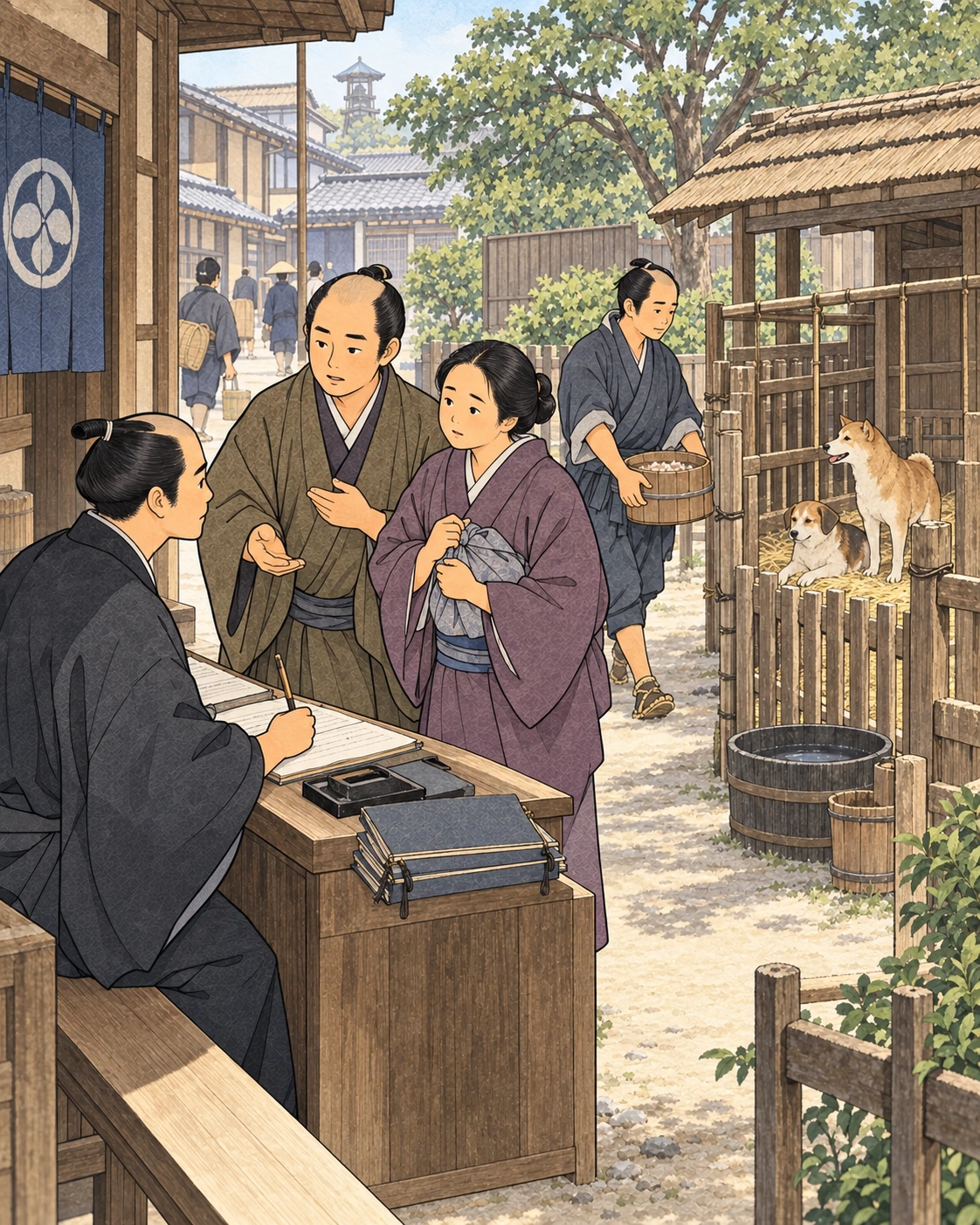
The measures grouped later as the Laws of Compassion began with orders concerning the treatment of animals and the abandonment of children, sick people and livestock. They accumulated across Tsunayoshi's government through repeated instructions, revisions and local enforcement; there was no single statute carrying the familiar collective title.
Officials, village leaders and urban neighborhoods had to report, shelter or transport living beings covered by the orders. Dog management became especially visible in Edo, including large kennels at Nakano. Enforcement imposed labor and expense, and surviving cases helped later critics turn the whole program into a story of arbitrary rule by the 'dog shogun.'
The orders were largely ended after Tsunayoshi's death. Their history nonetheless belongs to the development of early modern policing and welfare as well as animal protection. Compassion was translated into compulsory administration, with uneven burdens and uncertain outcomes.
Tsunayoshi was born in 1646 at Edo, present-day Tokyo, within the house of the reigning shogun Iemitsu. He was a fourth son, and his mother Keishōin had entered the household as a concubine. Iemitsu’s death in 1651 left his eldest surviving son Ietsuna as the next shogun, head of the warrior government. Tsunayoshi received land and retainers as a younger member of the dynasty. Those resources gave him a household distinct from the main ruling house.
The shogunate issued many orders over more than two decades. Their subjects and enforcement changed over time. Communities had to identify violations and provide care, while officials created facilities and procedures. A humane principle thus became a compulsory local workload.
The new shogun entered a government with powerful serving families. Sakai Tadakiyo had held the senior position of tairō under Ietsuna. Tsunayoshi removed him and promoted Hotta Masatoshi, a senior councillor who supported the succession, to that leading rank. The change placed a trusted adviser near the center of government. Tsunayoshi also settled the unresolved house dispute at Takada, in present-day Niigata, by dissolving its Matsudaira lordship. Even a prominent branch related to the dynasty could lose its domain through the shogun’s judgment.