Early seventh-century Buddhist patronage created demand for objects that had few established precedents in the archipelago. A sacred image required iconographic models, metal or timber, tools, furnaces, surface treatment and workers able to coordinate them. Texts and monks could carry doctrine, but worship also depended on material forms.
Tori enters this history through a craft name and transmitted family connections. Kuratsukuri refers to saddle makers, whose work could involve wood, metal fittings, lacquer, leather and textiles. Reference accounts connect his father and grandfather to immigrant communities and early Buddhism, but differ over the family's precise origin. The secure point is access to a network in which continental skills and religious patronage met.
Suiko's court supplied patrons able to gather resources at scale. In 605 the sovereign, Prince Umayado, Soga no Umako and other court figures joined a vow to produce large bronze and embroidered Buddha images. Tori was named as the person responsible for the work. This division of roles is the event's starting point: political and religious ambition required organized craft.
The Nihon shoki records completion of the earlier commission in 606. It attaches a story of Tori solving the problem of moving a large bronze image through a doorway. The episode celebrates technical ingenuity without providing enough information to reconstruct the procedure. More securely, the chronicle records royal praise, rank and land rewards. Court patronage recognized an artisan through the same resources used to organize service.
The bronze image is associated with Asuka-dera, but the surviving statue has undergone fire, repair and replacement. The traditional identification remains important without making every visible part an untouched product of Tori's hand. This preservation problem differs from that of the Hōryū-ji triad, whose inscription names its maker and date.
The Hōryū-ji project began in a household crisis. The inscription says that Prince Umayado and members of his family were ill in 622. A vow called for an image of Shaka, the historical Buddha, in hope of recovery and awakening. Death changed the commission's function. Completed in 623, the work became a memorial for people who could no longer receive physical healing.
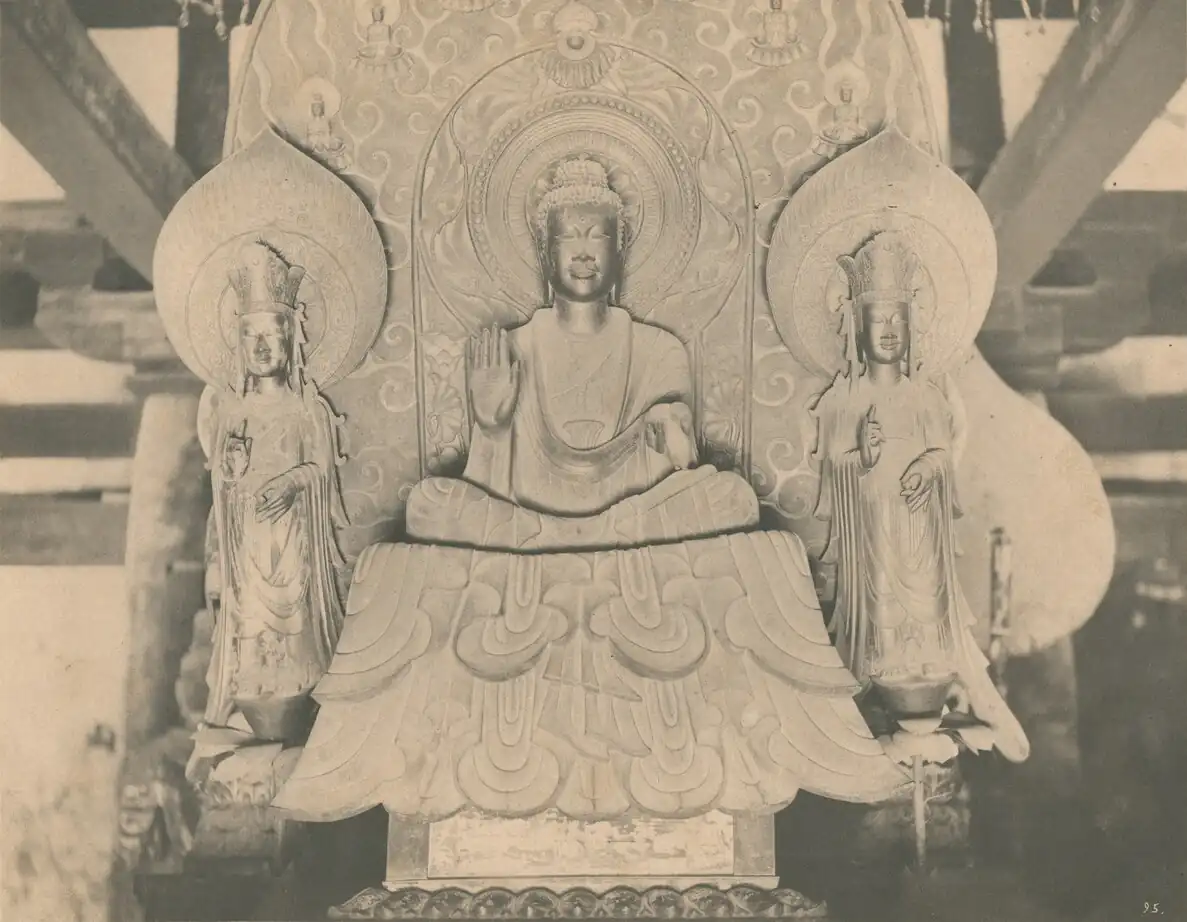
Tori's named responsibility did not remove collective labor. The triad was cast in bronze, gilded and joined to an elaborate halo carrying text. Patrons defined the religious purpose; learned participants helped formulate language; artisans prepared models, molds, metal and surface. The inscription preserves a named master within this larger operation.
The central Shaka sits between two attendants beneath a shared halo. Hōryū-ji and the Nara National Museum identify the work as a gilt-bronze triad completed in 623 by Tori. Its frontality, ordered folds and controlled expression turn Buddhist presence into a stable visual encounter. These features can be described without claiming a literal portrait of Prince Umayado.
The inscription supplies the project's human situation: illness, death, prayer and memorial aspiration.
Historical disagreement · Was the inscription added later?
Ōyama Seiichi’s reconstruction treated the halo inscription as a later composition. Tōno Haruyuki disputes that dating. He points to a flattened area prepared for the inscription during manufacture and traces of gilding on that surface, arguing that the inscription belongs with the triad’s completion around 623 rather than a later rewriting of the prince’s life.
The difference matters because a contemporary memorial and a later account carry different evidential weight. Dating the inscription does not identify its writer: naming Tori as the maker still does not make him the author of every line.
The work's completion gave Hōryū-ji a durable focus for worship and memory. It also left evidence of patronage and craft that the narrative chronicle alone could not preserve. Object and text are strongest when read together, with neither made to answer questions it cannot settle.
Tori's name gives early Japanese Buddhist art a rare identified maker. Later art history grouped frontal, symmetrical figures with patterned robes and restrained faces under the label Tori style. The label helps compare objects, but it describes a visual family rather than a signed catalogue of one person's hands.
The event therefore expands what counts as political and religious history. Rank, land, imported metal, temple patronage and workshop knowledge moved together. The court did not merely announce support for Buddhism; it paid for material forms and rewarded the people who made them.
The 623 triad is major within HO because it joins a turning point in religious material culture to unusually specific evidence: a surviving image, inscription, date, maker and purpose. It remains distinct from the 603 cap ranks, the 604 admonitions and the 607–608 Sui missions. Those Events describe court organization, political teaching and diplomacy; this one shows skilled production converting patronage and bereavement into an enduring object.