HO Guides
Shitennō-ji: Leaving a Name at the Gate of Paradise
Inside a medieval gateway, small parcels preserved the connections Osaka families hoped would extend beyond their lives.
Quick · About 2 min
The story in five points
A short route through the argument. Follow a point into Classic for its context and sources.
A second direction
Shitennō-ji’s main buildings follow a north–south axis, but its western gateway directs attention towards Amida’s Pure Land. The arrangement is old; the central buildings are largely postwar reconstructions. The west gate preserves another history within its fabric.
Read in contextRepairs opened a religious opportunity
Conservation revealed offerings between copper coverings and wooden cores. Their clustered dates shortly before a recorded repair suggest a coordinated deposit. Investigators infer an appeal to donors, although no announcement survives to establish how participation was organized.
Read in contextPackages gathered relationships
Nested paper bundles, named wooden slips and different invocations show several ways to participate. A parcel might contain contributions concerning several people; repeated handwriting on the slips also suggests mediation. Neither package totals nor object counts equal numbers of individual believers.
Read in contextBodies and names worked together
Hair, cremated bone and umbilical cords joined written names and prayers. Osaka City interprets them as wishes for personal or family rebirth. Leaving an identified bodily connection inside the gate allowed an offering to remain after its donor departed.
Read in contextDifferent histories share one entrance
Earlier writing could enter the gate in a later deposit, while a subsequent repair left no confidently identified offerings. The evidence records particular occasions when maintenance and devotion met, rather than an uninterrupted custom performed at every repair.
Read in context
Opening
The stone gateway at Shitennō-ji was keeping something that its appearance did not disclose. During conservation work in 1997–1998, its horizontal members were dismantled. Beneath copper coverings, the investigators found wooden cores—and, between copper and wood, offerings. Paper parcels held hair, fragments of cremated bone, umbilical cords, and coins. Names and Buddhist invocations covered their wrappers. Some parcels contained smaller packages, bringing several separate offerings into one enclosure.[1]
Most of the dated offerings pointed back to a few days in 1669. They had been placed inside an entrance already centuries old, at a temple older still. The donors were people of Osaka, and some supplied the names of their neighbourhoods. Their small possessions had acquired a place within a much larger monument.
This was the west gate, associated with the passage towards Amida Buddha's Pure Land. The offerings make that religious geography personal. A gate could mark a direction for those standing before it. Its concealed spaces could also retain names and bodily traces after the people who brought them had gone.
1. The temple had more than one direction
Shitennō-ji traces its foundation to Prince Shōtoku in 593. Its name refers to the Four Heavenly Kings, Buddhist guardians associated with the temple's founding tradition. That tradition supplies a princely beginning, but the great religious precinct in Osaka accumulated other relationships over the following centuries.[2]
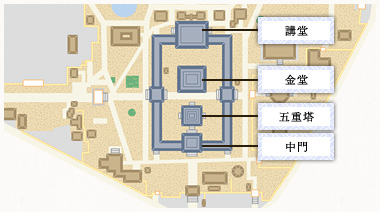
Its central buildings follow a north–south line. From the south, the Middle Gate leads towards the pagoda, the Golden Hall, and the Lecture Hall, with corridors enclosing the core. This arrangement gives the temple a readily intelligible architectural order. The buildings now presenting it are largely postwar reconstructions; the age of the arrangement and the age of the standing structures are different.[3]
The western entrance creates another orientation. Its torii—the two-post gateway with cross-members overhead—was erected in 1294 through the work of the monk Ninshō. Here, the significant direction led outward towards the setting sun and the western paradise of Amida, the Buddha associated with the promise of rebirth in a Pure Land. The gateway stood at the meeting of an actual temple boundary and a religious destination beyond ordinary sight.[4]
Those directions did not require worshippers to choose between two separate temples. The north–south arrangement gathered major buildings into one compound. The west gate attached a different significance to its edge. A place through which people could enter or leave became a place from which they could orient themselves towards another existence.
The distinction is useful because an architectural plan can make the principal axis appear to contain the institution's entire purpose. At Shitennō-ji, some of the most intimate evidence of religious life emerged at a threshold to one side of that axis. People did not have to add another great hall to make their relationship with the temple material. A small space within the gateway could serve.
2. A sunset that continued with closed eyes
Sunset contemplation had a scriptural procedure. The Sutra on the Contemplation of the Buddha of Infinite Life begins its sequence of visualizations by directing attention westward. The setting sun is to be apprehended as a suspended drum. Once that image is established, it should remain clear whether the eyes are open or closed. The passage calls this the first contemplation.[5]
The movement is from an external object to an image maintained within the mind. The sun's disappearance need not end the contemplation. In the following passage, water and ice provide further stages towards imagining the luminous ground of the Pure Land. Familiar appearances become starting points for a religious vision rather than its final content.
Shitennō-ji gave that westward attention a particular location. The temple still identifies its western gate with sunset contemplation at the equinoxes. Its explanation describes the torii as the eastern entrance to the Pure Land: east from the imagined paradise, west from the temple and the city.[6] The same threshold could therefore be understood from either side, joining the place occupied by the worshipper to the destination of the prayer.
A dramatic use of this setting survives in the Noh play Yoroboshi. A father distributes alms at Shitennō-ji for the welfare of the son he has expelled. The son, now blind, appears among those receiving them. In the sunset-contemplation episode, he evokes the landscape of Naniwa inwardly; the play eventually brings father and son together again.[7]
The play supplies a literary encounter, not a recovered case from the temple's charitable records. Its choice of setting nevertheless brings almsgiving, family separation, and a vision extending beyond immediate sight into one place. The gate's religious world was available for stories about the living as well as prayers concerning the dead.
The offerings found inside the torii would make another use of that world. They did not represent a sunset. They attached particular people to the threshold through which paradise was imagined. A practice of looking west and a practice of leaving something behind could give the same entrance different work to do.
3. The opening created by a repair
Calling the torii a stone gateway conceals an important feature of its construction. The horizontal members known as the shimagi and nuki contained wood covered with copper. The space between those materials accommodated the deposits. Their position made maintenance of the structure part of the history of the offerings.[8]
The dates establish a particularly close connection in 1669. Most dated items bear the fourteenth or fifteenth day of the twelfth month; others name the thirteenth or sixteenth. An inscription on the copper records a repair dated to the twenty-second day of that month. A concentration of written offerings thus falls shortly before the date recorded on the repaired structure.[9]
Osaka City's investigators interpret these deposits as a response to an appeal associated with the repair. They suggest that people brought their offerings before the horizontal members were raised into position again. No written announcement of that appeal had been identified in the study. The reconstruction of the occasion rests on the objects' clustered dates, their location, and the repair inscription.
That combination gives the episode a practical shape even without a surviving proclamation. Work on the gateway exposed a space that would ordinarily be enclosed. Once that space was closed again, the offerings could remain within the fabric. Repair could therefore provide an occasion for participation whose material result outlasted the work itself.
The building and the small packages supplied different forms of duration. Copper and wood made part of a working entrance. Paper, names, and bodily traces attached particular people to it. Bringing them together turned a temporary opening in the structure into a more enduring religious connection.
There had been an earlier opportunity too. Three documents naming participants are dated 1516. An inscription records work on the copper covering during 1510–1516, and the investigators connect those documents with that intervention.[10] The gate had received offerings on more than one occasion. Its interior was not simply a container sealed once when Ninshō established it in 1294.
4. Several people inside one parcel
The paper packages were not uniform. Many measured roughly ten to fifteen centimetres in height and only a few centimetres across, but their sizes and handwriting varied. Wrappers could contain additional papers bearing Buddhist names or lists of donors. Smaller bundles sometimes remained grouped inside a larger one. The investigators identified 154 packages in the principal deposit.[11]
A packet was consequently not the equivalent of one person's entry on a list. Its several layers could keep offerings together while preserving distinctions within them. A wrapper could gather names; an inner paper could identify another contribution; a small enclosed bundle could retain its own material contents. The packages accommodated relationships as well as individuals.
Their writing joined those identities to a religious purpose. Many carried Namu Amida Butsu, an invocation of homage to Amida Buddha, alongside names. Some used the invocation of the title of the Lotus Sutra. The surviving forms therefore preserve more variety than a single repeated formula, even though their shared setting was the gateway associated with the western Pure Land.[11]
Other donors appeared on thin wooden slips. There were 244 of these, with invocations and names on both faces. Most were written in the same hand. This contrasts with the varied handwriting of the paper bundles: many offerings could pass through one act of writing without all being written by the people named.[12]
The evidence does not identify the writer or supply a schedule of charges. It does make mediation visible. The written name and the hand producing it were not necessarily the same person's contribution. Someone could participate through a name entered among others, while the preparation of the object involved another member of the undertaking.
Neighbourhood names give these offerings an outward geography. The city's account identifies donors from Osaka's urban population and records addresses within the city. The gate's interior thus brought together people associated with places outside the precinct. Their papers did not erase those places. Names and addresses made the connection to Shitennō-ji specific enough to retain a person's identity within a shared deposit.
The contrast with the temple's princely foundation is striking in scale, rather than in religious seriousness. A founder could be commemorated through a great sanctuary. These donors entered the institution's material history through small things grouped inside an existing entrance. Their contributions required much less space, but they carried more individual information than the torii's exterior could display.
5. Why send part of a body?
The contents deepen the meaning of the written names. Hair, cremated bone fragments, and umbilical cords connect the deposit with bodies at different points in life and death. Coins and prayer texts accompanied that bodily material. The city's interpretation associates the contents with donors' wishes for their own or their families' rebirth in the Pure Land.[13]
These were small portions, not complete burials. A fragment could be placed at the religious threshold without requiring the entire body to be moved there. Hair could represent a connection with a living person; cremated bone belonged to someone who had died. An umbilical cord carried a bodily association different from either. The range of materials made the deposit more expansive than a collection concerned only with the recently dead.
The inscription on a wrapper supplied a connection the material could not announce on its own. A strand of hair does not visibly name its owner. A list of names, conversely, does not contain a physical trace of those people. Their combination made it possible to place an identified bodily association within the gate. This is an interpretation of how the packages joined their contents, rather than a claim to know the circumstances behind each family's offering.
The religious term kechien helps explain the intended relationship. It means forming a connection with the Buddha's teaching, understood as opening a possibility of future awakening. In Osaka City's explanation, the objects embody that wish for connection at a place already associated with passage towards the Pure Land.[13]
The gateway's role was therefore not exhausted by the moment someone passed beneath it. For an offering, remaining there was the important action. The donor could leave; the name and bodily trace would retain their place within the threshold. Distance from the precinct no longer required the physical connection to end.
This also allowed a person to act in relation to someone absent. Family material and lists of names could bring others into the offering without their all standing together at the entrance. The surviving packets do not yield complete family trees. They do show why an account confined to individual visitors would miss something essential: a religious act at Shitennō-ji could concern people beyond the person who performed it.
6. The dates inside were not the gate's whole calendar
Some of the notebooks and name papers carried dates extending from 1656 to 1669. Their written history was therefore longer than the few days associated with the repair deposit. Earlier entries could be gathered into something placed within the structure on a later occasion.[14]
This gives the packages another dimension. They could collect material accumulated over time, as well as offerings from more than one person. A date on a page need not identify the day that page entered the gate. The clustered dates of 1669 help locate the larger deposit, while the earlier writing preserves activity preceding it.
The distinction prevents the interior from becoming an imagined daily record of devotion. No offerings bearing a date after 1669 were identified in the study, although the copper inscriptions record another repair in 1759. That later intervention supplied no group of deposits the investigators could confidently assign to it.[14] The gate's care continued on a chronology different from the chronology recovered from its contents.
Nor was the modern discovery simply a total of individual believers. The designated collection comprises 586 items, but it includes parcels, wooden slips, books, coins, documents, hair, and prayer beads. A packet may contain several contributions, while several objects may concern one person. The catalogue's total describes the recovered collection, not a count of unique donors.
What survives is more particular than an unbroken custom extending unchanged from the Middle Ages. The objects preserve identifiable moments when care for the structure and acts of devotion came together. The 1516 papers and the much larger seventeenth-century group show that such opportunities could recur without making every repair the same religious event.
7. An entrance with people inside it
The gate and its deposits now have separate identities in cultural-property records. The medieval torii is protected as architecture; its offerings were designated by Osaka City as tangible folk cultural property. The latter category attends to the religious practices made material in the packages, rather than treating them only as incidental contents of an old building.[15]
The separation makes a concealed history available for study. The structure explains where the objects were placed; the inscriptions explain whom some of them concerned; their contents explain why writing alone was not the whole offering. Each part supplies something the others lack.
For Shitennō-ji, that history extends beyond its celebrated founder and reconstructed central buildings. Osaka's residents left a different record within the temple: small packages, grouped names, fragments connected with bodies, and dates close to a repair. They were not trying to produce a public history of urban devotion. They were establishing relationships with a religious place and with the future it promised.
The west gate could direct attention towards a sunset that would pass. Its enclosed spaces offered another kind of continuity. A name, a prayer, and something connected with a body could remain after the donor's visit was over. That is the particular achievement these offerings asked of the entrance: to keep a place for people who could not stay there themselves.
Next topic · HO Guides
Minatogawa: The Monument Before the Shrine
An inscription, a portable rubbing, and a newly designed sanctuary gave a medieval defeat successive public forms.
Continue readingSources and NotesView sourcesHide sources
Web materials were consulted on 16 September 2026. Historical numbered months retain their original calendar. The offering deposits are known here through Osaka City's designation account, not through independent examination of the objects or a full reading of the technical investigation report. Religious efficacy is described as belief. The discussion of Yoroboshi concerns a play, not an authenticated episode of temple relief.
- [1]
Osaka City Board of Education, “四天王寺西門石鳥居納入品 一括(586点),” pp. 1–2, opening account of the 1997–1998 dismantling, copper-covered wooden members, and contents. See the second page as an image. First-page image retrieval failed, so its object descriptions are used through the text, not as independent visual observations. The document cites 大阪市文化財総合調査報告書13 (1997), which was not independently read. Source credit: Osaka City. This essay translates, paraphrases, and adapts the city's explanation and adds analysis. The designation page, “有形民俗文化財,” expressly provides this download under CC BY 4.0. No endorsement by Osaka City is implied.
Return to the reference ↑ - [2]
Shitennō-ji, “四天王寺の歴史”, opening foundation account. Used for the temple's identification of 593, Prince Shōtoku, and the Four Heavenly Kings. The received foundation is not presented as a contemporary battlefield record, and its associated four charitable institutions are not used as proof of continuous sixth-century services.
Return to the reference ↑ - [3]
Japan Tourism Agency / Osaka Convention & Tourism Bureau, “Shitennoji Temple,” R4-00628, fiscal 2022, central-compound and reconstruction passages; Shitennō-ji's plan, linked from its history page, is the image cited here. The plan's broad south–north sequence is used, not independent archaeological dating of every foundation. The present compound is not treated as surviving sixth-century fabric.
Return to the reference ↑ - [4]
Agency for Cultural Affairs, “四天王寺石鳥居,” Cultural Heritage Online record 174016, architectural identification and 1294 date; Osaka City's account, note 1, p. 1, supplies Ninshō's association; p. 2 explains the west gate's Pure Land significance. The gateway's historical religious setting is not inferred merely from the modern distinction between Buddhist temples and Shinto shrines.
Return to the reference ↑ - [5]
Foshuo Guan Wuliangshou jing / Sutra on the Contemplation of the Buddha of Infinite Life, first contemplation and beginning of the second, original Chinese text, “p096”, passages from “繫念一處、想於西方” through “是爲日想、名曰初觀” and the following water/ice passage. The paraphrase is the author's, not a quotation of a modern translation. This is an explanation of a historical religious text, not advice to look directly at the sun or evidence that every temple visitor performed its full sequence.
Return to the reference ↑ - [6]
Shitennō-ji, “日想観”, substantive explanation of the western gate and equinoctial contemplation. It establishes the temple's published ritual interpretation as consulted. No future event date, uninterrupted performance history, or guaranteed view of an unobstructed horizon is promised.
Return to the reference ↑ - [7]
The Noh.com / CaliberCast, *Yoroboshi*, synopsis, the three narrative paragraphs: almsgiving at Shitennō-ji, the blind son, sunset contemplation, and reunion. The synopsis was read, not the full historical performance text or the modern translation PDF. Only the short plot comparison is used; the synopsis's social generalizations and inferred psychology are not adopted as historical findings.
Return to the reference ↑ - [8]
Osaka City, note 1, p. 1, opening structural explanation and discovery paragraph. The material sequence is stone gateway, copper-covered wooden horizontal members, and deposits in the intervening spaces. The report's tentative suggestion concerning reduction of weight is not developed into an independently established engineering explanation.
Return to the reference ↑ - [9]
Same account, p. 2, paragraphs beginning “これらの納入の時期だが” and “文献上で、寛文9年の修復の際に.” The dates on offerings and repair inscription are distinguished from the investigators' reconstruction of an appeal before the members were raised. No appeal notice was identified; participation terms, payment amounts, exact handling procedure, and individual donor motives are not reconstructed. The account's separate earthquake date is not needed for the argument and is not independently authenticated here.
Return to the reference ↑ - [10]
Same account, p. 2, the three documents dated Eishō 13 (1516) and the copper inscription recording repairs during Eishō 7–13. The association with that repair is the investigators' interpretation, not an independently witnessed deposition ceremony.
Return to the reference ↑ - [11]
Same account, p. 1, paper-bundle description from “主体となるのは包みと経木札” through the count of 154. The contents, names, variable handwriting, nested packets, invocations, and addresses are catalogue observations. The essay does not equate one package with one person, identify every relative, or use the different invocations to assign a definite sectarian identity to each donor.
Return to the reference ↑ - [12]
Same account, pp. 1–2, the 244 wooden slips and observation that most were written in the same hand. Mediation is inferred from the coexistence of multiple names and a recurrent hand; no professional scribe, fee, literacy level, or organized neighbourhood delegation is identified.
Return to the reference ↑ - [13]
Same account, p. 2, final interpretive paragraph and glossary entry “結縁”; see also the p. 1 contents. The family and rebirth interpretation belongs to the city account. The analysis of named bodily associations is limited to the documented combination of materials and writing; it does not attribute an individual hair or cord to a securely identified person, or establish a uniform theology among all donors.
Return to the reference ↑ - [14]
Same account, p. 2, dating discussion: notebooks/name papers dated 1656–1669, no identified dates later than 1669, and the separate 1759 repair. Its collection total is an object count. The source also describes a separate newspaper-wrapped group and prints an inconsistent Gregorian equivalent for Shōwa 8; neither that conversion nor a reconstructed modern redeposition sequence is used here.
Return to the reference ↑ - [15]
Agency for Cultural Affairs, record 174016, note 4, national architectural designation; Osaka City's fiscal-2005 designation list, “有形民俗文化財,” item 12, for the deposits' classification. The page was republished in 2026 but explicitly concerns fiscal 2005. Separate classification does not establish current display, physical availability for inspection, or an unchanged conservation arrangement.
Return to the reference ↑