Castle-Town Planning under Kanamori Nagachika
Attraction
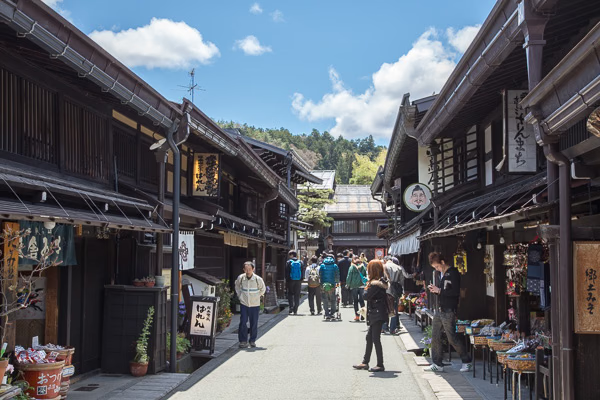
Kanamori Nagachika established Takayama as a castle town after taking control of Hida in the late sixteenth century. City interpretation emphasizes functional zoning: samurai districts, merchant streets and temple areas occupied different positions. The current merchant streets are not untouched buildings from Nagachika's lifetime, but the urban logic he helped establish is still readable in street alignment and district function. Sanmachi’s narrow plots, continuous eaves and street-front shops preserve the merchant scale of that plan. Water channels run beside the streets, while residences and storehouses extend behind relatively restrained façades. The important survival is therefore both architectural and urban: repeated plot form, circulation and commercial frontage make the former social geography readable across several blocks.
Current visibility
The place-specific feature discussed as “Castle-Town Planning under Kanamori Nagachika” is anchored by the castle compound, the present landscape, and the streetscape, but today's access or operating condition at Takayama Old Town requires a current official check.
Merchant Streets across Political Change
Attraction
When Hida came under direct shogunal rule in 1692, Takayama Castle was dismantled, but the merchant city did not disappear. Commerce continued and the town's economic importance grew. This reverses the usual castle-town hierarchy: the ruler's castle vanished while the merchant streets became the durable historical landscape visitors know today. The present streetscape contains buildings from different dates and businesses adapted to tourism, sake brewing and modern retail. Continuity does not mean every façade is an untouched Edo-period object. It lies in the accumulated plot pattern, building types and commercial use. Reading several neighboring houses together is more accurate than treating one picturesque shopfront as the whole old town.
Current visibility
Takayama's merchant streets, accumulated townhouse fabric, plot pattern, and continuing commerce remain visible below an absent, dismantled castle.
Repeated Townhouse Forms in Sanmachi
Attraction
The historical value of Sanmachi lies in repetition. Narrow plots, closely spaced façades and continuous eaves create a commercial street wall. Focusing on one picturesque house can hide the urban system. The street is the object; individual houses are units within it. Compare several adjoining properties: shallow street width gives way to deep plots, while doors, latticework and eaves repeat with individual variations. The collective rhythm is the historical object.
Current visibility
“Repeated Townhouse Forms in Sanmachi” is visible as a spatial feature of Takayama Old Town, with the streetscape carrying the on-site reading.
Attraction
After the Tokugawa shogunate took direct control of Hida in 1692, government no longer centered on a daimyo castle. The Jinya became the administrative symbol of a different political structure. This place is useful because it gives the urban district a second center: merchant streets persisted while political authority moved from castle lord to shogunal officials.
Current visibility
The place-specific feature discussed as “Takayama Jinya” is anchored by the castle compound, the administrative landscape, and the surviving building, but today's access or operating condition at Takayama Old Town requires a current official check.
The Archaeological Castle above the Town
Attraction
Takayama Castle is largely archaeological today, but its former position still explains the city's organization. The merchant district sat below the political center, while temple and samurai zones occupied other parts of the planned town. Absence at the top of the hill can make the surviving city below easier to understand.
Current visibility
Takayama Castle survives mainly as archaeological traces and a former hilltop position above the town; no intact castle building is claimed.
Urban Continuity beyond an Edo Streetscape
Attraction
Takayama is often consumed as an Edo-looking streetscape, but the historically stronger summary is urban continuity. Nagachika's castle-town plan, later shogunal direct rule and generations of merchant rebuilding all shaped what survives. The preservation district is therefore neither a frozen sixteenth-century town nor a theme-park Edo street. It is a living city carrying older spatial logic.
Current visibility
Takayama's older town plan and merchant streets remain legible as a living city, while the former castle survives only as an archaeological hilltop position.
Takayama Festival and the Yatai Storehouses
Attraction
Takayama’s merchant streets are also a living festival landscape. During the spring Sannō Matsuri and autumn Hachiman Matsuri, elaborate yatai floats emerge from storehouses distributed through the old town and move through streets whose width, corners and neighborhood organization shape the procession. The float festivals form part of UNESCO’s inscription of Yama, Hoko, Yatai traditions in Japan. Outside festival dates, the storehouses and exhibition halls still connect craft, neighborhood institutions and urban form without implying that a procession occurs every day.
Current visibility
The feature or practice discussed as “Takayama Festival and the Yatai Storehouses” is available only at announced times; the storehouse, the streetscape, and the museum display remain the stable context, and current official notices control access.