Attraction
Shureimon was first built in the sixteenth century and later became one of Shurijo's most recognizable symbols. The official interpretation emphasizes its Chinese-style paifang form and the plaque proclaiming Ryukyu a land of propriety. The gate was destroyed in 1945 and reconstructed in 1958. Its importance is therefore not as untouched fabric, but as a ceremonial statement about how the kingdom represented itself in a diplomatic world. The first famous gate is already about political language, not defense alone. The surviving archaeological remains of Shurijo form part of the UNESCO World Heritage property Gusuku Sites and Related Properties of the Kingdom of Ryukyu, inscribed in 2000.
Current visibility
Shureimon is the standing 1958 reconstruction of the gate destroyed in 1945; the separately protected archaeological remains belong to an older evidence layer.
Attraction
Sonohyan-utaki Ishimon was built in 1519 and functioned as a place where the king prayed for safe journeys. The official guide is explicit that this is shaped like a gate but was not made as a passage for people. That single fact is enough to break a common castle-reading habit. Shurijo's route contains sacred architecture whose function cannot be understood through defense or circulation alone. The stone gate was designated a National Treasure in 1933; the structure was restored after wartime damage and belongs to the UNESCO-listed archaeological and sacred landscape of Shurijo.
Current visibility
“Sonohyan-utaki Ishimon” can still be read at Shuri Castle through the gate sequence, the road and path, and the surviving building; the visibility claim concerns that setting, not a past moment preserved intact.
Una Court, Royal Government and Diplomatic Ceremony
Attraction
Shurijo was the king's residence, the seat of the royal government, a diplomatic venue and the center of major religious networks. The Una and surrounding buildings organized those functions spatially. This is why the site should not be reduced to 'Okinawa's castle.' A castle keep is not the organizing idea here; court ceremony, audience, ritual and government are. The architecture's Chinese and Japanese influences operate within a distinctly Ryukyuan political institution.
Current visibility
The Una court and its royal-government setting are interpreted within a complex repeatedly destroyed and reconstructed; current court access and construction conditions should be checked, and no surviving royal building fabric is claimed.
The Seiden Site and Current Reconstruction
Attraction
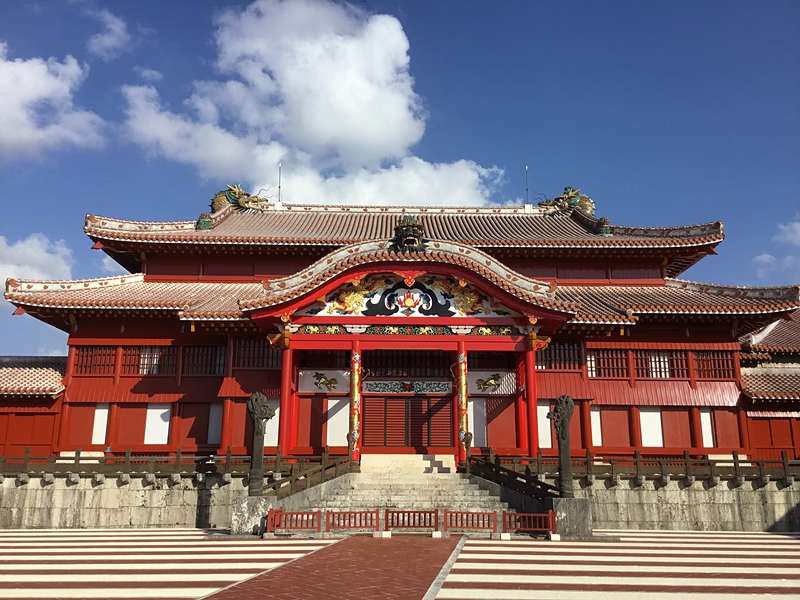
Archaeology dates the earliest Seiden on this location to the late fourteenth century. The building burned and was rebuilt several times under the Ryukyu Kingdom, was destroyed again in 1945, restored in 1992, and lost once more in the 2019 fire. The ancient stone foundations survive as a separate evidence layer below modern reconstruction. As verified in August 2026, the reconstructed exterior is visible while interior work continues, and general public opening of the Seiden is scheduled for 23 November 2026; current admission and reservation rules should be checked before visiting.
Current visibility
The visible Seiden is a current reconstruction, while ancient foundations survive below as a separate archaeological layer; interior access and opening arrangements remain time-sensitive and require an official current check.
The 1609 Invasion and Layered Ryukyuan Sovereignty
Attraction
The 1609 Satsuma invasion, involving King Shō Nei, transformed Ryukyu's political position without immediately erasing the kingdom or its court. After 1611 Ryukyu continued tributary relations with Ming China while also existing under Satsuma's control. This layered sovereignty is essential to understanding how the Ryukyu court continued to operate between two political relationships.
Current visibility
The castle precinct and reconstructed royal setting anchor the 1609 invasion narrative; surviving gates and archaeology must be distinguished from buildings lost or rebuilt later.
Shuri as a Ryukyuan Royal Capital
Attraction
Shurijo combined stone fortification with a royal court, sacred sites, diplomatic gates, government buildings and performance culture. Chinese and Japanese architectural influences are visible, but they do not make Shurijo a derivative object between two stronger traditions. The institution was Ryukyuan. The most important category here is not 'fusion' but Ryukyuan statehood expressed through a distinctive court complex.
Current visibility
At Shuri Castle, “Shuri as a Ryukyuan Royal Capital” is grounded in present on-site evidence—the gate sequence, the surviving building, and the performance space—without implying that every historical layer survives as fabric.