Map: GSI Japan Kōchi was one of the principal regional centers of the Freedom and People's Rights Movement. The city museum, Itagaki Taisuke's birthplace marker, the Risshisha site, and later monuments connect demands for an elected assembly and constitutional government to local organizations, education, print, and public memory. These are dispersed sites rather than a preserved political headquarters, so documents and markers carry more historical weight than surviving nineteenth-century rooms.
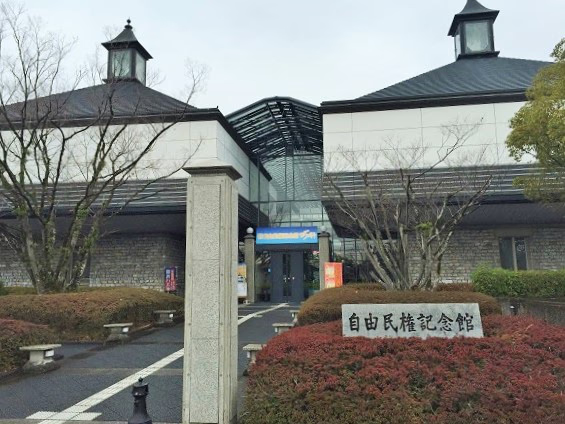
Kōchi City Freedom and People's Rights Memorial Museum
Attraction
Opened in 1990, the museum gives Kōchi's dispersed political sites a documentary center. Photographs, printed material, cartoons, models, film, and historical objects trace a movement that linked former samurai leaders with teachers, journalists, farmers, local associations, and new political parties. The building itself is modern and its four tower-like forms were designed around the image of the light of liberty. That symbolism should not overshadow the collections: the museum's central value is its ability to compare claims about popular rights with the organizations and media through which those claims became public.
Current visibility
The museum is an operating institution; current opening, admission, and exhibition information should be checked officially.
The 1874 Petition and Risshisha's Local Organization
Attraction
After leaving the Meiji government, Itagaki and fellow petitioners demanded an elected assembly in 1874. Back in Kōchi, he joined local associates in founding Risshisha. The society combined political education and debate with practical concerns about livelihood and the capacity to participate in public life. That combination is important: rights were not presented only as abstract constitutional language but as knowledge, organization, economic security, and repeated collective action. Museum documents and the Risshisha site marker connect a national petition to the local institution that kept pressure for representation alive after officials rejected the immediate demand.
Current visibility
The episode is interpreted through museum material and a marked city site; the original Risshisha office does not survive there as an intact building.
The Gifu Attack Dagger and the Making of a Political Slogan
Attraction
The museum holds the dagger associated with the attack on Itagaki at Gifu in 1882. Reports attached the phrase commonly translated as “Itagaki may die, but liberty never will” to the wounded politician, and the words became more durable than the precise circumstances of their utterance. The object permits a critical reading of political celebrity: violence, newspaper circulation, prints, and later retelling turned an attack far from Kōchi into a national symbol. Because historical objects can move for conservation or loans, the dagger belongs to the collection even when its exact display status should be checked.
Current visibility
The dagger is a museum collection object; permanent or temporary display should be confirmed with the museum.
Itagaki Taisuke Birthplace Marker
Attraction
A stone marker in central Kōchi identifies the neighborhood where Itagaki was born in 1837 into a Tosa samurai family. It is a commemorative marker, not his preserved birth house. That distinction shifts attention from domestic reconstruction to urban context: the future movement leader emerged from the castle town and its status order before becoming a Restoration official, resigning in the 1873 political crisis, and returning to organize locally. The marker is most useful when connected to the museum and Risshisha site, which show how a personal birthplace became one node in a broader political geography.
Current visibility
The outdoor marker identifies the birthplace area; no intact birth residence is implied.
Risshisha Site Marker in the Commercial City
Attraction
The Risshisha marker locates political organization within the working city rather than inside a government compound. The society used more than one office during its life, and the surviving monument does not reproduce a meeting room. Its value is positional: speeches, petitions, newspapers, education, and local membership required accessible urban premises. The marked site makes it possible to connect museum documents to the streets in which organizers recruited support and negotiated social divisions. It also prevents the movement from being reduced to Itagaki alone, since Risshisha depended on many named and unnamed participants.
Current visibility
A monument marks the historical location; the nineteenth-century office building is not preserved.
The Itagaki Statue at Kōchi Castle and Public Memory
Attraction
The Itagaki statue near Kōchi Castle places a modern political leader within the monumental landscape of the former domain. It is not evidence of his physical appearance at one documented moment, nor is it a surviving object from the Freedom and People's Rights Movement. As public commemoration, however, it shows how Kōchi selected Itagaki to represent a regional contribution to parliamentary politics. The contrast with the museum is productive: the statue condenses a complex career into a heroic figure, while documents reveal disagreements, party organization, cabinet service, and the uneven limits of political participation.
Current visibility
The outdoor statue is visible in the castle area; temporary event or maintenance restrictions may occur.