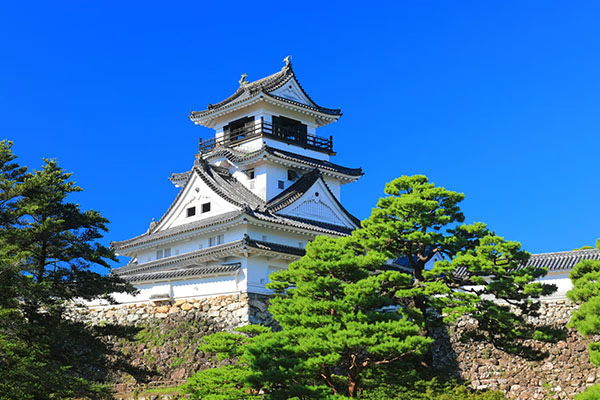
The Early-Seventeenth-Century Castle and the 1749 Keep
Attraction
Kazutoyo began building Kochi Castle in 1601 and the first complex was completed by 1611. The present keep, however, belongs to the rebuilding after the catastrophic 1727 fire. It was completed in 1749, with the wider restoration largely finished by 1753. The correct first impression is therefore layered: early-Edo foundation, mid-Edo surviving fabric. That distinction is visible before entry. Otemon predates the fire, while the keep rising beyond it belongs to the eighteenth-century rebuilding. Kochi is exceptional because the keep and the honmaru palace buildings survive together, allowing the summit to be read as a functioning political compound rather than as an isolated military tower. The surviving Edo-period buildings are nationally designated Important Cultural Properties, and the castle grounds are a National Historic Site.
Current visibility
Ōtemon retains fabric from before the 1727 fire, while the 1749 keep records the eighteenth-century rebuilding; the castle core consists of surviving historic structures rather than modern reconstructions.
Attraction
The 1727 fire destroyed almost every major building in the castle except Otemon and a limited number of structures. That makes the gate a crucial chronological anchor. Unlike the 1749 keep, it carries fabric from before the great rebuilding. Beginning the climb through Otemon lets the visitor physically cross from one historical phase into another. From outside the gate, the keep appears above the opening, producing the classic paired view of two structures from different phases. Pass through slowly and note the massive timbers, plastered walls and narrow approach. The gate is not simply an entrance photograph: it establishes the pre-fire baseline against which the rebuilt summit buildings can be understood.
Current visibility
The surviving setting at Kōchi Castle anchors “Ōtemon and the 1727 Fire”; its physical context is the surviving building, the castle compound, and the gate sequence.
The Surviving Honmaru as a Political Complex
Attraction
Kochi's greatest distinction is not simply that the keep survives. The official castle emphasizes that all the Edo-period buildings of the honmaru remain, including the palace. This lets visitors read a castle's main compound as an operating system: the lord's residence and audience rooms, defensive tower, gates and circulation all remain spatially connected.
Current visibility
At Kōchi Castle, “The Surviving Honmaru as a Political Complex” is grounded in present on-site evidence—the castle compound, the surviving building, and the palace rooms—without implying that every historical layer survives as fabric.
Honmaru Palace Rooms and Government
Attraction
Castle imagery privileges height, but most government happened in lower rooms. Kochi's surviving honmaru palace makes this obvious. Audience, residence and formal movement occurred here while the keep projected authority above. The palace preserves the everyday political function that a keep silhouette cannot show. Look beyond the display objects to the lower ceiling heights, room sequence and thresholds. They reveal how audiences and residence were organized beside the vertical military symbol of the keep.
Current visibility
The present precinct at Kōchi Castle still carries “Honmaru Palace Rooms and Government”; visitors can ground the text in the palace rooms, the castle compound, and the audience space.
Kazutoyo, Later Rebuilding and Accurate Dating
Attraction
Yamauchi Kazutoyo remains essential to Kochi’s origins: he began the castle and new domain center after Sekigahara, but he never saw the keep completed in 1749. A founder should not collapse later building history into one personal story. Kazutoyo founded the domain center after Sekigahara, but the surviving keep was completed long after his death. Separating those dates preserves his political importance without assigning later architecture to him.
Current visibility
The place-specific feature discussed as “Kazutoyo, Later Rebuilding and Accurate Dating” is anchored by the castle compound and the surviving building, but today's access or operating condition at Kōchi Castle requires a current official check.
The Intact Honmaru Political Core
Attraction
Kochi's value lies in relationships among surviving buildings. Otemon anchors the pre-1727 phase; the keep records the 1749 rebuilding; the palace and other honmaru structures preserve the operation of the main compound. The site does not need reconstruction to make the castle legible. Its surviving fabric already forms a coherent historical argument.
Current visibility
Kōchi Castle's Ōtemon, keep, palace, and related honmaru structures are surviving fabric from different historical phases; this core does not depend on modern reconstruction.