Read the article below. Interactive reading tools are available when scripts load.
Quick
Saichō was born in Ōmi, near Lake Biwa, in either 766 or 767. The two years reflect different evidence: a traditional biography underlies 767, while an institutional examination of official ordination documents supports 766. He studied with Gyōhyō, a monk in Ōmi, and received full ordination at Nara’s Tōdai-ji in 785. This ceremony admitted him to the state-recognized clergy under monastic disciplinary rules. Soon afterward he moved to Mount Hiei, where he established a small temple in 788. [1][2]
His community needed books as well as a place to practice. Other monks helped supply copied Buddhist texts. Saichō became a court chaplain in 797 and taught Tiantai, the Chinese tradition known in Japan as Tendai. Its interpretation of the Lotus Sutra’s “one vehicle” brought different paths toward a common destination: Buddhahood, awakening as a Buddha. Lectures at Takaosan-ji, a temple near the new capital, increased his access to patrons. Emperor Kanmu’s support helped make overseas study possible. [1][13][14]
In 804 Saichō crossed to Tang China with an official embassy. Kūkai, another monk sent to study in China, traveled in the same embassy on another ship; the two monks followed different routes and study assignments. Saichō went to the Tiantai region with Gishin, his disciple and interpreter. Chinese teachers provided instruction and books to copy. He received Tiantai teaching, meditation training and bodhisattva precepts: commitments to work toward awakening while helping other beings. [1][3]
Before departure he also received esoteric initiation, a ceremony admitting a student to religious instruction conveyed through supervised ritual practice. He returned to Japan in 805 with teaching and texts from several traditions. These resources could be combined around the Lotus Sutra, but an enduring school would need recognized students and teachers. [1]
In 806 the court granted Tendai two new officially recognized monks each year. One would study its scriptural and meditation curriculum, the other esoteric practice. Students still depended on the established ordination system for recognized full monastic status. Saichō’s school had gained a place in official Buddhism while remaining institutionally constrained. [1][9]
From 809 his surviving letters show requests to borrow Kūkai’s imported texts. In 812 he received Kūkai’s esoteric initiations at Takaosan-ji, and disciples also studied there. Saichō sought knowledge for Hiei; Kūkai insisted that advanced teaching required direct instruction. Their exchanges continued into 816, but cooperation deteriorated. A museum account associates a refusal to lend a text with 813, while Ryūichi Abé’s study places the final rupture around 816. Their disagreement did not erase the instruction already received or the choices of disciples such as Taihan, who remained with Kūkai. [3][4]
During these same years, Saichō’s work extended into the provinces. He visited Kyushu in 814 and the eastern provinces in 817, drawing on connections with monks who had helped supply his community’s books. He gave bodhisattva precepts and planned towers to house the Lotus Sutra. The project connected religious teaching with the protection of the country. [1]
A written controversy with Tokuitsu, a Hossō scholar monk active in Aizu in eastern Japan, became another major task. Saichō maintained that the Lotus Sutra’s single path to Buddhahood expressed the final truth. Tokuitsu defended distinctions between spiritual capacities and destinations. They argued through scriptural interpretation and criticism of each other’s explanations. Tokuitsu’s debate works have largely been lost, so his position is reconstructed through quotations preserved by opponents. Saichō’s later institutional success does not settle that doctrinal argument. [7]
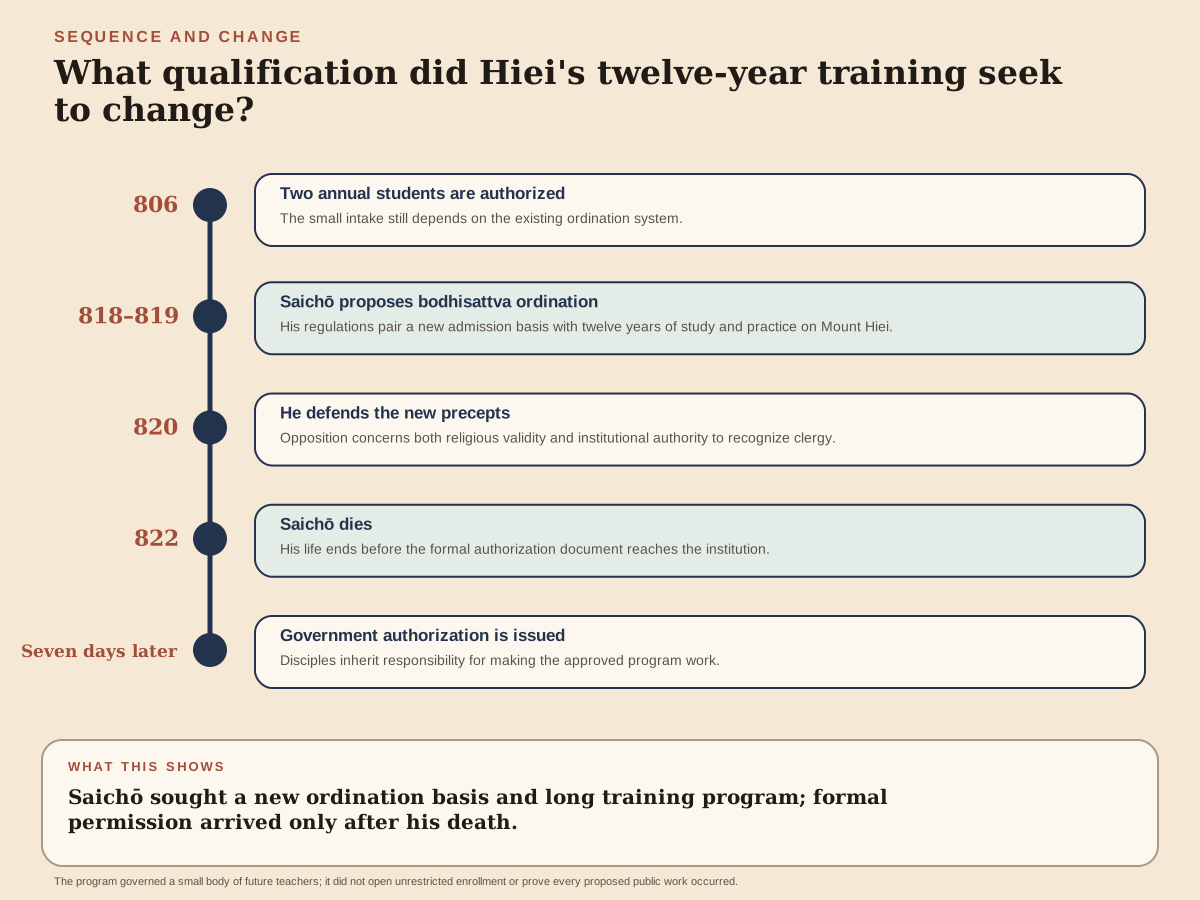
Alongside that controversy, Saichō submitted regulations in 818–819 proposing that Tendai students receive bodhisattva precepts on Hiei and undergo twelve years of mountain training. He wanted a recognized clergy suited to his understanding of the Lotus Sutra. His curriculum joined study with practice, and his proposals assigned graduates roles in teaching and service. It was intended to produce future religious leaders through a small intake, rather than admit everyone directly to a new educational system. [1][6]
The clerical authorities overseeing monks resisted the change in ordination standards. Saichō answered in petitions and his Kenkairon, a defense of the precepts completed in 820. He died in 822. The formal government document authorizing Hiei’s system was issued seven days after his death. An institutional biography reports an earlier imperial decision, but does not establish that Saichō learned of it. His disciples had to carry out the authorized system. [1][9]
After Saichō’s death, the mountain temple received the name Enryaku-ji and Gishin assumed responsibility for transmitting the teaching. Later monks, including Ennin, expanded the institution’s ritual and doctrinal resources. In 866 Saichō received the posthumous title Dengyō Daishi. That title belongs to the history of his commemoration, rather than to an office he held while alive. [9]
Hiei later educated figures such as Hōnen and Nichiren, who founded traditions with different emphases. Saichō supplied an institutional beginning whose possibilities others changed. The documents preserving his career also have histories of their own: letters survive in later copies as well as an autograph, and printed versions of his import catalogs contain manuscript differences. The letters preserve his requests for books and instruction; the catalogs preserve material for a community that other monks continued. [6][4][10][8]
Classic
Historical disagreement · 766 or 767?
In 785 Saichō received full ordination at Tōdai-ji, the great temple in Nara. The ceremony recognized him as a monk under the disciplinary rules used by Japan’s authorized clergy. He had trained with Gyōhyō in Ōmi, the province beside Lake Biwa, where he had been born in either 766 or 767.
The later traditional biography supports the familiar 767 date; an institutional historical note points to official ordination documents as evidence for 766. Neither estimate changes the sequence of his documented adult career. [1][2]
Saichō soon moved to Mount Hiei. In 788 he established the small temple called Ichijō Shikan-in, the beginning of the institution later known as Enryaku-ji. His early religious vows tied personal discipline to the benefit of other beings. They expressed a demanding aspiration: he was to qualify himself through practice before serving patrons, and the merit of his work was to be shared. Such promises describe his religious purpose; they do not provide a diary of what he felt or demonstrate that he fulfilled every vow. [1][12]
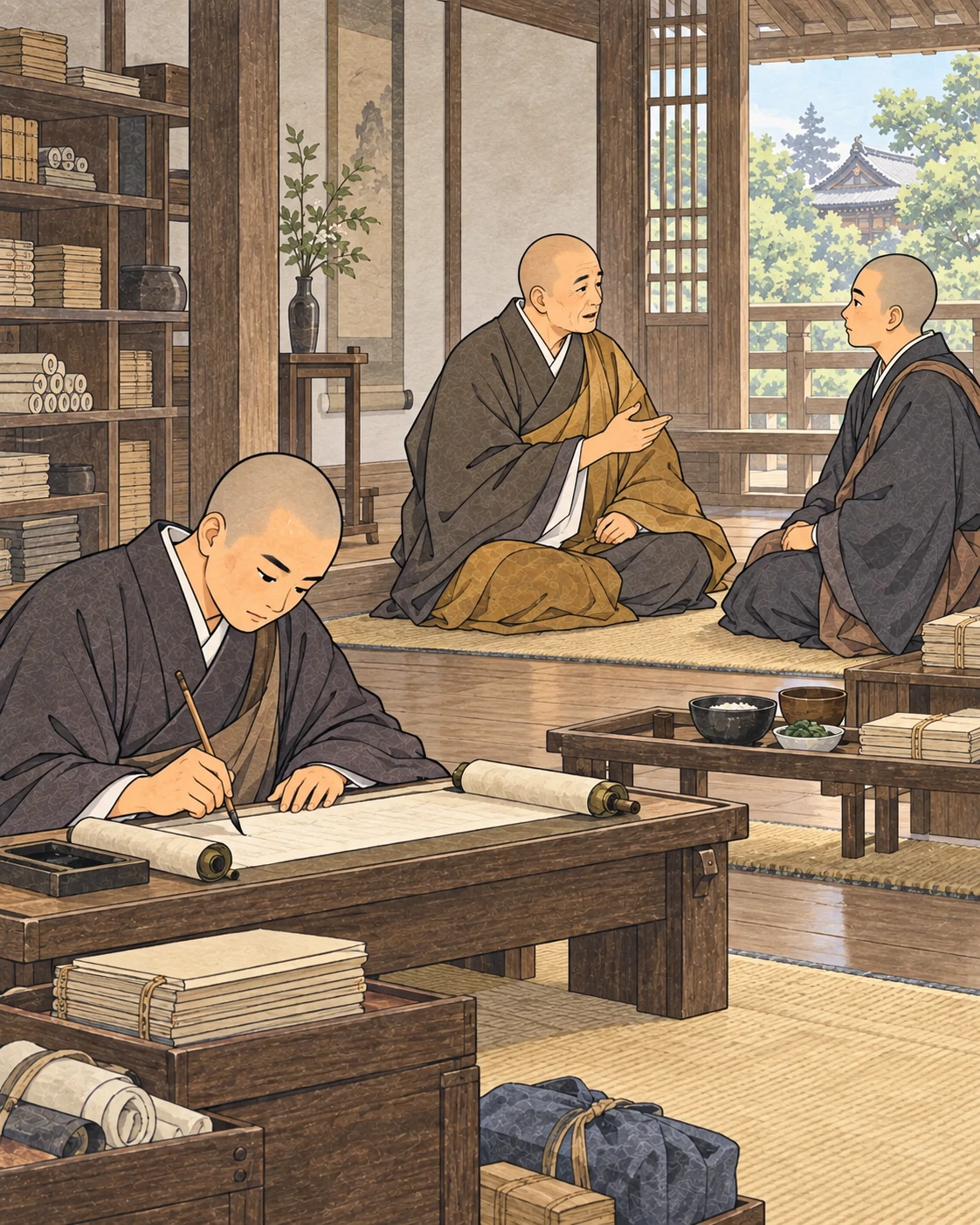
The mountain needed a collection of Buddhist writing. A community studying texts could not depend on Saichō remembering what he had read elsewhere. The Tendai institutional biography names Monjaku, a monk at Nara’s Daian-ji, and Dōchū, a monk in the eastern provinces, among those who supplied copied scriptures. Manuscript work made the community’s learning possible and connected the mountain to institutions beyond it. The same Nara world that later resisted Saichō’s ordination program also supplied scholarly contacts and books. [1]
In 797 he was appointed a court chaplain, a monk serving the emperor through religious rites. His access to Emperor Kanmu grew alongside his teaching. Saichō’s interpretation drew on Tiantai, the Chinese tradition associated with Zhiyi, known in Japan as Tendai and centered on the Lotus Sutra. Its “one vehicle” joined differing forms of Buddhist instruction within a path ultimately leading to Buddhahood, awakening as a Buddha. In 802 lectures at Takaosan-ji brought that learning into a setting supported by patrons close to the ruler. [1][13][14]
The mountain community thus developed through several kinds of work. Residence and religious discipline gave it a place and a purpose; copied books supplied teaching material; lectures and court service widened support. Saichō could read Tiantai writing in Japan, but traveling to China offered access to living teachers and further texts. The overseas journey arose from a community already taking shape. [1][9]
Saichō departed for Tang China in 804 under Kanmu’s patronage. He traveled through an imperial embassy, accompanied by Gishin, his disciple and interpreter. Kūkai sailed in the same embassy on a different ship, with a longer study assignment. Their separate routes matter: Saichō’s work centered on the Tiantai region, while Kūkai’s esoteric training developed in Chang’an. The embassy carried several projects rather than one shared course of learning. [1][3]
On reaching the Chinese coast Saichō and Gishin went toward Tiantai. Daosui made teaching texts available and facilitated copying; Xingman provided further instruction on the mountain. These teachers brought Saichō into a transmission extending beyond the books he had found in Japan. Gishin’s interpreting role joined language to religious learning: access to a teacher required communication, and the resulting instruction had to be carried home in a form others could use. [1]
Saichō received bodhisattva precepts, commitments to pursue awakening while benefiting other beings, as well as Tiantai instruction and meditation training. Before returning, he also encountered Shunxiao, a teacher who conferred esoteric initiation. Esoteric practice conveyed knowledge through ritual procedures under a teacher’s guidance. It supplied a different kind of resource from an explanation read in a commentary, although Saichō would try to place these teachings within one religious program. [1]
Evidence boundary · Two catalogs with different histories
The materials he brought back were recorded in two import catalogs. The Taizhou list principally records Tiantai-related writing; the Yuezhou list includes esoteric works and other items. Their survival is unequal. The Yuezhou catalog at Enryaku-ji is treated as Saichō’s own handwriting, while the Taizhou list survives through copies with differences in wording and order. Hiromi Yamaguchi’s study of a manuscript formerly held at Ishiyama-dera identifies variations in the order and wording of entries.
The printed Taizhou catalog reflects that history of copying. [8]
Saichō returned in 805. His Chinese study had been brief compared with the prolonged stay intended for Kūkai, but it gave him teachers, religious authorization and a body of material for his community. The teaching would now have to be reproduced in Japan. Books could be copied and instruction passed on, but students still needed recognized status, and the court expected religious service in return for support. [1][3][9]
In 806 Tendai received an allotment of two new, officially recognized monks each year. The government divided that intake between a course of scriptural study and meditation and a course of esoteric practice. This was a concrete opening: Saichō’s community could recruit within the authorized clerical system. It also placed obligations on the students, who were to perform practices associated with protection of the country. Recognition as a teaching community did not grant Hiei an independent way to confer recognized full ordination. [1][9]
The esoteric course required knowledge that Saichō continued to seek. His surviving correspondence with Kūkai includes requests to borrow imported books from 809 onward. Copying was practical institutional work. Hiei needed material from which more than one student could learn, and Saichō had facilities for transcription at his own temple. In letters analyzed by Ryūichi Abé, he explained the difficulty of arranging copying elsewhere, including food for those doing the work. Manuscript transmission consumed time and provisions. [3]
In 812 Saichō received esoteric initiations from Kūkai at Takaosan-ji. Kūkai’s initiation register places him at the head of the lists for the two mandala traditions, religious arrangements of deities used in ritual teaching. Several of Saichō’s disciples also took part. A letter requesting support from Fujiwara no Fuyutsugu, a court official, connects the ceremonies with the problem of supplying their participants. The cooperation was performed by a community whose religious work needed food and patronage. [3]
Saichō’s autograph letter of 813, preserved at the Nara National Museum and known as the Kyūkakujō, was addressed to Taihan, his disciple then studying with Kūkai. It asks for help understanding writing connected with their literary and religious exchanges. The letter preserves a respectful relationship, while the wider correspondence reveals different expectations. Kūkai insisted that advanced esoteric texts required direct instruction and qualified practice; Saichō pursued materials for a Tendai curriculum that included esoteric learning. [4][3]
Historical disagreement · When did Saichō and Kūkai finally break?
The chronology of the final break is less simple than a single refused loan. The museum explanation connects a refusal episode with 813. Abé, using correspondence showing continuing exchanges, places Kūkai’s final ultimatum and the rupture around 816. In his reconstruction, exchanges continued after the 813 episode.
Both accounts concern a relationship that became strained over access and training. [3][4]
Taihan remained with Kūkai, while other disciples carried learning back to Hiei. The developing schools acquired their boundaries through these choices as well as through their founders’ arguments. [3][4]
While Saichō was exchanging books and requests with Kūkai, he was also building connections outside the capital region. The institutional biography records a visit to Kyushu in 814 and travel to the eastern provinces in 817. In the east he visited temples connected with Dōchū, who had helped provide books for Hiei. He conferred bodhisattva precepts and esoteric initiation, linking provincial communities with the learning developed on the mountain. [1]
He planned towers at six locations to house the Lotus Sutra. The project gave a physical form to the association between Buddhist teaching and the protection of the country. It also depended on communities able to provide sites and sustain worship. The biography identifies towers at Daiji-ji in Shimotsuke and Midono-ji in Kōzuke, eastern provinces in what are now Tochigi and Gunma. The six-site scheme was a plan, however; that description does not establish that Saichō completed all six towers. [1]
Another eastern monk presented a challenge to Tendai teaching. Tokuitsu, a scholar of Hossō active in Aizu, defended a Buddhist account that distinguished spiritual capacities and the destinations available to them. The three vehicles referred to paths of disciples, solitary awakeners and bodhisattvas, which did not necessarily end in the same attainment. For Saichō, the Lotus Sutra’s one vehicle disclosed the ultimate destination of Buddhahood. The question was whether differences between paths were final or were provisional teaching leading toward a common end. [7]
The controversy developed in writing. Saichō’s Mirror Distinguishing Provisional and Final Teaching answered Tokuitsu’s criticism; further works enlarged the exchange. The argument concerned the interpretation of scriptures and the standing of Tiantai learning, including its explanation of meditation. Each writer sought to show that his account made sense of Buddhist teaching as a whole. [7]
Evidence boundary · Hearing Tokuitsu through his opponents
Much of Tokuitsu’s side survives through quotations incorporated into opponents’ responses because his debate works have largely been lost. That unequal preservation gives Saichō a larger surviving voice.
It also limits reconstruction of the exchange: a quotation selected for refutation does not preserve every part of the original argument. Saichō’s eventual success in securing an institution established a setting in which his teaching could continue. It did not provide a neutral verdict on every doctrinal question. The commitment to one vehicle nevertheless helps explain why the qualifications for Tendai monks became so important in his final years. [7][1]
Alongside his doctrinal controversy, Saichō sought permission for a different ordination system. Regulations submitted in 818–819, collectively known as the Sange gakushōshiki, set out a program for Tendai students on Mount Hiei. He proposed that bodhisattva precepts qualify its monks and that they remain on the mountain for twelve years of study and practice. Existing full ordination used a disciplinary code with 250 rules for monks and took place at established authorized centers. Changing the rule and the place of admission therefore affected the authority to recognize a member of the clergy. [1][9]
The curriculum was demanding. In the eight-article regulations, Saichō gave greater weight to study in the first six years and to reflection and practice in the latter six. Buddhist learning was accompanied by non-Buddhist study, and students were to lecture as part of their training. The scriptural and meditation course and the esoteric course prescribed different practices. These were regulations for a small body of future teachers, not evidence that every person could enroll in a new mountain school. The authorized intake remained two monks each year. [6]
His proposals also considered what graduates would do. The opening of the regulations valued religious purpose joined to the ability to speak and act. Subsequent provisions differentiated those suited to lead the mountain community from those who would teach or serve in the provinces. Provincial service could include maintaining irrigation and making bridges, under supervision by local officials. The proposals prohibited private commercial work. These provisions connected religious discipline with service and government oversight; they describe an intended arrangement rather than a verified record of public works completed by Saichō’s graduates. [11][5]
Nara clerical authorities opposed the new ordination standard. Saichō answered through petitions and the Kenkairon, a defense of the precepts completed in 820. His use of the dismissive term “lesser vehicle” for established discipline was part of his argument that a bodhisattva clergy required its own basis of admission. The opponents’ position concerned the validity of ordination as well as institutional control. The disagreement was serious even though all sides worked within a Buddhist world sustained by the court. [1][9]
Historical interpretation · Approval before or after death?
Saichō died in 822. The formal government document permitting Hiei’s ordination system was issued seven days afterward. A Tendai biography distinguishes that document from an earlier imperial decision reportedly preserved in an excerpt of the court chronicle.
The report does not establish that the news reached Saichō. His own petitions and defenses had made the case; disciples would now have to make the authorized program work. Permission altered Hiei’s institutional position, without proving that every building or provision had already been completed. [1][9]
After Saichō’s death the mountain temple received the name Enryaku-ji, and Gishin became responsible for transmitting its teaching. Ennin, a later leader, brought further learning from China and expanded the mountain’s religious practices. Enchin and Annen also contributed to the development of Tendai esoteric teaching. Their work matters because the broad religious system associated with Hiei grew after its founder: the ninth-century community did not emerge with all its later teaching, offices and buildings complete. In 866 the court granted Saichō the posthumous title Dengyō Daishi. [9]
In later centuries Hiei educated monks who established different religious traditions. Hōnen and Nichiren were among those who studied there, drawing on resources that they developed in distinct directions. Their careers demonstrate the reach of the educational institution, while also showing the limits of attributing later Buddhism to one man’s design. Saichō’s program made sustained learning and qualified religious practice an institutional task. Successors could continue it, change its content or pursue a different emphasis. [6][9]
Evidence boundary · Originals, copies and a printed edition
His surviving papers reveal another kind of continuity. The Nara National Museum holds a scroll copied by the monk Ryūshō in 1289, containing letters, Saichō’s will and an oath by Enchō, a disciple. Several letters concern borrowing texts from Kūkai and requests for religious transmission. This is a later witness to ninth-century communication, rather than a bundle of Saichō’s original sheets. Ryūshō’s copied scroll survives alongside the separate autograph letter of 813. [10][4]
Transmission also introduced problems. A preface to the 1821 printed edition of his import catalog states that the Taizhou original was lost amid the destruction of Hiei in 1571 and describes the copies used for the edition. Yamaguchi’s comparison identifies differences in order and wording across surviving witnesses.
Commemoration helped preserve the catalog and made it available in print, but it did not remove the accumulated changes of copying. [8]
Saichō’s achievement endured through the community that he founded, the texts it assembled and the disputed ordination program his disciples inherited. Those who taught, copied, defended and enlarged the institution gave his work its later scale. The founder’s life ended in 822; his presence in titles, manuscripts and the mountain’s teaching belonged to the work of later generations. [1][9][8]