Read the article below. Interactive reading tools are available when scripts load.
Quick
Rōben is conventionally dated 689–773, but accounts disagree about his origin. One places him in Sagami, now Kanagawa Prefecture, and associates his family with the Urushibe; another places him in Ōmi, around Lake Biwa in present-day Shiga Prefecture, and connects him with the Kudara line. The famous story in which an eagle carries the infant away to be raised by the monk Gien belongs to Tōdai-ji's later sacred memory. The legend eventually supplied Rōben with separation, providential rescue, and reunion with his mother. The tale is not a contemporary account of his childhood. Firm history begins later, when sources place an adult monk at the institutions from which Tōdai-ji developed. [3][4]
Rōben is remembered as a disciple of Gien and as a monk involved in mountain practice and protective rites. The community known as Kensaku-in and devotion to Shūkongōjin, a Buddhist guardian deity, belong to that religious setting. He worked among overlapping teachings and ritual traditions before Tōdai-ji developed its later Kegon, or Flower Garland Buddhist, identity. [1][3][4]
Tōdai-ji traces a predecessor to a mountain temple established in 728 to pray for the repose of Crown Prince Motoi, Emperor Shōmu's infant son, who had died that year. Rōben is placed at Kinshō-ji by 733. He served the resident community through the changes that later made it Yamato's principal provincial temple and the home of the Great Buddha. His importance was continuity as the institution grew. [1][2][3]
In 740 Rōben invited Shinjō, a monk from the Korean kingdom of Silla then associated with Daian-ji, to lecture on the Flower Garland Sutra at Kinshō-sanji. Tradition dates the opening to the eighth day of the tenth month and links it to Shōmu's fortieth year. The lectures introduced the Chinese Flower Garland tradition, known as Huayan and called Kegon in Japan, to the community that became Tōdai-ji. The timing was not peaceful. Fujiwara no Hirotsugu, an official challenging the government, had rebelled the previous month, and the court was mobilizing against him. Doctrine did not cause the rebellion or automatically produce the Great Buddha edict. It supplied a vision of interdependence centered on Vairocana, the Buddha represented by Tōdai-ji's Great Buddha, within a temple and court confronting political disorder. [1][3][8]
Shōmu's 741 provincial-temple policy changed Kinshō-ji's place in the realm. It became Yamato's Konkomyō-ji, a central institution tied to state rites. A 742 directive admitted it to the pattern of major temples holding an annual summer retreat. Around 743 Rōben appears as its senior monk, and the temple hosted a forty-nine-day model ceremony intended to guide practice elsewhere. In 746 Rōben began a Lotus ceremony at Kensaku-in, later remembered as the cherry-blossom assembly. These acts show institutional growth before the 752 opening: recurring calendar, doctrinal teaching, royal visits, and senior responsibility were already making a temple. [1]
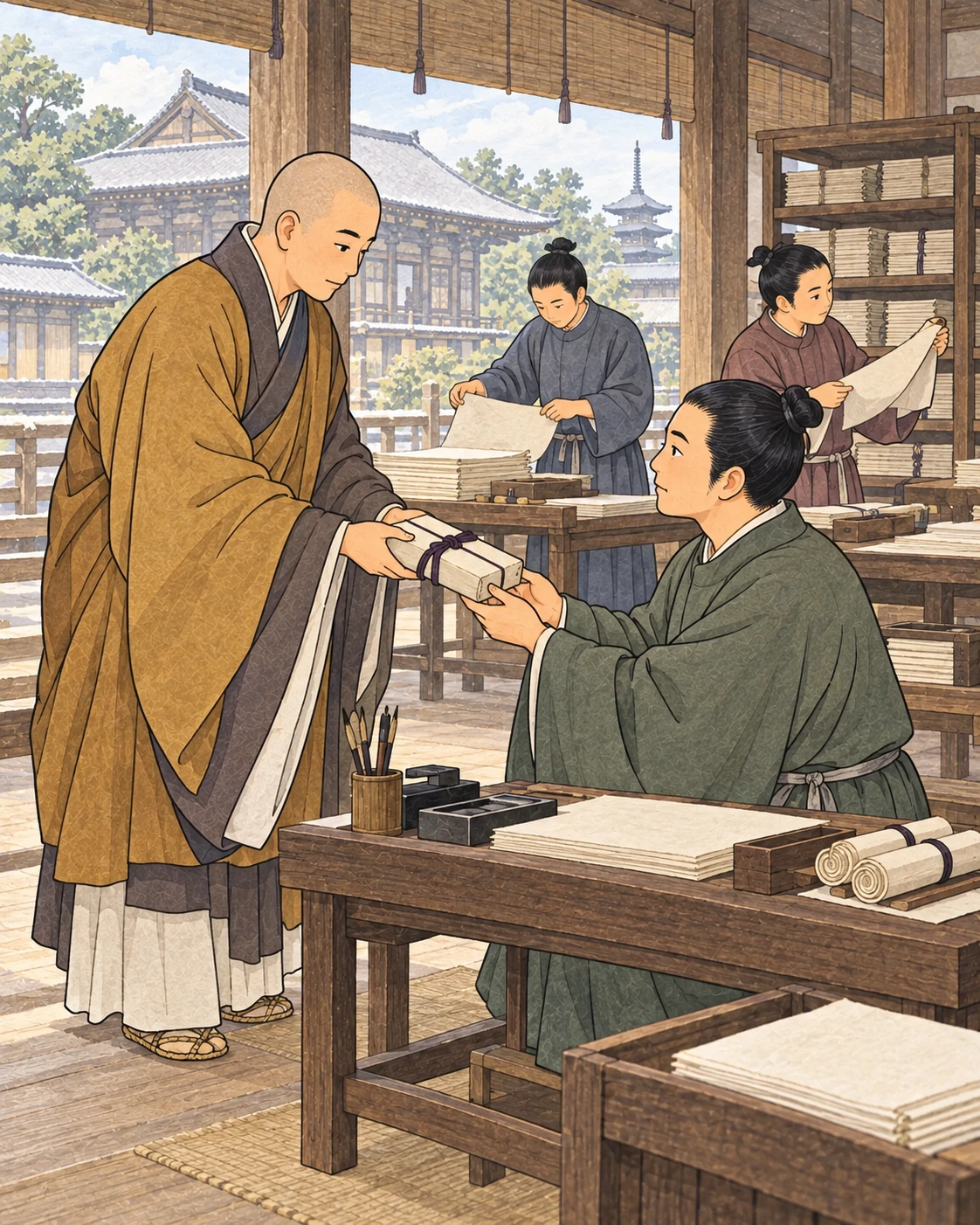
When the court returned to Nara in 745, the Great Buddha project moved into the Konkomyō-ji setting. Rōben's community supported construction while maintaining teaching and rites. Documents connect him with sutra-copying activity carried out through an organization that had grown from the household of Kōmyō, Emperor Shōmu's consort, and increasingly worked with the temple-building administration. His instructions helped turn religious requirements into assigned work. A directive bearing his signature survives from 753 among Shōsōin documents, kept in the imperial treasure repository at Nara. [8]
After the Great Buddha project moved to Nara in 745, Rōben led the older temple community within the expanding construction site. State officials procured materials and managed specialists; the resident monks maintained worship, teaching and provision for their community. Rōben communicated religious needs to the construction administration. His temple leadership was already important before the image was complete, although formal appointment as the first bettō, the monk responsible for temple affairs, followed the opening in 752. [3][8]
The year 749 brought several milestones. Gold from Mutsu, in northeastern Japan, answered the project's shortage and was presented by the court as a sign of Buddhist and divine support. The bronze body was completed in the tenth month after repeated casting. Gyōki, whose kanjin had mobilized contributions and participation, died before the bronze completion. In the twelfth month, a priestess of Hachiman, the Japanese deity worshipped at Usa Shrine in northern Kyushu, entered the capital in a purple palanquin and visited Tōdai-ji as sovereigns, officials, and thousands of monks gathered. These events expanded the temple's religious world: the Great Buddha and court patronage met protection by kami, Japanese deities. They did not finish the hall, surface, or institution. Later accounts give Hachiman a fuller promise than the earliest notices, so the developed story cannot simply be assigned to the first announcement. [7][8]
In the fourth month of 751 in the Japanese calendar, the court appointed Bodhisena, an Indian Buddhist monk, sōjō (the highest of the three offices), Rōben shōsōzu (the deputy rank), and Dōsen, another Buddhist monk, risshi (the junior rank). The appointments placed monks with different transregional histories into the recognized clerical hierarchy before the Great Buddha opening. On the ninth day of the fourth month of 752 in the same calendar, Bodhisena performed the eye-opening rite. The royal household joined clergy, officials and performers at the gathering. Rōben already led the resident community. Historian Horike Shunpō's biographical account dates his formal appointment as the first bettō, the monk responsible for temple affairs, to the first day of the following month, after the eye-opening. The ceremony made the image publicly and ritually present; it did not end Tōdai-ji's administrative work. [3][6][8]
Tōdai-ji did not settle into one practice after the opening. In 752 Jitchū, remembered as Rōben's disciple, established the annual Shuni-e repentance rite. In 754 Ganjin, the Chinese monk invited to establish recognized ordination, used a temporary platform before the Great Buddha to confer precepts, and a permanent ordination precinct followed. These developments added calendars, specialists, and forms of authority to the temple. Rōben's surviving copying instructions also place him within written administration. As bettō, he coordinated a plural institution, but Jitchū and Ganjin remain agents in their own right. [3][5]
Rōben attended Retired Emperor Shōmu during his final illness in 756. The court praised Rōben and Jikun for serving day and night and rewarded several monks. Rōben and Ganjin became daisōzu (a senior clerical rank). This was religious and bodily service, not merely temple politics. In 760 Rōben, Jikun, and Hōshin petitioned on clerical ranks and Tōdai-ji's resources. The temple's five thousand tax households were divided among repair, support of the Three Treasures—the Buddha, Buddhist teaching and monastic community—and resident monks, and state Buddhist rites. High office meant decisions about labor and income as well as ceremony. [3][6]
Rōben's institutional reach extended beyond Nara. From 761, the Office for Building Tōdai-ji expanded Ishiyama-dera near Lake Biwa and the Seta River. Records associate Rōben with directing a large clay image of Kannon, a Buddhist figure of compassion, and two guardian figures in 761–762. The site also served as a collection and transit point for timber moving toward Tōdai-ji. Ishiyama-dera later told a foundation story in which Rōben prayed for the gold needed by the Great Buddha and a sacred image refused to leave the rock. The story belongs to temple memory. Documents support construction and logistics more securely than the miraculous cause. [3]
Late in life Rōben reached sōjō, the highest regular clerical office. Tōdai-ji dates the promotion to 763. Architectural historian Koiwa Masaki's study identifies 771 in a clerical appointment register and 773 in temple chronologies, while reporting historian Kishi Toshio's document-based inference of 764. No single promotion year is established across those sources. His disciples and associates carried work into the next generation. He died in the intercalary eleventh month of 773 in the Japanese calendar. Tōdai-ji observes the sixteenth as his death day, while the Shoku Nihongi, the court chronicle, reports his death and the condolence mission under the twenty-fourth. It is unclear whether the later entry marks the death itself or its reporting. [3][4][6]
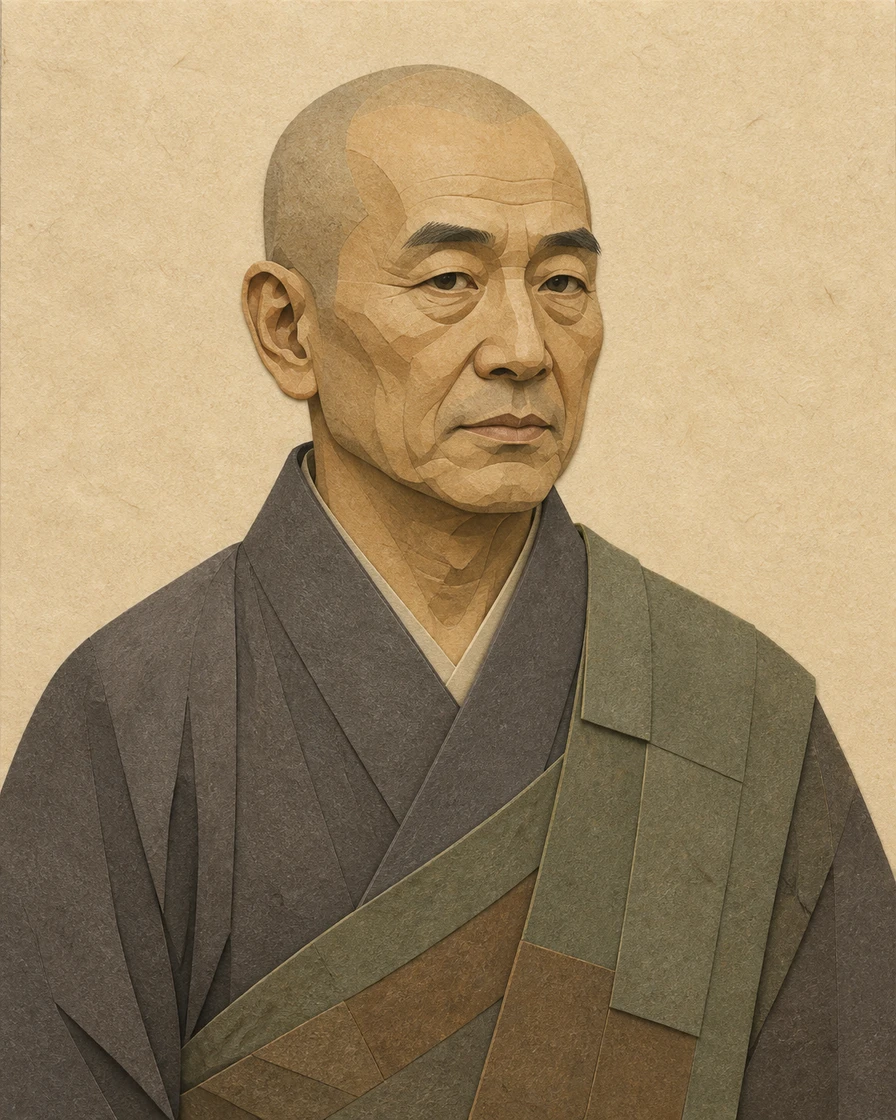
Tōdai-ji's Rōben did not end in 773. The temple first held a recorded memorial service in 1019 and created or enshrined the portrait associated with that observance. The present Founder’s Hall was comprehensively rebuilt in 1200, moved in 1250, and expanded. The statue itself is variously dated by tradition and style from the late ninth to eleventh century. Later devotion identified Rōben with Maitreya, the future Buddha, among the Four Saints and retold the eagle-child story in images and performance. A puppet-theatre play dramatized it in 1887 and was later adapted for kabuki. These objects and legends make the founder present to the temple. They are evidence for reception, not a direct portrait or autobiography from his lifetime. [3][4][8]
Classic
Rōben, conventionally dated 689–773, became Tōdai-ji's first bettō, the monk responsible for its temple affairs. His origins are less certain than that adult role. One tradition places him in Sagami, now Kanagawa Prefecture, and associates his family with the Urushibe lineage. Another places him in Ōmi, around Lake Biwa in present-day Shiga Prefecture, and connects him with the Kudara lineage. Both remain recorded in modern institutional descriptions rather than being combined into one settled birthplace. [3][4]
The famous eagle story gives him a different kind of beginning: an infant taken from his mother, raised by the monk Gien and eventually reunited with her. It belongs to later sacred narratives around the Nara temple and the cedar near Nigatsu-dō. The tale supplied separation and restored filial bonds to a founder otherwise known chiefly through institutions. It is not a contemporary record of an abduction. [3]
Rōben emerged from the religious networks associated with Gien and from forms of practice that later sources remembered as mountain-oriented. By the 730s he was connected to Kinshō-ji and to the royal Buddhist projects that transformed the eastern hills of Nara. His adult temple responsibilities are better documented than his beginnings.
Gien belongs to a generation of influential Nara teachers whose disciples entered different institutions and offices. To be formed under such a monk meant access to texts and discipline, along with patrons and fellow students. The record does not preserve Rōben's daily timetable, but it makes his later authority less mysterious: he entered Tōdai-ji's history through established monastic legitimacy. The title “Kinshō practitioner” and the association with a mountain hermitage matter because the eastern hills were not simply an urban monastery waiting to become monumental. Mountain-oriented practice could include recitation and austerities as well as protective rites. Later categories sometimes separate scholarly Buddhism from ascetic practice too sharply. Rōben's career suggests that institutional leadership could grow from both. [3][4]
Kensaku-in, connected with Fukūkenjaku Kannon, a form of the Buddhist figure of compassion, and the later Hokke-dō worship hall, adds a concrete ritual setting. Tradition places Shūkongōjin—the Vajra-bearing guardian—behind the principal image and connects Rōben with devotion to it. An early ninth-century tale already knew the guardian's concealed placement, though the fuller Rōben narratives developed later. The object and cult establish religious environment more securely than a miraculous childhood. Guardian devotion also helps explain court usefulness. A sovereign's religious protector did not serve only by discussing doctrine. Illness, political danger, ritual impurity, and the security of the realm could all call for disciplined rites and a monk reputed to perform them. Rōben's later service to Shōmu becomes historically intelligible without confirming supernatural causation. [4]
This formation was not isolated from continental learning. Texts and teachers moved through Japan, Silla, and Tang-linked networks. Gien's world was already transregional before Rōben invited Shinjō to lecture in 740. The later event made one intellectual connection visible; it did not begin all contact with continental Buddhism. Kegon, the Japanese Flower Garland Buddhist tradition, centers on the Flower Garland Sutra and became integral to Tōdai-ji's identity. Yet an eighth-century monk did not necessarily inhabit the hard institutional boundaries familiar from later sect histories. Rōben could organize a Lotus ceremony, work with protective and esoteric texts, support ordination, and promote Huayan teaching, the Chinese tradition known in Japan as Kegon, without seeing these as incompatible careers. [1]
Crown Prince Motoi, Emperor Shōmu's infant son, died in 728. A mountain temple established that year east of the capital provided a community to pray for his repose. Royal mourning had brought buildings and clergy to the site from which Tōdai-ji would develop. A rite performed once could express mourning; a resident community could continue the transfer of merit over years. The material capacity of the sovereign household made this mourning exceptional. Many families lost children without founding an endowed temple. Shōmu's loss gained buildings and clergy because dynastic death had public significance and state resources. The inequality does not make the grief false. Rōben's position was not that of an architect appearing at the moment of death. [1][2]
Sources place him at Kinshō-ji by 733 and later remember him as the monk who carried the community forward. That record does not establish a bedside commission in 728 or make him the originator of Shōmu's response. His agency lay in sustaining the religious form that patronage made possible. The temple's names show successive functions. Kinshō-sanji or Kinshō-ji, Kensaku-in, Yamato Konkomyō-ji, and eventually Tōdai-ji belong to related but not interchangeable stages. Buildings, precincts, legal status, and administrative purpose changed. A later visitor stands within accumulated place layers, not one temple frozen since 728. Residence required ordinary systems. Monks needed provisions, texts, ritual objects, shelter, and relations with donors and officials. A mountain community close to the capital could be both withdrawn and politically connected. [3]
Its location helped it serve royal worship while retaining an ascetic identity. The transformation also depended on policy outside the site. In 741 Shōmu ordered provincial monasteries and nunneries; the Kinshō institution was elevated into Yamato's Konkomyō-ji. In 743 the Great Buddha edict introduced an undertaking of a different scale, and after 745 the Nara site absorbed the project. No single foundation date contains all these changes. For Rōben, continuity created authority. A monk who knew the older community could mediate expansion: he understood its rites and people, while patrons understood him as a stable religious representative. Founding in this sense meant carrying inheritances through transformation rather than claiming empty ground. [1]
In 740 Rōben invited Shinjō, a monk from Silla, the Korean kingdom, to lecture on the Flower Garland Sutra. He identified a teacher, relied on an introduction from another monk, brought Shinjō from Daian-ji, and created a place and audience for extended interpretation. Intellectual transmission required social organization. Shinjō's Silla identity matters because East Asian Buddhism did not move through a single China-to-Japan corridor. Monks from the Korean peninsula studied continental texts, resided in Japanese temples, and taught Japanese colleagues. Rōben's formation and Tōdai-ji's later ceremony both depended on a geography wider than the court's political borders. Huayan, the Chinese Flower Garland tradition known in Japan as Kegon, interpreted the cosmos as radically interrelated and placed Vairocana, the Buddha later represented by Tōdai-ji's colossal image, at the center of an all-encompassing Buddha world. [3]
That vision could make a colossal Vairocana image intelligible, and it could allow a small contribution to be understood within a total field of merit. These are real connections between doctrine and monument. Causation still requires boundaries. The 740 lectures did not choose Shigaraki, organize copper, move the capital, or issue the 743 edict. Shōmu's policy arose amid epidemic and dynastic anxiety as well as capital movement and revolt. Rōben and Shinjō supplied an interpretive repertoire, not a secret construction order. The political chronology sharpens the point. Fujiwara no Hirotsugu, a court official who challenged the government, submitted his complaint in late summer 740 and rose in rebellion in the ninth month. Rōben's Huayan lecture began in the tenth month; the campaign ended soon after. At nearly the same time, the court ordered prayers to Hachiman, a Japanese deity worshipped at Usa Shrine in northern Kyushu. [8]
Teachings, military action, and protective rites occupied the same season without being reducible to one another. The setting at Kinshō-sanji joined royal commemoration to new doctrine. A temple founded around Prince Motoi's memory became a place where Shōmu's age was marked through scripture during crisis. Religious time—anniversary, lecture sequence, merit—offered continuity when political time was unstable. For Rōben, inviting a teacher was a form of leadership distinct from claiming mastery. He recognized knowledge he did not possess in the same form and brought its holder into his community. Shinjō's authority as a teacher remained distinct from Rōben's role as his host. The outcome was durable but gradual. Huayan became foundational to Tōdai-ji's identity, while Lotus, repentance, guardian, ordination, and other practices remained active. [1]
In 741 Shōmu ordered provincial monasteries and nunneries across the realm. Kinshō-ji became Yamato's Konkomyō-ji, the principal monastery of the province around Nara, with responsibility for Buddhist rites under state patronage. Yamato's temple occupied a special position near the capital and the sovereign, but it still had to demonstrate the practices the policy claimed to reproduce elsewhere. The 742 summer-retreat directive shows how status became calendar. The retreat required clergy to gather, study, observe discipline, and receive support during a defined period. Repetition made institutional identity tangible. A temple became important not only because a ruler named it, but because people and resources returned according to schedule. Rōben's appearance around 743 as jōza, the senior monk, places him inside the sangō structure rather than above it as a legendary founder. [1]
The three principal temple offices divided responsibility among senior clergy. This gives his authority an administrative setting: he worked through offices and colleagues before becoming first bettō. The forty-nine-day ceremony of 743 carried an explicit model function. Monks were summoned, scripture recitation spread through the country, killing was prohibited for the period, and Yamato Konkomyō-ji held an exemplary assembly. Religion here operated through synchronized time. A central rite became a pattern intended to organize distant practice. Rōben's 746 Lotus assembly at Kensaku-in adds doctrinal plurality. The monk later memorialized as Kegon founder also established a ceremony centered on the Lotus Sutra. Lotus and Kegon activities coexisted within the same institutional career. It is evidence that temple identity was built from multiple ritual and textual currents before later school maps hardened.
Royal presence reinforced the institution. Shōmu, Retired Empress Genshō, and Empress Kōmyō, Shōmu's consort, visited Kinshō-ji for a lamp offering in the tenth month of 746. A sovereign visit concentrated gifts, ceremony, officials, and visibility. It also demanded preparation by the resident community. Patronage was performed through ritual rather than existing only in decrees. The Great Buddha project was already moving into this environment after the return to Nara in 745. The existing calendar, clergy, senior offices, and court relations became infrastructure for an undertaking much larger than the earlier temple. Rōben's value lay in carrying one scale into another without allowing daily religious work to disappear entirely beneath construction. The sources still do not give him unlimited command. Construction offices, court patrons, and other monks possessed distinct authority.
The court returned from Shigaraki, in present-day Shiga, to Nara in 745, bringing the Great Buddha project to the older temple community. The site around Konkomyō-ji already had monks, halls, rites, and court relations. It could provide religious continuity while construction offices reoriented materials and labor. Rōben stood inside the receiving institution, not above the political decision to relocate. The Great Buddha's doctrinal program needed texts. Huayan interpretation explained Vairocana; protective scriptures supplied rites for sovereign and realm; ceremonial manuals and copied sutras created objects to be read, offered, deposited, or taught. An image of universal Buddhism was surrounded by a documentary world in which particular texts had to be selected and produced. Sutra production also required scribes, materials and support from the copying organization. [8]
The office history complicates any simple “temple versus court” division. The copying organization grew from an operation associated with Kōmyō's household, passed through several administrative forms, and eventually came under the Office for Building Tōdai-ji. Religious patronage, palace administration, and temple construction overlapped. Rōben's orders or involvement worked through this changing bureaucracy. Documentary traces show him as more than a symbolic abbot. A 741 record mentions a scripture borrowed from “Rōben's teacher's place,” and later copying papers indicate production carried out under his instruction. A 753 directive of shōsōzu Rōben—the deputy clerical official—survives with his signature among Shōsōin documents, kept in the imperial treasure repository at Nara.
These fragments catch authority moving through documents rather than through later miracle. The content of copied texts also corrects rigid school history. Research notes materials that later readers would associate with esoteric or protective practice. Their presence fits Rōben's remembered formation as a mountain practitioner and ritual protector. It does not make him a member of a later Japanese esoteric sect before that institution existed. Writing created distance. Rōben did not need to stand beside every scribe if an authenticated order could specify work and a chain of officials could act. This is a different form of religious power from preaching or performing a rite. The signature and written instructions connect his authority with the people who carried out the copying.
After the project moved to Nara, Rōben led the older religious community as construction expanded around it. His earlier position as senior monk placed him within the sangō, the three principal temple offices. The resident institution and the state construction office had different responsibilities. Officials procured materials and organized workshops; monks had to maintain worship and teaching while receiving new people and resources. [8]
Religious requirements still affected what was built. The image's form and accompanying texts required learned judgment, while the technical work belonged to specialists rather than being conferred by a monastic title. Rōben could communicate the temple's needs to officials with the means to meet them. Resident monks and visiting teachers needed provision just as the construction workers did, so a royal grant had to become a continuing supply rather than remain a promise. [8]
These responsibilities preceded the completed image. Rōben's later appointment as the temple's first bettō, the monk responsible for temple affairs, would give formal expression to that leadership after the opening in 752. It did not turn the immense construction organization into his personal command. [3]
In 749 gold from Mutsu, in northeastern Japan, answered a shortage in the Great Buddha project. Shōmu presented the contribution as a sign of Buddhist and divine support. Local knowledge, officials and transport brought the metal to the court; the religious meaning of the gift did not replace that material history. Tōdai-ji dates completion of the bronze body to the tenth month, following eight major casting stages over three years. [8]
Gyōki had died in the second month, before that completion. His kanjin, the gathering of contributions and participation through religious networks, had supported the undertaking; Rōben's community received and used resources at the temple. The work still depended on specialists such as Kuninaka no Muraji Kimimaro, who organized the image-making. Neither monk's role gave him personal mastery of the casting. [8]
In the twelfth month a priestess carried the presence of Hachiman, the deity worshipped at Usa Shrine, into Nara in a purple palanquin. The sovereign household attended Tōdai-ji and thousands of monks reportedly assembled. Shrine personnel and the Buddhist temple met within court ceremony, rather than acting as two wholly separate religious worlds. The bronze body was complete, but preparation for its consecration continued. [7]
Later accounts gave Hachiman a vivid promise to lead the gods and join the construction material with the deity's own body. Earlier notices describe support less explicitly, so that full promise cannot securely be assigned to the earliest announcement. It became part of the temple's founding belief without demonstrating that Rōben personally devised the shrine relationship. [7]
In 751 the court appointed senior monks to the recognized clerical hierarchy before the Great Buddha's opening. Bodhisena, an Indian Buddhist monk who had traveled through China and reached Japan, received the highest of the named offices. Rōben became shōsōzu, a deputy clerical official; Dōsen, another immigrant monk, became risshi, a lower clerical office. The sequence displays transregional expertise inside Japanese court recognition rather than as decorative foreign attendance. Office and ritual role were not identical. Bodhisena officiated at the opening, while Rōben bore ongoing responsibility for Tōdai-ji. [6]
On the ninth day of the fourth month of 752 in the traditional calendar, Bodhisena performed the eye-opening rite, the consecration that publicly dedicated the image for worship. The resident institution prepared the site and arrangements for the court, monks and performers who attended. Bodhisena's ritual authority belonged to him; Rōben's leadership concerned the community that would maintain worship after the gathering. According to the historian Horike Shunpō's biographical account, Rōben was formally appointed the first bettō on the first day of the following month. His long-established temple role and that appointment should not be collapsed into the same date. [3][8]
In 752, according to Tōdai-ji's tradition, Rōben's leading disciple Jitchū established the annual Shuni-e repentance rite. The repentance before Eleven-Headed Kannon required a separate hall, trained officiants, a detailed sequence, material preparations, and return each year. Its later survival makes Jitchū more than a subordinate name in Rōben's biography. Jitchū carried temple responsibilities of his own. Later, from 760 to 766, Jitchū acted as Rōben's mokudai, or deputy, before taking other temple offices. [5]
Delegation made Rōben's responsibility scalable, while giving the disciple operational experience. Calling every Jitchū achievement “Rōben's work” would erase the mechanism of institutional succession. Ganjin, the Chinese monk invited to establish recognized ordination, arrived in Japan late in 753. Japan already had monks, texts, and ordinations, but the mission sought a recognized vinaya (Buddhist rules and procedures governing monastic discipline) assembly capable of reproducing its authorization. In 754 the temporary platform before the Great Buddha became a place where sovereigns, novices, and established monks received different forms of precept or ordination. Rōben did not become the ordination master merely because the ceremony occurred at his temple. His role was institutional reception: Tōdai-ji provided site, authority, participants, and a court-connected environment. Ganjin and his companions supplied a lineage and procedure the project had specifically sought. [3]
Rōben's written instructions also belong to this continuing administration. Teaching and copying coexisted with Jitchū's annual rite and the new ordination precinct; their different responsibilities remained visible within one temple.
Rōben attended Retired Emperor Shōmu during his final illness in 756. His remembered mountain-practitioner and protective background became practical court service rather than an abstract sacred identity. The chronicle's reward notice is unusually concrete. It exempted the households of 126 attending practitioners from certain burdens. For Rōben, Jikun, and Ankan, the exemption extended to both parental households for the duration of the monks' lives. The policy connected a monk's service to lay kin and fiscal administration. Religious reward moved through registered households. The same notice praised learning and discipline among Ganjin, Rōben, Jikun, Hōshin, and Kyōshun. It singled out Rōben and Jikun for exertion during the illness. [3][6]
Ganjin and Rōben rose to daisōzu; the others received offices below them. Promotion thus combined personal service, clerical reputation, and the court's need for an ordered hierarchy. Private emotion remains inaccessible. Rōben had served Shōmu across decades of mourning, construction, ritual, and temple growth. It is reasonable to recognize the duration of the relationship, but not to invent final conversations or assign one feeling. The chronicle records service and reward more securely than intimacy. The 760 petition reveals what senior office required after bereavement. Rōben, Jikun, and Hōshin addressed clerical grades and the economic structure of Tōdai-ji. Their proposal divided the temple's five thousand tax households: one thousand for repair of towers, temple buildings, and monastic residences; two thousand for offerings and resident clergy; and two thousand for Buddhist rites performed for the state. [3][6]
These were not abstract numbers. A household allocation meant claims on produce or revenue mediated by local administration. Repair funds supported timber, tile, tools, transport, and workers. Resident support fed monks and maintained daily worship. State-rite funding linked the temple to ceremonies expected by the court. The division turned a royal endowment into functional budgets. Allocation also exposed competing purposes. Money spent on a state rite could not repair a leaking building; income reserved for residents could not automatically be redirected to expansion. Senior clergy had to define boundaries so that one prestigious demand did not consume the whole institution. The petition also addressed clerical ranks. Titles should correspond to learning, discipline, responsibility, and recognized order rather than remain improvised rewards.
Rōben's temple work extended to Ishiyama-dera, near Lake Biwa and the Seta River, with building work documented in 761–762. He could work through the Tōdai-ji construction organization, image makers, local resources, and river geography to establish or expand another religious site. Location was decisive. Ishiyama stood where Lake Biwa drains into the Seta River. Timber cut in the mountains of Ōmi could be assembled, processed, and moved through waterways toward the Nara projects. A temple there belonged to regional logistics as well as worship. Sacred place and supply node were not mutually exclusive. Documents identify expansion in 761–762 under an office subordinate to the Tōdai-ji building administration. The main hall grew from an earlier structure. [3]
A monumental clay Kannon, a Buddhist figure of compassion, seated upon a rock base and two large guardian figures were produced under Rōben's direction. The named office and dated work provide stronger evidence than a general claim that he “founded” the temple. Image construction again required distributed expertise. Clay sculpture needed a wooden core, modeling material, skilled hands, drying control, pigment, and an architectural space adequate to the figure. Later fire destroyed the original ensemble, and the present image and hall contain subsequent restorations and rebuilding. The current visitor does not face an unchanged 762 interior. The gold-prayer legend gives the site a different origin. In this narrative Shōmu sends Rōben to pray for the metal needed to gild the Great Buddha. A divine dream redirects him from the sacred mountain Kinpusen to Ishiyama; a sacred image placed on the rock cannot be removed after gold is found in Mutsu, so a temple remains.
The later story ties Ishiyama's foundation to the national monument and to an image that could not be moved. The Mutsu gold event is historical; Rōben's prayer mission and dream belong to later temple narrative. The legend interprets why Ishiyama deserved lasting sanctity and why it shared in Tōdai-ji's merit. It does not replace construction-office papers. Rōben has a strong project relationship to Ishiyama-dera in 761–762 and a reception relationship to the 747 foundation legend. The legend became part of the temple's sacred identity; the dated building papers document another part of its history. The building organization and timber routes connected the Nara institution with Ōmi.
Rōben eventually reached sōjō, the highest regular clerical office, but its date differs among sources. Tōdai-ji's tradition gives 763. Architectural historian Koiwa Masaki's study distinguishes 771 in the Sōgō Bunin, a register of clerical appointments, from 773 in the Tōdai-ji Yōroku, the temple's historical compilation, and the Seven Great Temples' Chronology. It also reports historian Kishi Toshio's inference from documents that the promotion occurred in September 764. These are different source-based chronologies, not evidence that he repeatedly received the same promotion. His temple leadership had not depended solely on that highest rank. [3][4][6]
Jitchū continued temple work as Rōben's disciple and deputy. Later records also connect Prince Sawara, a royal monk, with the succession to his teaching. The tradition that Rōben entrusted the “one vehicle of Huayan” to Sawara at death provides a formal succession scene. This succession scene survives in later records rather than a contemporary deathbed account. The death day differs between memorial tradition and the court chronicle. Tōdai-ji's memorial tradition identifies the sixteenth day of the intercalary eleventh month in 773. The Shoku Nihongi, the official court history, has an entry on the twenty-fourth reporting that sōjō Rōben died and that the court sent a representative to offer condolences. [3][4]
The later notice may record the reporting or court response rather than the biological moment, but the evidence does not prove that explanation. Modern conversion creates another trap. The lunar date falls in early 774 by the Gregorian calendar, so some institutional displays list 774 while Japanese era chronology calls it 773. This is a calendar conversion difference, not evidence for a second year-long life. Rōben was traditionally eighty-five by inclusive count. That count depends on the conventional 689 birth and does not settle his disputed origins. The court's condolence mission recognized a monk whose office connected temple and state, although the brief notice preserves no cause of death or last words. [3][4]
Historical disagreement · When was Rōben’s portrait sculpture made?
In 1019 Tōdai-ji held its first recorded Rōben memorial, roughly two and a half centuries after his death. Tōdai-ji says the Founder’s Hall and portrait were established around that memorial, while stylistic analysis has led some scholars to date the sculpture earlier, in the late ninth century.
The difference is not a minor catalog error. It asks whether an existing image was recruited into a new memorial or created for it. [4]
The sculpture is powerful precisely because it is not a neutral photograph. Its solid body, concentrated expression, robes, and ritual object communicate the kind of founder later monks wished to encounter. Tradition identifies a staff and the nyoi ritual scepter as possessions associated with Rōben, but claimed ownership requires separate object history. Devotional proximity does not guarantee eighth-century custody. Architecture makes the time layers visible. Chōgen rebuilt the hall in 1200 during the Kamakura restoration of Tōdai-ji. In 1250 it was moved and enlarged with an outer worship space. The present building therefore embodies one founder through the work of another great restorer and a later community. It is not the room in which Rōben lived. The Four Saints framework gives the foundation a sacred division of roles.
Shōmu, Gyōki, Bodhisena, and Rōben became manifestations of different bodhisattvas, Buddhist figures devoted to helping others reach awakening; Rōben was associated with Maitreya, the future Buddha. This theology unifies people whose historical participation occurred at different times and through unequal responsibilities. It belongs to Tōdai-ji's institutional self-understanding rather than an eighth-century committee record. The eagle returned through visual and performing culture. The abduction, Gien's rescue, the mother's search, and reunion could be staged with an emotional clarity absent from administrative documents. In 1887 a puppet-theatre play dramatized the story; it was later adapted for kabuki. Its longevity shows what paperwork could not provide: a founder with vulnerable infancy and restored filial bonds. Places claiming his origins or foundation used these narratives to connect themselves with the founder's sacred history. [3][8]