Read the article below. Interactive reading tools are available when scripts load.
Quick
Ogyū Sorai (1666–1728) was born in Edo, now Tokyo, into a physician’s family. His father Hōan served Tokugawa Tsunayoshi, then lord of Tatebayashi. When Sorai was about fourteen, his father incurred the lord’s displeasure and was expelled from Edo. The family moved to Honnō, his mother’s home village in Kazusa, in present-day Chiba. Sorai spent years there studying the books available to him, including Confucian texts on conduct and government. After his father was pardoned, the family returned to Edo around 1690. Sorai supported himself through teaching. His eventual place near government grew from scholarly work and patronage after this extended period outside the city. [1][2]
In 1696 Sorai entered the service of Yanagisawa Yoshiyasu, a favored attendant of Tsunayoshi, by then shogun and head of Japan’s warrior government. Sorai taught, edited Chinese historical texts and took part in the household’s records. The relationship brought opportunities to speak with the ruler. After Tsunayoshi died and Yoshiyasu retired in 1709, Sorai established a private teaching residence in Edo while remaining a supported retainer. He and other scholars later compiled a chronicle of Tsunayoshi under Yoshiyasu’s commission. Completed in 1714, it was presented to the government by Yoshiyasu’s son in 1717. Patronage sustained scholarship even as access to the reigning ruler changed. [1][2][7]
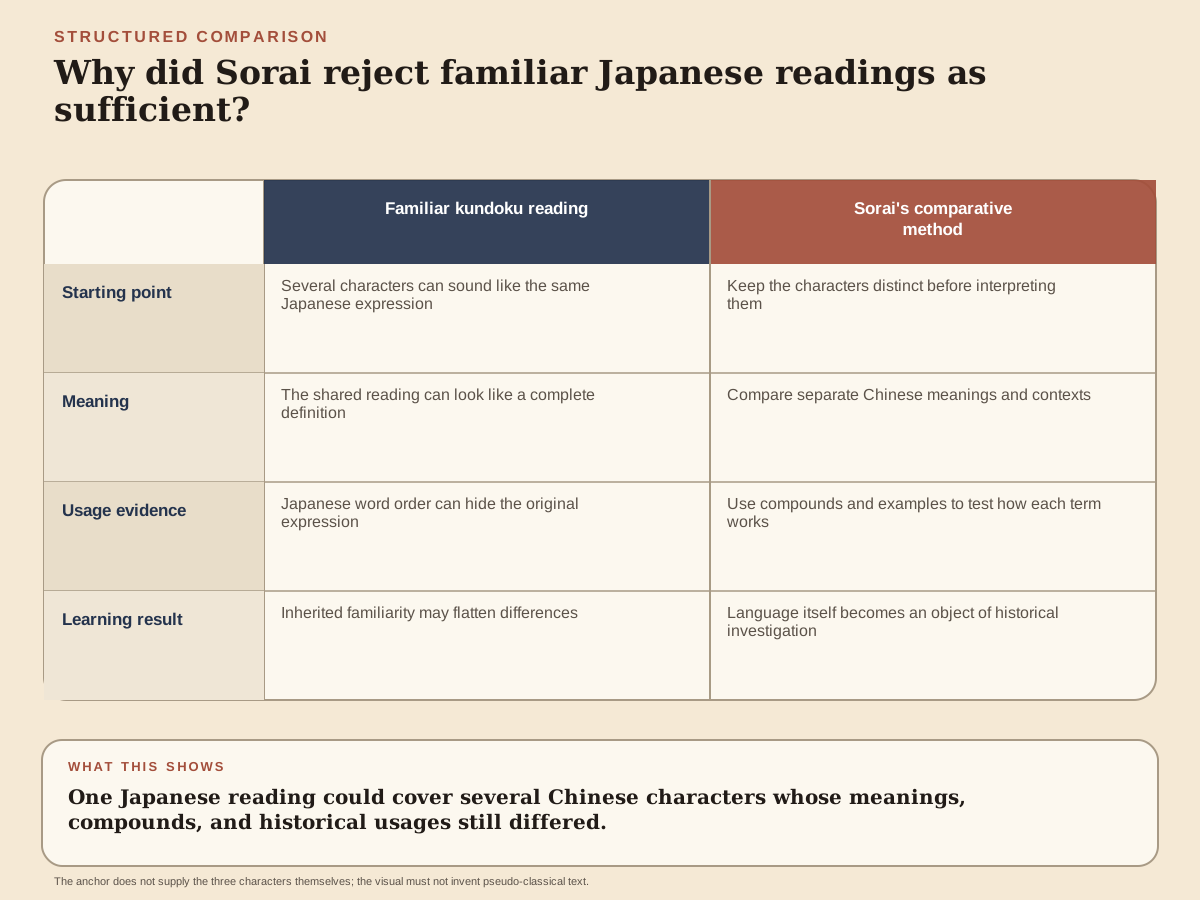
Sorai’s study of Chinese language became the foundation of his distinctive scholarship. Japanese readers commonly rearranged Chinese writing into Japanese grammar and assigned familiar readings to its characters. He argued that this could obscure differences between words and between the two languages. His Yakubun Sentei compared characters with the same Japanese reading, explaining their differing meanings and usage with examples. Its initial printed portion appeared in 1714–1715. At his Ken’en school he also organized study of contemporary Chinese from 1711, involving teachers such as Okajima Kanzan. Ancient texts required attention to the language in which they had been composed, rather than reliance on later explanations alone. [3][4][2]
Sorai applied close study of ancient Chinese language to Confucian ideas. He challenged interpretations associated with the later Chinese scholar Zhu Xi and with the Kyoto thinker Itō Jinsai. His Bendō, drafted in 1717 and later revised, explained the Way; Bemmei examined major terms such as virtue and benevolence. Sorai understood the ancient sages’ Way through rites, music, punishment and government: institutions intended to bring order and security to people. Personal cultivation mattered within that task, but good intentions alone could not organize a society. Bendō was published after his death in 1737. The dates of an argument’s development and its public printed circulation were therefore different. [1][2][5]
At Ken’en, Sorai trained scholars and writers including Dazai Shundai and Hattori Nankaku. He valued differences in aptitude rather than requiring every pupil to become the same kind of scholar. Poetry and prose in Chinese had their own place in his teaching: poems expressed human feelings and could deepen understanding of people. The school produced political argument as well as literary work, and its pupils did not form one uniform intellectual party. Sorai’s attention to the historical meanings of words also influenced later study of Japanese classics. That influence involved adaptation and criticism by subsequent thinkers, whose questions differed from his own. [1][2][8]
Under the eighth shogun, Tokugawa Yoshimune, Sorai received scholarly commissions and opportunities to advise. In 1721 he added Japanese reading aids to the Chinese moral-instruction book Rikuyu Engi. His four-volume Seidan, generally dated around 1725–1727, proposed wider reform. It diagnosed warriors’ dependence on urban cash expenditure as living like lodgers away from a secure productive base. Sorai proposed planned rural placement, population registration, restrictions on movement and consumption according to status, and changes in offices and recruitment. These were proposals for reshaping the ruling order. His access did not result in adoption of the complete scheme, whose promised security also required strong controls over subjects’ lives. [1][2][6][8]
Sorai’s later work extended beyond political counsel. He wrote on the Analects, a collection of sayings attributed to the ancient Chinese teacher Confucius, as well as on learning, military study and the law of China’s Ming dynasty. Pupils joined work across several fields. His Gakusoku and answers to scholarly questions appeared in 1727. He died in Edo in 1728 and was buried at Chōshō-ji in the city’s Mita district. Pupils and editors continued transmitting his texts. Bendō reached print in 1737; Seidan circulated more widely in manuscript during the later eighteenth century and was printed at Kyoto in 1868. His legacy joined a method of reading to institutions, literature and proposals that later readers could use or dispute. [1][2][5][6]
Classic
Ogyū Sorai was born in Edo, now Tokyo, in 1666. His father Hōan was a physician serving Tokugawa Tsunayoshi, at that time lord of Tatebayashi rather than shogun. Medicine placed the family within the lord’s household relationships. Around 1679, when Sorai was about fourteen by traditional age, Hōan was expelled from Edo after offending Tsunayoshi. The consequence reached the whole family, who moved to Honnō, his mother’s home village in Kazusa, in present-day Chiba. Their residence and prospects changed with the father’s standing before his employer. [1][2]
The Kazusa years gave Sorai prolonged experience of rural life. Bitō Masahide’s biography emphasizes close reading of a small supply of books; Hiraishi Naoaki also identifies the Four Books compilation and military learning received from his maternal grandfather. Confucian study concerned conduct, government and the interpretation of ancient Chinese writings. Books could be reread and compared even where access to a large scholarly community was limited. The future critic of received interpretation therefore began within the traditions he would later challenge. [1][2]
After Hōan’s pardon the family returned to Edo around 1690. References give differing traditional ages for Sorai at the return, so the sequence is firmer than one exact year. He opened a teaching establishment near Zōjō-ji, a major Buddhist temple in the city’s Shiba district, and earned his living by lecturing. Teaching made his learning available to others and brought him to the attention of potential patrons. In 1696 he entered the service of Yanagisawa Yoshiyasu, a close attendant of the ruler. The transition joined a scholar’s accumulated reading to a household that could offer income, work and access. [1][2]
Sorai entered Yanagisawa Yoshiyasu’s service in 1696. Yoshiyasu was a close attendant of Tokugawa Tsunayoshi, the fifth shogun and head of Japan’s warrior government, and his household provided a channel into the ruler’s circle. Sorai worked on household records, taught young serving men and edited Chinese histories, including the Book of Jin. Such duties required the practical skills of reading, collation and explanation. They also gave his learning an audience with political resources. A house scholar’s influence depended in part on the tasks and introductions that his patron supplied. [1][2]
Tsunayoshi’s death in 1709 changed Yoshiyasu’s position. Sorai then left the domain residence for a house at Kayabachō in Edo’s Nihonbashi district, where he developed the teaching community known as Ken’en. He remained a retainer with income from the Yanagisawa house. Living and teaching outside its residence enlarged the setting for his work without making that work independent of all household provision. Students, visitors and manuscripts could gather around a scholar whose livelihood still rested partly on service. [1][2]
Yoshiyasu commissioned Sorai and other scholars to compile Tsunayoshi’s reign chronicle after the ruler’s death. The National Archives identifies a request from Kōben, an imperial prince who held high Buddhist office. The work was completed in 1714, and Yoshiyasu’s son Yoshisato presented a fair copy to the government in 1717. It arranged events chronologically and included the ruler’s scholarly activities. The commission’s origin in a favored attendant’s circle matters to its evidence: the record preserved information while also belonging to the relationships through which a reign was commemorated. It was a collaborative work, distinct from Sorai’s philosophical books. [7][1][2]
Sorai sought to read Chinese texts with greater precision. A familiar Japanese reading could cover several characters whose Chinese meanings differed. Rearranging sentences into Japanese grammar could likewise conceal how the original expression worked. His Yakubun Sentei addressed the problem by grouping characters with shared Japanese readings and comparing their meanings, compounds and examples. [3][4]
One example makes the difficulty tangible. As Zhang Qian shows, the dictionary’s sixth volume groups 誤, 錯 and 過 under the Japanese reading ayamaru, “to err.” Sorai explains 誤 as bungling an action, 錯 through the image of interlocking teeth, and 過 as an error without evil intention. He also notes that contemporary spoken Chinese uses 錯 in place of 誤. The shared Japanese reading concealed differences in meaning, while actual Chinese usage could cross the distinctions drawn in the entries. Learning a reading alone could not settle which sense a passage required. Sorai supplied comparisons through which a student could examine the words’ different uses. [4]
Imported books and encounters with Chinese Buddhist monks helped create wider interest in contemporary Chinese during Sorai’s lifetime. His own study involved teaching and interpretation near Tsunayoshi’s circle. In 1711 he established a language-study association at Ken’en, with Okajima Kanzan among its instructors. Sorai’s method encouraged Chinese pronunciation and explanation through ordinary Japanese, separating understanding from inherited habits of rearranged reading. Contemporary language study did not erase the distance from ancient usage; it helped make the difference between Chinese and Japanese languages visible. [4][3]
The dictionary had circulated in manuscript from earlier instruction before the initial portion was printed in 1714–1715. Zhang’s study traces revision and supplementation between those stages. The printed book joined explanations of words to statements about how learning should proceed. Its later continuation, published in 1796, incorporated expansion by another editor from Sorai’s material. These stages distinguish work completed and circulated during his life from later additions. More broadly, the method made language itself an object of investigation: meanings had histories, and the words of ancient Chinese classics needed to be examined within those histories. [4][3][2]
During the 1710s in Edo, Sorai developed a gradually widening attack on received Confucian interpretation. He had studied the tradition associated with Zhu Xi, a twelfth-century Chinese thinker, and his Ken’en Zuihitsu of 1714 still criticized the Kyoto Confucian thinker Itō Jinsai from a position connected with that learning. By Bendō, drafted in 1717, he was advancing a more extensive criticism of both Zhu Xi and Jinsai. He argued that later readers could misunderstand ancient writings by giving their words meanings drawn from subsequent thought. Historical language study supplied the method for questioning those interpretations. [1][2]
Bendō offers a general account of the Way, while Bemmei works through thirty-four major terms, including virtue, benevolence and wisdom. Both were written in Classical Chinese. For Sorai, the Way was embodied in institutions made by ancient sage rulers: rites, music, punishment and administration. These forms ordered relations and sought the security of the governed. Rites concerned organized conduct and rank; music also belonged to the shaping of a community. The claim directed attention toward what rulers instituted and how people could live within it. [5][1][2]
The separate treatment of rites and righteousness in Bemmei shows how these arrangements worked in Sorai’s account. Rites supplied established forms of conduct; righteousness concerned what was appropriate when changing circumstances exceeded those fixed forms. Music had a different task, comforting and ordering feeling. Together these practices joined rules for conduct to ways of shaping feeling. [9] Sorai also insisted that rites and music had to be learned through practice and familiarity with their forms. Understanding a verbal explanation was insufficient. The distinction carried his argument beyond the meaning of a word: a person acquired cultivated habits by participating in the practices the word named. [10]
Sorai criticized the belief that one underlying natural principle could be read equally through the cosmos, social relations and human nature. His emphasis fell instead on arrangements established by the sages for human life. Self-cultivation still had a political purpose, including the trust needed by those who governed. Different personalities could find places within a common order. The possibility of making institutions gave rulers responsibility for reforming inherited practice, while the sages remained his authoritative model. His critique thus stayed within an account of ancient Confucian authority even as it changed what political learning should examine. [2][1]
Bendō carries a signature dated to the seventh month of 1717 in the Japanese calendar. Sorai continued revising it and asked students to collate citations; its publication followed in 1737, nine years after his death. Bemmei also survives in later printed editions. The transmission of these works depended on pupils and editors as well as the author’s initial argument. Readers encountered a body of thought whose formation, manuscript use and printing occurred at different times. [5]
Sorai’s Ken’en community gathered students with differing interests and abilities. Dazai Shundai became a prominent writer on government and economy, while Hattori Nankaku developed a distinguished literary career. Sorai’s educational thought valued the differences between people. Learning could find a use for varied capacities within a shared order. The school’s work included reading, interpretation, poetry and the practical preparation of texts, so teaching offered several paths through which a pupil could participate. [1][2][8]
Sorai treated poetry as an expression of human disposition. Studying the Book of Songs, an ancient Chinese collection included among the Confucian classics, could enlarge understanding of people rather than merely provide examples for praise and blame. Hiraishi Naoaki places this literary dimension alongside Sorai’s institutional thought. The historian Bandō Yōsuke, in a dissertation summary, further interprets the school’s poems and discussions as ways of confronting feeling and frustrated political ambition within its account of community. That reading helps explain why a thinker concerned with government could also give literary expression substantial room. [2][8]
The school’s intellectual life contained differences between Shundai and Nankaku, not a single program shared in every detail. Bandō also argues that Kamo no Mabuchi, a later scholar of Japanese classics, developed his criticism from close relations with questions already present among Sorai’s followers. Other references identify Sorai’s language method as an influence on Motoori Norinaga’s study of ancient Japanese writing. Receiving a method did not require accepting its entire political or Confucian purpose. The inheritance therefore spread through literary practice, rival interpretation and work in other bodies of texts. [8][1][2]
Tokugawa Yoshimune became eighth shogun in 1716. Sorai received an order in 1721 to add Japanese reading marks to Rikuyu Engi, a Chinese work explaining moral instructions. He also prepared Taiheisaku and later Seidan in connection with the ruler’s inquiries. Sources differ over proposed formal recruitment, but agree on commissioned work and political consultation. In 1727 Sorai was allowed an audience with Yoshimune. Learned access provided a setting for advice without itself establishing that a proposal had become government policy. [1][2][6]
Seidan’s four volumes are generally dated around 1725–1727. Sorai described warriors concentrated in cities as occupying a condition of lodging: they depended on buying necessities rather than on a secure connection to local production. Cash expenses exposed serving households to prices and weakened the material basis of rank. He also criticized large population movements and conduct that, in his view, no longer followed properly defined status. The analysis connected livelihood and governing capacity, making inadequate institutions central to the problem as he understood it. [6]
Sorai proposed planned placement of warriors in the countryside, rather than simply announcing a return to an earlier age. Registration would bind people to recognized home places; restrictions on movement and rules of consumption would sustain differences of status. He sought to reduce dependence on commercial provision by defining how groups should obtain and use resources. The promised stability came with coercive requirements. A household’s residence, movement and standard of living would become subjects of deliberate regulation within an order built to sustain warrior rule. [6][2]
The third volume considers offices, ranks and the selection of officials who could carry out reform; the fourth extends discussion across ritual, punishment, civil administration and teaching. Sorai argued for arrangements made deliberately instead of habits allowed to develop without coherent design. The complete program was not implemented. Seidan nevertheless preserved his attempt to join close classical learning to contemporary institutions and material need. Its value as evidence includes the diagnosis, the proposed remedies and the distance between a scholar’s program and the decisions of the government he hoped to influence. [6][8]
Sorai’s later writings included Rongochō, a commentary on the Analects, the collection of sayings and conversations attributed to Confucius. Gakusoku addressed learning, while his answers to questions recorded exchanges with others. He also studied military matters and Ming Chinese law with pupils. These fields required the interpretation of terms and practices as well as broader judgment about government. His output joined work for patrons, teaching texts, philosophical argument and practical inquiry, each with a different audience and use. [1][2]
Sorai died in Edo in 1728 and was buried at Chōshō-ji in Mita, now part of Tokyo. His death did not complete the public circulation of his major books. Bendō, already revised and collated during his life, was published in 1737. Students and later editors therefore helped determine how subsequent readers encountered his thought. Continued transmission made a private teaching community consequential beyond the years in which its founder could lecture or answer questions. [1][5][2]
Seidan followed another path. Its political contents were handled privately, and Bitō’s reference account describes Sorai’s stated intention to submit his handwritten text without showing it to pupils. Copies spread in the later eighteenth century, and a Kyoto edition appeared in 1868 after the shogunate’s fall. That history separates his immediate access to Yoshimune from the book’s later influence as a record of social conditions and reform thought. Sorai’s importance rests in the concrete work his learning made possible and in arguments that others could inherit, adapt or contest, rather than in the realization of one comprehensive plan. [6][1][2]