Read the article below. Interactive reading tools are available when scripts load.
Quick
Sanetomo was born in 1192 in Kamakura, south of present-day Tokyo. First called Senman, he was the younger legitimate son of Minamoto no Yoritomo and Hōjō Masako. Yoritomo headed a warrior government and received the imperial court’s shogunal title that year. The later Kamakura chronicle describes him presenting the infant to his gokenin, warriors directly bound to his lordship, and asking their protection. Senman’s elder brother Yoriie remained the expected successor. [11]
Yoritomo died in 1199, when Senman was about seven. Yoriie inherited the lordship, but administration involved senior warriors and document-trained officials as well as the young shogun's Hiki-connected household. Masako's father Hōjō Tokimasa and her brother Yoshitoki were leading figures in government. The Hiki family, tied to Yoriie's wife and children, had a different stake in the ruling household. These relationships did not create permanent, unanimous family blocs. Senman was politically important before anyone formally selected him. He embodied another legitimate son of Yoritomo and could preserve the founder's line while allowing a new household coalition around the lord. That made his safety dependent on adults whose conflicts he could not control. The record cannot tell us exactly what the child understood. It does show that the same family tie which protected him made him usable if Yoriie's government failed. [11]
In 1203 the Hiki were destroyed and Yoriie was removed. Kamakura reported to the court that Yoriie had died and requested succession for Senman even though the deposed shogun was still alive. Court records and the later Kamakura chronicle differ in how they describe the appointment procedure. The court nevertheless granted rank and shogunal office. Senman came of age at Tokimasa's residence and took the adult name Sanetomo; a contemporary court diary associates the name with the retired emperor Go-Toba's decision. [11]
More than a hundred gokenin attended the Kamakura ceremony. The child shogun carried Minamoto legitimacy, but depended on the adults who had secured his appointment. Yoriie remained alive in exile until he was killed in Izu in 1204. Sanetomo’s new office had been established through the destruction of his brother’s governing household.
In 1204 Sanetomo married a daughter of Bōmon Nobukiyo, later known as Nishi-Hachijō Zenni. Her court family was connected to Go-Toba's world. A later account says Sanetomo rejected an eastern bride and sought a Kyoto wife; historians also read the match as a compromise among Tokimasa, Masako, and court interests. The marriage produced no biological child. In 1205 Tokimasa and his wife Maki no Kata's household became associated with a plan to remove Sanetomo and elevate their son-in-law Hiraga Tomomasa. Masako moved Sanetomo from Tokimasa's residence to Yoshitoki's, and armed supporters followed the shogun. Tokimasa lost power and retired to Izu. Sanetomo survived because his body, title, and location reorganized allegiance. Hōjō authority had divided against itself. [2][5][7][8][11]
Sanetomo practiced waka, classical Japanese court poetry, for years, held gatherings in Kamakura, requested evaluation from the leading court poet Fujiwara no Teika, and received a poetic treatise in 1209. In 1213 a valued copy of the Man’yōshū, an eighth-century Japanese poetry collection, reached him through court-poet and administrative networks. A version of the collection later called Kinkai Wakashū carries a 1213 colophon. Surviving textual lines differ in poem count and arrangement. Poetry was craft, education, sociability, and authority, not an escape diagnosed from later murder. Sanetomo could summon an attendant through verse, judge a composition, exchange favor, study older styles, and connect Kamakura with Kyoto expertise. Smallpox in 1208 left him seriously ill and, according to the chronicle, ashamed of visible scarring; he withdrew from major shrine appearances for years. Even here, bodily consequence is better supported than a complete psychological explanation. [1][2][3][5][7]
By 1209 Sanetomo’s court rank allowed him to establish a Mandokoro, the shogunal household and financial office, and issue documents through it. The chronicle also records him refusing Yoshitoki’s request to raise certain private retainers into a higher warrior status. He could make judgments that mattered, while still depending on senior officials and armed followers to carry them out. Poetry and court promotion gave him another channel of standing through Go-Toba’s Kyoto court. [8][11]
In 1213 a conspiracy investigation implicated relatives of Wada Yoshimori, a veteran retainer who headed the Samurai-dokoro, the office responsible for retainers and policing. Sanetomo pardoned Yoshimori's sons but refused mercy for a nephew treated as a principal organizer. Yoshitoki's public handling of the prisoner and an estate dispute deepened grievance. Sanetomo therefore acted in the legal sequence even though he did not control its full escalation. When fighting began, Masako and Sanetomo's wife were moved toward the shrine; Sanetomo left the palace with the senior administrator Ōe no Hiromoto for Yoritomo's memorial hall, the Hokkedō. Wada forces burned the government residence. Sanetomo received reports, made a religious offering, returned after defeat, authorized rewards, and appointed Yoshitoki to Wada's vacated office. The chronicle preserves shogunal action while framing victors as government. Limited military command did not mean absence. [8][11]
After the Wada war, the chronicle attributes to Sanetomo an order that Hatakeyama Shigeyoshi be captured rather than killed. A retainer killed him anyway, and Sanetomo punished the disobedient man. The distinction between custody and unauthorized killing mattered even though punishment could not restore the dead man. Other entries show the shogun participating in land disputes, court patronage and relief. [8][11]
Such decisions depended on officials and warriors to carry them out. The chronicle's accounts of drought and partial tax relief connect ritual with government care, but do not establish how every province implemented the orders. Sanetomo's judgments had consequences without giving him a monopoly of force.
In 1216 Chen Heqing, a specialist from China's Song dynasty associated with the reconstruction of Tōdai-ji's Great Buddha, came to Kamakura and told Sanetomo that the shogun had once been an abbot at a Chinese Buddhist site and that Chen had been his disciple. The chronicle says Sanetomo connected this claim with a private dream and accepted it. This establishes a reported belief encounter, not reincarnation as historical fact. Sanetomo then ordered a vessel for travel to Song. [4][10]
Yoshitoki and Hiromoto reportedly objected, but the vessel was built. Religious pilgrimage and direct access to Chinese learning may have attracted Sanetomo; an overseas absence would also raise practical problems for government. The surviving account does not establish one overriding motive. The chronicle emphasizes pilgrimage; historian Sakai Kōichi's 2022 interpretation instead gives direct trade with Song China a central place.
The vessel built at Yuigahama, Kamakura’s open beach, was hauled toward the water in the fourth month of 1217 in the Japanese calendar. It could not be launched as intended and was left to decay. No technical report establishes a single cause; Sakai interprets shallow coastal water as the obstacle. Kamakura’s protected Wakae harbor was not built until 1232, so this project faced the difficulties of an open shore. Its failure ended the proposed journey, not Japan’s existing sea connections with China.
Sanetomo became provisional middle counsellor in 1216 and rose rapidly in 1218 to minister of the right, a leading imperial court office. Court rank did not transfer Yoshitoki’s military networks to him. The later Kamakura chronicle attributes a warning about rapid promotion to Hiromoto and a reply expressing concern that Sanetomo’s family line would end. [6][8][11]
Alongside the failed voyage, Sanetomo’s household had to plan for a succession without his own child. His wife adopted Yoriie’s daughter; Sanetomo treated Yoriie’s son Kugyō as a quasi-son. Kugyō returned from religious training in 1217 and became head of Tsurugaoka’s shrine-temple establishment. These relationships carried different claims to care, office and inheritance, none of which made the later attack inevitable.
In 1218 Masako met Go-Toba's influential nurse Fujiwara Kaneko in Kyoto to discuss a prince becoming a future Kamakura lord. The succession project was already under discussion before the assassination.
On the twenty-seventh day of the first month of Kenpō 7 (1219), Sanetomo went to Tsurugaoka Hachimangū for the formal worship associated with his appointment as right minister. Snow covered Kamakura. The procession assembled court and warrior ranks, attendants and shrine clergy along the avenue and shrine approach. Sanetomo's court title became visible inside the sacred center founded and enlarged by his family. The surviving Tsurugaoka is a layered place, not an unchanged murder set. The present upper main sanctuary dates from 1828, and stairs and approaches have been repeatedly repaired. [5][6][7]
The familiar story that Kugyō concealed himself behind a great ginkgo is not established by the principal early accounts. The procession’s shrine setting is secure; that famous hiding place belongs to later retelling.
As Sanetomo descended after worship, Kugyō attacked and killed him. Minamoto no Nakaakira was also killed; one early account treats him as mistaken for Yoshitoki. Kugyō then proclaimed the act, sought support connected with the Miura, and was killed later that night. Sanetomo was twenty-six by Western count, twenty-eight by traditional reckoning. The two major early narratives disagree. The later Kamakura chronicle Azuma Kagami says Yoshitoki withdrew before the ceremony because of illness; the court-connected monk Jien's near-contemporary history Gukanshō places him lower on the approach after an instruction from Sanetomo. [2][5][6][7]
One says the severed head was not recovered and hair served at burial; the other says it was found in the snow. Famous forewarnings and the ginkgo concealment carry additional literary or late problems. The evidence proves murder by Kugyō, not who—if anyone—stood behind him. Benefit after the killing is not proof of conspiracy. Conspiracy theories name Yoshitoki or Miura Yoshimura; Sakai argues for Kugyō's group acting without either organizer. His 2022 account reports support from many researchers, not a demonstrated universal consensus.
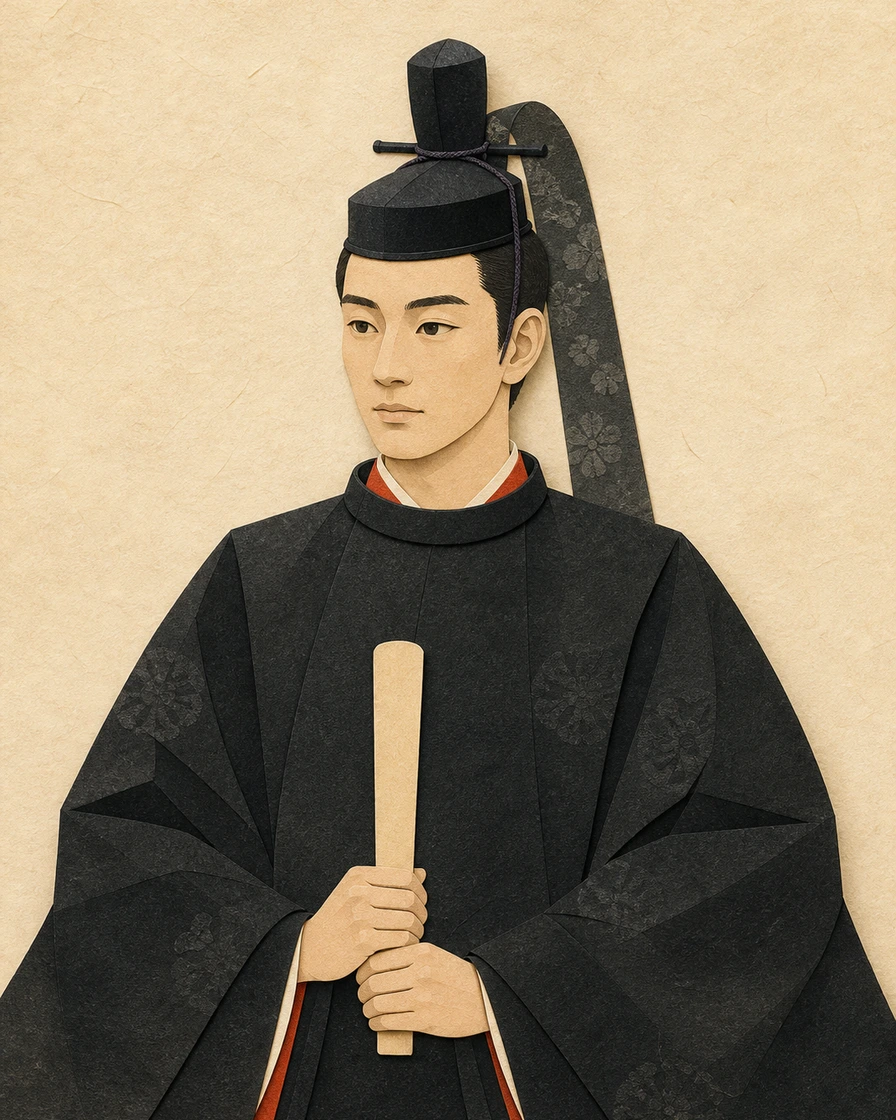
Sanetomo’s widow took Buddhist vows and continued as Nishi-Hachijō Zenni, maintaining household and memorial relationships. Masako and Yoshitoki kept government operating, but Go-Toba refused the proposed imperial prince. Mitora, a child of the Kujō family, came to Kamakura in 1219 and became shogun as Kujō Yoritsune in 1226. Sanetomo’s poems and memorial images survived through other custodians. A statue preserved at Kai Zenkōji is dated partly by comparison with a Yoritomo image repaired in 1319; it is not a securely documented portrait made during Sanetomo’s life.
Classic
Minamoto no Sanetomo was born in Kamakura in 1192, the younger legitimate son of Minamoto no Yoritomo and Hōjō Masako. He was first called Senman. His father had established a warrior government in this town south of present-day Tokyo; his elder brother Yoriie was the expected successor. The later Kamakura chronicle describes Yoritomo presenting the infant to his gokenin, warriors bound directly to his lordship, and asking them to protect the child. Senman’s birth gave the family another possible successor, without making the younger son its heir. [11]
Reserve status could be dangerous. A younger child might become the focus of factions while lacking the adult capacity to choose them. Protection and political availability were two sides of the same lineage. The nursing household deserves notice because aristocratic and warrior births were collectively sustained. Awa no Tsubone and other women associated with the residence appear around childcare in received records, though individual biographies remain partial. They mediated access before the child could speak. Nursing also created durable political kinship. A nurse's relatives might gain daily proximity, receive patronage, carry messages, or later serve the grown child. The archive's inability to name every attendant is therefore not evidence that the celebrated presentation was only a relation between father, son, and male warriors; domestic labor made the ceremony possible. [11]
Yoritomo received the court title seii taishōgun in the same year. A shogun headed a warrior government under an appointment granted by the imperial court. The title recognized a regime that already managed warrior service and land claims. Senman would inherit it only in 1203, after his elder brother’s government collapsed.
Before Senman could take decisions himself, his lineage made his safety a matter for powerful adults. Yoritomo’s followers, Masako’s Hōjō relatives and the nursing household protected him. Those same connections would make him available when the succession became contested.
Yoritomo died in 1199. Yoriie succeeded him, but inherited neither his father’s experience of war nor the personal authority built through it. Senior warriors and officials took part in handling petitions through the arrangement usually called the thirteen-member council. Their interests differed, and Kajiwara Kagetoki soon fell from power. Yoriie’s wife and children tied his household to the Hiki family. Senman remained another legitimate son around whom a different coalition could gather. [11]
Access to a child meant control of information, companions, ceremony, and bodily safety. Moving or guarding him could be described as care while also changing which adult household could present him if succession opened. The sources preserve outcomes more readily than his daily itinerary. The Hiki household had intimate ties to Yoriie's wife and children. That gave it access which Hōjō actors could experience as exclusion. Masako was both Yoriie's mother and a Hōjō woman; those roles did not dictate one response to every conflict. Senman provided an alternative without yet directing an opposition. If Yoriie died, became incapable, or was removed, the child could be enthroned while preserving Minamoto lordship. For that reason, every adult coalition had to consider where he lived and who guarded him.
Masako's father Hōjō Tokimasa and her brother Yoshitoki were leading members of the warrior government. Their family and the Hiki household, tied to Yoriie's wife and children, had competing access to the two brothers. They did not form permanent, unanimous family blocs: Tokimasa would later be removed by his own children, Masako and Yoshitoki. During Yoriie’s government, however, Senman’s presence offered a way to replace the ruling household while keeping Yoritomo’s son as lord.
The younger boy had become a political resource before he could direct an opposition. If Yoriie died or was removed, adults could elevate Senman and reorganize government around him. That possibility turned the household conflict into a succession danger. [11]
In 1203 the Hiki leadership was destroyed, Yoriie was removed and Senman was selected to replace him. Kamakura reported to Kyoto that Yoriie had died, although he was still alive. This false or premature notice allowed the imperial court to appoint a successor without openly managing two living shoguns. The warrior government could control the child and the local settlement, but could not issue the court office to itself. The retired emperor Go-Toba remained a ruler after leaving the throne, directing court appointments and relationships. The court records and later Kamakura chronicle differ over whether the appointment came through a proclamation or a personnel ceremony, and over its precise instruments. [11]
The coming-of-age ceremony took place at Hōjō Tokimasa’s residence. Adult clothing, a cap and a new name marked the child’s change in status before more than a hundred gokenin. A contemporary court diary connects the name Sanetomo with the retired emperor Go-Toba’s decision. The court’s appointment gave the local settlement recognition beyond Kamakura, while Tokimasa’s control of the ceremony placed him at its administrative center. [11]
His power depended on organizing government around a son of Yoritomo. Sanetomo's person carried lineage that the Hōjō could protect, constrain, or exploit but not reproduce through signature. Yoriie's continuing life remained a threat to narrative closure. Exile in Izu removed him from Kamakura; his killing in 1204 ended the possibility of restoration through his person. Later hostile characterizations of him come through a successor order and require caution. Sanetomo thus acquired real office under conditions that denied autonomous choice. A child can be politically instrumental and still occupy an office whose ritual, appointments, petitions, patronage, and future relationships allow agency to grow.
The accession did not settle legitimacy once for all. It created a dual architecture: shogunal lordship embodied by Yoritomo's son, administrative and military capacity concentrated among adults who had won the succession. Sanetomo's biography is the history of what he could and could not build inside that structure.
Sanetomo's marriage in 1204 connected Kamakura to Kyoto before Sanetomo's adult poetic reputation could explain the choice. The bride was a daughter of Bōmon Nobukiyo, from a court family close to Go-Toba's political environment. Her attendants, letters, goods, rituals, and kin created a new channel into the residence. The story that Sanetomo personally rejected an Ashikaga bride and dispatched for a court woman may preserve preference. But he was about twelve or thirteen, and the match followed the Hiki catastrophe. Tokimasa and his wife Maki no Kata, Masako and the bride's court family all had reasons to shape it. Nishi-Hachijō Zenni is usually introduced through father, husband, and later religious name. As shogunal wife she maintained a household, embodied court connection, survived the assassination, performed tonsure, and participated in memorial and adoptive relationships. [2][5][7][8][11]
The absence of biological children became politically decisive later. Medieval sources do not give a secure private explanation. The 1205 crisis demonstrates that the Hōjō were not one actor. Tokimasa and Maki no Kata's household had different affinal interests from Masako and Yoshitoki. Their son-in-law Hiraga Tomomasa represented a route through marriage and court-warrior status that could replace both Sanetomo and the existing central balance. Masako's intervention worked through place. Moving Sanetomo out of Tokimasa's house and into Yoshitoki's changed which guards, messengers, and petitioners controlled access. Warriors at Tokimasa's residence crossed over to the place where the shogun now stood. [11]
This movement made legitimacy operational. Sanetomo did not need to lead troops personally for his physical location to determine which gathering counted as government. Tokimasa's administrative experience could not compensate once armed followers stopped recognizing his household as the shogun's protector. The plan's full detail remains source-layered. Later narration could sharpen ambiguous preparation into a completed assassination conspiracy. The threat and political alignment were sufficient for preventive action; they do not supply every private instruction. Sanetomo survived, but protection came with a new dependence. Yoshitoki replaced Tokimasa at the administrative center, while Masako confirmed her independent power over succession. The young shogun escaped one controlling household through another coalition rather than emerging as a Yoritomo-style commander. The episode complicates “puppet” language. An empty symbol could not draw soldiers away from Tokimasa. Sanetomo's embodied office was practically decisive even where his personal authorship was limited. His later search for court, cultural, and adjudicative authority unfolded after discovering how much power attached to controlling his residence. [11]
From 1205, Sanetomo practiced waka, classical Japanese court poetry, and held gatherings in Kamakura. He sought the newly compiled Shin Kokinshū, an imperial anthology associated with Go-Toba, reportedly interested in the inclusion of his father. In 1209 he sent poems to Fujiwara no Teika, a leading court poet, for judgment. Poetry connected the young shogun’s household to experts and texts in Kyoto. [1][2][3]
Teika marked the work and sent an instructional text later known as Kindai Shūka. The exchange did not require constant face-to-face discipleship; couriers, intermediaries, copies, and patronage made distance education possible. Teika was neither a neutral admirer nor a puppet of the shogun. His standards came from court poetics and his own position. Sanetomo could accept instruction while developing preferences that later readers associate with older Man'yō expression. Sanetomo’s poetry grew through named teachers, exchanged texts and sustained practice rather than through solitary inspiration.
The Man’yōshū, an eighth-century collection of Japanese poetry, reached him in a valued copy in 1213. Asukai Masatsune's legal concerns and poetic connection intersected when a disputed steward matter was addressed near the transfer. The collection now called Kinkai Wakashū or Kamakura Udaijin Kashū survives in differing textual forms. One line contains 663 poems and another 719. Those numbers warn against treating “the book” as a single untouched author manuscript. More importantly, extraction of a poem from its sequence to prove “depression,” “pacifism,” or “premonition” would be historically unsound. Smallpox also interrupted his public life. The chronicle attributes a withdrawal from Tsurugaoka worship to concern over scars. [1][2][3][5][7]
The statement may preserve intimate shame, but later readers should not turn it into the sole cause of seclusion or poetic tone. Sanetomo's literary achievement stands independently. Ninety-two poems entered later imperial anthologies, and reception changed from medieval court evaluation through early-modern commentary to modern Man'yō-centered praise. Politics made his access possible; it did not write the poems for him. Poetry enlarged what a Kamakura shogun could know, make, exchange, and become.
By 1209 court rank had altered Sanetomo's administrative standing. Reaching the third rank placed Sanetomo among kugyō, the senior court nobility, and made a Mandokoro (the shogunal administrative office for household and financial affairs) appropriate to his status. Documents issued through that office attached shogunal lordship to a repeatable chancery rather than only personal speech. The change did not remove officials. Clerks drafted texts; Yoshitoki, the senior administrator Ōe no Hiromoto and other leading figures controlled information and execution; messengers carried orders; local warriors decided whether to obey. Formal authorship and operational authorship remained divisible. One dispute concerned Yoshitoki's own followers. Yoshitoki sought recognition for accomplished household retainers as “samurai,” a status with implications for access and descendants. Sanetomo refused, reportedly warning that later generations could treat exceptional favor as hereditary entitlement. The refusal preserved a distinction between Yoshitoki's private followers and warriors whose standing derived directly from the shogun. It comes through the later Hōjō-era chronicle and may idealize foresight. [8][11]
Letters associated with Jien, a senior Buddhist monk connected to Kyoto's court, complicate the picture. They suggest that Sanetomo could be secluded or difficult to access and identify Masako, Yoshitoki, and Hiromoto as additional points for negotiation. Kamakura functioned through several authorities rather than one master behind a curtain. Go-Toba's role was equally plural. He controlled court appointments and led a major poetic culture. Recognizing Sanetomo raised a warrior lord within the imperial hierarchy and created a personal channel toward Kamakura. Sanetomo actively wanted that recognition. Rank distinguished him from gokenin and from Hōjō administrators whose executive influence exceeded their public lordship. Poetry and court office gave him competencies they could not manufacture internally. Concern was rational without a conspiracy. The Hōjō needed a prestigious shogun but could worry when his dignity and contacts grew through a separate center. [8][11]
Court office and poetry gave Sanetomo standing outside the Hōjō household. That standing did not displace Yoshitoki’s armed followers or administrative connections. Sanetomo’s position grew through judgments, patronage and court recognition, while the machinery that executed his decisions remained shared.
In 1213 an investigation of a plot implicated relatives of Wada Yoshimori, an old gokenin who headed the Samurai-dokoro, the office overseeing retainers and policing. Sanetomo pardoned Yoshimori’s sons because of their father’s service, but refused to release the nephew treated as a principal conspirator. Yoshitoki’s handling of that prisoner and a disputed estate sharpened Yoshimori’s grievance. The judgment came before open fighting and did not settle the conflict. [8][11]
Yoshitoki controlled prisoner handling and benefited from the disputed estate. Public humiliation intensified Wada grievance. Later Hōjō-shaped narrative may arrange cause to make armed action appear an unambiguous rebellion, so responsibility for escalation cannot be read solely from its labels. Miura Yoshimura's choice mattered. Though bound by wider kinship, he informed the government rather than sustain Wada alignment. This made household relation a decision environment, not automatic loyalty. The location of the shogun became operational when violence began. Moving Masako and Nishi-Hachijō Zenni protected dynastic and household figures. Sanetomo went with Hiromoto toward Yoritomo's memorial Hokkedō, later joined by Yoshitoki. Wada forces attacked and burned the palace. Destroying the residence challenged both its inhabitants and the physical center through which shogunal authority appeared. [8][11]
Streets, neighboring compounds, shrine approaches, and memorial ground became battlefield terrain. Sanetomo was not commanding tactical units, but reports reached him because his judgment and survival mattered. The chronicle says he had a vow text prepared and added poems before offering it to Hachiman, a deity honored as a protector of warriors. After Wada's defeat, Sanetomo returned, distributed recognition, and placed Yoshitoki in the vacated Samurai-dokoro leadership. Formal appointment attached the institutional transfer to shogunal authority, even if Yoshitoki's military victory made the choice difficult to refuse. The outcome deepened the split structure. Yoshitoki now combined central administrative and military-personnel offices. Sanetomo retained lordship, rank, patronage, adjudicative episodes, and the power to authenticate results. Each gained a different kind of centrality. The social cost extended beyond leaders. Dead retainers left families behind; residents lost homes, and confiscation changed who could claim their land. A “victory for government” is not an adequate human description. His selective pardons had shaped the grievance; after the battle, his appointment ratified the transfer of an important office. [8][11]
After the Wada war in 1213, the chronicle attributes to Sanetomo an instruction that Hatakeyama Shigeyoshi be taken alive. A retainer killed him. Sanetomo then punished the disobedient killer. The episode comes through the later chronicle, but its legal distinction is precise: an order to capture did not license execution. That distinction mattered even where remedy was incomplete. Punishment could not restore the dead man. It could assert that armed subordinates were not entitled to convert custody into killing on their own judgment. Other entries place the shogun among land claims, court intermediaries, prayers, tax relief, and appointments. A dispute touching the poet-courtier Asukai Masatsune, for example, belonged to a network where Kyoto status, eastern property, documents, and personal patronage overlapped. [8][11]
Sanetomo's court relationships could become administrative resources as well as literary ones. Relief traditions also need calibrated reading. The chronicle presents drought, rites, and remission of a portion of dues in a moralized sequence. Weather, prayer, revenue, and compassion were connected in medieval governance, but a later narrative arrangement does not reveal every province's implementation or prove a miraculous causal chain. Clerks and messengers conveyed decisions, but local officials and armed subordinates determined how they reached affected households. The distance between decree and result was the normal material of rule, not evidence that no decree mattered.
These acts protected the value of shogunal appointment and judgment even where Sanetomo could not control every armed subordinate. Yoshitoki needed his authorization to consolidate offices after the Wada victory. Sanetomo, in turn, needed the administrators and warriors who could make an order effective beyond his residence.
In 1216 Sanetomo met Chen Heqing, a specialist from China's Song dynasty associated with rebuilding Tōdai-ji’s Great Buddha in Nara. The Kamakura chronicle says Chen told Sanetomo that he had been a Buddhist master in a previous life and that Chen had been his disciple. It adds that Sanetomo recalled a dream supporting the claim. These are reported religious beliefs, not a verified previous life. Chen’s association with a major temple reconstruction gave the proposal a credible bearer of technical and religious knowledge. [4][10]
Historical disagreement · Why did Sanetomo plan a voyage to China?
The chronicle presents the proposed journey as pilgrimage to a place associated with Sanetomo's previous life. Historian Sakai Kōichi offers a different emphasis in a 2022 interview: direct trade with Song China may have been the practical ambition behind the religious account.
Neither reading establishes Sanetomo's private intentions conclusively.
Chen's presence and the imported goods reaching Kamakura made a connection with China more than an abstract possibility.
Sanetomo ordered a vessel for a proposed journey to Song China despite objections attributed to Yoshitoki and Hiromoto. His absence would raise questions about succession and the conduct of government. The project nevertheless proceeded far enough to mobilize construction on the Kamakura shore. [4][10]
Construction at Yuigahama continued into 1217. In the fourth month of the Japanese calendar, the large vessel was hauled toward the sea, but could not be launched as intended. The hull was then left to decay. The record supplies no technical report identifying one cause. The project had moved beyond proposal: timber and labor had been committed to a vessel that never entered service. [4][10]
A launch required enough depth for the hull as well as a way to move it from land. Sakai attributes the difficulty to shallow coastal water at Yuigahama in his 2022 account. That is a named historical interpretation, not a surviving technical report. The record does not conclusively identify one cause or establish deliberate sabotage. The Wakae harbor works date from 1232 and were unavailable to the builders in 1217. [4][10]
The hull's decay left less physical evidence with which to explain the failure. Other vessels carried people and goods between Japan and China. Coastal shipping connected provinces; envoys, monks, merchants, and vessels crossed to the continent; Kamakura sites yield Chinese ceramics and other imported material. The failed project cannot establish that Japanese shipbuilding or all Sanetomo's decisions were ineffective. The shogun had overruled objections and bears patronal responsibility, but Chen, supervisors, material limits, and collective execution retain agency. The labor and resources committed to the abandoned hull had been lost. Failure closed the proposed direct journey.
Sanetomo became provisional middle counsellor in 1216. His promotions accelerated in 1218, ending with appointment as minister of the right, one of the highest offices in the imperial court. Rank placed the Kamakura lord above ordinary gokenin in court society. It did not give him direct control of Yoshitoki’s military networks. The later Azuma Kagami attributes a warning about the speed of advancement to Ōe no Hiromoto, a senior Kamakura administrator. [6]
Sanetomo's attributed reply accepts extinction of his descendants and seeks honor before the line ends. That exchange appears in Azuma Kagami, compiled under later Hōjō authority. The surviving evidence may preserve a real conversation, a summarized policy disagreement, or retrospective foreshadowing. Its perfect fit with childlessness and assassination makes source caution essential. Sanetomo's marriage had produced no child. The reason is not securely recoverable. No evidence licenses a medical diagnosis, a verdict about the marriage, or a claim that he deliberately refused descent in order to escape politics. Succession planning therefore became household and diplomatic work. Nishi-Hachijō Zenni's Bōmon kin connected the residence to Kyoto; Masako carried founder-widow and maternal authority; court intermediaries could reach Go-Toba's family. Formal title was only one carrier of authority. [6][8][11]
His wife, later known as Nishi-Hachijō Zenni, adopted a daughter of Yoriie and maintained her connections with the Bōmon court family. Such relationships could preserve care, property and household continuity without supplying a male heir of Sanetomo's own.
Yoriie's son Kugyō entered the religious career attached to Tsurugaoka and was treated in sources as Sanetomo's quasi-son. In 1217 he returned from training and became its bettō, the head of the shrine-temple establishment, through a process involving Masako. Spiritual office placed a rival-line male at the ritual center of shogunal Kamakura. None of these relations made later violence inevitable. Quasi-filiation did not erase Kugyō's descent or grievance, but it also cannot be reduced retrospectively to camouflage. Before 1219 it organized education, dignity, obligation, and institutional location.
In 1218 Masako traveled to Kyoto and met Fujiwara Kaneko, Go-Toba’s influential nurse, often called Kyō no Tsubone. The near-contemporary Gukanshō, the monk Jien’s historical account, describes discussion of an imperial prince coming to Kamakura as a future lord. Such a successor could preserve the office despite Sanetomo’s childlessness while strengthening its court connections. The discussion preceded the assassination; it was a prospective settlement rather than a response to his death. [6][8][11]
The evidence supports serious exploration of a princely succession, not a signed and irrevocable contract. Go-Toba and eastern leaders retained choices. Sanetomo's own intentions come through accounts written with knowledge of the assassination. By the end of 1218 he had reached his highest court office, but the household still needed a future lord. The worship planned for 1219 would display his elevated status in Kamakura's principal ritual center.
On the twenty-seventh day of the first month of Kenpō 7 (1219), Sanetomo went to Tsurugaoka Hachimangū for worship associated with his appointment as minister of the right. Snow, a ranked procession and large attendance appear in the early accounts. The ceremony brought his Kyoto court office into public view in Kamakura. Court nobles and eastern warriors occupied different positions; attendants and shrine clergy organized a procession in which precedence mattered. Snow was a recorded condition, not evidence that participants knew a disaster was approaching. [5][6][7]
Sanetomo wore and carried the material signs appropriate to high office. These objects did not disguise “real” power; they were one means by which office became socially real. Their use required capital expertise and eastern labor together. Tsurugaoka was equally composite. It was a Hachiman cult center, the shogunal family's ritual foundation, a shrine-temple complex employing clerics, and a place integrated with the avenue and government town. Kugyō's position as bettō belonged to that institution, not to a freestanding hiding place. The ascent toward the upper worship area created controlled compression. Large entourages could be organized below while a smaller ranked group advanced. Exact positions matter because early sources disagree about where Yoshitoki remained and who accompanied Sanetomo at the decisive moment.
The popular story that Kugyō hid behind Tsurugaoka’s great ginkgo is not established by the principal early accounts. The shrine itself continued to change: the present upper sanctuary was rebuilt in 1828. Its later buildings and commemorative traditions preserve the place’s importance, but cannot supply every detail of the 1219 procession. [5][6][7]
For the participants, the visit celebrated Sanetomo’s highest court appointment. His household, gokenin and court attendants assembled around him at the shrine-temple center associated with his father’s rule. The attack interrupted that public affirmation of office.
As Sanetomo descended after formal worship, his nephew Kugyō attacked and killed him. Kugyō was Yoriie's son and the head of Tsurugaoka's shrine-temple establishment, giving him both a competing descent claim and access to the ceremony. Minamoto no Nakaakira also died. The Gukanshō indicates that he may have been struck because he was taken for Yoshitoki. Yoshitoki's location is disputed: the Azuma Kagami, compiled under later Hōjō rule, says he felt ill after a troubling sign and withdrew before the upper ceremony.
The Gukanshō, written from a different institutional position and closer in time, places him at the lower gate after Sanetomo directed a change. Neither is a camera; each organizes causation and character. The disagreement about Sanetomo's head is equally stark. One tradition says it was not recovered and that hair was used in the coffin. The other reports finding it in the snow. Kugyō's actions after the attack show that killing was not yet government. He reportedly announced himself as successor and approached Miura-linked support. Miura Yoshimura did not convert lineage claim into protection; a force killed Kugyō that night. Motives can be graded. Revenge for Yoriie's deposition and death is plausible and is attached to Kugyō in early narration.
Historical disagreement · Was someone behind Kugyō’s attack?
Kugyō’s reported attempt to claim the shogunate supports a succession motive as well as revenge for Yoriie. Theories of an organizer behind him differ. The Yoshitoki theory points to his absence at the attack; the Miura theory points to Yoshimura’s close connection with Kugyō and the support Kugyō sought afterward. Historian Sakai Kōichi argues instead for Kugyō’s group acting without either organizer: Yoshitoki had participated in the princely succession project, and Yoshimura helped have Kugyō killed.
In a 2022 account Sakai reports support from many other researchers, but that is his assessment, not proof of universal agreement. No surviving evidence conclusively establishes a larger conspiracy.
Kugyō and his associates killed Sanetomo and Nakaakira after worship; Kugyō was killed later that night. [5][6][7]
Sanetomo’s wife took Buddhist vows after the killing, becoming the woman later called Nishi-Hachijō Zenni. The accounts also describe gokenin taking vows in mourning. These acts marked the loss of the lord to whom they had been bound. His widow retained a household and relationships that continued beyond his death.
Nishi-Hachijō Zenni continued to hold and transmit connections. As widow and adoptive mother she belonged to court, Kamakura, property, and ritual networks. Her household continued after the sequence of Minamoto shoguns ended. Masako and Yoshitoki faced an office without an agreed successor. Government did not cease: documents, appointments, guards, revenue, litigation, and relations with Kyoto continued. Yet continuity of operations did not solve the legitimacy of the shogunal person. The earlier princely prospect now required Go-Toba's consent under radically altered conditions. The retired emperor refused to send an imperial prince. Negotiation eventually produced Mitora, a child of Kujō descent connected maternally to Yoritomo's line. Mitora arrived in Kamakura in 1219, years before receiving the shogunal title.
Mitora became shogun as Kujō Yoritsune in 1226, seven years after arriving in Kamakura. Sanetomo’s poems survived through a separate history of copying and selection. The Kinkai Wakashū exists in textual lines commonly counted at 663 and 719 poems. A statue traditionally identified as Sanetomo was preserved at Kai Zenkōji. Its dating is partly inferred from stylistic similarity to a Yoritomo statue repaired in 1319, rather than from a repair inscription on Sanetomo’s own image. Memorial objects and poetic texts carried different parts of his reputation beyond the succession crisis.
The poems and images preserved different versions of the shogun for later readers and worshippers. Masako's later Buddhist memorial patronage and the survival of Tsurugaoka, grave traditions, portraits, and poem collections distributed Sanetomo across places and media. Each selected a courtier, son, husband, shogun, victim, poet, or ancestor. The durable historical figure is larger than “tragic shogun.” Sanetomo judged cases, protected distinctions, patronized learning, ordered a ship, held high court office, and inhabited a plural household before he was murdered. After death, other actors controlled his body, office, texts, and image. Their custodianship explains the tragedy's power without making tragedy the whole life.