Read the article below. Interactive reading tools are available when scripts load.
Quick
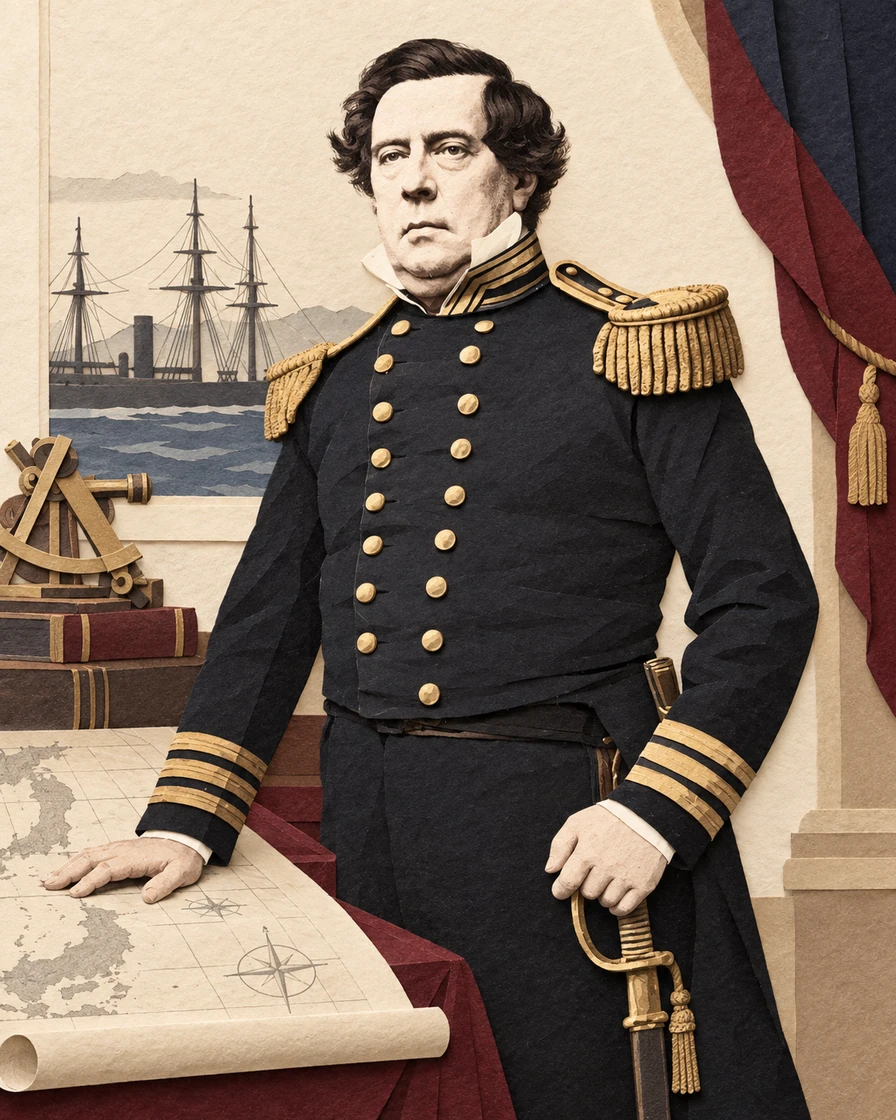
Matthew Calbraith Perry was born in Newport, Rhode Island, in 1794. His father and elder brother Oliver Hazard belonged to the navy. Appointed a midshipman in 1809, Matthew served under Oliver in the schooner Revenge, then under John Rodgers and Stephen Decatur. During the War of 1812 against Britain he gained wartime experience and became a lieutenant in 1813. He was not the Perry who won the Battle of Lake Erie: that was Oliver. [1]
Matthew married Jane Slidell in 1814; they had ten children. After a merchant voyage to Holland during naval leave, he resumed naval service, accompanied an African settlement mission and commanded Shark from 1821. Mediterranean duties and command of Concord followed. By 1833 his career moved into sustained shore work at New York. [1][19]
At the New York Navy Yard, Perry helped establish the Naval Lyceum in 1833 to circulate professional knowledge. He advocated training for recruits and officers and became a captain in 1837. That year he took command of Fulton II, a paddle steamer used for experiments and gunnery instruction. [1][2][3]
Steam power brought new equipment and training responsibilities. Perry examined European steamships, ordnance and lighthouses in 1838, and developed gun practice at Sandy Hook and aboard Fulton. He became the New York yard’s commandant in 1841. These assignments made his career more than a succession of voyages: he was working on the people, equipment and instruction through which a changing navy operated. [1][19]
Perry commanded the Africa Squadron from 1843. Its tasks combined suppression of the slave trade, protection of commerce and support for Liberia, a settlement project for free Black Americans. These purposes brought American warships into conflicts along the African coast. The navy’s later account describes both an episode in which Perry judged Americans to have been the aggressors and another in which an African ruler and interpreter were killed. [4][5]
In 1846 Perry joined the Mexican-American War in the Gulf of Mexico. He succeeded David Conner as Home Squadron commander in 1847 and led river and coastal attacks. Capturing towns did not ensure continued control: one expedition lacked enough men to leave a garrison, while illness and Mexican resistance later forced withdrawal from Tabasco. After the war, he supervised ocean mail steamers. [6][7][19]
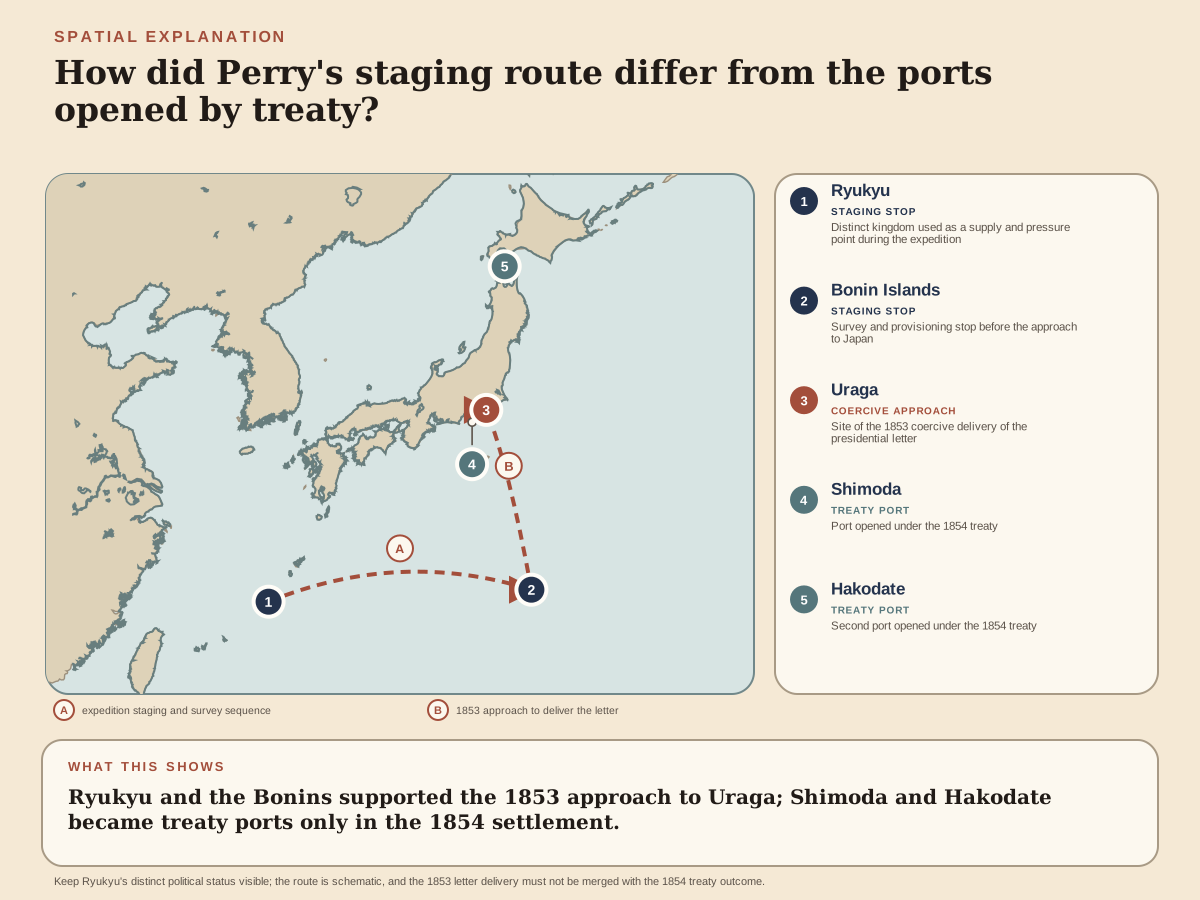
In 1852 Perry received the East India Squadron and the American mission to Japan. President Millard Fillmore’s demands concerned commerce, supplies and protection for castaways. Departing in November, Perry reached Ryukyu, a kingdom under Satsuma’s control that also maintained tribute relations with Qing China, in May 1853, used it as a base and examined the Bonin Islands as possible supply stops. Coal deliveries and missing vessels delayed preparations. [9][15][16]
His four warships appeared off Uraga, near Edo, the capital of Japan’s military government, on July 8. He refused instructions to negotiate at Nagasaki and pressed for reception of the presidential letter. On July 14, representatives of the Tokugawa government accepted it at Kurihama. Perry withdrew with a warning of a larger return; no treaty had yet been signed. [9][10][11]
After the first visit, senior councillor Abe Masahiro circulated translations of the American documents and requested the lords’ opinions. Perry meanwhile assembled a larger force, repaired vessels and arranged supplies. In early 1854 he returned and negotiated with commissioners headed by Hayashi Fukusai. [11][16]
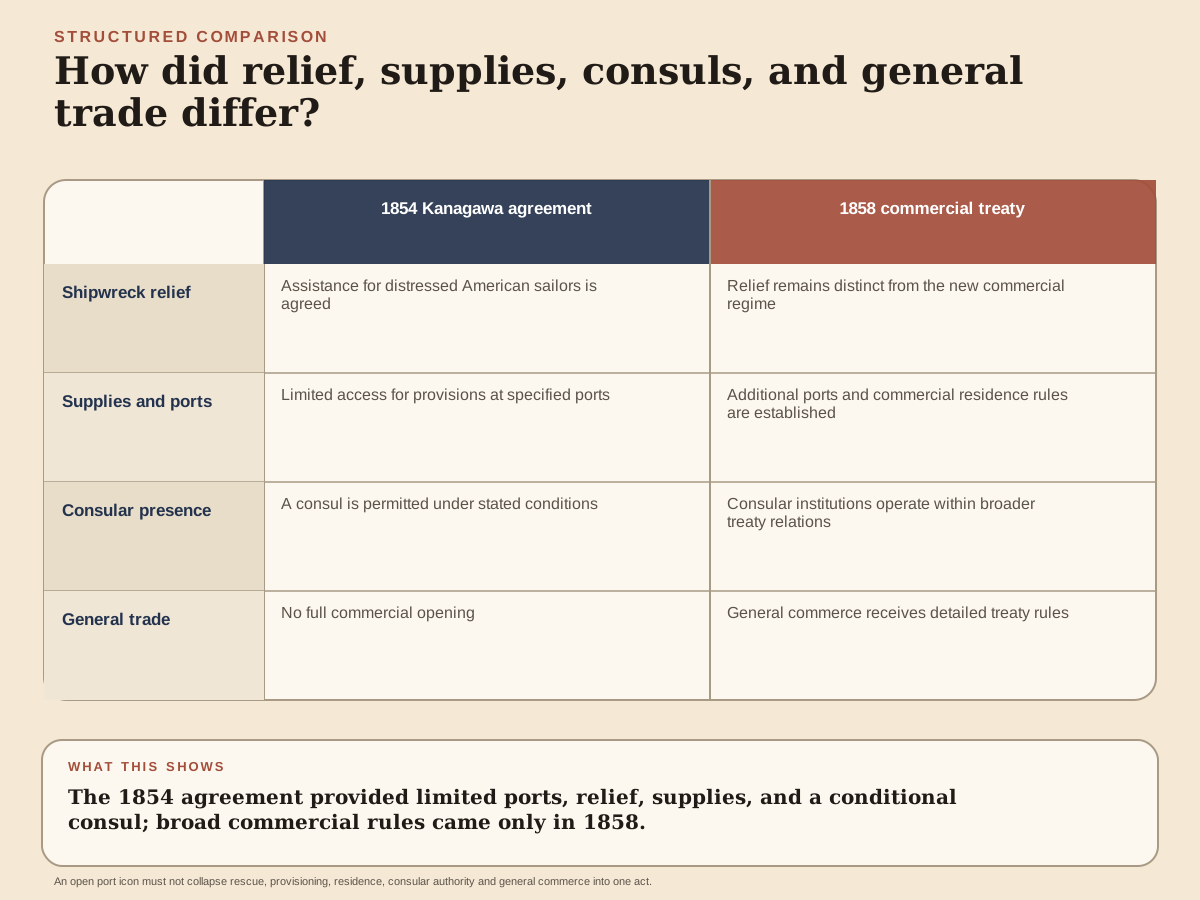
The Kanagawa convention, signed on March 31, provided access to Shimoda and Hakodate for supplies and assistance, protected castaways and made provision for a consul at Shimoda. Purchases remained under Japanese officers’ management; ordinary access was limited to those two ports. General commercial relations required further negotiation. [12][13]
On July 11 Perry concluded a separate compact with Ryukyu for provisions, rescue and other arrangements. Historian Steve Rabson emphasizes the pressure imposed on Ryukyuan officials and the local consequences of American crew violence. [14][15]
Perry returned to New York in 1855 and served on a board reviewing naval officers’ fitness for service. The government’s account of the expedition began appearing in 1856, compiled under his supervision from journals, notes, official papers and other writings. Expedition artists William Heine and Eliphalet Brown Jr. contributed visual records. [17][18][19][20]
Perry died in New York on March 4, 1858. Later that year Townsend Harris obtained the commercial treaty that Perry’s convention had left unfinished. A copy of the expedition narrative brought to Japan by Kimura Yoshitake in 1860 prompted a domain-sponsored translation, completed in 1862. Its Japanese readers encountered an American account of the negotiations, rather than a single record shared by both governments. [1][8][18]
Classic
Matthew Calbraith Perry was born in Newport, Rhode Island, in 1794. His father Christopher Raymond Perry had served as a naval officer; his elder brother Oliver Hazard also entered the service. Matthew received a midshipman’s appointment in 1809 and began active service in the schooner Revenge under Oliver. He subsequently served under John Rodgers in President and Stephen Decatur in United States. Family connections gave him an entry into a profession in which experience aboard ship provided much of the training. [1]
The War of 1812 against Britain brought combat and confinement by blockade. Perry served on cruises against British commerce and became a lieutenant in 1813. His time under Decatur included service in a frigate blockaded at New London. This was a different career from Oliver’s command on Lake Erie, where the elder brother won his celebrated victory in 1813. [1][19]
In 1814 he married Jane Slidell, the daughter of a New York merchant; they had ten children. His maritime work also crossed the boundary between government and commerce. On naval leave in 1816–1817, he commanded a merchant vessel on a voyage to Holland. He then resumed naval duties. As an officer in Cyane, he accompanied the 1820 voyage carrying settlers from the United States to West Africa. From 1821 he commanded the schooner Shark, serving in African and Caribbean waters. [1][19]
Further Mediterranean assignments followed. In North Carolina he served under Rodgers during the 1820s; in 1830 he took command of Concord, which transported the American envoy John Randolph to Russia. These duties connected ship command with commerce and representation abroad well before the Japan mission. His move to the New York Navy Yard in 1833 gave him a different arena: the organization and technical preparation of the service itself. [1][19]
At the New York Navy Yard, Perry helped establish the Naval Lyceum in 1833. It was a professional organization for circulating knowledge among naval officers, with a magazine following in 1836. This work addressed a practical problem: experience accumulated on separate voyages had to become available to people preparing for other commands. Shore institutions could collect and circulate information beyond the crew of one ship. [1][2]
He became a captain in 1837 and took command of Fulton II, commissioned that December. The paddle steamer conducted ordnance experiments and trained officers in gunnery, while also assisting vessels in distress. Its designation matters: an earlier Fulton, also known as Demologos, had been built in 1814–1815. Perry’s achievement lay in developing the operation and uses of naval steam power, rather than inventing the war steamer. [3][19]
Steam propulsion and gun practice were linked through instruction. Perry promoted apprenticeship and recruit training, and developed gunnery work at Sandy Hook and aboard Fulton. A ship needed people able to maintain and operate its machinery as well as handle weapons. Training therefore belonged to the same program as experiments with equipment. The later biographer William Elliot Griffis described apprentices learning seamanship, war exercises and aspects of engine operation aboard the steamer. [1][19]
In 1838 Perry visited Britain and France to examine steamships, ordnance and lighthouses. In 1841 he became commandant of the New York Navy Yard. These responsibilities gave him access to technical work and administrative decisions within a public institution. They did not give him sole control of the navy’s transition to steam. Shipbuilders, engineers, officers and enlisted crews turned equipment into usable service; Perry’s contribution included command, advocacy and instruction within that larger effort. [1][2][3]
Evidence boundary · Naval service and beliefs about slavery
Perry took command of the Africa Squadron in 1843, sailing aboard Saratoga. Its tasks combined suppressing the transatlantic slave trade with protecting American citizens, commerce and the settlement of Liberia. The settlement had grown out of the American Colonization Society’s project to send free Black Americans to Africa. Its supporters included people with sharply different views of slavery; many abolitionists rejected the premise that Black and white Americans could not live together.
Naval support for the settlement cannot by itself establish Perry’s position on every aspect of slavery or racial citizenship. [4][5]
Historical interpretation · Reading the navy’s account of protection
The squadron’s operations brought competing claims of protection onto the African coast. In its later history of Saratoga, the navy describes a dispute at Sinoe involving the schooner Edward Burley: an American captain had seized canoe crews in retaliation for a paid worker’s departure, and two Americans were subsequently killed. According to this account, Perry judged the Americans to have initiated the aggression and dropped the matter. It also describes a later confrontation at Little Berebe in which the ruler Ben Krako and an interpreter were killed by the American force.
The account’s praise of Perry’s fairness belongs to its commemorative perspective; the armed encounter and deaths show the force involved in protecting commerce. [4]
In 1846 he joined the American war against Mexico as commander of Mississippi, initially under David Conner in the Home Squadron. He succeeded Conner in 1847. At Veracruz the navy worked alongside Winfield Scott’s army; operations extended to coastal towns and river ports. The smaller steamers, schooners and boats could go where the deeper-draught Mississippi could not. In the 1846 Frontera and Tabasco operation, the large steamer remained near the river mouth while smaller vessels proceeded upriver. Command required matching vessels to the water as well as assembling weapons and men. [6][7][19]
Conquest and occupation were separate problems. The navy’s short history of Nonata says Perry withdrew from one captured town because he lacked enough men for a garrison. In 1847, his forces again moved against Tabasco with ships and landing parties, but the remaining American garrison later withdrew under pressure from yellow fever and Mexican troops. Victories brought neither unlimited manpower nor immunity from disease and resistance. When Perry left the Home Squadron in 1848 to supervise ocean mail steamers, he carried experience of technical administration and coercive overseas operations into work on maritime communications. [6][7][19]
In 1852 Perry received command of the East India Squadron and responsibility for the American mission to Japan, replacing the earlier designated commander John Aulick. The United States had acquired California after the war against Mexico and anticipated expanding Pacific traffic with China. Steamship routes required places to obtain fuel and water; whalers sought refuge and help for castaways. The expedition was a government response to these American interests. [8][10][19]
President Millard Fillmore’s letter of November 13, 1852 asked for friendship and commerce, supplies and humane treatment of shipwrecked Americans. It proposed suspending commercial restrictions for five or ten years as an experiment. Japan already maintained regulated overseas contacts, including Dutch and Chinese trade at Nagasaki. The request concerned changing those arrangements. Although addressed to the emperor, the letter would be received by representatives of the Tokugawa shogunate, the military government that conducted the negotiations. [9][11]
Perry departed the United States in November and reached Naha in May 1853. Ryukyu was a kingdom with its own government, subject to Satsuma’s control while maintaining tribute relations with Qing China. Perry used it as a base and examined the Bonin Islands for possible supply stops. His June 25 report connected Port Lloyd in the Bonins to a projected steam mail route between California and China. The islands were part of a proposed network of ports, rather than merely waypoints on a direct voyage to Japan. [15][16]
His power there was unwelcome to local officials. Historian Steve Rabson’s account, drawing on the expedition narrative, describes the Ryukyuan regent’s unsuccessful efforts to prevent a visit to Shuri Castle in June 1853. Perry went with armed escorts and artillery. The palace visit placed a royal government under pressure before the squadron reached Uraga. It did not mean that Ryukyu had become an American possession. [14][15]
Preparation also imposed mundane constraints. Perry’s June report describes waiting for a coal vessel and a competent Chinese interpreter, delayed arrivals from the United States, insufficient officers for surveying and large sick lists. On July 8 his four warships appeared off Uraga near Edo, now Tokyo. Japanese officials directed negotiations to Nagasaki; he refused and pressed farther into the bay. His July 7 letter had warned of a larger fleet the following spring. On July 14, Uraga magistrates Toda Ujiyoshi and Ido Hiromichi received Fillmore’s documents at Kurihama. Perry had secured their reception under pressure, while the terms of a treaty remained unresolved. [9][10][16]
After Perry’s first departure, senior councillor Abe Masahiro had translations of the American papers prepared and shown to the lords, asking for their opinions. Perry’s interlocutors were part of a government that translated demands and considered responses through its own officials and domains. Consultation did not remove the disparity in military force or give the lords a binding vote. It made the impending decision a subject of argument beyond the senior council. [11]
Perry meanwhile had to sustain the pressure he had promised. His September 1853 report lists Powhatan’s engine and boiler repairs and other ships protecting American interests in China. He proposed retaining armed storeships both to increase the apparent fleet and to carry coal and provisions, enabling the steamers to stay while negotiations continued. In an earlier report he had asked for a small, shallow-draught steamer: using it to assist surveys could reduce the fuel consumed by larger vessels. Engineers repairing boilers, crews handling stores and officers surveying waters were participants in the diplomatic force. [16]
Returning in early 1854 with a larger squadron, he negotiated with commissioners headed by Hayashi Fukusai. The convention signed on March 31 names Hayashi and fellow commissioners Ido, Izawa and Udono alongside Perry. The agreement emerged through several meetings, rather than the mere acceptance of the previous year’s presidential letter. [11][12]
The twelve articles established defined access. Shimoda and Hakodate would receive American ships seeking supplies, as far as the Japanese could provide them; Hakodate’s opening followed Shimoda’s. Shipwrecked crews were to receive assistance and avoid confinement. Temporary residents had specified local freedom of movement. Purchases of supplies and goods had to pass through appointed Japanese officers, while ordinary ship access remained restricted to the two ports. A provision for consuls or agents at Shimoda applied after eighteen months if either government deemed it necessary. These conditions retained Japanese administrative control over important aspects of contact. [12]
The most-favoured-nation clause gave the United States any later privileges Japan granted other countries without fresh consultation. It made future concessions relevant to the American agreement. Nevertheless, the convention did not establish general commercial relations. The English version also lacked Japanese signatures; the National Archives reproduces Perry’s explanation that Japanese law forbade signing a foreign-language document. That accommodation concerned the form of the agreement, while warships remained the basis of his bargaining position. [12][13]
Perry then concluded a separate compact with Ryukyu on July 11, providing for supplies, rescue and other arrangements. Crew conduct had imposed further costs there. Rabson, quoting the official narrative, recounts the sailor Board’s sexual violence against a woman and his death during a pursuit by local men. Perry demanded local judicial proceedings; two Ryukyuans received banishment sentences, while he ordered courts martial for two surviving American participants in the disturbance. The narrative left execution of the banishments doubtful. An agreement described as friendship coexisted with coercion and an uneven capacity to demand punishment. [14][15]
Perry reported his return to New York in January 1855 and served that year on a board reviewing naval officers’ fitness for service. His work also continued through publication. The government’s expedition narrative began appearing in 1856 under his supervision, with Francis L. Hawks compiling material from Perry’s journals and notes, official documents and other writings. William Heine and Eliphalet Brown Jr. supplied visual records; Brown also made daguerreotypes. Their pictures helped give American readers a view of places and people encountered by the squadron. [17][18][19][20]
Evidence boundary · An American narrative and Japanese images
The Narrative was an organized American account, rather than a verbatim record agreed by all participants. Its text and illustrations travelled beyond the immediate negotiations. Japanese artists had also drawn the ships and foreigners in prints, broadsheets and paintings; their varied renderings did not form a single matching official publication. These different records preserved curiosity, observation and the unequal encounter in different forms. [17][18]
Perry died in New York on March 4, 1858. Later that year Townsend Harris negotiated the fuller commercial treaty, after establishing a consulate at Shimoda in 1856. The subsequent settlement required new negotiations by people with different resources; it was not a treaty Perry had already completed. [1][8][15]
The expedition narrative acquired a further life in Japan. Kimura Yoshitake, an officer in the 1860 mission to America, brought back a copy and gave it to the scholar Ōtsuki Bankei. Sendai lord Date Yoshikuni ordered its translation; Tezuka Setsuzō and Kudō Iwaji carried out the work, completed in 1862 as Peruri Nihon kikō. A publication presenting an American expedition thus entered Japanese study through a returning official, scholarly contacts, domain patronage and translators. This continuation belonged to the book and its new readers after Perry’s death. [18]