Read the article below. Interactive reading tools are available when scripts load.
Quick
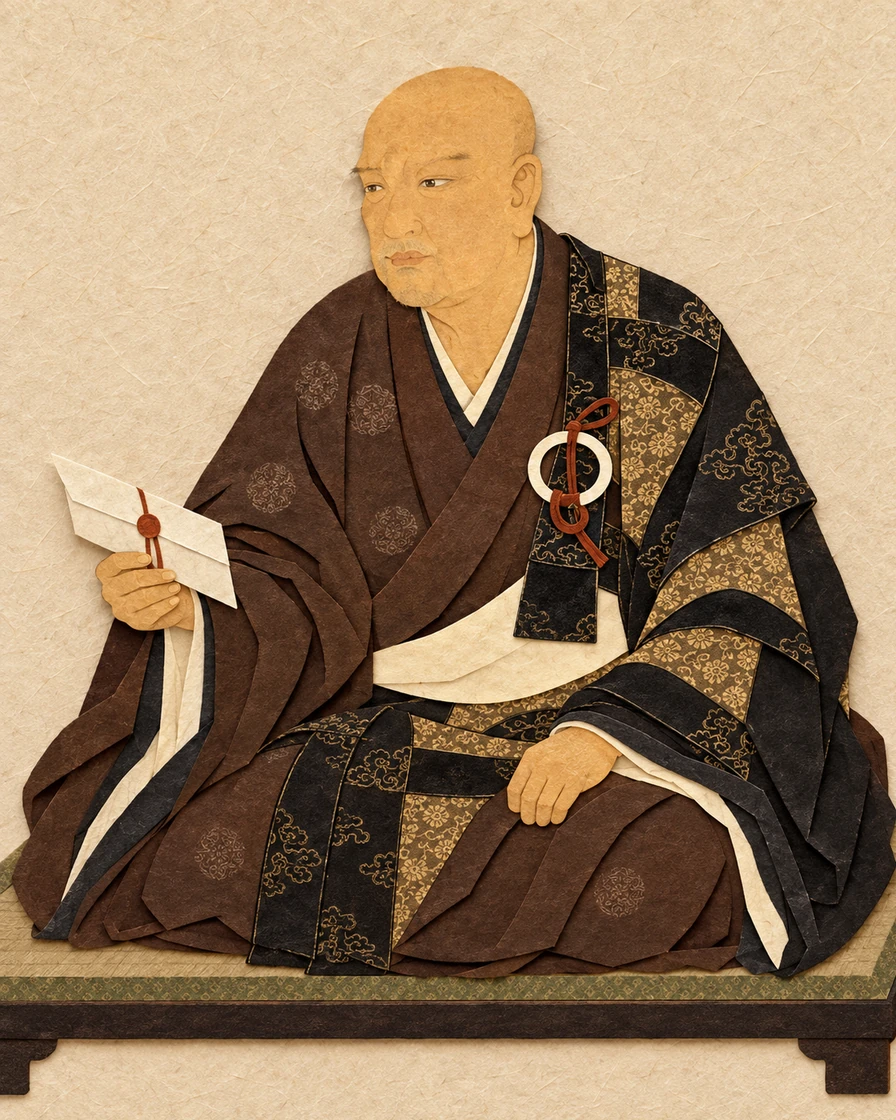
Konchiin Sūden, also called Ishin Sūden, was born in 1569 into the Isshiki family. He entered Nanzenji, a monastery of the Rinzai school of Zen Buddhism, in Kyoto while young, studying under Genpo Reisan and later inheriting the teaching of Seishuku Tokurin. In 1605 he became abbot of Nanzenji and lived at its subtemple Konchiin, which he helped restore. His learning also extended through other Kyoto religious institutions. The future Tokugawa adviser first acquired standing as a monk, teacher and administrator. Those skills belonged to older institutions with experience in records, ceremony and correspondence; they would become useful to a government establishing itself after prolonged warfare. [1][10]
In 1608 Sūden entered service with Tokugawa Ieyasu at Sunpu, in present-day Shizuoka. Ieyasu had passed the shogunal title, leadership of the warrior government, to his son Hidetada but continued directing major affairs. Sūden drafted foreign correspondence within a practice previously served by other Zen monks. Commercial permissions and replies to foreign rulers helped regulate overseas trade. He also worked with the scholar Hayashi Razan on Ieyasu’s printing projects. His diary records materials, payment and proofreading, showing that the making of learned books required organized labor and money. Correspondence and publication both turned textual expertise into work conducted for the ruling house. [1][2][3]
From 1612 Sūden worked with Itakura Katsushige, the government’s senior official in Kyoto, on temple supervision and disputes. Ieyasu also had court and temple records gathered to inform new regulations. In 1615 Sūden drafted the first Warrior House Laws, or Buke Shohatto, at Ieyasu’s direction. The thirteen clauses were read before territorial lords at Fushimi as Hidetada’s command. Separate rules addressed the court and religious institutions. The act depended on several roles: knowledge of precedents, composition, the rulers’ decisions and enforcement. Sūden supplied a crucial part of that work while the authority to command rested with the government. [1][5][4]
Sūden’s command of words also served coercive decisions. At Ieyasu’s direction he composed an anti-Christian declaration in the traditional year 1613, issued in Hidetada’s name and followed by expulsions in 1614. It represented Christianity as a threat to the country’s religious and governing order. Sūden then participated in the dispute over words on the Toyotomi-sponsored Hōkōji temple bell. The Tokugawa side treated phrases invoking peace and prosperity as an insult to Ieyasu. That accusation helped bring an armed rival household into open conflict. The alleged curse was the Tokugawa accusation, rather than an established intention of the inscription’s writer. [6][1][7]
When Ieyasu died in 1616, Sūden advocated honoring him with a myōjin title, an honorific for a deity. Tenkai, a Tendai Buddhist monk, supported gongen, a designation expressing a Buddhist manifestation. Hidetada chose the latter, and court procedures led to the title Tōshō Daigongen. Sūden’s advice had not prevailed on an important ritual question. His wider position also changed after the founder’s death, as his access to Hidetada became more limited. He nevertheless retained responsibilities: in 1619 he became sōroku, an official overseeing appointments and affairs within major Zen institutions. Reduced proximity to the ruler coexisted with continuing authority in a defined clerical field. [8][1]
In 1626 Emperor Go-Mizunoo awarded Sūden the title Enshō Honkō Kokushi, honoring him as a distinguished religious teacher. A year later Sūden and the senior official Doi Toshikatsu challenged court permissions for abbacy and purple robes at Daitokuji and Myōshinji, two Kyoto Zen monasteries. The robes marked elevated religious standing. Opponents, including Takuan Sōhō, protested in 1628; resistant monks were exiled in 1629. Sūden advocated severe punishment. The dispute concerned which authority could recognize clerical status and whether the government’s regulations took priority over imperial permissions. His own court honor had not prevented him from pressing restrictions on the court’s treatment of other monks. [1][3][9]
During his final years Sūden rebuilt Konchiin at Nanzenji. Its grounds included a shrine to Ieyasu and a dry landscape garden designed by Kobori Enshū and built by Kentei. His cultural work included selecting auspicious dates and assessing paintings and calligraphy. Recorded visits in 1629 brought both Hidetada’s son and successor Iemitsu and Hidetada himself to Konchiin, where Sūden served tea. These contacts qualify an account of complete withdrawal after Ieyasu’s death. Sūden died in 1633. His diaries and diplomatic records preserve much of his work, but brief notes and later copies give different kinds of evidence. The surviving temple and writings carry a life of religious learning, service and coercive responsibility. [10][1][11][3]
Classic
Konchiin Sūden, also called Ishin Sūden, was born in 1569 into the Isshiki family, associated with the Ashikaga warrior government. His early formation took place at Nanzenji, a monastery of the Rinzai school of Zen Buddhism in Kyoto. Genpo Reisan taught him there. He also studied through the religious establishments of Daigo and Shōkokuji, before becoming the successor in teaching to Seishuku Tokurin of Konchiin. These connections gave his education several institutional settings. Clerical learning joined mastery of texts with relationships through which a monk could advance. [1]
In 1605 Sūden held the abbacy at Kenchōji and then Nanzenji, according to the reference sequence. He lived at Konchiin, a subtemple within Nanzenji, and worked on its revival after earlier destruction and decline. An abbacy placed a monk over a community and its resources; restoration required patrons, builders and continuing administration. He was already exercising these responsibilities before joining Tokugawa Ieyasu, founder of the warrior government based at Edo, present-day Tokyo. [1][10]
Chinese classical learning and the conventions of formal writing had long given Zen monks work beyond their monasteries. The historian Takagi Shōsaku places Sūden within that earlier tradition of literate clerical service. Diplomatic documents had been a responsibility of monks under the Ashikaga as well. The Tokugawa could draw upon skills and precedents developed before their own government. Sūden’s path into service brought that inherited competence to a new ruling household. [1][2]
Ieyasu summoned Sūden to Sunpu, in present-day Shizuoka, in 1608, after the death of the earlier diplomatic monk Saishō Jōtai. Ieyasu was the retired shogun, or head of the warrior government, while his son Hidetada held office at Edo. The founder nevertheless continued handling important external affairs. Sūden joined this household as a drafter of diplomatic documents, working within conventions already maintained by Zen predecessors. The succession in expertise mattered alongside the succession in the ruling family: documents still had to be composed when an earlier specialist died. [1][2]
Ieyasu’s regulation of overseas commerce had begun before Sūden’s arrival. A return letter to Annam, in northern Vietnam, in 1601 offered protection to visiting ships and asked that Japanese merchants without red-seal permits be denied trade there. Such documents joined an assurance to a demand for cooperation from another government. Sūden later worked within this developing practice of letters and permissions. The surviving diplomatic records associated with him include the work of predecessors as well as his own, preserving the circumstances of composition alongside exchanges. [2][1]
Sūden and Hayashi Razan, a scholar of Chinese classics, also supervised editions produced under Ieyasu’s patronage at Sunpu. The National Archives describes entries in Sūden’s diary recording printing equipment, the casting of copper type and payment to monks comparing the text with its source. A patron’s command thus passed through editors, skilled makers and proofreading labor before becoming a book. Sūden’s records let that practical process emerge from an undertaking otherwise remembered under the founder’s name. His responsibility connected the handling of texts with the management of resources. [3]
Sūden and Itakura Katsushige shared responsibility for temple administration from 1612. Itakura was the senior warrior official representing the government in Kyoto. Their work included disputes as well as supervision of religious establishments. At the same time, Ieyasu sought records held by court families and temples. A survey in 1614 identified texts that could be submitted and copied. Knowledge preserved by older houses became material available to the new rulers when preparing court and temple regulations. [1][5]
After the fall of Osaka in 1615, Ieyasu ordered preparation of rules for territorial lords. Sūden drafted the first Warrior House Laws, known as the Buke Shohatto. Thirteen clauses addressed conduct and the means through which a lord maintained power, including castle repair and marriage. At Fushimi the assembled lords heard the text as Hidetada’s order. Drafting and proclamation linked a monk’s command of language to the shogun’s ability to require obedience. The text could then guide judgments affecting a ruling household’s fortifications and family arrangements. [4][1]
A surviving draft shows that this work continued after the first proclamation. At Konchiin, an eleven-clause version dated to the traditional tenth month of 1616 is identified as Sūden’s own handwriting. The cultural-property description notes an erased correction in its second clause and a small addition in the ninth. Each rule is followed by an explanation of its purpose. These marks preserve composition in progress, rather than a pristine decree already beyond alteration. His diary also records a direct instruction to revise the warrior laws that month. The thirteen-clause text of 1615 was therefore followed by revision during Sūden’s lifetime, before the more familiar changes of 1635. The surviving manuscript belongs to that 1616 revision; it is not the original sheet read to the lords in 1615. [12]
Regulations for the imperial court and for temples accompanied the warrior laws, addressing groups with different positions and traditions. The preparation used older learning to make new demands upon those institutions. The first warrior text also preceded the later revision of 1635, which formalized alternating residence for lords under Iemitsu, Hidetada’s successor. Following the versions preserves the scale of Sūden’s actual contribution. He helped give early Tokugawa rule legal expression; later governments extended and revised that settlement. [4][5][1]
At Ieyasu’s instruction Sūden composed the declaration against Christianity associated with the traditional year 1613. It was promulgated in Hidetada’s name, a sequence distinguishing the founder’s decision, the monk’s formulation and the shogun’s order. The text invoked a country founded upon deity worship, Confucian learning and Buddhism, presenting Christian teaching as disruptive to its proper order. This was the government’s justification for exclusion. The document gave religious condemnation a form through which officials could act. [6]
In 1614 missionaries and Japanese Christians were expelled to places including Macao and Manila. Among them was Takayama Ukon, a Christian warrior. The declaration’s consequences reached people whose faith and associations exposed them to removal from Japan. Sūden’s diplomatic work and his participation in prohibition therefore belong within the same career. A government could maintain overseas commercial relationships while excluding religious ties it considered threatening. Textual expertise helped articulate both permission and persecution. [6][2][1]
Evidence boundary · Was the bell intended as a curse?
Hideyori, son of Ieyasu’s predecessor Toyotomi Hideyoshi, had rebuilt Hōkōji’s great Buddha establishment in Kyoto in 1614. His retainer Katagiri Katsumoto sought Ieyasu’s agreement to ceremonial arrangements. The Tokugawa side objected to phrases on the new bell, interpreting them as a curse against Ieyasu and praise of Toyotomi prosperity. Sūden took part in the dispute. The inscription became a focus for conflict with a household that still held Osaka Castle and armed followers.
The alleged curse was an accusation used in that conflict, rather than an established intention of the inscription’s writer. [7][1]
Ieyasu’s death in 1616 required the successors to decide how he would be worshipped. Sūden supported the divine honorific myōjin. Tenkai, a monk of the Tendai school, argued for gongen, a deity understood as a Buddhist manifestation. Hidetada ruled in favor of gongen. The government sought court authorization, then selected Tōshō Daigongen from the proposed titles. Clerical counsel, shogunal judgment and imperial procedures contributed different powers to the result. Sūden’s participation gave him a voice, but it did not give him the final decision. [8]
Evidence boundary · A later explanation of the ritual choice
A familiar account links Tenkai’s argument to the unhappy fate of Toyotomi Hideyoshi’s deity cult. The National Archives presents that rationale through a book published in 1789, long after the original debate.
The comparison belongs to a later account of the reasoning. [8]
Takagi Shōsaku also describes Sūden becoming more distant from Hidetada’s inner circle after Ieyasu’s death. Loss of the founder’s direct patronage changed the setting in which the monk’s expertise was employed, even while particular responsibilities continued. [8][1]
Sūden established a Konchiin presence at Edo after the founder’s death and became sōroku in 1619. That position carried influence over the appointment of abbots within major Zen institutions and the handling of clerical affairs. An adviser’s access to the ruler and an official’s jurisdiction were related but distinct sources of power. The office gave Sūden continuing work through institutions with their own ranks, property and claims. Those responsibilities would place him within the later dispute over permissions issued by the imperial court. [1]
Emperor Go-Mizunoo granted Sūden the title Enshō Honkō Kokushi in 1626. Kokushi, or national teacher, was an honor bestowed upon a distinguished monk. Court recognition remained meaningful to someone serving the warrior government. The following year Sūden and Doi Toshikatsu, a senior government official, challenged the admission and advancement of monks at Daitokuji and Myōshinji. At these Kyoto Zen monasteries, imperial permissions recognized appointments and the right to wear purple robes, signs of elevated religious status. The challenge placed that practice against rules issued in 1613 and 1615. [3][1][9]
Monks including Takuan Sōhō submitted a protest in 1628 to Itakura Shigemune, the government’s senior Kyoto official. Resistance continued, and in 1629 the government sent protesting monks into exile in the northeast. Sūden pressed for severe punishment. The sequence involved regulations, objections, negotiations and penalties rather than a robe alone. A symbol of religious distinction carried a dispute about the power to make appointments and the authority to require obedience. The punishment removed particular opponents from their communities. [9][1]
Takano Toshihiko interprets the dispute as an effort to establish the priority of government law over conflicting imperial permissions and extend supervision to Zen institutions still outside full control. That interpretation explains why rank and appointment became matters of state authority. It also leaves the monks’ resistance visible: court-linked religious standing gave them a basis from which to object. Sūden’s legal and clerical work supported the government’s demands, at a cost to other religious practitioners. His later reputation for harshness arose from actions with consequences beyond the wording of a decree. [9][1]
Rebuilding at Kyoto’s Konchiin began in 1627. The establishment included a Tōshōgū shrine honoring Ieyasu and a garden before the abbot’s quarters. Kobori Enshū designed the dry landscape garden, while Kentei carried out its construction. White gravel, crane and tortoise islands and a central worship stone arranged the ground. Sūden supplied the institutional setting and patronage; other specialists supplied design and labor. The temple joined the memory of the founder to the community in which his adviser had lived and taught. [10]
Historical interpretation · What continued after Ieyasu’s death?
Sūden’s later work included auspicious-date selection and the appraisal of paintings and calligraphy. Ishii Chiemi’s study compares his diary with later Tokugawa chronicles to investigate his ties to Hidetada’s son and successor Iemitsu. It describes visits in the traditional tenth month of 1629 by Iemitsu and, two days later, Hidetada, with Sūden serving tea at Konchiin. Such recorded encounters show contact continuing after the founder’s death.
They do not restore every earlier responsibility, but they give the later career a fuller shape than disappearance from government. [11][1]
Sūden died in 1633, bringing the diary’s record to an end. The original survives at Kyoto’s Konchiin, while the National Archives holds a copy. Letters, gifts, accounts and the circumstances of official writing reveal the work moving through his hands. Ishii notes how terse his descriptions of himself can be, requiring comparison with other records for some encounters. The nickname “black-robed chancellor” concentrates a varied career into one image. The records instead let its responsibilities be followed separately: a learned monk composed commands, administered institutions and helped give the new government durable forms, while sharing responsibility for the people those commands excluded or punished. [3][11][1][6][9]