Read the article below. Interactive reading tools are available when scripts load.
Quick
Kōdai-in is the later name of Nene, also called One, principal wife of Toyotomi Hideyoshi. She came from Owari, in present-day Aichi, as a daughter of Sugihara Sadatoshi and an adopted daughter of Asano Nagakatsu. Her birth year is disputed, most often given as 1548 or 1549. She married Hideyoshi in 1561, when he had not yet become Japan’s dominant military ruler. As his position rose, their household acquired new standing. His appointment as kanpaku, imperial regent, in 1585 brought her the honorific Kita-no-Mandokoro. That designation belonged to the wives of regents; it was not a unique personal name or an office making her a regent herself. [1][2][3][10]
Nene received Junior First Rank at the imperial court in 1588, an exceptionally high standing recorded in surviving appointment documents. Her position included lands granted by Hideyoshi and an extensive family network. Her brother Kinoshita Iesada’s descendants included Kobayakawa Hideaki, who inherited a warrior lordship through adoption. A surviving certificate records Hideaki borrowing money from Nene. These records show a principal wife holding assets and dealing with relatives who governed their own lands. Her role depended on court standing, resources and correspondence as well as marriage to the ruler. [1][4][5][8][11]
Hideyoshi spent long periods campaigning and wrote repeatedly to Nene. She supervised affairs at Osaka Castle, where Yodo-dono, another woman in Hideyoshi’s household, gave birth to his son Hideyori in 1593. Hideyoshi wrote from Nagoya Castle in Hizen, his base for the invasion of Korea, to tell Nene how the child should be named. The letter places her within the practical arrangements surrounding the birth of the family’s future heir. She was Hideyoshi’s principal wife and a keeper of his household; Yodo was the child’s mother. [8]
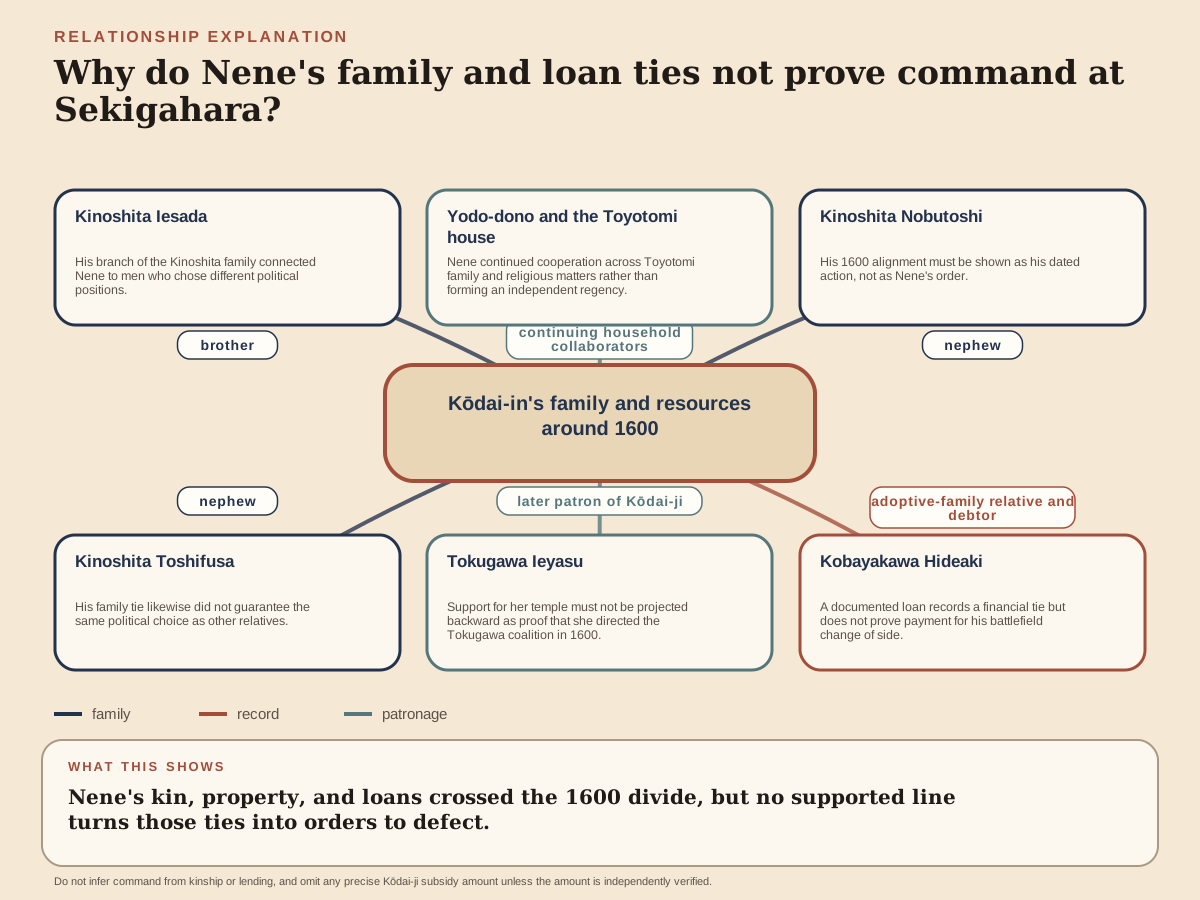
After Hideyoshi died in 1598, Nene moved from Osaka to a Kyoto residence in 1599. She occupied part of the palace-castle he had built southeast of the imperial court. The military contest of 1600 divided people connected with her family. Her nephew Kinoshita Nobutoshi supported Tokugawa Ieyasu, the powerful lord who won at Sekigahara; another nephew, Kinoshita Toshifusa, belonged to the opposing coalition. Kobayakawa Hideaki changed sides during the battle. Nene’s kinship and financial dealings do not establish that she directed his decision. Osaka Castle Museum describes her continuing cooperation with Yodo and the Toyotomi household after Hideyoshi’s death. [9][7][8][4][11]
Nene formally entered Buddhist religious life in 1603 under the Sōtō Zen teacher Kyūshin Zenkyo and received the court-authorized name Kōdai-in. Religious succession documents and the court’s authorization survive at Kōdai-ji. In 1606 she founded that temple in Kyoto’s eastern hills to commemorate Hideyoshi. Ieyasu provided substantial financial assistance. The memorial joined her own resources and family purpose with support from the ruler whose authority had grown after 1600. Its preserved objects include portraits, religious documents and decorated furnishings associated with the couple. Commemoration required buildings, income and people who could keep the institution functioning. [5][8][6][4]
The destruction of Hideyoshi’s ruling house at Osaka in 1615 did not end Kōdai-in’s own household. Tokugawa authorities continued her income, and she maintained relations with surviving relatives. In 1624 she congratulated her nephew Nobutoshi on the marriage of his daughter to the son of his brother Toshifusa. She recalled that her own wedding had been modest, yet their later life had become widely known, and used that memory to wish the new couple well. She died that year and was buried at Kōdai-ji beneath her statue in the memorial hall. Her letters and temple preserved family remembrance after the loss of dynastic power. [1][7][8][6]
Classic
Kōdai-in, widely known as Nene, came from Owari, around present-day Aichi. Modern reference biographies identify her father as Sugihara Sadatoshi and describe her adoption into the household of Asano Nagakatsu. Adoption gave her a recognized family affiliation before her marriage to Toyotomi Hideyoshi in 1561. These relationships distinguish the household into which she was born from the one through which she married. Her husband was then a warrior whose great advancement still lay ahead. [1][2]
Nene, One or Nei—and an uncertain birth year
The familiar names Nene and One appear alongside the abbreviated signature Ne. Historian Fukuda Chizuru argues that this signature follows women’s practice of shortening a personal name, and reads her name as Nei, with Nene a familiar form.
Other reference works continue to use Nene or One. The birth date is less secure: references differ between 1548 and 1549, while library excerpts describe an earlier 1542 proposal and objections based on her elder brother’s chronology. [10][1][3]
Hideyoshi became kanpaku in 1585. The title designated an imperial regent acting within court government; Kita-no-Mandokoro was an honorific for his principal wife. Nene was one among several historical women who bore it. Her new designation placed their marriage within the established language of regent households, while military power gave that household exceptional reach. Court documents and her letters would preserve her public identity alongside the familiar names by which she remains known. [1][2][5][8]
The court raised Nene to Junior First Rank, an exceptionally high court standing, in 1588. Kōdai-ji preserves an instrument of this appointment, catalogued alongside the later authorization of her name Kōdai-in. Rank identified her standing within court society, where Hideyoshi’s appointment as regent had already changed their household’s position. The documents gave her a recognized place in the relations between the Toyotomi family and the imperial court. [1][5][8]
The Toyotomi family documents transmitted through the Ashimori Kinoshita house include Hideyoshi’s grant to Nene of lands assessed at 10,000 koku. Koku, a measure of rice volume, was also used to express the assessed resources of land. The archive includes letters addressed to her and a certificate for money borrowed by Kobayakawa Hideaki. A grant and a borrowing certificate record different transactions: one established resources under her control; the other created a financial obligation within the family. These are unusually tangible traces of the material means behind her relationships. [4]
Hideaki was a son of Nene’s brother Kinoshita Iesada and passed through adoptions by Hideyoshi and Kobayakawa Takakage. His new household gave him lands and followers, while his aunt remained connected with him through kinship and money. The family archive retained papers concerning Hideaki, Hideyoshi’s regent successor Hidetsugu, the Kinoshita relatives and Kōdai-ji. Their survival through the Kinoshita house joins several branches of family history. [4][8][11]
Hideyoshi’s correspondence with Nene ran across his campaigns. Letters preserved or catalogued by Osaka Castle Museum place her among the people to whom he communicated while away from his governing household. In 1593 he was at Nagoya Castle in Hizen, in present-day Saga, the Japanese base for the invasion of Korea. Nene was overseeing the Osaka Castle household. The distance joined domestic arrangements to the ruler’s military absence: orders concerning the family had to be conveyed through letters and those who carried them. [8]
Yodo-dono, another woman in Hideyoshi’s household, gave birth to his son Hideyori at Osaka Castle in 1593. The museum’s explanation of Hideyoshi’s letter describes a protective custom in which the newborn was ceremonially abandoned and then picked up by the elder retainer Matsuura Shigemasa. This supplied the child’s name Hiroi, associated with being picked up. Hideyoshi’s letter addressed Nene with instructions about the name and its use, including how lesser members of the household should refer to him. It shows an attempt to protect the child through a familiar custom while regulating how people spoke of him. [8]
The same letter tells Nene to convey thanks to Matsuura and says that Hideyoshi will return and speak with her. Its recipient was therefore expected to communicate and carry out arrangements in Osaka. Yodo’s maternity and Nene’s senior position had different functions within that household. The letter records arrangements shared across the household surrounding the newborn. Hideyoshi’s death in 1598 changed the conditions under which they continued to act. [8]
In 1599 Nene moved into the Kyoto palace-castle built by Hideyoshi in 1597, southeast of the imperial court. Archaeological research combines diary entries and old maps to identify her residence within its reduced grounds. Her move left Osaka, but brought her into an existing Toyotomi property close to court society. Her residence retained towers, stone walls and inner walls recorded in contemporary diaries. Parts of its gates and walls were damaged or removed in 1600; a particular wall and moat discovered by excavation were buried later, during court rebuilding in 1627. [9]
The campaign of 1600 did not turn all Nene’s relatives into one political party. Sakai City Museum identifies her nephew Nobutoshi as a supporter of Tokugawa Ieyasu, the powerful lord victorious at Sekigahara, later rewarded with the Hiji lordship in present-day Oita. Osaka Castle Museum describes his brother Toshifusa on the western side; Toshifusa lost his lands, but survived and later received protection within the family. Hideaki’s change of sides at Sekigahara formed another course among her relatives. A family connection could continue through very different military choices and territorial outcomes. [7][8][4]
Family finance and political allegiance
The borrowing certificate records a family financial relationship; it does not establish an instruction to Hideaki to change sides at Sekigahara. Meanwhile, the museum’s account of Nene’s widowhood emphasizes her continued dealings with Yodo and the household at Osaka. Her later receipt of Tokugawa support can therefore coexist with concern for the Toyotomi family. [4][8][1][6]
The surviving documents distinguish Nene’s religious entry from the court’s authorization of her new name. Osaka Castle Museum dates her becoming a disciple of Kyūshin Zenkyo, a Buddhist teacher in the Sōtō Zen tradition, to 1603, five years after Hideyoshi’s death. Religious succession papers described by the Agency for Cultural Affairs recorded her place within that teaching lineage. A document from Emperor Go-Yōzei authorized the name Kōdai-in. Her widowhood, religious affiliation and court standing thus had separate documentary expressions. [5][8][1]
Kōdai-ji gives 1606 as its foundation year. Kōdai-in established it to commemorate Hideyoshi, while Ieyasu supplied extensive financial support. The temple interprets his assistance in terms of political considerations. His backing made a lasting memorial possible within the emerging Tokugawa order, even though the memorial centered on his predecessor. Papers relating to temple laws and support survive alongside the family documents. Maintaining religious observance depended on resources and governing arrangements as well as devotion to the deceased. [6][4][8]
The foundation was followed by another institutional step during her last year. According to Kōdai-ji’s own history, Sankō, a monk from Kennin-ji, was invited as its opening abbot in the seventh month of 1624. Her entry into religious life, the establishment of the memorial and the appointment of its opening abbot were thus distinct stages, spread across more than twenty years. The memorial took institutional shape over much of her widowhood. [6]
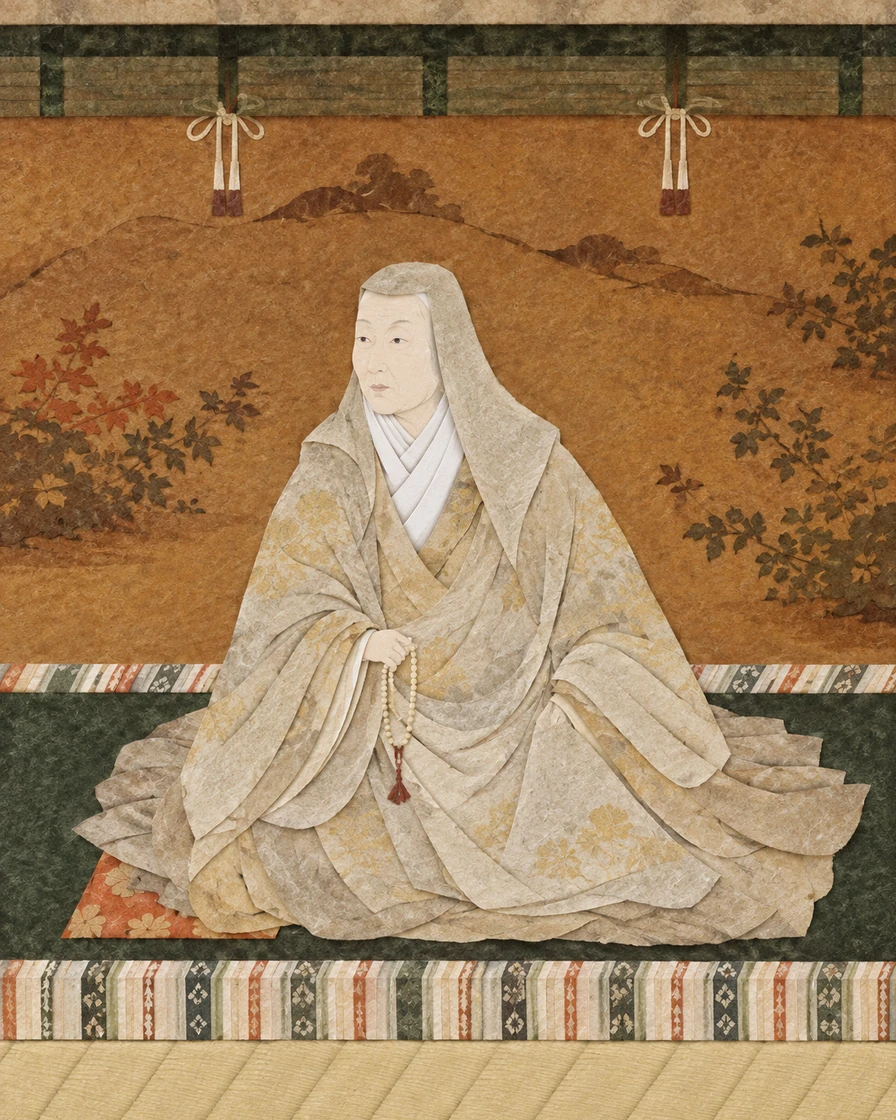
The temple’s memorial hall honors Hideyoshi and Kōdai-in with statues and richly decorated lacquerwork. Furnishings associated with the couple preserve another part of this material world. A writing box described by Osaka Castle Museum contrasts black lacquer and gold surfaces, with bamboo and autumn grasses forming its decoration. Such works gave later name to the style known as Kōdai-ji maki-e, lacquer decoration using sprinkled metallic powder. The objects connect writing, household use and artistic workmanship with the institution that preserved them. [6][8][5]
The Toyotomi ruling house fell at Osaka in 1615. Kōdai-in survived, and the Yamakawa biography states that her treatment by the Tokugawa authorities continued after that destruction. The Tokugawa grant of income in Kawachi, in present-day Osaka, supported her later life. What remained was a household capable of maintaining relatives, correspondence and a religious memorial. Such continuity did not reverse the loss of Hideyoshi’s ruling line. [1][2][6][8]
In the traditional fifth month of 1624 Kōdai-in wrote to Kinoshita Nobutoshi about a family marriage. His daughter Okuri had married Kumanosuke, the son of his brother Toshifusa. In the letter she congratulated them and responded to news that the wedding had been arranged hastily. She recalled that her own wedding, too, had been modest, before their subsequent life became known throughout the country. Rather than dismissing the new ceremony, she made that comparison into a wish for lasting prosperity. She also reported having the wedding day assessed as auspicious. [8]
Nobutoshi’s house at Hiji and Toshifusa’s house at Ashimori continued under Tokugawa rule, preserving the Toyotomi clan designation in their family history. Kōdai-in’s letter joined their next generation through marriage. She died in 1624; Kōdai-ji locates her grave beneath her own statue in its memorial hall. That site commemorates the couple together, while court papers, religious certificates, letters and portraits preserve relationships extending beyond the marriage. Her final-year recollection preserves her own account of the modest ceremony with which their married life began. [8][6][4][5]