Read the article below. Interactive reading tools are available when scripts load.
Quick
Kasuga no Tsubone was born in 1579 and was first known as Fuku. Her father, Saitō Toshimitsu, served the military lord Akechi Mitsuhide, whose forces were defeated in 1582 after Mitsuhide’s attack on his overlord Oda Nobunaga. Toshimitsu died in that collapse, and Fuku relied on her mother’s Inaba relatives. She became an adopted daughter of Inaba Shigemichi and married his adopted son Masanari. Their children included Masakatsu. The marriage later ended. These family relationships preceded her work in the Tokugawa household. Her future influence began from service and existing ties, after the destruction of the house her father had served. [1]
In 1604 Fuku became wet nurse to Takechiyo, the child later named Tokugawa Iemitsu. His father Hidetada became the second shogun, head of the warrior government, in 1605, while grandfather Ieyasu continued governing in retirement. Care placed Fuku close to a child who might inherit that office. A famous story describes her appealing to Ieyasu when the younger brother Tadanaga appeared favored. The National Archives presents the episode as a transmitted account; its displayed illustration of the brothers’ treatment comes from a work compiled in 1709. Iemitsu received the shogunate in 1623. Fuku remained important around him, but the anecdote is not a complete contemporary explanation of his succession. [1][2]
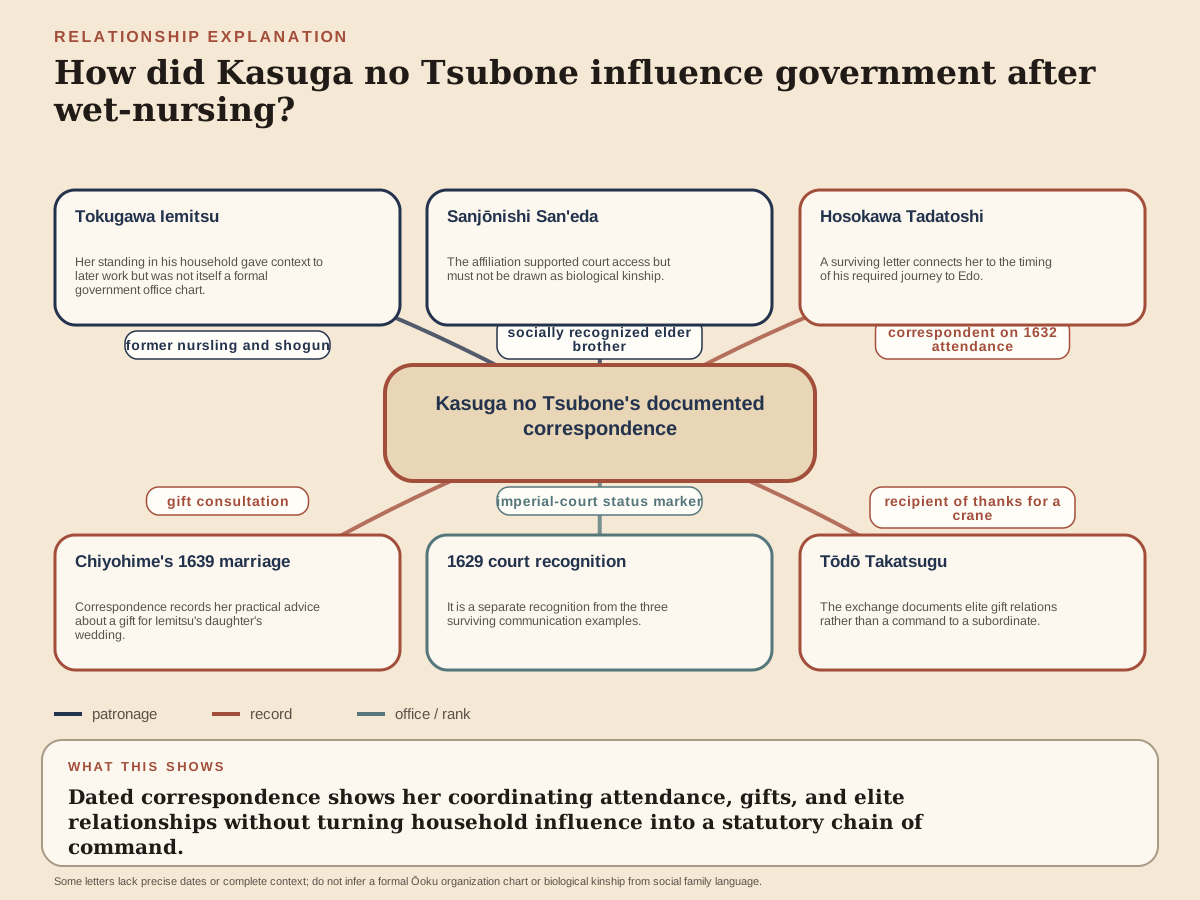
Fuku’s influence continued after Iemitsu became shogun. Following the death of Hidetada’s wife Gō in 1626, reference accounts describe her directing the women’s household at Edo Castle, later known as the Ōoku. This responsibility connected personal service with access to the ruler, relatives and territorial lords. Letters make the network concrete. In 1632 Hosokawa Tadatoshi sought the timing of his attendance at Edo through her and other contacts. Another letter replies to consultation about gifts for Iemitsu’s daughter’s marriage. An undated letter thanks Tōdō Takatsugu for a gift of cranes. Household work involved information, ceremonial obligations and continuing relationships, whose influence extended beyond the women’s quarters. [1][4][8][3]
In 1629 Fuku traveled to Kyoto with the retired shogun Hidetada’s support, during conflict between Emperor Go-Mizunoo’s court and the warrior government. She acquired the socially recognized position of younger sister to the courtier Sanjōnishi San’eda and received an imperial audience. The affiliation helped place a warrior-household woman within court relationships; it was not biological siblinghood. She was granted the name Kasuga no Tsubone, by which she became best known. The encounter extended her standing beyond the shogun’s household. It also joined personal service to relations between institutions already tied by the marriage of Hidetada’s daughter Masako to the emperor. [1]
Kasuga’s family ties reached more than one branch of the Tokugawa. Masakatsu served Iemitsu as a senior councillor, while another son, Masatoshi, served the younger brother Tadanaga. After Tadanaga lost his lands and died in 1633, Masatoshi entered custody under Hosokawa Tadatoshi in Kyushu in 1634. Kasuga and Masakatsu had sought Tadatoshi’s assistance. Later correspondence describes conflict over Masatoshi’s conduct and restrictions on his movement. It also reports Kasuga demanding that he take his own life; it does not show that the demand was fulfilled. Her influence could secure arrangements for a relative, but it also operated within a government capable of punishing the household branch he had served. [1][5]
Kasuga established a temple at Yushima in Edo, later called Rinshō-in. Its institutional history describes land and buildings provided through Iemitsu’s patronage and an endowment assessed at three hundred koku of rice. She died in 1643 and was buried there. Temple traditions remember a vow to refuse medicine after Iemitsu recovered from illness and explain openings in her grave through a wish to keep watching over the government. Those accounts show how devotion and continuing protection became part of her remembered life. Portraits and a statue also survive, some with uncertain attribution. Her historical work remains clearest in the nursing relationship, court recognition, family arrangements and correspondence through which influence took practical form. [6][7][9][1][3][4][5]
Classic
Fuku, later Kasuga no Tsubone, was born in 1579, the daughter of Saitō Toshimitsu. He was a senior retainer of Akechi Mitsuhide, a military lord serving Oda Nobunaga. Mitsuhide attacked Nobunaga in 1582 and was then defeated by Toyotomi Hideyoshi’s forces. Toshimitsu died during the collapse of Mitsuhide’s side. Fuku’s subsequent life depended upon relatives outside that defeated military establishment. The family loss altered the resources available to a child whose later career would develop under a different ruling house. [1]
Her mother’s Inaba relatives supplied a household in which she could be placed. Fuku became an adopted daughter of Inaba Shigemichi and married Masanari, his adopted son. Adoption linked succession and marriage within that family, making it part of her social position before Edo service. She bore children including Masakatsu and Masatoshi, whose later careers would connect her own family with the Tokugawa. Her marriage to Masanari ended, although brief accounts differ over the sequence in relation to her appointment as nurse. [1][5]
Differences in the family chronology
Kitahara Akio’s biography counts four sons and places separation before her nursery service. Britannica’s short account gives three children and associates the divorce with becoming Iemitsu’s nurse.
These differences call for caution about the compressed family chronology; they do not erase the recorded relationship with Masanari. [1][11]
The reference accounts also differ over birthplace and the number of sons, while the broad relationships remain consistent. [1][11]
They support a family history shaped by military defeat, adoption, marriage and separation. Those changes give the later nurse a life beyond the famous image of a commanding woman at Edo Castle. Existing ties to warrior families could help make a new place possible. Those ties continued to matter when her children entered Tokugawa service. [1]
Takechiyo was born in 1604 within the Tokugawa household at Edo, present-day Tokyo. Fuku became his wet nurse through the recommendation of Itakura Katsushige, the government’s senior Kyoto official, according to reference accounts. Nursing provided bodily care and repeated access to a child whose upbringing mattered to the ruling family. He would later take the name Iemitsu. Fuku’s service therefore placed her within an intimate household relationship that continued to have consequences as the boy entered public office. [1]
Hidetada, the boy’s father, became shogun, head of Japan’s warrior government, in 1605, while his own father Ieyasu continued governing in retirement. A younger brother, later named Tadanaga, also gained a place within the ruling family.
The later story of an appeal to Ieyasu
Accounts of parental favoritism toward that brother explain Fuku’s supposed appeal to Ieyasu, often dated to 1615 and linked with an Ise pilgrimage. The National Archives marks the narrative as reported. Its displayed story of Ieyasu distinguishing the boys while distributing sweets belongs to the Buya Shokudan, compiled in 1709.
That date separates an influential later narrative from a contemporary transcript of the household’s decisions. [1][2]
Iemitsu became the third Tokugawa shogun in 1623, while Hidetada retained substantial authority as the retired ruler. His appointment made the dynastic outcome public through court recognition. Fuku’s continued service and later influence are attested parts of that career. The famous appeal expresses how a nurse could be remembered as protecting an heir, while its details require separate assessment. Iemitsu’s succession also depended upon the decisions and resources of his father, grandfather, officials and the imperial court. The enduring connection with Fuku gave her a place around the adult ruler as well as the child. [1][2]
After Gō, Hidetada’s principal wife, died in 1626, Fuku became a leading figure in the women’s household, or Ōoku, at Edo Castle. The early organization developed further under later shoguns; the responsibilities around Fuku need to be followed within her own lifetime. Her connections helped relatives enter government service. Masakatsu, her son, became a senior councillor, and other family-linked men obtained positions. Personal relationships formed within the ruling house could affect appointments outside its inner rooms. The process gave household service consequences for the wider warrior administration. [1]
Hosokawa Tadatoshi, a territorial lord in Kyushu, corresponded with officials and household contacts while judging when to attend the ruler at Edo. The University of Tokyo’s introduction to the edited letters describes him seeking that timing through Fuku, Masakatsu and others in 1632. It also identifies his report to her of Masakatsu’s entry into Kumamoto Castle on official business. These exchanges show information passing between a lord, an official and the official’s mother. The exchanges joined official business with a household relationship maintained through personal contact. [4]
The correspondence belonged to a year of political uncertainty. Tadatoshi had returned from Edo to Kokura after Hidetada’s death when he sought advice about his next attendance. In the fifth month of 1632, the government removed Katō Tadahiro from Higo, whose principal castle was Kumamoto. Masakatsu was sent as a commissioner to take possession of the castle. Tadatoshi arranged roads and provisions for the journey and reported Masakatsu’s arrival to Fuku. Later that summer, senior councillors acknowledged his preparations after Masakatsu had reported them to Iemitsu. The mother-son relationship was one channel within a larger circuit of official information. Tadatoshi received Higo himself in the tenth month, but these letters do not establish that Fuku procured that award. [4]
A letter catalogued by Kumamoto University replies to Tadatoshi’s consultation over gifts for the 1639 marriage of Iemitsu’s daughter Chiyohime into the Owari Tokugawa house. Another letter in Iga City’s archive, addressed to Tōdō Takatsugu according to its wrapper, repeatedly thanks him for cranes. The catalogue places that undated item within 1630–1643 and describes the birds as apparently sent salted. Advice, gifts and acknowledgments maintained obligations between territorial lords and a woman close to the ruler. [8][3]
Fuku’s visit to Kyoto in 1629 came during strained relations surrounding Emperor Go-Mizunoo and the government’s control of clerical permissions. Hidetada, the retired shogun, supported her journey. He was also the emperor’s father-in-law through his daughter Masako. The relationship between court and warrior government involved kinship as well as competing authority. A trusted woman from the ruling household could enter that setting through forms of affiliation recognizable to the court. [1]
Sanjōnishi San’eda was a courtier connected with communication between the imperial court and warrior government. Fuku became his socially recognized younger sister, a relationship distinct from birth kinship. With that standing she entered the imperial presence and received the name Kasuga no Tsubone. Recognition gave her a court identity that could continue after the encounter. The familiar name thus belongs to an advancement late in her career, rather than the name under which she had first entered nursery service in 1604. [1]
The audience showed how connections could carry household influence across institutional boundaries. Kasuga represented a person trusted by the Tokugawa while receiving recognition from the emperor. Neither relationship removed the court’s tensions with the warrior rulers.
Did the audience explain the emperor’s abdication?
The event is often placed beside Go-Mizunoo’s abdication later that year, but the audience does not by itself establish his private reasons or a complete account of pressure upon him. [1]
Its demonstrable consequence for Kasuga was public recognition through a name and court relationship that enlarged her standing. [1]
Masakatsu, Kasuga’s son, became a senior councillor under Iemitsu. His brother Masatoshi had instead served Tadanaga, Iemitsu’s younger brother. Their careers placed members of her family within different parts of the ruling house. Tadanaga’s removal and death in 1633 left Masatoshi without his former master and exposed to the consequences of that defeat. Kinship with the influential nurse did not give him the same path as his brother. Masakatsu himself had died early in 1634. [1][5]
In 1634 Masatoshi was transferred from Takasaki, in present-day Gunma, into Tadatoshi’s custody in Higo, now Kumamoto. The edited-source introduction identifies earlier requests from Kasuga and Masakatsu and qualifies the extent of Iemitsu’s private agreement. Masatoshi first stayed at a temple and then at a residence in the Kikuchi district. The arrangement used an existing relationship with a territorial lord to manage the aftermath of service to Tadanaga. Assistance took the form of supervised placement, with movement and conduct still subject to other people’s judgment. [5]
Letters from the following years describe disagreements over Masatoshi’s freedom to travel and complaints about his behavior. Tadatoshi warned that a poor reputation at Edo endangered his prospects. The correspondence also reports Kasuga suggesting suicide after hearing of further incidents. These reports reveal severe pressure within the network that had placed him under supervision. The reports do not show that her demand was carried out. Kasuga’s family influence included responsibility for a constrained relative whose actions other officials judged troublesome, alongside appointments that increased her household’s standing. [5]
Rinshō-in’s Tokyo institutional history dates the temple’s origin as Tentakuji to Kasuga’s request in 1624. Iemitsu provided land and a building formerly associated with Hidetada. The account describes a new abbot’s arrival in 1630 and Kasuga’s religious name in 1634, along with resources assessed at three hundred koku of rice. Patronage made a continuing religious community possible through land, structures and support. The temple became a place for her own religious life and the commemoration of her family. [6][1]
Kasuga died in 1643 and was buried at the Yushima temple.
Temple traditions of lifelong devotion
Its history preserves the story of a vow never to take medicine again if Iemitsu recovered from illness. It also explains the openings in her gravestone through a wish to continue watching over the country’s government.
The temple presents these accounts as traditions of devotion. They extend the image of the nurse’s protection beyond the shogun’s childhood and beyond her own death. [6][7]
Kyoto has another Rinshō-in associated with Kasuga, distinct from her Tokyo burial temple. The 2025 Tokyo National Museum exhibition listed a seventeenth-century statue from that Kyoto establishment, a portrait attributed to Kanō Tan’yū and a poem slip attributed to Kasuga. Its Iemitsu portrait is dated to 1746, a later act of remembrance. Those different objects carry different claims about authorship and time. Her name also remains in Tokyo place names. Alongside those public memories, the letters preserve work conducted between living households: care, information, gifts, official advancement and difficult obligations to kin. [9][7][3][4][5]