Read the article below. Interactive reading tools are available when scripts load.
Quick
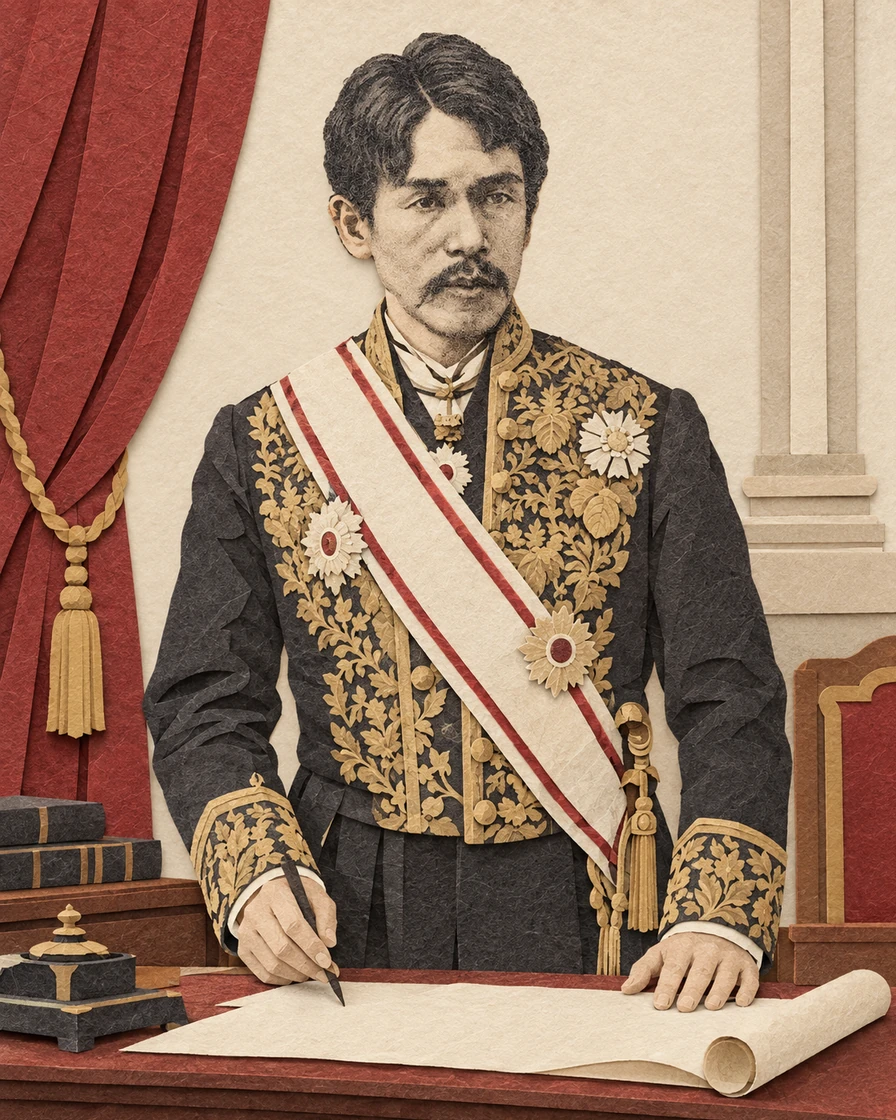
Inoue Kowashi (1844–1895), later a legal official in Japan’s Meiji government, was born into the Iida household in Kumamoto, a domain on Kyushu. His father served a senior domain retainer. Adopted into the Inoue family, he studied with Kinoshita Saitan and at the domain school, Shishūkan. These institutions gave him a strong grounding in Chinese classical learning. In 1867 the domain sent him to Edo, now Tokyo, where he studied French. His later drafting work drew on both kinds of education, while appointments and political patrons gave that knowledge access to government. [1][2][3]
Inoue entered the Justice Ministry in 1871 and investigated European legal institutions in 1872–73, especially in France. After returning, he prepared studies including Chizaihō Bikō, on criminal procedure, and advocated judicial reform, including abolition of torture. He accompanied senior minister Ōkubo Toshimichi to Qing China in 1874 and gained the confidence of influential government leaders. This was his own earlier legal investigation, distinct from Itō Hirobumi’s constitutional study mission a decade later. His work supplied proposals and comparative knowledge; their adoption required decisions by officials with authority to change institutions. [1][2][3]
Inoue drafted policy arguments for senior leaders as well as legal texts. In 1879 he helped defend Western knowledge and practical education against a proposed restoration of Confucian moral authority. In 1881 he supported a constitution granted by the emperor, using the German kingdom of Prussia as a model and keeping the cabinet separate from parliamentary control. The court statesman Iwakura Tomomi submitted the resulting constitutional outline. The October crisis removed minister Ōkuma Shigenobu and produced an imperial promise of a Diet, a national legislature, in 1890. Inoue helped formulate the governing coalition’s route; he did not possess the power to decide that settlement alone. [8][4][2][6]
From 1886 Inoue worked on the constitution under Itō Hirobumi’s direction. His two draft versions and a draft by the German adviser Hermann Roesler supplied material for discussions in 1887. Itō, Inoue, Itō Miyoji and Kaneko Kentarō revised the text through several stages, including the Natsushima draft. In 1888 the appointed Privy Council examined it before imperial approval and promulgation on 11 February 1889. Inoue was a central legal writer, but the constitution emerged from shared work and political decisions. Its presentation as an imperial grant did not describe the literal labor by which its articles had been made. [3][5][6]
The 1889 constitution placed governing authority in the emperor while requiring him to exercise it through constitutional rules. It established a Diet of two houses and required its consent for laws and annual budgets. Rights of subjects included protection against unlawful punishment and freedoms defined within legal limits. Ministers advised the emperor; their appointment did not depend on an elected majority. Imperial command, protected expenditure and continuation of the previous budget limited parliamentary control. Inoue helped build a real legal framework around a powerful monarchy. The separate Imperial House Law kept dynastic rules outside ordinary Diet amendment. [7][5]
In 1890 Inoue and the imperial tutor Motoda Nagazane revised the Education Rescript under Prime Minister Yamagata Aritomo and Education Minister Yoshikawa Akimasa. Inoue opposed wording tied to a particular religious or philosophical doctrine and sought a form separate from an ordinary political order. Issued on 30 October without a minister’s supporting signature, the text joined family virtues, learning, public service and obedience to imperial authority. Copies and school-reading instructions carried it into education. Its unusual form helped raise it above ordinary cabinet controversy; it did not make the imperial account of duty politically neutral. [8][9]
The first Diet, Japan’s national legislature, opened in 1890, and budget debate soon confronted the government with organized opposition. In a letter to Itō Hirobumi dated 23 February 1891, Inoue reported a split among Liberal members and expected a majority favorable to the government. He discussed budget and land-tax arguments and celebrated the constitution’s defenses. His confidence recorded a partisan assessment during a live conflict. It did not prove that parliamentary opposition had become powerless. The rules he had helped draft now required officials to interpret protected spending and assemble support, rather than rely on the text alone. [10][11][7]
Inoue became education minister in Itō Hirobumi’s second cabinet in March 1893. He promoted attendance measures, vocational and supplementary schools, teacher training and financial support. A vocational-education subsidy law passed in 1894 after parliamentary revision, while his proposed national subsidy for elementary education failed during his tenure. University reforms recognized departmental faculty councils and specialized teaching and research posts. New high schools were intended chiefly for specialist education but became dominated by preparation for university entry. Illness brought retirement in 1894. His short ministry therefore left both enacted institutions and plans whose outcomes differed from their design. [12][13][2]
Illness ended Inoue’s ministry in 1894, and he died in March 1895. Drafts, correspondence and books later formed the Goin Bunko, named for his literary name, Goin, at Kokugakuin University. The collection preserves constitutional, educational and other policy work, including writing associated publicly with senior leaders. His career made legal drafting a consequential form of political action. The resulting institutions cannot be reduced either to the intentions of their author or to their later uses. His papers allow specific contributions, revisions and limits to be examined together. [2][3][12]
Classic
Inoue Kowashi, a future Meiji legal official, was born in Kumamoto on Kyushu in 1844, before the Meiji government replaced the Tokugawa warrior government. His birth household, the Iida family, belonged to a subordinate retainer relationship within the domain. Adoption into the Inoue household changed his family name and social position. Household membership and learned ability were different resources: one situated him within service relationships, while the other helped him obtain opportunities beyond them. [1][2]
Recognition by a senior retainer and instruction from Kinoshita Saitan preceded residence at Shishūkan, Kumamoto’s domain school. Classical study trained him to read established arguments about government and express advice in forms officials recognized. Selection for advanced study also depended on a patron’s judgment and a school’s support. Residence at the school gave a selected student resources for study and a recognized place within domain service. [2][3]
The domain-directed journey to Edo in 1867 brought French study into that formation. The language offered access to legal and administrative knowledge that Chinese classical education alone could not supply. His subsequent work would use imported categories without simply abandoning older intellectual resources. The question became how an official could make unfamiliar institutions intelligible to leaders deciding Japan’s new government. That work required both learning and a position from which advice could be heard. [2][3]
Joining the Justice Ministry in 1871 placed Inoue inside a government rebuilding courts and law. His 1872–73 investigation concentrated on European legal institutions, with substantial study in France. This journey preceded Itō Hirobumi’s 1882–83 constitutional investigation and served a different immediate purpose. A later association with a German-influenced constitution should not obscure his earlier engagement with French judicial practice. [1][2]
Inoue’s writings after return included Chizaihō Bikō, a study of criminal procedure, and argued for changes such as ending torture. The subject concerned how the state obtained evidence and treated people under accusation, as well as the organization of courts. Sakamoto Kazuto’s study of Inoue and his archive identifies this advocacy as part of legal modernization. Proposing reform, drafting its language and establishing its actual practice remained separate steps. [3]
Treaty revision added urgency to legal reconstruction: foreign powers defended consular jurisdiction—the authority of their own officials to judge cases involving their nationals—by questioning Japan’s institutions. Translation and drafting involved many workers. Mitsukuri Rinshō translated French codes; the adviser Gustave Boissonade worked with Japanese jurists. Inoue’s learning formed one contribution to this wider effort. His growing relationships with Ōkubo and the court statesman Iwakura Tomomi gave him access to policy discussions, bringing technical writing closer to decisions about the new state. [6][1][2]
Inoue’s advice could appear under a senior leader’s name. The 1879 Education Opinion, submitted by Itō Hirobumi, defended useful Western knowledge against the court tutor Motoda Nagazane’s call to restore Confucian moral authority. Hattori Yuki’s research identifies Inoue as its writer. Its objection to government management of a state religion did not make him an opponent of monarchy. It addressed how authority should operate in education. [8]
In June 1881 an outline associated with the court statesman Iwakura Tomomi proposed an imperial grant, gradual institution-building, the model of the German kingdom of Prussia, two chambers and restricted elections. The National Diet Library attributes its drafting to Inoue; an enlarged outline followed in July. Keeping the cabinet at a distance from the legislature protected the executive from a party majority’s control of appointments. The choice concerned the distribution of power, rather than whether Japan should have written institutions at all. [4]
The 1881 struggle also involved Ōkuma Shigenobu, a senior minister favoring an earlier parliamentary route. His removal in October strengthened the coalition supporting controlled preparation and a promised national assembly in 1890. Inoue worked behind leaders holding appointment and imperial access, helping turn their preference into documents. Public demands for representation still influenced the settlement. The promise created an obligation and a timetable, while leaving the government considerable control over what it would prepare. [2][6][4]
Inoue began sustained drafting under government leader Itō Hirobumi’s direction in 1886. His two versions, usually called the A and B drafts, stood alongside Hermann Roesler’s proposal as resources for revision. Roesler was a German jurist employed as a government adviser. Different working texts meant that wording and arrangement remained open to selection; the final constitution was not merely a clean copy of one initial draft. [3][5][6]
In 1887 Itō, Inoue, Itō Miyoji and Kaneko Kentarō worked through proposals in discussions associated with Natsushima, south of Yokohama. Further October, February and March versions show continued revision. Inoue supplied major legal formulations; colleagues contributed research, writing and judgment, while Itō directed political choices. This small circle concentrated expertise and access. People who would live under the constitution did not thereby become participants in its confidential drafting. [5][6]
The Privy Council, an appointed body advising the emperor, reviewed the draft in 1888. Itō presided; Inoue and Itō Miyoji participated as secretarial officials. Emperor Meiji’s approval gave the completed text authority, and promulgation followed on 11 February 1889. These stages distinguish technical writing, deliberation and sovereign sanction. Inoue’s importance survives that distinction: he made institutional arguments precise enough to become articles, without holding every power that selected and enacted them. [5][1]
The constitution promulgated in 1889 combined a hereditary emperor with newly specified institutions. Article 4 assigned governing authority to him while requiring its exercise according to the constitution. Articles 5 and 37 made consent by the Diet, the national legislature, necessary for legislation. A bicameral legislature meant two houses, the House of Peers and the elected House of Representatives. Those rules gave representative institutions a consequential role without transferring sovereignty or cabinet selection to an elected majority. [7]
The subjects’ rights chapter prohibited punishment outside law and protected property, privacy and several freedoms. Article 28 recognized religious freedom while qualifying it by public order and subjects’ duties. Article 29 placed expression, publication and association within limits established by law. The text provided claims against arbitrary government, while allowing legislation and interpretations of duty to narrow their exercise. Constitutional protection and an unrestricted right were different arrangements. These qualifications would also matter when education claimed authority over conduct and belief. [7][8]
Articles 64–71 required annual budget consent but protected certain existing expenditures and allowed continuation of the previous year’s budget if agreement failed. Ministers advised the emperor and bore responsibility for that advice; the text did not require confidence from the lower house. Article 74 placed amendment of the Imperial House Law outside Diet deliberation. These provisions protected executive continuity and dynastic control, while leaving room for bargaining over new laws, taxes and spending. Inoue’s institutional work joined legal limits to deliberate defenses of government authority. The first Diet would test both. [7][10][11]
The Education Rescript took shape in 1890 after prolonged disagreement over moral education. Inoue, then head of the bureau preparing government legislation, criticized a draft by the educator Nakamura Masanao for its religious and philosophical coloring. He prepared another version and exchanged revisions with Motoda Nagazane, the emperor’s Confucian tutor. Prime Minister Yamagata Aritomo and Education Minister Yoshikawa Akimasa also participated in the process. Shared revision and imperial approval produced a document whose language cannot be assigned to one writer’s intention alone. [8][9]
Hattori’s research quotes Inoue’s June letter to Yamagata distinguishing a monarch’s public moral writing from a political command and defending freedom of conscience. His October letter to Motoda argued against a minister’s countersignature. Such a signature would identify advice with ministerial responsibility and make it vulnerable to parliamentary dispute. The issued Rescript carried the emperor’s name and seal without that signature. Inoue sought to avoid doctrinal conflict while strengthening the document’s authority beyond changing cabinets; those two purposes belonged to the same design. [8][7]
Issued on 30 October 1890, the text located education within imperial ancestral virtue, then urged family affection, trust, learning, public benefit, respect for constitutional law and service in emergency. The ministry distributed copies and instructed teachers to read and explain it at school ceremonies. Commentary by the philosopher Inoue Tetsujirō, a different person from Kowashi, followed in 1891; it was published as a personal work rather than a single officially authorized interpretation. The Rescript’s meaning developed through teaching, commentary and ceremony as well as drafting. A concern for conscience in its preparation did not determine how every pupil would encounter its authority. [8][9]
When the Diet, Japan’s national legislature, began operating in 1890, opposition members used budget deliberation to challenge government spending. Debate over which expenditures required government consent before reduction tested the constitution’s protections for executive continuity. Agreement nevertheless depended on motions, votes and alignments among members. The first budget settlement made parliamentary bargaining part of the state’s work, even when ministers denied dependence on a party majority. [11][7]
Inoue’s letter of 23 February 1891 to Itō reports that twenty-two members associated with an earlier Liberal grouping had committed to separation, and predicts a wider split sufficient to produce a favorable majority. It also refers to disputed constitutional interpretation, protected expenditure and an unsettled land-tax argument. His comments combine information and expectation. They show a writer closely engaged with the political operation of rules, watching how factional divisions could help the government prevail. [10][11]
Evidence boundary · A drafter judges his own constitution
The letter celebrates the Meiji government’s good fortune and describes the constitution’s defensive arrangement as unbreakable.
That claim belongs to Inoue’s immediate evaluation. The same document depends on news of a party split and acknowledges an unresolved tax question. Constitutional defenses mattered, yet their successful use still required particular political circumstances. The government’s position rested on constitutional protections operating together with divisions among elected members. Inoue was an actor interpreting a system he helped design, rather than an observer standing outside its conflicts. [10][7]
Appointment in March 1893 made Inoue responsible for administering education, beyond writing its authoritative texts. Encouraging elementary attendance involved fees and the resources of poor households and local governments. He pursued fee reduction or abolition and simpler arrangements where resources were scarce. His proposed national subsidy for elementary education did not become law then. The distinction matters for children whose attendance depended on family work and local finance: declaring education useful did not itself provide the means to sustain it. [12]
The 1893 supplementary-school rules combined reinforcement of elementary learning with accessible vocational instruction. Regulations for apprentices and agricultural schools followed. In 1894 a national vocational subsidy law passed after the Diet broadened a proposal emphasizing industrial schools to cover vocational schools more generally. Industrial education still received priority in implementation. Teacher-training arrangements supplied another necessary resource. School rules established functions, subsidies supplied resources and trained teachers made instruction possible. [12]
Imperial university reform legally recognized departmental faculty councils and introduced designated teaching and research posts. That recognition gave existing professional deliberation a clearer institutional place; it did not remove all ministerial authority. Inoue also sought high schools centered on specialist education, with a preparatory course for those entering the university. Actual development favored that preparatory course. Plans for separate girls’ secondary institutions produced regulations after his retirement. His policy record includes restriction of teachers’ political activity as well as wider educational provision. Enactment, access, professional autonomy and political freedom did not advance as a single process. [13][12]
Inoue retired because of illness in 1894 and died in March 1895. His death came while the educational institutions associated with his ministry were still developing. Some proposals had failed; others acquired results different from those intended. His short tenure left decisions and projects whose development continued after his withdrawal from office. [2][12]
His documents and books became the Goin Bunko, using his literary name, at Kokugakuin University. The family deposited the collection in 1957 and donated it in 1983. It includes thousands of documents, among them constitutional research, drafts and correspondence. Sakamoto Kazuto identifies substantial Inoue authorship behind the constitutional commentary published under Itō’s name. Such evidence restores drafting labor to a history often centered on the leaders who announced decisions, while retaining their separate powers of revision and enactment. [3]
Inoue’s career joined comparative legal learning, defense of monarchical government, qualified constitutional rights and practical educational projects. The Education Rescript’s form sought to avoid doctrinal conflict while protecting imperial moral authority; school dissemination gave it effects beyond the writing desk. Vocational subsidies and faculty councils show other ways institutions could extend capacity, while failed funding and altered school functions reveal limits. His work raises a question grounded in those decisions: how much could precise rules secure, and what still depended on resources and the people applying them? The surviving papers keep that question open to examination. [7][8][9][12][13][3]