Read the article below. Interactive reading tools are available when scripts load.
Quick
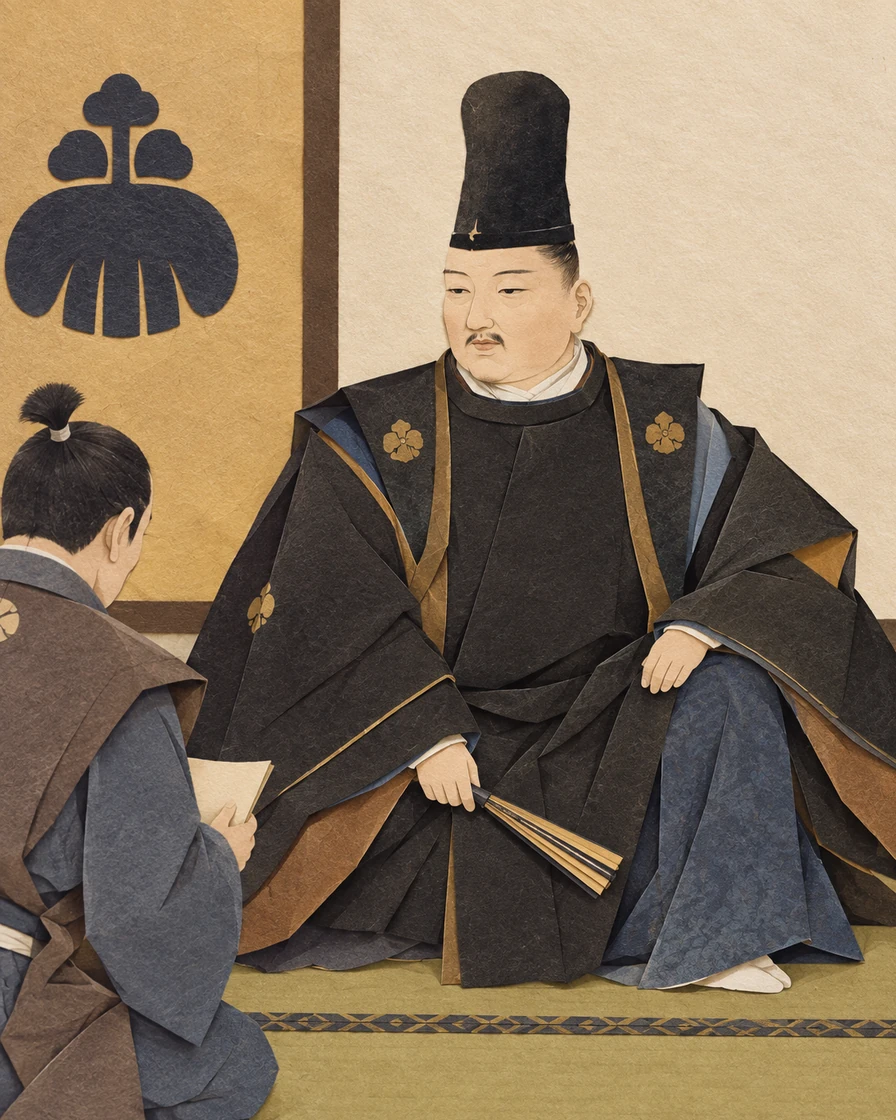
Imagawa Yoshimoto was born in 1519 into the house ruling Suruga, around present-day Shizuoka. His father Ujichika strengthened its government, and his mother Jukeini came from a Kyoto court family. Yoshimoto entered Buddhist training and used the religious name Baigaku Shōhō. His elder brother Ujiteru’s death in 1536 opened a struggle for leadership. Yoshimoto left monastic life and defeated his rival brother Genkō Etan, becoming head of the Imagawa house. The monk Taigen Sessai supported him as an adviser with religious and political connections. Taking the headship gave Yoshimoto authority over an established house whose lands, retainers and neighboring powers still demanded attention. [1][6][4][5]
In 1537 Yoshimoto married a daughter of Takeda Nobutora, lord of Kai in present-day Yamanashi. The marriage linked the Imagawa and Takeda houses but disturbed the Imagawa’s earlier relationship with the Hōjō lords to the east. Hōjō Ujitsuna invaded, and Yoshimoto lost control of eastern Suruga beyond the Fuji River. This conflict is known as the Katō struggle. Yoshimoto worked with the Takeda and other powers opposed to the Hōjō while retaining the support of his own followers. He recovered eastern Suruga in 1545 and reached a settlement. The episode showed that a marriage connecting two houses could unsettle a wider regional arrangement. [1][4]
Yoshimoto strengthened government through land surveys, regulation of retainers and control and promotion of commerce. In 1553 he added twenty-one provisions to the Imagawa Kana Mokuroku, the territorial law his father had issued in 1526. The additions dealt with relationships of service, inherited holdings, privileged jurisdictions and the procedures for disputes. They explicitly asserted that Imagawa power supported the house’s law. A charter described in the Fuji family catalogue confirms local rights under Yoshimoto in the same year. The army likewise drew on leading retainer houses and warriors who ordinarily lived in villages. A written law expressed governing claims, while applying them still depended on the people and disputes within the territories. [1][2][7][5][3]
In Mikawa, in present-day eastern Aichi, Yoshimoto supported the Matsudaira house against pressure from Oda Nobuhide, a lord in neighboring Owari to the west. Imagawa forces defeated the Oda at Azukizaka in 1548 and took Anjō Castle in 1549. That year the young Matsudaira heir Takechiyo, later Tokugawa Ieyasu, came under Imagawa control at Sunpu, in present-day Shizuoka. Yoshimoto’s government also took charge of the Matsudaira center at Okazaki after the death of Takechiyo’s father. The child later came of age, used the name Motoyasu and served Yoshimoto with his own followers. Imagawa expansion could thus work through a subordinate house whose heir and troops remained connected to their home territory. Their dependence would change after Yoshimoto’s death. [1][4][9][12]
By 1554 Yoshimoto had established a three-house alliance with Takeda Harunobu, later called Shingen, and Hōjō Ujiyasu. Marriages connected the ruling families and reduced the danger of conflict on the eastern side of Imagawa territory. Yoshimoto could concentrate more of his activity on Mikawa and the frontier with Owari. Sunpu also sustained relations with Kyoto’s court nobles and religious figures. The courtier Yamashina Tokitsugu visited in 1556 and recorded contacts with Yoshimoto and his mother Jukeini. In the late 1550s Yoshimoto assigned major governing responsibilities to his son Ujizane. The house’s work now involved both the government of its established territories and further western campaigning. [1][4][5][11]
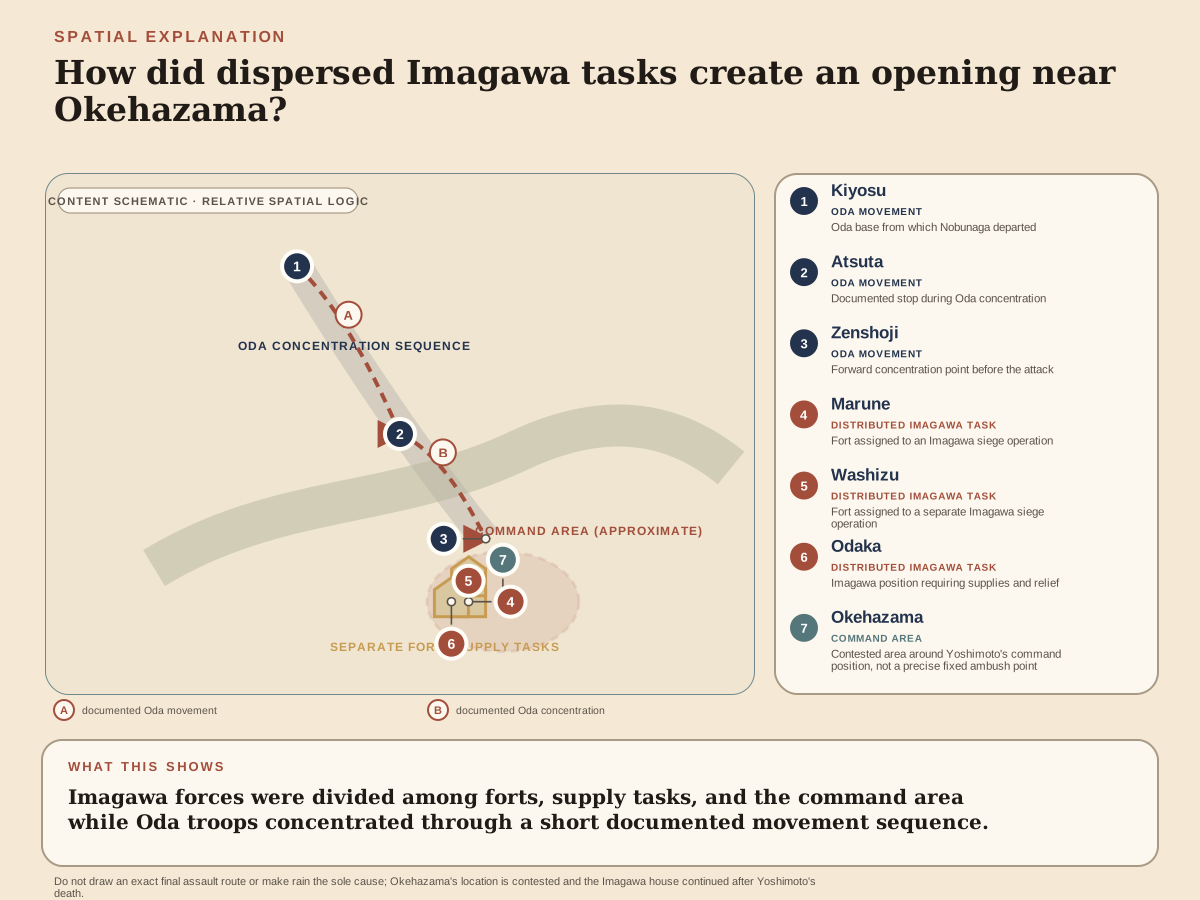
In 1560 Yoshimoto marched into southern Owari to deal with a frontier where Oda Nobunaga threatened Imagawa positions. His forces supplied Ōdaka Castle and attacked the nearby Marune and Washizu forts. Matsudaira Motoyasu carried out the provisioning operation away from Yoshimoto’s command group. Nobunaga advanced from his own base at Kiyosu, gathered forces and attacked near Okehazama. Yoshimoto’s guards fought, but he was killed and the command position collapsed. The armies’ exact numbers, the complete route of the assault and Yoshimoto’s distant objectives remain disputed. The immediate result was the loss of the commander holding the Imagawa campaign together. [4][5][8][9][1]
Yoshimoto’s death at Okehazama in 1560 was followed by Imagawa withdrawals and surrender of frontier positions. Ōta Gyūichi’s retrospective chronicle describes the return of his head toward Suruga and the deaths of retainers in the fighting. Motoyasu returned to Okazaki, where he began rebuilding Matsudaira authority. He still operated on the Imagawa side for a time before moving toward cooperation with Nobunaga. Yoshimoto’s son Ujizane continued governing; charters preserved in the Fuji family catalogue record his acts after 1560. The Imagawa territories were lost through later conflicts with the Takeda and the developing Tokugawa power. Yoshimoto’s defeat altered the regional order, while his government and relationships had helped shape the world its successors inherited. [8][9][7][6][1][2]
Classic
Imagawa Yoshimoto (1519–1560) was a son of Ujichika, lord of Suruga and Tōtōmi, covering much of present-day Shizuoka. The Imagawa were related to the Ashikaga family that headed the Muromachi shogunate, Japan’s military government centered in Kyoto. Ujichika had strengthened territorial government through assessment and a legal code. Yoshimoto’s mother Jukeini came from the court family of Nakamikado. After Ujichika’s death she had conducted affairs during the youth of Yoshimoto’s elder brother Ujiteru, issuing documents under her own seal. The household’s governing authority therefore included the work of a widow as well as the succession of its male heads. [1][6][2]
As a young son, Yoshimoto was trained for Buddhist life at a temple in the Fuji area. He used the name Baigaku Shōhō and also trained in Kyoto. The monk Taigen Sessai, who had connections with Kyoto religious institutions, became an important figure in his education and later service. When Ujiteru died in 1536, another brother, Genkō Etan, contested the succession. Yoshimoto defeated him and returned to secular life as head of the Imagawa. A succession struggle had turned his religious formation toward the responsibilities of ruling a military house. [1][4][5][6]
Sessai’s position crossed the religious and political relationships on which the house depended. He served as abbot of Rinzai-ji while assisting Yoshimoto in government, military affairs and diplomacy. His access to Kyoto was part of that contribution. Yoshimoto also inherited established warrior households and the territorial arrangements of his father and elder brother. He would extend their policies while making new decisions about the neighboring Takeda and Hōjō houses. Those decisions soon brought both an advantageous marriage and a dangerous war. [5][6][1][4]
Yoshimoto’s marriage in 1537 joined him to Takeda Nobutora’s family in Kai, to the north of Suruga. Marrying Nobutora’s daughter established a direct family tie between the two ruling houses. The Imagawa had previously maintained an alliance with the Hōjō, whose territories lay east of Suruga. The new Takeda connection upset that arrangement and brought invasion under Hōjō Ujitsuna. Yoshimoto lost the territory east of the Fuji River, a significant part of the province that formed his house’s center. The marriage provided an ally while exposing another frontier to war. [1][4]
The museum’s account of the Katō conflict describes unrest among followers as well as the Hōjō invasion. Yoshimoto urged supporters to remain united and cooperated with powers opposed to the Hōjō. The prefectural library’s Fuji family catalogue preserves a more particular trace of such relationships. It summarizes a Yoshimoto letter praising Fuji Miyawaka’s service in fighting at Koizumi, tentatively assigned to 1537. A separate charter of 1537 grants Miyawaka land-related offices in Suruga. The Fuji were hereditary priests of the Asama shrine and also local warrior lords. Religious office, military service and territorial rights could be held within the same household. [4][7]
Yoshimoto regained eastern Suruga in 1545 after renewed fighting with the Hōjō. Recovering the territory restored control over the part of his central province lost in the earlier invasion. The settlement did not prevent future negotiation among the Imagawa, Takeda and Hōjō houses. Their later alliance developed from a region in which they had already fought, allied and changed partners. Yoshimoto’s government also had to regulate the land and service obligations through which local households remained connected to him. Expansion westward would increase that work. [1][4][2][7]
The Imagawa Kana Mokuroku combined Ujichika’s territorial code of 1526 with Yoshimoto’s additions of 1553. The earlier code addressed land boundaries, sale and lending, marriage restrictions and the control of private fighting. Yoshimoto’s twenty-one additions regulated service relationships, succession to holdings, privileged jurisdictions and litigation. Its assertion of the house’s own power gave a legal form to authority exercised without relying simply on orders from the shogunate in Kyoto. Historian Katsumata Shizuo emphasizes the code’s control of retainers and the requirement that their disputes come under Imagawa judgment. The regulations concerned concrete relationships among people who possessed land, claims and followers. [2]
Historical interpretation · What can a law code prove?
Historian Shimizu Katsuyuki cautions against treating these territorial codes as evidence of a government already enforcing order everywhere. He points to earlier precedents for rules such as punishment of both parties to a quarrel and to the importance of complaints by the parties themselves. A prohibition on private revenge could coexist with violence that had not been brought before the ruler.
The code’s claim to jurisdiction was significant, but its text alone cannot measure enforcement across every village. The provisions show the problems his house sought to judge and the authority it claimed when judging them. [3][2]
The Fuji family catalogue describes a 1553 Yoshimoto charter confirming rights held by Fuji Matahachirō in upper Fuji. This was an act of recognition directed to a particular household. The wider program of land assessment helped specify resources and obligations across the Imagawa territories. Government required leading houses such as the Asahina and Okabe, as well as warriors who lived in villages and assembled for service. The museum’s account makes those less prominent followers part of the army’s formation. Yoshimoto’s power was exercised through these people, whose holdings and obligations connected the territorial government to its campaigns. [7][1][5][2]
Mikawa, in present-day eastern Aichi, lay between the Imagawa territories and the Oda interests in Owari to the west. The Matsudaira house at Okazaki faced pressure from Oda Nobuhide and sought Imagawa support. Yoshimoto’s armies intervened and defeated Oda forces at Azukizaka in 1548. The capture of Anjō Castle in 1549 further weakened the Oda position in Mikawa. The biographies connect it with the exchange that brought the young Matsudaira heir Takechiyo from Oda custody under Imagawa control. The transfer strengthened Yoshimoto’s hold over a house whose lands were useful to westward expansion. [1][4]
Takechiyo’s father Matsudaira Hirotada died in 1549, and Yoshimoto’s government took control at Okazaki. Takechiyo grew up at Sunpu, the Imagawa center in present-day Shizuoka. As the heir to the Matsudaira house, Takechiyo connected Imagawa custody with a following rooted in Mikawa. At his coming-of-age ceremony in 1555 he received the name Motonobu, with the character moto granted by Yoshimoto. The National Archives’ explanation identifies this as confirmation of their lord–retainer relationship. He subsequently used the name Motoyasu. Takechiyo, Motonobu and Motoyasu were successive names of the man later known as Tokugawa Ieyasu. The court and religious connections around Yoshimoto formed part of the environment of the young heir’s upbringing. [1][9][5][6][12]
By 1560 Motoyasu was serving in Yoshimoto’s campaign with Matsudaira followers. His movement of provisions into Ōdaka Castle was part of the larger Imagawa operation. He could act through his own household’s men while Yoshimoto set the objectives of the campaign. This arrangement allowed Imagawa power to extend through a house rooted in Mikawa. It also preserved a potential center of local authority distinct from Sunpu. After Yoshimoto’s death, returning to Okazaki would give Motoyasu the place from which to gather the Matsudaira following again. [8][9][1]
The alliance of the Imagawa, Takeda and Hōjō houses was established by 1554. Takeda Harunobu, later known as Shingen, ruled Kai; Hōjō Ujiyasu headed the house to the east. Marriage connections tied the three ruling families together. For Yoshimoto, stabilizing the eastern frontier supported his pursuit of Imagawa interests in Mikawa and Owari. The alliance followed a period of fighting and changing relationships, including his own 1537 Takeda marriage and the loss and recovery of eastern Suruga. It was an arrangement among houses whose cooperation had been made through those choices. [1][4]
The marriages connected the next generation of rulers. In 1552 Yoshimoto’s daughter married Takeda Yoshinobu, Shingen’s heir. In 1554 a daughter of Hōjō Ujiyasu married Yoshimoto’s son Ujizane, and later that year Shingen’s daughter married Hōjō Ujimasa. The three households were linked through their children, with Ujizane acquiring a family connection to the eastern neighbor his father had fought. His increasing responsibilities at Sunpu consequently belonged to a network of marriages as well as to an internal transfer of duties. These ties helped sustain cooperation among separate houses; they did not combine their governments into one. [13]
Kyoto nobles and monks visited the Imagawa center at Sunpu. Yoshimoto’s family connections and Sessai’s religious ties helped maintain access to the capital. Shizuoka’s municipal account describes Yamashina Tokitsugu staying for about half a year from 1556. His diary records contacts with Yoshimoto and Jukeini, as well as religious performances. The museum notes his use of the title taishu, a designation for a provincial lord, for Yoshimoto. Excavated objects associated with the Imagawa mansion likewise place the household within networks of valuable goods. Courtly culture and military government coexisted in this center; refinement alone cannot explain a later battlefield defeat. [5][1][6][11]
In the late 1550s Yoshimoto gave major responsibilities to Ujizane, his son. Yoshimoto remained active in Mikawa and in plans for further control in Owari. The son’s responsibilities therefore preceded the father’s death, even though the loss of Yoshimoto would place new demands on him. The 1560 campaign began within a house already sharing work across generations. [1][4][6]
Yoshimoto’s advance in 1560 addressed a contest already taking place around Imagawa positions in southern Owari. Nobunaga, the Oda lord based at Kiyosu, had erected forts threatening the connection between Narumi and Ōdaka. The positions mattered before any distant plan to reach Kyoto could be carried out. Ōta Gyūichi’s chronicle describes Imagawa preparations to move provisions into Ōdaka and attack the Marune and Washizu forts. Motoyasu served in these operations with his Matsudaira following. The force in the field was consequently spread among provisioning, attacks and Yoshimoto’s own command group. [4][5][8][9]
Evidence boundary · Reading the account of Okehazama
Gyūichi follows Nobunaga from Kiyosu through the Atsuta area and his frontier positions, gathering men before the decisive attack. His account places heavy rain before the assault and describes the sky clearing as Nobunaga ordered his troops forward. It then follows the contraction of the group defending Yoshimoto and identifies Mōri Shinsuke as the warrior who took his head. These details belong to an account written retrospectively by a man associated with the Oda house. Its speeches and explanation in terms of divine favor are the narrator’s reconstruction.
The account does not establish a complete route concealed throughout by the storm, nor should its large army totals be treated as a modern muster roll. [8]
Yoshimoto died while his men were fighting to defend their command group.
Historical disagreement · What was Yoshimoto’s army trying to reach?
Modern accounts differ over whether the advance aimed at Kyoto or at nearer territorial objectives. The museum’s exhibition account stresses relief of the threatened Imagawa frontier positions.
Provisioning Ōdaka and reducing the Oda forts are actual operations on which the sources used here converge. [8][1][4][5][9]
The death of the leading commander broke their coordination and left the remaining forces to withdraw or make new arrangements. [8][1][4][5][9]
Gyūichi describes Yoshimoto’s severed head being examined by Nobunaga and then sent toward Suruga with an attendant and monks. He also records the deaths of leading retainers, including members of the Matsui following. The campaign’s loss fell on the households whose service had made the Imagawa army possible. Other commanders and garrisons withdrew or surrendered. Yoshimoto’s death thus removed the central commander while reducing the people and positions available for the house’s next response. [8][5][9]
Motoyasu received news of the defeat while based at Ōdaka and returned toward his home territory in Mikawa. After Imagawa troops left Okazaki, he entered the castle and gathered Matsudaira relatives and followers. The National Archives’ account emphasizes that he initially continued fighting on the Imagawa side. His later cooperation with Nobunaga developed after the return, rather than occurring automatically at the instant Yoshimoto died. Okazaki gave him a base from which to make and sustain that change. A house previously operating within Imagawa command could now reassemble around its own heir. [9][1]
Ujizane continued as head of the Imagawa after Yoshimoto’s death. The Fuji documents catalogue records an administrative appointment under him in 1561, a reward for campaigning in 1563 and a market privilege in 1566. These acts show a house still appointing officials, recognizing service and issuing economic regulations. Its territorial power ended through later Takeda and Tokugawa invasions. The defeat at Okehazama was a major rupture within that process, but it did not make continued government disappear in 1560. Yoshimoto’s legal provisions, local charters and court connections leave evidence of the regional order he helped build before the final battle. [6][7][9][2][5][11]