Read the article below. Interactive reading tools are available when scripts load.
Quick
Hōjō Tokimune was born in 1251 at Kamakura, south of present-day Tokyo. His father Tokiyori was regent, directing the warrior government beneath the formally appointed shogun, and head of the main Hōjō family line, or Tokusō. Tokimune's mother Katsura-dono was a daughter of the senior Hōjō leader Shigetoki. Her standing helped make the younger boy the principal heir ahead of his older half-brother Tokisuke. That choice gave him powerful support without eliminating the elder brother's claim. [9][12][13]
Tokiyori resigned the regency and took Buddhist vows in 1256 but remained influential as head of the main Hōjō family. Nagatoki and then Masamura held the regency while Tokimune grew up. In 1257 the shogun, Prince Munetaka, sponsored his unusually early coming of age. Tokimune entered the Small Samurai Office, which arranged close service around the shogun, in 1260 under Hōjō Sanetoki. The next year he married Horiuchi-dono, identified as Adachi Yoshikage's daughter adopted by Yasumori, though some references call her Yasumori's daughter. Tokiyori died in 1263. In 1264 Tokimune became co-signatory, the senior official who authenticated decisions alongside the regent. His older half-brother Tokisuke held a post at Rokuhara, Kamakura's supervisory base in Kyoto, without receiving the main inheritance. [9][13][14][15]
As co-signatory, Tokimune worked within Masamura's regency and a government staffed by councillors, judicial officials, clerks, and the learned Hōjō Sanetoki. In 1266 Prince Munetaka was accused of dangerous political activity, removed as shogun, and returned to Kyoto. His young son Koreyasu replaced him. The winning government controls much of the surviving allegation, so removal is firmer than the full conspiracy story. Masamura retired in 1268 and Tokimune became the eighth regent while still a teenager. [9][13]
Mongol envoys arrived in Japan in the same period. Their demands changed the new regent's agenda, but Tokimune had already spent years preparing for office through supervised service and marriage alliances.
From 1266 Qubilai Khan, the Mongol ruler whose empire would take the name Yuan, sought contact through Goryeo, the Korean kingdom under Mongol domination. His letter reached Dazaifu, the administrative center in northern Kyushu, in 1268. It offered friendly relations within Qubilai's imperial hierarchy and ended with the possibility of force. Dazaifu reported the approach to Kamakura and the court in Kyoto. Court figures considered a reply, while Tokimune's shogunate maintained nonreply. Silence avoided issuing a document that could be read as acceptance of subordination, but left Qubilai free to judge Japan defiant. More approaches followed. [12][13]
In 1271 the shogunate ordered eastern gokenin—direct warrior vassals of the shogun—with land in Kyushu to move toward their western holdings and prepare for attack. The next year domestic violence struck Tokimune's rivals. In February 1272 leading members of the Nagoe Hōjō branch were killed in Kamakura, and his older half-brother Tokisuke was killed at Rokuhara in Kyoto. The surviving accusations do not establish every victim's guilt equally securely. The purge removed alternative centers of Hōjō power before the first invasion. Foreign danger increased pressure for unified command without proving that the victims served Qubilai. [13]
In late 1274 a force assembled through Mongol imperial command, Goryeo ships and troops, and personnel from conquered Chinese regions crossed from the peninsula. It attacked Tsushima and Iki, overwhelming defenders and devastating communities, then entered Hakata Bay. Invaders landed around the bay and fought Japanese forces at places including Momochi, Akasaka, Torikai, and Hakozaki. The expedition used coordinated formations, massed arrows, drums, and gunpowder projectiles, while Japanese forces also fought collectively under regional commanders; the old contrast between disciplined armies and isolated duelists is too simple. Reported force totals require source caution. [3][5][12][17]
The invaders did not establish a lasting inland base and withdrew to their ships. Explanations differ over the roles of combat, supply and weather. Hattori Hideo also questions the familiar one-day timetable, while a decisive 1274 typhoon remains debated. Tokimune directed policy from Kamakura, not the Hakata battlefield. [4][5][12]
After 1274 the Yuan sent Du Shizhong and other envoys. They were taken to Kamakura and executed at Tatsunokuchi in 1275. Another group was killed at Hakata in 1279. The shogunate also considered an attack on Goryeo, the expeditionary base, but did not execute the plan. Refusal had become lethal and military, not merely silent. The most durable answer was defensive. In 1276 the shogunate required Kyushu provinces to build roughly twenty kilometers of stone and earth embankment along Hakata Bay in about six months. [5][12][13]
Provincial groups built assigned sections using different local materials and techniques. Their work imposed labor costs well below the warrior households named in the orders. Tokimune authorized construction; local communities made and maintained the wall.
Coastal guard duty had been regularized in 1275 through provincial rotation; assigned groups later guarded and repaired their wall sectors. Travel and equipment consumed estate income even in years without battle. The government widened mobilization beyond its direct vassals and requested protective rites from religious institutions. [12][13]
Western households lived closest to the risk and carried much of the cost. Guard service meant maintaining men away from home while the property that supported them still needed management. The long watch created problems of compliance and reward before the next fleet appeared. [5][13]
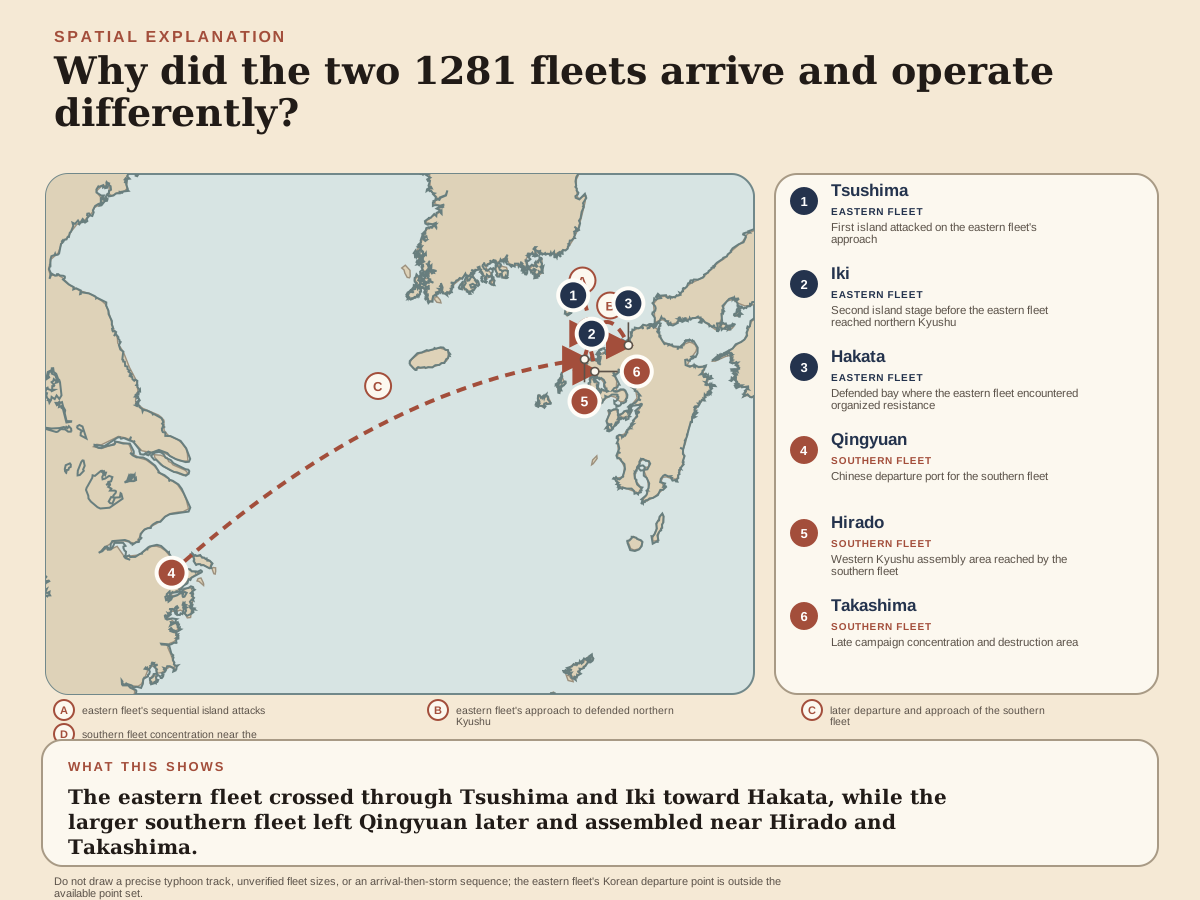
Qubilai's second expedition in 1281 was much larger and more complex. An Eastern Route force assembled through Goryeo and attacked Tsushima and Iki before reaching northern Kyushu. A Southern force drew heavily on the recently conquered Southern Song realm and sailed later by a different route. Recorded totals are enormous but vary in reliability and may combine fighters, sailors, transport workers, and support personnel. At Hakata the embankment and prepared defenders denied the early force the easy landing space available in 1274. [3]
Japanese small boats attacked enemy ships as fighting continued around islands and anchorages. The Eastern force struggled to establish a base while waiting for its Southern partners. The fleets eventually converged in the western Kyushu theater after weeks of fighting, delay and supply pressure. Tokimune remained in Kamakura; provincial commanders made decisions on the scene. [3]
A powerful storm struck late in the 1281 campaign, wrecking many ships in western Kyushu waters, with severe losses around Takashima. Underwater finds of anchors, ceramics and weapons make the disaster tangible. The storm hit forces already constrained by weeks of fighting, delayed coordination and difficulty establishing a base. Japanese troops then killed or captured stranded survivors, so the wrecks did not immediately end the violence. Religious institutions interpreted the outcome as protection and sought recognition for their prayers. The government nevertheless continued defensive preparations because Qubilai could still consider another attack. [3][5][6][16][17]
The invading fleets left no large body of enemy estates in Japan to distribute. Warriors still sought reward for costly service. Takezaki Suenaga, a Higo warrior from present-day Kumamoto, traveled to Kamakura after the first invasion because ordinary channels had not adequately recognized his actions. In 1275 Adachi Yasumori helped him obtain reward, including a land-steward appointment at Kaitō. Suenaga fought again in 1281 and later recorded his service in the invasion scrolls. His case shows that rewards existed and influential intermediaries mattered, without establishing equal access for all claimants. [2][13]
Continued defense consumed resources, while debt and inheritance problems also had causes beyond the wars. Yasumori's powerful warrior house and Taira Yoritsuna's direct Tokusō retainers brought different claims to postwar decisions. Tokimune's victory left these constituencies, as well as the coastal households, needing a settlement. [13][15]
Tokimune's father had already supported Chinese Zen teachers and Kenchōji. Zen emphasizes meditation and training under a Buddhist teacher; its Chinese tradition is also called Chan. Wugaku Zuyuan reached Japan in 1279 after the Yuan conquered the Southern Song, and taught at Kenchōji under Tokimune's patronage. Later sayings celebrate their relationship but do not establish meditation as the cause of military victory. Welcoming a Chinese monk while resisting the Yuan also shows that the teacher's homeland and the invading state were not interchangeable. [11][12][13][14]
In 1282 Tokimune founded Engakuji with Wugaku as opening teacher. It provided a permanent community for Zen training and prayer for the realm. The monastery's tradition also describes mourning those killed in the invasions without separating enemy and ally. Artisans built the halls and supplied ritual objects, while patronage sustained the monks. [1][11][12]
Fires and rebuilding later changed the complex. Butsunichian, a smaller temple within Engakuji, maintains Tokimune's memorial center. What continues is an institution, not an untouched set of buildings from 1282. [1][13]
Tokimune died in 1284, aged thirty-two by Western count and thirty-four by traditional reckoning. Shortly before death, he and Horiuchi-dono took vows under Wugaku; she became Kakusan Shidō. The evidence supports illness and ritual preparation but not a confident modern diagnosis. Qubilai's government had continued to consider another expedition, while walls, guard duty, reward claims, and debt remained. Their son Sadatoki, born in 1271, inherited Tokusō headship and became regent as an adolescent. [8][13][15]
Adachi Yasumori and the Tokusō retainer leader Taira Yoritsuna remained powerful around the boy; their rivalry became deadly in 1285. That year Kakusan-ni founded Tōkeiji with Sadatoki as patron, according to temple history. Tradition traces its divorce-refuge purpose to the foundation, but the earliest surviving divorce document dates to 1738. The exact original procedure cannot be inferred from that later record. Tokimune's death left both an active widow and an unresolved political settlement. [7][8][15]
Medieval religious institutions interpreted survival as divine protection, while warriors recorded service and Engakuji continued memorial rites. Modern audiences encountered a different presentation: a hall in Fukuoka's Higashi Park displayed ten invasion paintings in 1910, and the neighboring panorama changed from a modern naval battle to the Mongol invasion in October 1911. [1][2][5][12]
This public commemoration made medieval defense vivid. Tokimune's youth and refusal could be presented as exemplary heroism, while the violence of domestic purges and envoy executions, and the costs borne by western households, were less easily fitted into a victory story.
Classic
Hōjō Tokimune was born in 1251 at Kamakura, the warrior government's seat south of present-day Tokyo. His father, Tokiyori, was regent: he directed government beneath the formally appointed shogun. Tokiyori also headed the main Hōjō family line, or Tokusō, with its estates and private retainers. Tokimune's childhood name was Shōju. His mother, Katsura-dono, was a daughter of the senior Hōjō statesman Shigetoki. An older half-brother, Tokisuke, had a mother of lower household standing. Tokiyori selected the younger boy as his principal heir. [9][12][13]
Katsura-dono's family strengthened the younger boy's position. Her father Shigetoki had served as co-signatory, a senior official who authenticated government decisions alongside the regent, and at Rokuhara, Kamakura's supervisory base in Kyoto. Tokimune's inheritance thus rested on an alliance between important branches of the Hōjō. Tokisuke's different maternal standing placed him outside the principal succession, although he remained a Hōjō son who could hold office and attract allies.
The Adachi connection extended through another branch of the family. Tokimune's paternal grandmother belonged to that powerful house of gokenin, direct warrior vassals of the shogun, and his own marriage would renew the alliance. Attendants and tutors prepared the chosen child for public duties. The main Hōjō household had exceptional resources, but making its heir a ruler still required cooperation from senior relatives and other warrior houses.
In 1256 Tokiyori resigned the regency and took Buddhist vows. Hōjō Nagatoki became regent, while Tokiyori retained influence as head of the main family. Adult relatives could hold the public office until the chosen heir was old enough to serve. In 1257 the shogun, Prince Munetaka, sponsored Tokimune's coming-of-age ceremony. The boy received his adult name at only about six years of age. His new cap and name publicly marked him as an emerging political figure; the ceremony could not give a child the experience needed to settle disputes or command warriors. [14]
In 1260 Tokimune entered the Small Samurai Office, which arranged close service and ceremony around the shogun. The experienced Hōjō Sanetoki provided supervision. Attendance and documentary work introduced the heir to a government he could not yet direct on his own. [13][15]
In 1261 Tokimune married Horiuchi-dono. Heibonsha's World Encyclopedia identifies her as Adachi Yoshikage's daughter, adopted by Yasumori; Yamakawa's dictionary also notes a variant calling her Yasumori's daughter. The marriage renewed the older Hōjō–Adachi alliance regardless of this difference in the recorded kinship. Yasumori's powerful warrior house was related to the heir, not simply subordinate to him. Horiuchi-dono would carry those ties into her later roles as mother, nun and temple founder. Tokiyori died in 1263. In 1264 Tokimune became co-signatory under the regent Hōjō Masamura, helping authenticate decisions alongside experienced councillors and clerks. [9][13][14]
Tokisuke received a senior post at Rokuhara, Kamakura's supervisory base in Kyoto. It gave him substantial responsibility in western affairs while keeping him away from the main household in Kamakura. Tokimune's accelerated advancement thus depended on adult mentors and alliances, but it also made the elder brother's exclusion increasingly visible. [13][15]
Tokimune's appointment in 1264 brought him into the shogunate's documentary government. Petitions passed through clerks and councillors before decisions received the signatures of the regent and co-signatory. Inheritance and land disputes continued even as the heir learned his work. Masamura supplied political continuity, while Sanetoki brought knowledge of texts and ceremony. Both had reputations independent of the young Tokimune. The shogun also remained consequential: Prince Munetaka's imperial connections and household could provide a focus for warriors dissatisfied with Hōjō rule. [9]
In 1266 the government accused Prince Munetaka of dangerous political activity, removed him as shogun and escorted him back to Kyoto. The full accusation survives largely through the authorities who defeated him. His young son Koreyasu took his place. Munetaka had sponsored Tokimune's coming of age; that ceremonial connection did not protect him once the Hōjō judged his household a threat. Koreyasu's imperial descent continued to supply legitimacy, although his childhood made independent political action more difficult. [13]
When Masamura retired in 1268, Tokimune became the eighth regent. Koreyasu remained shogun, formally above the Hōjō officials who directed government. Tokimune's rise had been prepared through his father's designation, early ceremony, marriage and supervised service. The Mongol approaches reaching Japan in the same period changed his agenda; they did not create his claim to office. A teenage regent now had to coordinate decisions with a court beyond his household and warriors far from Kamakura. Experienced Hōjō relatives and allies remained necessary to his rule. [9][13]
From 1266 Qubilai Khan, the Mongol ruler whose empire would take the dynastic name Yuan, sought contact with Japan through Goryeo, the Korean kingdom under Mongol domination. An embassy carrying his letter reached Dazaifu, the administrative center in northern Kyushu, in 1268. The letter offered friendly relations but placed them within an imperial hierarchy defined by its sender. Its closing reference to force made refusal dangerous. Qubilai could seek recognition and submission before undertaking the much more costly work of sending an army across the sea. [12][13]
Dazaifu reported the approach to the Japanese centers of power. Kamakura evaluated the military threat, while the imperial court in Kyoto possessed the diplomatic learning and authority to consider a reply. Surviving records indicate disagreement over whether to answer; contemplating or drafting a response did not mean that an embassy was dispatched. Tokimune's shogunate favored nonreply. Silence avoided issuing a document that Qubilai might interpret as acceptance of his hierarchy, but it also left the sender free to regard Japan as defiant. Goryeo's participation in carrying demands, and later supplying ships and troops, took place under domination rather than demonstrating a single Korean desire for conquest. [12][13]
News also crossed through traders and monks rather than official embassies alone. In 1271 the Sambyeolcho, a Korean military force resisting Mongol control, approached Japan. Such reports came from people with opposed interests. The court and shogunate had to decide whose claims to trust and whether the threat of force would become an invasion. Acceptance carried the danger of subordination; refusal carried the danger of war. Tokimune authorized a policy within this network of reception and consultation, without personally replacing the interpreters or officials who made it possible.
In 1271 Kamakura ordered eastern gokenin—direct warrior vassals of the shogun—with holdings in Kyushu to move toward the western defense zone. A household with property in both regions had to send someone west while keeping its eastern land under management. Equipment and income had to follow the traveler. Dazaifu officials and local warrior families supplied knowledge of the coast that Kamakura lacked. Distance made compliance difficult to judge: a delayed arrival could result from resistance, lack of money or a dispute over land. [13]
Tokisuke embodied the succession wound created at Tokimune's birth. Older, Hōjō, and stationed at Rokuhara, he had both lineage and an institutional position near Kyoto. None of those facts alone proves a plan to overthrow his brother. The Nagoe branch had its own history of friction with the main line. Tokiaki and Noritoki held high standing within the shogunal government. The February 1272 violence struck them in Kamakura before armed action extended to Tokisuke in Kyoto. Received narratives do not support a perfectly clean prosecution. Tokiaki's guilt was questioned or treated differently within the aftermath, while Noritoki was characterized more directly as resistant. Such distinctions warn against repeating “the conspirators” as a homogeneous legal fact. At Rokuhara, killing Tokisuke required one arm of the Kyoto institution to act against the other. [13]
The 1272 killings removed Tokimune's displaced elder brother and leading members of a rival branch. Main-line retainers and dependable allies gained greater relative weight. Foreign danger supplied an argument for unified command, but it cannot independently establish the accusations against every domestic victim. Nor does it prove an alliance between Tokisuke and Qubilai. The preparations in Kyushu and the purge within the Hōjō occurred together, concentrating power in a government increasingly concerned about attack. [13]
In late 1274 an expedition assembled under Mongol imperial command crossed from Goryeo toward Japan. The Korean kingdom supplied ships, crews and troops under imperial domination; personnel from conquered Chinese regions also joined the force. Recorded totals describe an army and its supporting labor, not a verified manifest of combatants. Tsushima and Iki were attacked before the force reached Hakata. Local defenders including Sō Sukekuni and Taira Kagetaka were overwhelmed, exposing the island communities to destruction and captivity. [3][5][12][17]
At Hakata the invaders confronted Kyushu forces under regional leaders including Shōni Kagesuke. Beaches and tidal ground divided the battlefront; a landing did not immediately provide a secure inland base. Takezaki Suenaga, a gokenin from Higo in present-day Kumamoto, fought in the campaign and later sought reward for his service. The invaders used exploding gunpowder projectiles, also pictured in the illustrated scroll associated with Suenaga. The scroll preserves battlefield scenes but centers a particular warrior's achievement. Japanese fighters valued witnessed action and named merit, while also operating through commanders, retainers and collective shooting. The familiar picture of lone duelists facing a uniformly coordinated enemy misses that organization. [3][5][17]
Historical disagreement · Why did the invading army withdraw in 1274?
Fighting drove Japanese forces back from parts of Hakata Bay, damaging settlements around Hakata and Hakozaki. Defenders had suffered wounds and losses before the invaders returned to their ships. Withdrawal required decisions about supplies, wounded men and exposure at sea. Its explanation remains contested: some accounts emphasize a storm, others the fighting or operational difficulties. Evidence for a catastrophic typhoon in 1274 is less secure than for the destructive storm of 1281. [4][5][12]
The timetable is also contested. Historian Hattori Hideo questions the familiar account in which a large army fought at Hakata and returned to its ships within a single day. A 2025 Engakuji account still notes disagreement over whether a typhoon struck in 1274.
Neither the campaign's duration nor the cause of withdrawal should be reduced to one settled explanation.
Tokimune received reports in Kamakura rather than witnessing the battle. The expedition failed to retain territory, giving his government time to prepare against a renewed attack. [4][5][12]
In 1275 Du Shizhong and other Yuan envoys were brought to Kamakura and executed at Tatsunokuchi. A second embassy was killed at Hakata in 1279. These acts ended possible channels of negotiation and made reversal harder, although no surviving private memorandum conclusively ranks the government's motives. Kamakura also considered a counter-expedition against Goryeo, whose ports and ships supported the invasions. It did not carry the plan out. An attack across the same sea would have required transports and supplies that defense on the Japanese coast did not. [12][13]
Construction offered a more practicable defense than the unexecuted counter-invasion. In 1274 the invaders had gained beaches along Hakata Bay. A raised stone-and-earth embankment could restrict landing and concentrate defenders at threatened sectors. From roughly March to August 1276, groups assigned from nine Kyushu provinces built a line extending about twenty kilometers from Imazu toward Kashii. A central order became provincial work, with responsibilities divided along the shore. [5]
The surviving wall sections differ in stone and technique, reflecting local materials and the provincial groups assigned to build them. Quarrying and hauling imposed burdens on cultivators as well as warriors. Maintenance continued after construction. The embankment was a practical answer to the landings of 1274, and its varied fabric shows how a central order became work carried out by many local communities. [12][13]
Guard service had already been regularized in 1275 through rotating provincial duty. After construction, assigned groups also guarded and repaired their wall sectors. Rotation kept men on the coast without requiring every warrior to remain there continuously. Travel and equipment still consumed the income of the estates that supported the service. A landholder absent at Hakata also lost some ability to oversee rent collection or a dispute at home. [5][13]
The wall had to be maintained, and maritime information kept arriving through coastal officials, fishing boats and traders. Where direct-vassal ties were insufficient, the government widened its demands to warriors and landholders under other authorities. Court, temple and shrine jurisdictions continued to exist, making mobilization a matter of exceptional command and negotiation rather than a single chain of unquestioned obedience. [12][13]
Temples and shrines conducted protective rites requested by court and warrior authorities. They too used resources and institutional networks, and would later claim that their prayers had helped preserve Japan. The burden of the long watch fell most directly on western communities. Families and cultivators sustained the property from which absent warriors drew their means. Years without battle brought costs without the possibility of acquiring an enemy estate. [5][12][13]
Qubilai sent a second expedition in 1281, this time with two forces taking different routes. The Eastern Route army came through Goryeo and moved first against Tsushima and Iki, then toward Hakata. A Southern force sailed later from the former Southern Song realm, conquered by the Yuan in 1279. Its maritime resources came from a society recently brought under imperial control. The two forces had to find one another across the sea before they could operate together. [3]
At Hakata, the earlier force met the embankment and defenders prepared during the intervening years. The wall did not close every possible landing place, but it obstructed a repetition of the first invasion's advance. Japanese small craft also approached enemy ships, sometimes at night, to attack or board them. Fighting continued around islands and anchorages, including Shikanoshima. When the invaders shifted toward Iki and western rendezvous waters, Japanese forces pursued them. This was a campaign extending over weeks, not a fleet destroyed as soon as it appeared. [3]
The Southern force's delay prolonged the Eastern force's exposure. Ships needed fresh water and repairs while their occupants consumed provisions and dealt with sickness or wounds. Without a secure base ashore, much of that support had to remain afloat. Japanese coordination also depended on provincial commanders with their own followers and reward interests, making local decisions far from Tokimune. The enormous totals in narrative sources are not verified manifests: they can group fighters and supporting personnel differently. Whatever the exact count, assembling the forces increased both their power and the difficulty of sustaining them. The fleets eventually converged in the western Kyushu theater after this prolonged period of fighting and waiting. [3]
A powerful storm struck late in the 1281 campaign and destroyed many ships in the waters of western Kyushu, with severe losses around Takashima. The fleets had been brought there by earlier attempts to land and combine their forces. Their position and prolonged time afloat shaped what the storm encountered. Narrative sources organize its chronology and religious meaning differently; they do not permit reconstruction of its precise path as though modern instruments had recorded it. Exact loss figures also depend on uncertain starting totals. [3][5]
Takashima's underwater remains provide evidence independent of the victory narratives. Anchors and ship-related material identify the expeditionary presence, while ceramics and weapons preserve parts of its cargo. Finds include tetsuhau, gunpowder projectiles. These objects make the wrecked fleet tangible without reconstructing the fate of every vessel. The storm also left survivors exposed to Japanese forces, which killed or captured stranded personnel. Destruction at sea did not immediately bring the violence to an end. [3][6][16][17]
Some of those caught after the wrecks belonged to coerced contingents rather than having chosen the expedition themselves. Japanese defenders and coastal families had also suffered deaths, injuries and damage that the fleet's destruction could not undo. Religious institutions nonetheless interpreted the outcome as protection. Court and warrior patrons had requested prayers before battle, giving temples and shrines grounds to seek recognition for the result.
Tokimune's government continued defensive preparations. The Yuan Empire had survived the loss of its fleet, and Qubilai considered another attack. Dismantling guards or abandoning wall repairs would have required certainty that the regent did not possess. The storm broke an expedition already constrained by fighting, delayed coordination and difficulty securing a base. It was decisive without erasing the military actions that preceded it or the killings that followed.
Earlier wars within Japan could leave confiscated estates available for reward. The invading fleets left no comparable body of conquered Japanese land. Warriors still sought recognition for service and incurred expenses that preserving their existing property did not repay. Their claims depended on witnessed achievement and access to an adjudicator. After the first invasion, Takezaki Suenaga went to Kamakura because ordinary channels had not adequately recognized his service. [2][13]
In 1275 Adachi Yasumori helped Suenaga obtain reward, including appointment as jitō, a land steward, at Kaitō in Higo. Suenaga fought again in 1281. His later illustrated scroll gave his actions and witnesses a durable record, although the surviving object has undergone loss and rearrangement. It centers a successful claimant rather than showing how every applicant fared. His case demonstrates that rewards existed and that reaching an influential intermediary mattered. It does not establish equal access or a sufficient settlement for the whole defensive effort. [2][13]
Temples and shrines also claimed reward for rites requested before the invasions. They competed with warriors for recognition and scarce resources. Continued fear of another fleet meant that guard duty and repairs could not simply end. Within Tokimune's circle, Adachi Yasumori represented a powerful gokenin house related by marriage, while Taira Yoritsuna drew authority from the Tokusō household's direct retainers. These constituencies brought different claims to the same settlement. [13][15]
Debt and fragmented holdings had causes beyond the invasions, including divided inheritance and litigation. Defensive service could intensify those pressures without alone explaining the shogunate's eventual fall half a century later. For Tokimune, the immediate problem was how to recognize costly service while continuing to demand it. A successful battle claim such as Suenaga's did not resolve the needs of all the households keeping men on guard.
Tokimune's father had already patronized Chinese Zen teachers and Kenchōji at Kamakura. Zen, a Buddhist tradition emphasizing meditation and training under a teacher, was part of the heir's political and religious environment before the invasions. After the Yuan conquered the Southern Song in 1279, Tokimune invited Wugaku Zuyuan, who came to Japan that year and taught at Kenchōji. The monk crossed the same sea from which another invading force would soon approach. [11][13][14]
Wugaku brought instruction and a monastic lineage that Tokimune valued; the regent supplied patronage and protection. Later accounts celebrate the teacher's fearlessness and brief exchanges said to have freed Tokimune from fear. They express religious ideals more securely than they reveal the regent's private thoughts during the crisis. Neither those sayings nor meditation can be established as the cause of military victory. The relationship also distinguishes a Chinese monk from the Yuan state that had conquered his homeland. [12]
In 1282 Tokimune founded Engakuji in Kamakura with Wugaku Zuyuan as its opening teacher. The monastery provided a permanent home for Zen training and prayer for the realm. Its institutional tradition also describes mourning those killed in the invasions without distinguishing enemy from ally. That Buddhist purpose did not erase responsibility for the war, but it extended commemoration beyond Japanese defenders alone. [1][11][13][14]
This purpose is expressed in the tradition of onshin byōdō, mourning across the division between enemy and ally. Construction depended on work and resources supplied beyond the patron and teacher: artisans made the halls and ritual objects, while estates helped sustain the resident community. The story that a Buddhist scripture was found during construction explains the temple's sacred name. It belongs to foundation tradition rather than an excavated construction record. [1][12]
Later disciples and patrons extended the institution. Its teaching contributed to Five Mountain culture, the network of leading Zen monasteries associated with medieval learning and the arts. Fires and rebuilding changed the complex over time. Butsunichian, a smaller temple within Engakuji, maintains the memorial focus associated with Tokimune and later main-line Hōjō figures. The continuing institution should not be mistaken for a complete set of unchanged buildings from 1282. [1][13]
Tokimune died in 1284, leaving defense preparations and reward disputes unresolved. Shortly before death he took religious vows under Wugaku. His wife Horiuchi-dono did so as well, receiving the religious name Kakusan Shidō. The sources establish illness and ritual preparation more securely than a clinical cause. Her new role would continue beyond his final ceremony: as an Adachi woman and mother of the heir, she remained connected to the coalition around the main Hōjō household. [8][13]
Their son Sadatoki, born in 1271, succeeded as head of the main Hōjō line and as regent while still an adolescent. He inherited the support, and competing interests, of senior men. Adachi Yasumori was a powerful warrior related through Sadatoki's mother; Taira Yoritsuna led direct retainers of the Tokusō household. Their rivalry erupted into deadly conflict in 1285, after Tokimune's death. The outcome cannot be treated as a settlement his father had knowingly designed. [15]
Qubilai's consideration of further expeditions left the external threat open. Kakusan-ni also began work beyond her husband's final ceremony. Tōkeiji dates its foundation to 1285, identifying her as founding religious leader and Sadatoki as patron. Its tradition traces a refuge for women seeking divorce to the foundation, but the earliest surviving divorce document it cites is from 1738, with detailed temple rules recorded in 1745. Those later documents cannot establish the exact procedure operating in 1285. The temple nevertheless preserves a history of the widow's agency distinct from Tokimune's military reputation. [7][8]
Engakuji's memorial rites continued after Tokimune's death, while the young regent and his advisers faced unresolved defense and reward problems. His widow's convent added another institution to the household's legacy. Tokimune had coordinated these relationships; his early death left their competing claims to be worked out by others.
Medieval shrines and temples interpreted survival as divine protection. Court and warrior authorities had requested their rites before battle, and afterward religious institutions used the outcome to press claims for reward. This belief coexisted with continuing guard service and wall repair. Sacred protection did not make preparation unnecessary in the government's own practice. [1][2][5][12]
The invasion scrolls and Engakuji preserved different forms of memory: a warrior's claim to service and a monastery's continuing rites. Both depended on later custodians. Parts of the embankment were buried or reused as the shore developed, so its visible fragments do not reproduce the whole original line. These survivals preserve evidence of the campaign alongside the sacred interpretations.
Modern commemoration gave the invasions a new public setting. In spring 1910 a diorama hall in Fukuoka's Higashi Park displayed ten large oil paintings of Japanese warriors fighting Yuan forces. Its neighboring panorama initially depicted the modern Battle of the Japan Sea; in October 1911 it was changed to the Mongol invasion. Fukuoka's city history identifies Yada Isshō as the painter. The installations placed medieval defense alongside a recent naval victory, bringing the older conflict to audiences through an immersive modern form.
Such displays could make victory easier to grasp than the dispersed decisions and costs behind it. Tokimune's refusal and youth lent themselves to an exemplary defender's story. The domestic killings, executed envoys and claims of western households complicate that image. The history of sacred protection is part of the outcome's meaning; it does not substitute for the fighting and work through which people experienced the invasions.