Read the article below. Interactive reading tools are available when scripts load.
Quick
Hayashi Razan was born in Kyoto in 1583. Razan was his scholarly name; his personal name was Nobukatsu. Later biography describes adoption by an uncle who traded in rice. Kyoto's court and Zen Buddhist temples remained centers of learning despite warfare. Classical Chinese gave a student access to Buddhist scriptures, Chinese histories and Confucian writings about moral conduct. [1][2]
The country was not yet ruled by the Tokugawa house. Military leader Toyotomi Hideyoshi was consolidating national power; Tokugawa Ieyasu would establish his warrior government in 1603. Razan's education began in Kyoto's existing networks. In 1595 he entered Kenninji, a major Zen temple.
Razan studied at Kenninji from 1595 but declined permanent ordination and left in 1597. The often-cited ages thirteen and fifteen use traditional inclusive counting, not modern birthday ages. His exact private motive cannot be recovered.
He kept the temple's Chinese-language reading skills and turned toward Zhu Xi, the twelfth-century Chinese philosopher who linked personal cultivation with social order. Books and scholarly contacts sustained his studies after he returned home. In 1604 he met Fujiwara Seika, whose own career offered a route from Zen training into Confucian scholarship.
In 1604 Razan met Fujiwara Seika, another scholar who had moved from Zen training toward Confucian learning. Seika's recognition gave him direction and credibility with patrons. This learning was not newly invented in Japan: Chinese texts had long circulated, and Seika had exchanged ideas with Korean scholar Kang Hang during Kang's captivity after Hideyoshi's invasions.
Seika recommended Razan to Tokugawa Ieyasu around 1605. Some biographies date the audience to 1605 and formal recruitment to 1607; these may refer to different stages. The connection opened a career in which Razan could apply his scholarship to a ruler's practical needs.
Ieyasu made his son Hidetada shogun, head of the warrior government, in 1605 but retained substantial authority. Razan became a reader, teacher and adviser on historical precedent within this ruling household. Ieyasu also employed Buddhist specialists, including the Zen monk Sūden and the Tendai monk Tenkai.
In 1615 Razan and Sūden prepared a copper-type edition of the Daizō ichiranshū, a digest of Buddhist scriptures, for Ieyasu. The work shows how practical scholarship crossed doctrinal boundaries. Razan's service continued under Hidetada, his son Iemitsu, and later Iemitsu's son Ietsuna; he served four successive Tokugawa shoguns without controlling all their policies.
In 1607 Razan met Korean envoys at Sunpu, Ieyasu's retirement center in present-day Shizuoka. They came from Joseon, the Korean kingdom. Classical Chinese allowed learned participants to exchange written questions despite different spoken languages.
The mission followed Hideyoshi's invasions and sought diplomatic repair and the return of captives. Tsushima's Sō family mediated the relationship through its island between Japan and Korea. Scholarly exchange was part of this postwar settlement. It did not erase Korean memories of invasion or disagreements about rank.
After Ieyasu died in 1616, his body was first interred at Kunōzan near present-day Shizuoka. Nikkō became the dynasty's principal cult center in 1617. His divine title was chosen through Hidetada's government and the imperial court.
The National Archives identifies Sūden as favoring myōjin, an illustrious deity, and Tenkai as favoring gongen, a deity understood as a Buddhist manifestation. The selected title was Tōshō Daigongen. Its account does not establish a decisive proposal by Razan. A familiar Razan-versus-Tenkai duel therefore overstates his documented role. Razan continued serving the same rulers whose cult employed Buddhist ritual.
After Seika's death in 1619, Razan made his commitment to Zhu Xi's philosophy clearer. It linked study and disciplined conduct to the proper performance of family and political duties. Hierarchy carried obligations for superiors as well as demands on subordinates, although power limited how safely a ruler could be criticized.
In 1629 Razan received Minbu-kyō Hōin, a clerical-style rank, and served as Dōshun. His public category came from institutions he criticized intellectually. His appointment did not establish one exclusive state philosophy, and he did not personally design a uniform four-class social system. Teaching and a durable family institution gave his ideas their longer reach.
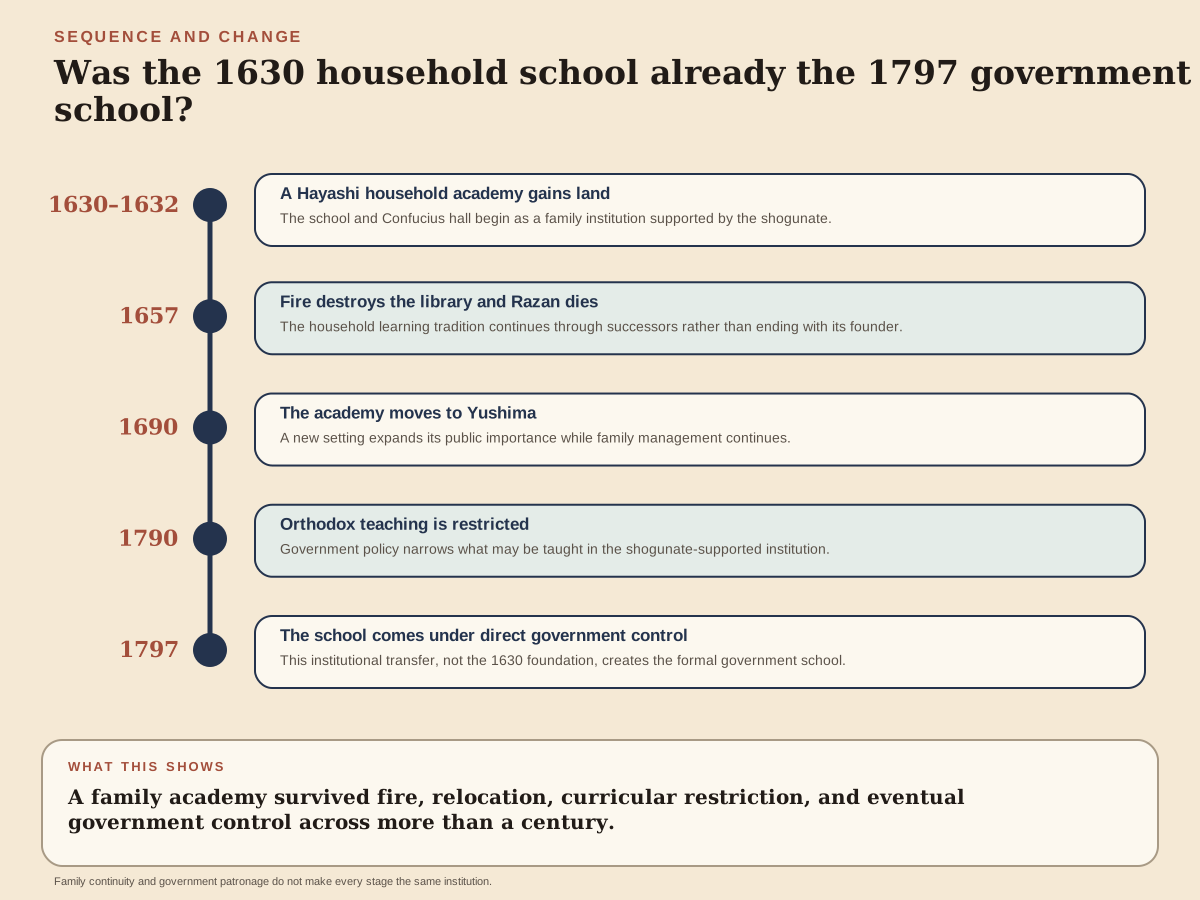
In 1630 Iemitsu granted Razan land at Shinobugaoka in Ueno, a district of Edo, now Tokyo. A hall honoring the ancient Chinese teacher Confucius followed in 1632. Tokugawa Yoshinao, Ieyasu's son and lord of the Owari branch house, helped support it.
The academy joined books, teaching and ritual on a permanent site. It remained a Hayashi household institution under political patronage. Razan's son Gahō and other family members could inherit its work and relationships. The later government academy developed from this base, but was not already present in its final form.
In 1635 Razan helped prepare and publicly read the revised Buke shohatto, regulations for warrior houses. Its provisions regularized alternate attendance: territorial lords spent specified periods in Edo as well as their domains. Travel, residences and controls on castles or marriages bound them more closely to Iemitsu's government.
The 1615 code had been strongly associated with Sūden's drafting; Razan did not originate it. Even in 1635, he gave policy its ordered wording rather than deciding and enforcing everything himself. Ceremony and documents made the rules known, while military power supported them. The same reign persecuted Christianity and suppressed the Shimabara-Amakusa uprising in 1637–1638.
In 1635 the Yanagawa affair exposed altered or forged diplomatic documents managed through Tsushima's Sō house. The shogunate retained the family but tightened supervision. Razan's documentary and scholarly role expanded around the Korean mission of 1636.
His private letter to three envoys asked seven questions, including why Dangun, Korea's legendary founder, supposedly ruled for over a thousand years and was absent from Chinese histories. Guan Yaquan's 2016 study reads this as learned argument carrying a Japan-centered claim to standing.
Razan's collected writings say the envoys could not answer; the Korean records examined do not confirm delivery, but describe later face-to-face debate. Envoy Kim Se-ryeom portrayed Razan as receiving correction about Zen influence. The differing records sustain different readings of the encounter, rather than a simple victory for either side.
Between 1638 and 1645 Razan developed Honchō Jinja Kō, an investigation of Japanese shrines. Shinto writings in the 1640s connected sacred tradition with Confucian principle. He also criticized Buddhism and Christianity.
Ritō Shinchi Shintō names a tendency in his thought, not a fully standardized church. Kokugakuin's Yazaki Hiroyuki notes the absence of one clear definition or complete exposition and limited evidence for public propagation. The Tokugawa government continued to employ Buddhist clergy and temples. Razan's intellectual criticism did not produce their removal or the later Meiji separation of kami and buddhas.
In 1641 Iemitsu ordered warrior genealogies compiled under Ōta Sukemune, with Razan and his son Gahō among the editors. Around 1,400 houses supplied records. The Kan'ei shoka keizuden was completed in 1643 in Literary Chinese and Japanese forms.
A surviving Shimazu draft attributed rewards collectively to Hideyoshi's senior administrators; the presentation version emphasized Ieyasu's initiative. This documented change shows how an official collection could frame inherited information.
In 1644 Razan began supervising the chronological Honchō Hennenroku, with portions finished by 1650. Much was destroyed in 1657. His service had continued into Ietsuna's reign, but the later Honchō Tsugan was completed by Gahō and successors after his death.
The Great Fire of Meireki destroyed much of Razan's library and historical material in 1657. Expert biographies locate the burned main library in Kanda, not automatically at the Shinobugaoka academy. Books divided between two sons survived. A 2017 archival study counts 437 Chinese-book titles in 4,385 bound units in later custody, not in his original library.
Razan died of illness four days after the fire. Accounts connect his last days to the destruction of the books, but grief alone is not an established medical cause. He did not live to see the historical project rebuilt.
Gahō restarted the family's national-history work under Ietsuna's 1662 order. The Honchō Tsugan was completed in 1670 in 310 volumes. Under Tsunayoshi, the academy moved to Yushima around 1690–1691 and the Hayashi head gained more explicitly public standing.
Competing Confucian scholars, including Itō Jinsai and Ogyū Sorai, developed different interpretations. Only in 1790 did the reform government restrict academy teaching toward Zhu Xi orthodoxy; direct shogunal control followed in 1797. These stages should not be compressed into Razan's first appointment.
After the shogunate fell in 1868, the books passed through new arrangements and entered the Cabinet Library's custody in 1890. Razan's household had created resources that later patrons transformed into a government institution and archive.
Classic
Hayashi Razan was born in Kyoto in 1583. His personal name was Nobukatsu; Razan was a scholarly name. Later biography describes his adoption by his father's elder brother, a rice merchant. His family background brought him into the city's literate households, not into a hereditary office for Confucian scholars, whose studies centered on ethical teachings from ancient Chinese classics. The office eventually associated with the Hayashi family did not yet exist. [1][2]
Kyoto was Japan's imperial capital, although emperors no longer commanded the armies that decided national power. Warfare had damaged the city's neighborhoods and institutions. Court nobles nevertheless preserved ceremonial expertise, and Zen Buddhist monasteries remained centers of Chinese-language learning. Classical Chinese connected Japanese readers to a much wider East Asian written culture. A student could use the same literacy to read Buddhist scriptures, Chinese histories or Confucian classics concerned with conduct and social relationships.
The political future was unsettled. Oda Nobunaga, the military leader who had brought much of central Japan under his control, had died in 1582. Toyotomi Hideyoshi was building the regime that would unite the country. Tokugawa Ieyasu's victory at Sekigahara in 1600 and establishment of a shogunate—a warrior government headed by a military ruler holding a court-conferred title—in 1603 still lay ahead. Razan's early opportunities belonged to this older Kyoto world, before he acquired a connection to the eastern warrior house.
Books needed teachers as well as readers. Access to a temple library or a knowledgeable household could determine which texts a youth encountered and how he understood them. Razan's later collecting and teaching grew out of these relationships. His first documented educational turning point came at Kenninji, a major Zen temple in Kyoto, where he began study in 1595.
Biographical accounts place Razan at Kenninji in 1595 and his departure in 1597, when he declined permanent ordination. The ages often given—thirteen and fifteen—use traditional inclusive counting, in which a child began at one. They should not be read as modern birthday ages. The sequence establishes a change of career, but supplies no reliable transcript of the adolescent's decision. [4][5]
Kenninji belonged to the Gozan network of major Zen monasteries. These institutions taught Chinese-language reading and commentary alongside Buddhist learning. Razan carried those skills home with him. He continued to study Confucian texts, especially the commentaries of Zhu Xi, a twelfth-century Chinese philosopher whose account of moral cultivation linked personal conduct to family and political order. [3][4]
Leaving a monastery meant giving up an established route to office and community. There was no equivalent secular post to which the young reader could simply apply. Scholarship outside the temple depended on access to books and on people willing to support or employ a learned man. Razan's continued reading therefore did not make him intellectually isolated. The texts, methods and contacts available in Kyoto helped sustain his new direction.
His later criticism of Buddhism grew from knowledge acquired in Buddhist institutions. He could dispute an interpretation because he could read and compare it. His use of kanbun, the Japanese reading and composition of Literary Chinese, likewise continued beyond the temple. That continuity mattered when his learning eventually became useful in government correspondence. For now, he needed a teacher who could give his studies direction and recognition outside monastic life. In 1604 he met Fujiwara Seika. [3][4]
Fujiwara Seika had also trained in Zen before making Confucian study the center of his learned life. When Razan met him in 1604, Seika could offer both an intellectual model and access to patrons. A teacher's recognition mattered in a society without standardized academic credentials. It made a younger scholar's learning credible to people who might employ him.
Seika's circle belonged to an East Asian exchange of books and interpretation. Confucian classics had circulated in Japan long before either man. The recent Korean connection had a harsher setting. Hideyoshi's invasions of Korea in the 1590s brought captives to Japan as well as books and technologies. Among them was Kang Hang, a Korean scholar captured in 1597. During confinement he exchanged learning with Seika, before returning to Korea in 1600. Their contact was real, but it should not become a claim that one captive transferred an entire philosophy to a single Japanese founder. [4][9]
Razan selected and interpreted an inherited body of learning. Zhu Xi's commentaries gave him methods for reading the classics and discussing the relationship between knowledge and conduct. Seika could test those readings and show how scholarship might function outside a permanent Buddhist vocation. The connection also gave Razan a practical route toward service. Around 1605 Seika recommended him to Tokugawa Ieyasu. [2][4][5][9]
Accounts distinguish stages of this beginning differently: an audience in 1605 appears in Kyoto's municipal biography and several reference accounts, while Ishida Ichirō's scholarly encyclopedia dates formal recruitment to 1607. These need not describe the same administrative event. The secure outline is an introduction followed by recurring service. Ieyasu wanted readers able to answer questions about earlier institutions and useful books. Razan's erudition met that need; the first introduction did not make him the author of an exclusive state doctrine. [2][4][5][6]
Ieyasu had established the Tokugawa shogunate in 1603 and passed its headship to his son Hidetada in 1605, while retaining substantial authority himself. Razan entered a ruling household that already employed learned monks and other specialists. He became useful as a reader and teacher, able to explain texts and investigate historical precedent. Personal access developed into repeated work. [1][2]
Ieyasu's book interests extended well beyond Confucian philosophy. He collected Chinese and Japanese works and sponsored editions that made rare texts more widely available. This patronage gave Razan a place in the material work of scholarship. Comparing copies and preparing an edition affected what later readers could consult. Print required artisans, typesetters and people capable of checking difficult passages, even when a prominent scholar's name stood over the undertaking. [1][6]
In March 1615 Ieyasu ordered Razan and Sūden, a Zen monk who worked on diplomatic and legal documents, to publish the Daizō ichiranshū. This digest arranged extracts from Buddhist scriptures to make them easier to consult. The copper-type edition was finished in June. Razan's part in publishing Buddhist material shows what service required: a patron could value his scholarship without accepting all his objections to Buddhist doctrine. [1][4][6]
The wording of government documents was another form of learned work. A drafter supplied titles and precedents, giving an agreed decision a defensible written shape. Executive authority remained with the rulers and their officials. Razan worked alongside specialists with other responsibilities. Tenkai, a senior Tendai Buddhist monk, organized temples and dynastic ritual; Sūden drew on Zen institutional networks. Their overlapping work brought several traditions into the same government. [1][6][7]
After Ieyasu's death, Razan continued under Hidetada and then Hidetada's son Iemitsu, who became shogun in 1623. His employment eventually extended into the early rule of Iemitsu's son Ietsuna. Four successive patrons gave the Hayashi household lasting access to government. That endurance grew from repeated service, not from a complete scholarly bureaucracy created at his first audience. [1][2][11][24]
In 1607 Razan encountered members of a mission from Joseon, the Korean kingdom, at Sunpu, Ieyasu's retirement center in what is now Shizuoka. Classical Chinese gave learned Japanese and Korean participants a way to communicate in writing when their spoken languages differed. Questions and poems could move across the linguistic boundary. [5][16]
The visit followed Hideyoshi's invasions of Korea, which had ended in 1598. Its purpose included answering Japanese diplomatic correspondence and recovering people taken to Japan during the wars. Joseon called it an answer-and-repatriation mission. The familiar label 'communications envoys' groups it with a later series whose diplomatic circumstances changed over time. [8]
Returning captives was part of the settlement, not a picturesque accompaniment to literary exchange. Research summarized by Ritsumeikan's Asia-Japan Research Institute describes more than six thousand people returning through different routes, including the missions and their own efforts. Others remained in Japan. A courteous exchange between scholars took place alongside these unfinished human consequences of war. [8]
Tsushima, the island between Japan and Korea, supplied essential intermediaries. Its ruling Sō family depended on Korean trade and maintained contacts that the Tokugawa government could not readily replace. Envoys crossed a chain of official instructions and local negotiation before they met a scholar such as Razan. His contribution belonged within that larger process.
The shared written culture could make disagreement precise. A title or a historical reference carried assumptions about which ruler stood above another. Korean representatives had their own diplomatic standing to defend. Razan's early contact helped establish a field of work that would become more important in the 1630s, when the shogunate scrutinized the documents passing through Tsushima.
Ieyasu died in 1616. His body was first interred at Kunōzan in Suruga, the province around present-day Shizuoka, before the dynasty established its principal cult center at Nikkō in 1617. The burial rites and the choice of a divine title involved different authorities. Bonshun, a priest of the Yoshida Shinto tradition, participated in the initial ritual arrangements. [7][22][23]
The National Archives of Japan describes a dispute between Sūden, who favored a myōjin title, and Tenkai, who favored gongen. Myōjin designated an illustrious kami, or sacred deity. Gongen interpreted a deity as a manifestation of a Buddha or Buddhist being. Hidetada settled on the latter form; the imperial court then supplied alternatives from which the government selected Tōshō Daigongen. [7]
One reason attributed to Tenkai was political. Hideyoshi had been worshipped under a myōjin title, yet the Toyotomi dynasty had fallen. The Archives illustrates the argument with a biography of Tenkai published in 1789, long after the decision. That retrospective text is evidence for how the explanation was preserved, not a transcript of a meeting in 1616.
Razan is often added to a simplified contest in which Confucian or Shinto learning loses to Buddhism. The archival account just described identifies Sūden and Tenkai as the advocates. Razan's studies of ritual and sacred tradition make him relevant to the intellectual setting, but this account does not establish his precise intervention in the decision. His continuing career cannot be explained through an imagined defeat. [7]
The outcome kept Buddhist manifestation theory at the center of the founder's cult. Razan nevertheless remained a scholar in the same government. The combination was administratively workable: Tenkai's temple organization and Razan's teaching or documentary work supplied different capacities. Their coexistence is clear; a private rivalry governing every shared episode is not. [1][6][7]
Seika died in 1619. Ishida Ichirō's account of Razan's thought places a clearer declaration of his allegiance to Zhu Xi's account of principle and material force after that death. Razan had read more widely than one school. His subsequent commitment was a choice within that learning, not the simple repetition of everything taught by his master.
Principle made things and relationships intelligible; material force accounted for their concrete forms. Moral cultivation required people to study and correct their conduct within everyday relationships. A ruler or parent held obligations as well as authority. In Razan's account, occupying a position without meeting its duties damaged order. Ritual trained conduct by giving those relationships repeated visible form. [4]
These ideas supplied Tokugawa rule with a moral language beyond military victory. They could justify hierarchy, but also set standards for judging someone who exercised authority badly. The second function did not make subjects equal to rulers. Whether criticism could be safely voiced depended on power. Razan's account gave inequality an ethical justification while insisting that a superior's conduct mattered.
In 1629 he received the rank Minbu-kyō Hōin. Hōin was a high clerical designation, and he served under the name Dōshun. The government recognized a Confucian scholar through categories long used for learned clergy. His criticism of Buddhist doctrine did not prevent him from accepting that public status. [3][4][5][19]
His appointment is sometimes treated as the beginning of one exclusive Tokugawa ideology. The later school history does not support that compression. The Hayashi academy initially remained a family institution, and direct government administration came much later. Nor did Razan personally devise a uniform 'four-class system' covering all inhabitants. The familiar samurai-peasant-artisan-merchant formula omits other statuses and differences among jurisdictions. His more demonstrable contribution was a teachable language of moral duties and hierarchy, sustained through a patronized scholarly household. [18][19]
In 1630 Iemitsu granted Razan land at Shinobugaoka in Ueno, a district of Edo, now Tokyo. The site gave his teaching and books a more permanent home. The patronage signaled that his learning mattered to the rulers, while the Hayashi family retained the work of managing the institution. [18][19]
A hall honoring Confucius followed in 1632. Confucius was the ancient Chinese teacher whose writings and attributed sayings stood at the center of this scholarly tradition. Tokugawa Yoshinao, Ieyasu's son and lord of the Owari branch of the family, supported the hall. Its name, Senseiden, marked a place for ritual as well as study. [10]
The Tokyo Metropolitan Library preserves a design drawing of the hall. Its description identifies a foundation inscription naming Yoshinao and Hayashi Dōshun, the name Razan used in service. The building thus has more specific evidence of patronage than the loose description 'shogunal academy' suggests. A branch-house patron contributed to an institution run by the scholar's household.
Ritual helped organize a community of learning. Honoring Confucius gave teachers and pupils a visible connection to the tradition they studied. Books, classrooms and ceremony could now occupy one site. Family members and assistants sustained the work; Razan's son Hayashi Gahō would later continue the teaching and historical projects.
The household form made succession practical. A son could inherit collections, relationships and trained responsibilities, reducing the risk that years of scholarly service would vanish at one death. It also concentrated access and authority within a family. Political patronage and private management coexisted at Shinobugaoka. This distinction matters when following the institution's later development: the directly administered government academy belonged to subsequent rulers and descendants, not to a finished education system created by Razan.
In 1635 Iemitsu's government issued a revised Buke shohatto, the regulations for warrior houses. Razan helped draft the text and read it before assembled daimyō, the territorial lords. Written rules and public ceremony brought the scholar's work into the regulation of powerful military families. [1][5][11][24]
The code had a history before that reading. Its 1615 version followed the Osaka campaigns and destruction of the Toyotomi house. Sūden had played a major part in preparing its language. The 1635 revision belonged to a government with two more decades of experience. Keeping the versions separate prevents Razan from being credited with originating the entire code. [24]
Among the revised provisions was regular alternate attendance, requiring lords to spend specified periods in Edo as well as in their domains. Travel and residences consumed resources, while proximity to the shogun helped bind the lords to his authority. Castle and marriage controls likewise constrained military independence and alliances. The rules disciplined domains that retained their own administrations.
Razan's wording gave the command an ordered form. A drafter needed to identify who was bound and which acts required permission. Precedent could present an innovation as continuous with earlier rule. These choices mattered, but policy and enforcement belonged to Iemitsu and the officials deliberating and administering the code. Razan was neither its sole political author nor merely a voice with no influence over meaning. [24]
After the public reading, the Hosokawa household promptly copied the code and circulated it to friendly shogunal retainers. A five-sheet copy shared among members of the Matsui household survives at Kumamoto University Library. The library's description traces this circulation from the ceremony into working administrations. Khirin also catalogues a 1635 manuscript held by Ōshū City. Such objects show how a spoken command became a text that officials could consult, copy and pass on.
Learned form did not remove force from this government. Iemitsu's reign also included the violent suppression of the Shimabara-Amakusa uprising in 1637–1638 and persecution of Christianity. Those policies had several causes and decision-makers; they cannot be derived solely from Razan's polemics. His historical importance here lies in giving military rule precise language and ceremonial expression, within institutions capable of imposing severe material burdens. [24]
The Yanagawa affair brought diplomacy's paperwork into a public dispute. Tsushima's Sō house had altered or falsified documents passing between Japan and Korea. A conflict within its own administration exposed the practice, and in 1635 the shogunate judged the case. The Sō family remained in place, but documentary work came under closer supervision. [8][16]
The large Korean mission of 1636 gave Razan renewed scope as a composer and scholarly interlocutor. Titles and dates could claim political standing. Korean envoys defended Joseon's own position; accepting a shared written language did not require accepting the hierarchy a Japanese document proposed. [8][16]
One surviving text makes the tension concrete. Razan composed Ki Chōsenkoku Sankanshi, a private letter addressed to three Korean envoys, on the traditional date of the twelfth month's eighth day in 1636. It asked seven questions. The first challenged the account that Dangun, Korea's legendary founder, had ruled for more than a thousand years. Razan asked whether successive descendants could explain the duration and why Chinese histories did not record the story. [8][16]
Guan Yaquan's 2016 study interprets the questions as an assertion of learning and of Japan's standing. Its reproduced Korean account supplies a different view of the encounter. The envoy Kim Se-ryeom described debate in which he criticized Razan's thinking as still influenced by Zen; Razan was reported as welcoming corrective advice. These are source-specific presentations, not an impartial score of who won.
The letter's delivery is itself uncertain. Razan's collected writings say it went through Sō Yoshinari, lord of Tsushima, and that the envoys could not answer. Guan notes that the Korean records examined do not confirm receipt, although they describe overlapping questions at a meeting five days later. An unanswered letter therefore cannot simply prove the envoys' ignorance.
The exchange admits different readings. Razan's own account asserts learned superiority; the envoy's report gives the Korean scholar a corrective role. Guan's Japan-based study reads Razan's questions as part of a claim to Japan's standing, while recognizing the uncertainty over delivery. Shared classics enabled communication and argument together, and the records preserved each participant's position.
Razan's scholarly independence also took shape in writing about Japan's sacred traditions. His Honchō Jinja Kō, an investigation of Japanese shrines, developed between 1638 and 1645; writings on Shinto transmission followed in the 1640s. These works gave a concrete textual setting to his effort to connect the Way of the kami with Confucian moral principle.
He criticized Buddhist doctrine from a position that placed cultivation within family and political relationships. A claim to liberation from those relationships could look, to him, like neglect of their duties. He also opposed Christianity. These arguments defined a learned position, but did not place him in charge of temple administration or all religious policy. [3][4]
The label Ritō Shinchi Shintō is associated with his account of sacred and moral order. Kokugakuin scholar Yazaki Hiroyuki stresses that the term occurs across Razan's writings without a clear definition or one complete exposition. The family transmitted this learning, but evidence for Razan actively spreading it as an organized public movement is limited. The label consequently describes a tendency in his learning rather than a standardized public creed. [15]
His criticism existed within a government that continued to employ Buddhist institutions. Temples conducted funerals and memorials and became increasingly involved in registering households. Tenkai's work had secured a Buddhist framework for Ieyasu's cult. Razan's clerical-style rank remained another sign that intellectual distinctions did not neatly separate public offices. [3][7][19]
The coexistence sets a limit to his achievement. He helped Confucian scholars articulate independent claims to learning and reinterpret sacred tradition; he did not displace Buddhism from Tokugawa government. Later state-enforced separation of kami and buddhas after 1868 created a different setting. Reading that later settlement back into his writings would give him a policy and institutional world he never controlled.
In 1641 Iemitsu ordered a compilation of warrior genealogies. Ōta Sukemune, a lord and government official, supervised the project; Razan and his son Gahō worked among its principal editors. Roughly 1,400 houses supplied records. Descent mattered for rank and service, so households had practical reasons to preserve—and sometimes improve—the account of their past. [1][11][12][24]
The Kan'ei shoka keizuden was completed in 1643. Presentation copies took two forms: Literary Chinese and Japanese with kana, the syllabic signs used alongside Chinese characters. The compilation brought dispersed family accounts into a collection supported by government authority. It did not make every submitted memory equally reliable. [11]
The National Archives identifies a revealing difference between a draft and the presentation version of the Shimazu entry. In the draft, rewards after Hideyoshi's death in 1598 came from his senior administrators collectively. The presentation text emphasized Ieyasu's initiative in consultation with the other leaders. The difference gives the Tokugawa founder a more prominent role. It shows editorial framing within a particular passage, not grounds for dismissing the entire genealogy as invented.
The next commission enlarged the ambition. In 1644 Iemitsu ordered a chronological history of Japan. Razan supervised the Honchō Hennenroku, drawing on earlier court histories; subordinates and family members did much of the writing. Surviving portions completed by 1650 demonstrate a workshop as well as an individual scholar's project. [1][14]
Collection and arrangement gave the regime a usable past. Compilers preserved earlier records, including material later lost, while choosing sequences and categories that made events politically intelligible. The resulting texts can preserve evidence and shape it at the same time. The genealogy's draft and presentation forms let readers see that process in action.
Razan's service continued after Iemitsu's death in 1651 into the early reign of his son Ietsuna. The historical project nevertheless faced a rupture that patronage could not prevent: much of the Hennenroku was lost in the fire of 1657. Its later successor, the Honchō Tsugan, belonged to Gahō and a renewed commission after Razan's death. It must not be credited as a completed work by the father. [1][14]
The Great Fire of Meireki devastated Edo in 1657. Wooden buildings and dense settlement allowed the disaster to reach homes and institutions across the capital. Razan's library burned at his main residence in Kanda, according to the scholarly accounts by Ishida Ichirō and Yamamoto Takeo. The loss should not be placed automatically at the Shinobugaoka academy. [4][5][17]
His collection had accumulated through decades of reading, copying and government-supported work. Later accounts describe tens of thousands of volumes, but titles and bound units are not interchangeable measures. Beyond their number, worked copies held annotations and the results of comparison. The fire also destroyed much of the Honchō Hennenroku, undoing years of collective compilation. [4][5][17]
Not everything was lost. Books Razan had divided between two sons survived the disaster. Further fires and transfers reduced that inheritance over time. A 2017 National Archives study by Tsuchiya describes 437 Chinese-book titles in 4,385 bound units held by the Archives from this surviving collection. Those figures describe later custody, not the original library's size or a complete inventory immediately after the fire. [17]
Razan died of illness four days after the fire. The traditional date was the first month's twenty-third day; it should not be treated as January 23 in the Gregorian calendar. The destruction of his books understandably became part of accounts of his final days. The proximity of disaster and death does not establish a medical diagnosis that grief itself killed him. [1][4]
His loss was unusually visible because later institutions valued his surviving books. Other households lost lives and records with much less documentation. Razan did not live to see the city's recovery or the rebuilding of the historical project. Those efforts belonged to survivors, including sons whose separate custody of books had preserved part of the family's scholarly resources.
Gahō continued the family's historical work after Razan's death. In 1662 Ietsuna ordered national-history compilation to resume, and the resulting Honchō Tsugan was completed in 1670 in 310 volumes. It extended through 1611. Razan had established a line of work that his son rebuilt; he had not written this finished successor history. [1][14]
Under the fifth shogun, Tokugawa Tsunayoshi, the academy and Confucius hall moved to Yushima around 1690–1691. The Hayashi head received Daigaku-no-kami, a court-derived title associated with leadership of learning. This later public standing belonged to descendants. Books and inherited expertise made the household useful, but new patrons changed its institutional form. [18][19]
The intellectual field remained contested. Itō Jinsai, a Kyoto Confucian scholar, challenged Zhu Xi through close reading of the ancient classics. Ogyū Sorai later emphasized ancient language and institutions. Their alternatives helped prevent one household's interpretation from representing all Tokugawa scholarship. Domain and temple education also continued outside the Hayashi school. [19]
In 1790 Matsudaira Sadanobu's reform government restricted teaching in the academy toward Zhu Xi orthodoxy. In 1797 the shogunate took direct control, creating the Shōheizaka Gakumonjo as a government-administered school. The Ministry of Education's institutional history distinguishes these stages from the earlier family academy. A common description of Razan as the founder of official learning identifies an institutional ancestry; it becomes misleading when it gives his first appointment all the exclusivity of these later measures. [18][19]
The fall of the shogunate in 1868 ended its patronage system. The academy's collection passed through new custodial arrangements and came under the Cabinet Library in 1890. The National Archives traces that transfer and the books inherited from Gahō. Materials once assembled for warrior-government service now belonged to a different state archive. [18]
Razan's lasting importance lies in the learned service, teaching and collections that descendants and rulers could develop. His household preserved skills and books through inheritance, even as fires and political change interrupted the work. The government academy and modern archive emerged from that inheritance through later decisions, each with patrons and purposes of its own.