Read the article below. Interactive reading tools are available when scripts load.
Quick
Ganjin was born in 688 in Jiangyang county, in the Yangzhou region of Tang China. An account completed in Japan in 779 identifies his lay surname as Chunyu and says his father received Buddhist precepts and studied meditation with a monk at Dayun Temple. According to the same text, Ganjin, fourteen by traditional reckoning, accompanied his father to the temple, was moved by an image, and asked permission to enter religious life during a state-authorized ordination initiative in 701. [1]
The account is early and important, but its polished conversion scene was written long after the child’s experience. Yangzhou’s temples, waterways, markets, and official connections explain the opportunities around him. They do not prove that a future voyage to Japan was already implicit in his childhood. [1]
In 705 Ganjin received bodhisattva precepts from Dao'an: ethical commitments available to lay Buddhists as well as clergy. He traveled to Luoyang in 707 and then Chang'an, the Tang capital, where Hongjing served as preceptor at his full monastic ordination in 708. That ceremony admitted him to the recognized monastic community under vinaya, Buddhist rules of discipline. After studying scriptures and procedure in the capitals, he returned to the Huainan region in 713. [1][2]
For nearly three decades after returning south, Ganjin taught in the Yangzhou region and became a leading preceptor at Daming Temple. The 779 biography presents him as the foremost vinaya authority of Jianghuai by the time he was forty-six. It credits him with repeated lectures on major discipline texts, temple and image projects, relief for poor and ill people, large copying programs, many trained disciples, and more than forty thousand ordinations. Those totals express remembered scale rather than totals recoverable from surviving registers. [1]
The broader fact is firm: by 742 Ganjin was not an itinerant novice available for adventure. He led a mature teaching and welfare network. Japanese monks sought him because he could assemble qualified preceptors, explain procedure, and reproduce a lineage—not because Japan lacked Buddhism.
Japanese monks Yōei and Fushō had spent about ten years in Tang China seeking teachers for ordination. They had helped send Dōsen to Japan earlier, but still sought a qualified assembly: full ordination required monks able to serve the prescribed ritual roles and train future preceptors. In 742 they approached Ganjin while he was lecturing at Daming Temple. The 779 biography says he asked his assembly who would answer the invitation; after silence, he declared his willingness, and twenty-one monks then agreed to join. The decision was collective even before a ship existed. [1][8]
Acceptance began a group undertaking. Ganjin and his companions still needed patrons, a vessel and permission to move through Tang ports before the Japanese request could become a successful crossing.
The first plan collapsed before reaching open water. With a letter from the powerful Li Linfu’s brother, supporters arranged shipbuilding and provisions at Yangzhou. Coastal piracy was then severe enough for authorities to restrict maritime movement. A dispute inside the group led the monk Ruhai to accuse organizers of collusion with pirates. Officials searched temples, found supplies, arrested participants, and confiscated the vessel. Yōei, Fushō, and others were held from roughly the fourth to the eighth month before the case was resolved. [1]
The court recognized the Japanese monks’ status and allowed their return, but that did not authorize Tang clergy to leave with them. The failure exposed three constraints at once: internal trust, security law, and the state’s power to distinguish foreign students from Chinese religious personnel. [1]
The next efforts did not repeat the first in identical form. One plan used a purchased military vessel, eighteen sailors, a large stock of food, religious objects, and a remarkable group that the surviving account describes as seventeen clerics and eighty-five skilled workers. Storms wrecked the ship twice near the coast; food and water ran out before patrol officials and local residents brought rescue. Other preparations were exposed or stopped before sailing. The expedition’s roster continually changed. [1]
Some companions withdrew or sought to prevent their teacher from leaving; others joined new preparations. The traditional count of six attempts includes plans stopped on land as well as actual sailings. It describes persistence toward one objective, not six completed sea crossings. [1]
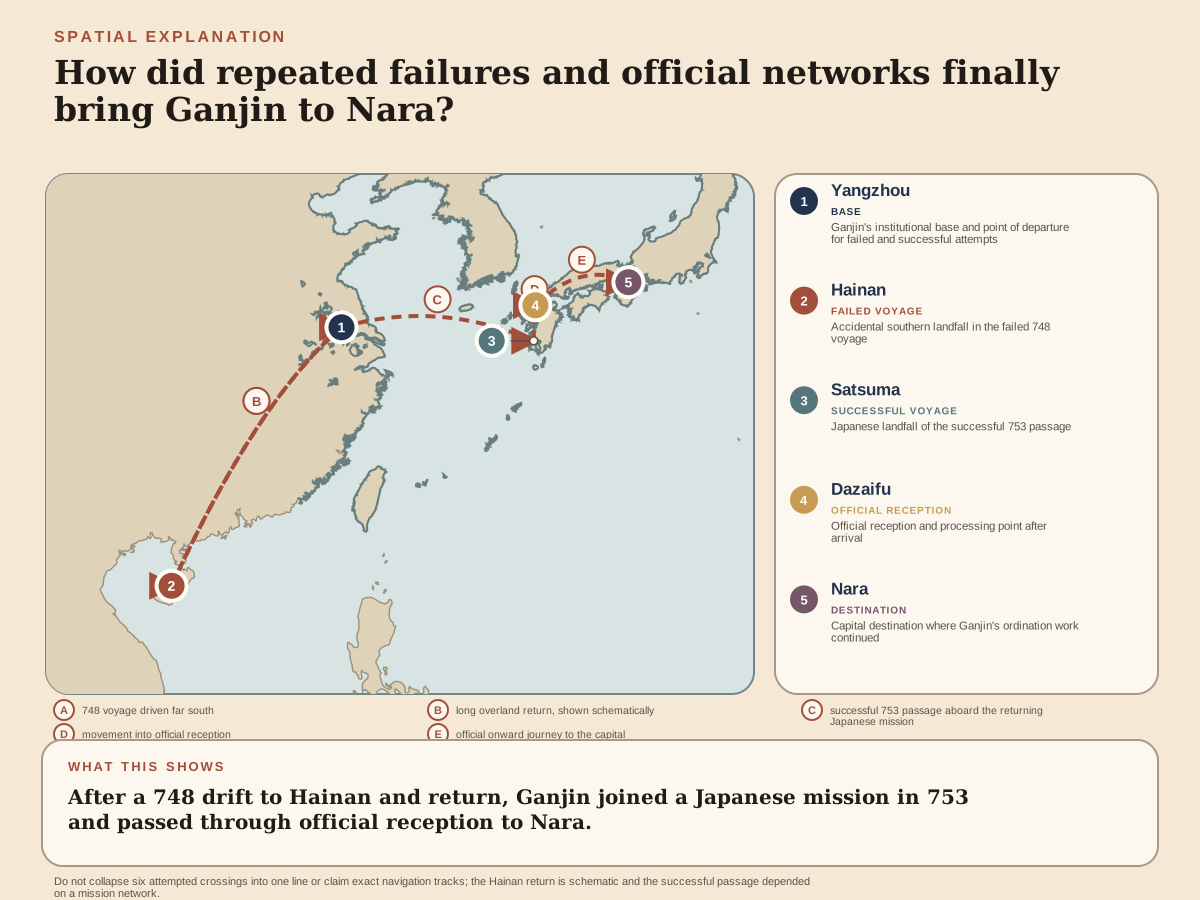
The most extreme attempt left in 748 with a party the surviving account counts at thirty-five, including fourteen named religious or lay travelers and eighteen sailors. Wind carried the ship south for fourteen days without dependable fresh water. Instead of Japan, they reached Hainan, an island off China's southern coast. Ganjin remained there long enough to repair or construct temple buildings, teach, and confer precepts before beginning a multi-year return through southern China. Officials, temples, boats, roads, and armed escorts carried the group north. [1]
Yōei died at Duanzhou, and other companions were lost. The failed eastward voyage thus became a religious circuit through regions never intended as destinations. The surviving account frames rain, dreams, and survival as sacred intervention. The account records what the community believed; weather and faith claims remain distinct. [1]
The 779 biography places Ganjin’s loss of sight during the return through southern China. It says repeated heat weakened his vision and that a foreign practitioner offered eye treatment during the return north, after which he became blind. The sequence is early testimony, not a clinical record. No surviving source establishes a modern diagnosis or proves exactly what the treatment caused. Blindness became the most powerful bodily symbol of the voyage, but it was also a practical disability. [1]
Ganjin needed companions to guide movement, read documents, arrange space, identify people, and protect him on ships and roads. Continuing toward Japan was not an act of will that erased impairment. It was possible because the expedition adapted around a changed body and because his authority did not depend on eyesight alone. [1]
In 753, a returning Japanese embassy finally supplied a state-connected route. Its leaders included Fujiwara no Kiyokawa, Ōtomo no Komaro, Kibi no Makibi, and Abe no Nakamaro. Chinese authorities closely guarded Ganjin, and embassy leaders feared punishment if he were discovered aboard. Ōtomo, the embassy's deputy leader, nevertheless brought him and his companions secretly onto a ship at night. The biography's twenty-four-person list belongs to the preparatory journey from Yangzhou toward Suzhou, before the passengers' repeated boarding and removal from embassy ships. It includes monks, three nuns, a lay supporter and travelers identified with several regions beyond China. Fushō eventually traveled on another embassy ship; the list is not a fixed final total of everyone who arrived in Japan. [1]
They carried texts on monastic discipline and works of Tiantai, a Chinese Buddhist tradition of scriptural study and meditation, together with images and ritual materials. Ganjin's ship reached Satsuma in southern Kyushu in the twelfth month of 753 in the traditional calendar, then Dazaifu, the government's center in northern Kyushu. The party entered Nara on the fourth day of the second month of 754 in the same calendar. [1][2]
The court received Ganjin at Tōdai-ji, the great imperial Buddhist temple at Nara, and gave him a high clerical teaching rank. In the fourth month of 754, a temporary platform was built before the Great Buddha Hall. Members of the imperial household received bodhisattva precepts, ethical commitments available beyond the clergy. Hundreds of novices and monks then received or repeated ordination under Ganjin’s assembly. Institutional summaries often say “about four hundred”; the 779 biography lists more than 440 novices and more than eighty existing monks who relinquished earlier status and received the new procedure. The brief summaries do not reproduce the biography's separate categories; the totals cannot simply be treated as the same attendance count. The ceremony did not begin Japanese Buddhism or prove every prior monk false. It gave court-backed authority to a specific vinaya transmission and created a large constituency for its continuation. [1][3][8]
In 755, a permanent ordination precinct was established west of Tōdai-ji’s Great Buddha Hall. Tradition says soil from the temporary platform used in 754 was transferred into the new structure, giving material continuity to the founding ceremony. A ritual site, trained preceptors, texts, records, and court recognition now made ordination repeatable without rebuilding an exceptional event each time. Ganjin worked from Tōdai-ji for about five years, but the institution was collaborative. Chinese companions taught; Japanese monks learned and served as future preceptors; Tōdai-ji provided administration and property; the court defined recognized clerical status. Later regional platforms at Kanzeon-ji and Shimotsuke Yakushi-ji extended the system, a development not reducible to one man’s personal command. [1][4][8]
Students who came to study discipline at Tōdai-ji sometimes lacked support and left. In 757, the court granted one hundred chō (a historical unit of land area, roughly one hectare in this context) of rice fields in Bizen to sustain the teaching community. Ganjin later received part of the former Nara residence of Prince Niitabe. At the urging of Fushō and Situo, a Chinese monk who had accompanied Ganjin, he established an invited vinaya community there in 759—the institution that became Tōshōdai-ji. The new place provided residence, lectures, worship, storage, and continuity distinct from Tōdai-ji. [1][3]
It was not yet the precinct visitors see today. The lecture hall incorporates a building moved from Heijō Palace and altered later; the Golden Hall belongs to the later eighth century; other halls and images span centuries. Ganjin founded a living community, not a finished heritage site. [5][6]
Returning to the 753 crossing, the expedition's cargo shows the materials available for teaching in Japan. The 779 inventory names forty-eight groups of texts, including the sixty-scroll Dharmaguptaka Vinaya, commentaries, Tiantai works, meditation manuals, a biography of nuns, and Xuanzang’s travel account. It also lists relics, icons, ritual objects, calligraphy, aromatics, spices, and medicinal substances. Some items entered the imperial collection. This was real cultural transfer, but it was collective and selective. The party included monks, nuns, a lay supporter, and people from several maritime backgrounds; earlier plans had recruited specialist artisans. Japan already received Tang knowledge through missions, immigrants, merchants, and other monks. [1]
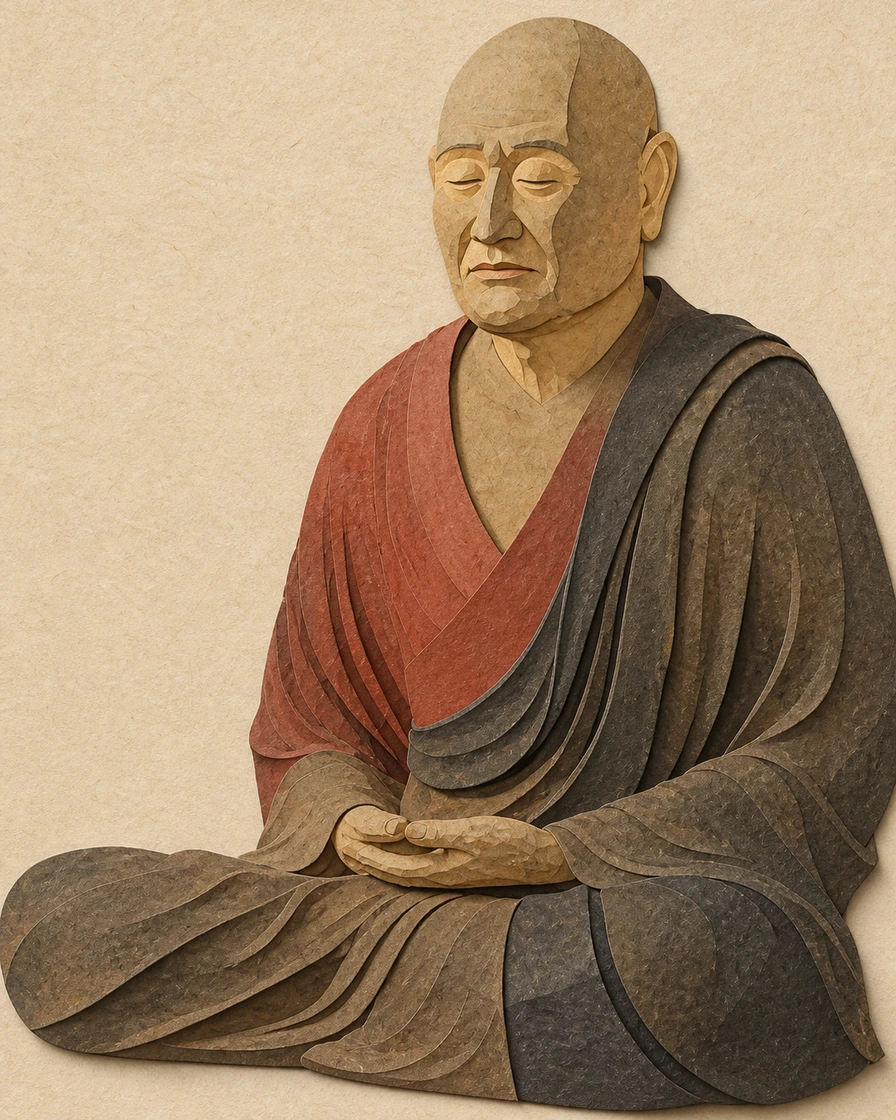
Ganjin died at Tōshōdai-ji on the sixth day of the fifth month of 763 in the Japanese calendar, seventy-six by traditional reckoning. His disciple Ninki is associated with the making of his seated portrait, an eighth-century hollow dry-lacquer sculpture about 80.1 centimeters high. The early biography links it to a dream warning of the teacher's death. The image preserves close early commemoration, not a direct record of his final emotion. [1][4]
In 779, sixteen years after Ganjin's death, the Nara court writer Ōmi no Mifune composed the Tō Daiwajō Tōseiden at Situo's request, drawing on the disciple's longer, now-lost biography and community testimony. Routes, names and ceremonies appear alongside sacred speeches, dreams and signs. The painted Tōseiden Emaki of 1298 retold the voyage five centuries after the events. Meanwhile, the teachers and communities described in the early biography continued the work for which Ganjin had crossed the sea. [1]
Classic
Ganjin was born in 688 in Jiangyang county, near Yangzhou in Tang China. His lay surname was Chunyu, according to the biography that Ōmi no Mifune completed in Japan in 779. The Tang dynasty then governed China, and Yangzhou's river and canal connections linked its temples to officials, merchants and travelers. The biography says Ganjin's father studied with Zhiman at Dayun Temple. That relationship gave the boy a route into an established Buddhist community. [1]
The biography gives little detail about his family beyond his father's religious connection. It describes the boy seeing a Buddhist image, asking to enter the monastery and receiving his father's permission. Written from community memory sixteen years after Ganjin's death, this is a remembered conversion scene rather than an eyewitness childhood diary.
The account places his admission in 701, during an imperial initiative permitting ordination in the provinces. What follows is a long Chinese career: he was already an established teacher before Japanese monks asked him to cross the sea.
Entry into the monastery placed him within a system of teachers, ceremonies and clerical registration. His later authority would depend on learning recognized by other Buddhist communities. The next years took him from the Yangzhou region to China's imperial capitals.
In 705 Ganjin received bodhisattva precepts from Dao'an, ethical commitments that could be taken by lay Buddhists as well as clergy. He traveled to Luoyang in 707 and then Chang'an, the Tang imperial capital. At Shiji Temple in 708 he received full monastic ordination with Hongjing as preceptor. Full ordination admitted a candidate to the recognized monastic community through prescribed ceremonies and witnesses. Vinaya, the Buddhist rules of monastic discipline, governed the procedure. Study in the capitals gave Ganjin access to teachers and institutions with authority beyond his home region. [1][2]
Bodhisattva precepts and full monastic ordination served different purposes. The first expressed ethical commitments that lay followers could also undertake; the second admitted a candidate to the monastic community. Ganjin would later conduct both in Japan, where rulers, novices, and monks already holding clerical status did not all require the same ceremony. His own full ordination came at about twenty years of age, followed by five more years before his return south.
Ordination required teachers, witnesses and a recognized site as well as knowledge of texts. His metropolitan training connected him with assemblies able to confer that recognition beyond Yangzhou.
When he returned to the Huainan region in 713, he brought metropolitan training into the lower Yangzi Buddhist community. The next three decades would establish his reputation there through teaching and the organization of religious life.
From 713 to 742 Ganjin taught and organized Buddhist life in the lower Yangzi region for nearly three decades. Japan's petitioners sought an established preceptor, not a novice looking for an overseas career. The 779 biography credits him with repeated lectures on monastic discipline, major copying programs, temple construction and relief for poor and ill people. It also reports more than forty thousand people ordained or given precepts across his work. [1]
The account supplies no underlying registers for that total, which may combine different ceremonies and years. It nevertheless describes a large regional teaching community and names around thirty-five disciples as leading teachers in different places. Ganjin's authority had spread through people able to continue teaching without him.
Japan already had Buddhist temples, scriptures, clergy and learned traditions. Dōji, a Japanese monk who had studied in China, had addressed the transmission of discipline; Yōei and Fushō had also helped bring Dōsen, another Chinese teacher, to Japan. The remaining task was a recognized assembly able to perform full ordination and train successors. Ganjin could bring experienced companions as well as books. [1][8]
The invitation of 742 therefore asked him to leave a mature institution, not merely seek a new appointment. Students and colleagues could continue his work in China, while companions would be needed to reproduce its ceremonies elsewhere. The decision placed an established Chinese teaching community behind the proposed Japanese mission.
In 742 the Japanese monks Yōei and Fushō approached Ganjin at Daming Temple in Yangzhou. They had spent about a decade in Tang institutions seeking qualified teachers for Japan. They had already helped send the vinaya teacher Dōsen, but full ordination required an assembly able to perform and teach its different roles. Ganjin could bring a community as well as a learned individual. [1][8]
The biography presents the decision as a test of resolve: the assembly initially remained silent, one monk spoke of the dangers, Ganjin offered to go and others followed. Its speeches are remembered religious testimony, not a verbatim meeting record. Twenty-one monks agreed to join him. Their number makes clear that the proposed transfer required a community even before sailors and artisans were hired. [1]
Yōei and Fushō had arrived with a Japanese embassy and received Tang support as foreign students. That standing did not permit them to take Chinese preceptors home without authorization. Ganjin could accept their religious request, but neither he nor the petitioners controlled the ports from which they needed to sail. [1]
The participants began arranging a ship and provisions through supporters in Yangzhou. Those preparations brought their religious undertaking within the Tang state's coastal security system.
The first plan failed while the organizers were still preparing a ship. According to the 779 biography, a quarrel arose after a monk questioned Ruhai's qualifications. Ruhai then accused the group of colluding with pirates. Officials searched temples, found stored provisions and Japanese monks in hiding, arrested participants, and confiscated the vessel. The biography came through Ganjin's community and blames Ruhai's anger; its account of his motive is not an independent judgment of the quarrel. [1]
The preparations had coincided with serious coastal raiding around Taizhou, Wenzhou, and Mingzhou. A letter from Li Linzong had helped Yangzhou official Li Cou supervise construction and supplies. Investigators examined those papers and accepted that the project was not a pirate conspiracy. Even so, they warned against maritime departure and seized the ship. Elite patronage could explain the preparations, but it did not exempt them from coastal controls. [1]
The central office checked the Japanese students' assigned temples and stipends and confirmed their legitimate status. Permission for them to return to Japan did not extend to the Chinese clergy they hoped to bring. Their detention from the fourth to the eighth month in the Tang calendar consumed a sailing season. The vessel had been confiscated, and another attempt needed fresh resources and support. [1]
For the next preparation Ganjin supplied funds to buy a vessel associated with a military official and hired eighteen boatmen. Food, water containers, medicines and religious furnishings were assembled for a substantial company. The biography lists seventeen clerics and eighty-five skilled workers, including painters, sculptors, casters and embroiderers. This was a plan to move practical expertise as well as a teacher's library. The biography describes them boarding one vessel; the company would change again after its wreck. [1]
The ship’s wreck near the coast and a second collision after repair show why preparation did not control outcome. The party was stranded, supplies failed, and rescue came from local maritime people and officials. The failure occurred within the Chinese coastal world rather than on a straight line to Japan. Ports, island temples, patrol systems, and donors absorbed a displaced group whose original resources had become useless. Other attempts ended differently. A temple community might report Japanese monks in order to retain Ganjin; a disciple might appeal to officials out of fear for his teacher; travel permission might fail before a vessel was ready. The early biography assigns motives and moral lessons to these interruptions, but the recurring mechanism is clearer than every motive: a famous monk’s departure affected institutions that did not consent to lose him. [1]
The traditional count of five failures followed by a sixth success combines plans stopped on land with journeys that reached the water. Some ended in wreck; others in interception or withdrawal of support. It counts renewed efforts toward one objective, not six completed sea crossings. The membership changed throughout, so each new preparation depended on survivors and new recruits. [1]
By 748 the mission had survived interventions on land as well as wrecks at sea. Its next departure would carry it much farther from the intended destination.
The 748 departure carried a company of roughly thirty-five according to the biography. Wind took the vessel far south toward Hainan, an island off China's southern coast, instead of east to Japan. The account describes raw rice rationed without fresh water and fourteen days at sea before landing. Its rain and rescue stories also contain dreams and miraculous signs, showing how the community understood survival amid real material distress. [1]
The stranded group became involved in local Buddhist work. The biography says they rebuilt a damaged hall at Zhenzhou and later raised a hall, lecture building and brick pagoda after another fire, created an image and conducted ordinations. Local officials organized material support. In one construction episode the account describes orders for enslaved workers to bring roof timbers. The religious buildings depended on local power and labor as well as the presence of a famous preceptor. [1]
The return north depended on power. One administrator reportedly sent hundreds of armed escorts for a forty-day movement; other officials arranged boats, lodging, and public receptions. These acts honored Ganjin, displayed local patronage, and protected a valuable group through areas represented as insecure. Religious charisma traveled because provincial government and local wealth supplied infrastructure. Loss continued inside that support. At Duanzhou, Yōei died after more than a decade pursuing Japan’s ordination mission. The famous success would later be narrated through Ganjin, but one of the two petitioners who initiated the decisive invitation never saw it. His death altered the expedition’s memory and left Fushō to continue the Japanese side of the obligation. Hainan therefore changed the meaning of failure. The voyage did not reach Japan, but it generated temple work, ordinations, new patronage, and a vast internal journey.
Ganjin's return north brought another lasting loss: his sight was failing.
The 779 biography connects Ganjin's failing sight with repeated southern heat and says a foreign practitioner offered eye treatment, after which he became blind. It places this sequence during the return north, following the group's stay in Guangzhou and movement to Shaozhou. The testimony supplies no clinical detail establishing a modern diagnosis or the treatment's exact effect. [1]
Blindness made guidance on unfamiliar roads and ships more important. Ganjin had already taught for decades, and the expedition included trained companions able to carry texts and procedures with him. His religious authority could continue within that community, though successful travel would not restore his sight. [1]
The loss of sight remained part of his life in Japan. The successful crossing ended the expedition's long struggle to arrive, not the practical consequences of disability.
The Japanese embassy offered what earlier coalitions lacked: ocean-going vessels prepared for a state mission, experienced crews, recognized officers, and a return itinerary linked to Japanese reception. Yet the same diplomatic status created liability. If Tang officials searched the ships and found a protected master being removed, an ambassador could be accused of violating the conditions under which the mission traveled. Ganjin’s name and those of several disciples were reportedly presented, then removed from the official passenger arrangement when leaders feared the consequences. Ōtomo no Komaro, a deputy leader of the Japanese embassy, later brought the group aboard secretly at night. This was not a clean transaction between two states jointly sponsoring cultural exchange. Success emerged from a state route used through individual risk and partial concealment. [1]
The biography names twenty-four companions at a preparatory departure from Yangzhou toward Suzhou in the tenth month of 753. They included fourteen male clergy, three nuns, a lay supporter and travelers identified with regions beyond China. This was one stage in a changing passenger arrangement: clergy boarded embassy vessels, were ordered ashore, and later boarded secretly; Fushō traveled on a different embassy ship. The twenty-four should not be read as a fixed final total of everyone who reached Japan. The older geographical labels also cannot simply be converted into modern nationalities. Texts, images, relics and ritual materials accompanied the travelers and would equip the teaching community in Japan. [1]
The embassy's four ships separated on different routes. Ganjin's vessel passed islands south of Kyushu and landed in Satsuma, a province in southern Kyushu, in the twelfth month of 753 in the traditional calendar. Days later the party reached Dazaifu, the government's center in northern Kyushu. In the second month of 754 they traveled through Naniwa, near modern Osaka, and Kawachi before entering Nara on the fourth day of that month. The court placed them at Tōdai-ji, the great Buddhist temple associated with the imperial Great Buddha project. Arrival had become official recognition and a place from which to begin teaching. [1][2]
The final passage joined unauthorized boarding to an official route home. Once the group entered Japanese jurisdiction, the court that had requested preceptors could recognize its presence and provide a base. The long-sought crossing was complete, but the work of establishing ordination in Japan had only begun.
In 754 the court established a temporary ordination platform before Tōdai-ji's Great Buddha Hall. The setting linked Ganjin's procedures with retired Emperor Shōmu's major Buddhist project. Imperial recipients took bodhisattva precepts, ethical commitments available beyond the clergy. Novices received full monastic ordination, while established monks relinquished earlier ordination and took the new procedure. These were different ceremonies and changes in status, not one undifferentiated act performed on four hundred identical candidates. [1][8]
The surviving accounts count participants differently. Museum and temple summaries use approximately four hundred; the 779 biography gives more than 440 novices and more than eighty older monks in addition to the imperial recipients. The shorter summaries do not reproduce the biography's separate categories, and no underlying attendance register is available here to reconcile the totals. Repeated ordination shows that validity was negotiated, not self-evident. Japanese monks already possessed robes, offices, temple roles, and recognized careers. Some chose to place those statuses under the new procedure; the account does not establish how every other monk responded. The ceremony’s force came from producing enough participants and patrons that later ordinations could point to a recognized precedent. The court’s involvement joined discipline to administration. Official recognition of clerical status affected appointments, exemptions, temple residence, and the state’s ability to regulate monks and nuns. [1][3]
A stricter lineage could strengthen religious accountability and also concentrate control in the institutions authorized to ordain. Spiritual reform and bureaucratic classification were not separate effects. Reception before the ceremony made that alignment explicit. Chinese monks already in Japan, senior Japanese clergy, and more than a hundred officials are placed around the arrival in the early biography. Kibi no Makibi conveyed the sovereign’s welcome and assigned Ganjin broad responsibility for transmitting ordination. The account celebrates consensus, but the number and rank of greeters show that the court treated this as policy, not a private temple experiment. Ganjin’s group supplied what a manuscript could not: teachers occupying differentiated roles, embodied knowledge of ritual sequence, and a community able to judge candidates.
The court's participation gave the ceremony public standing, while Ganjin's companions supplied experienced officiants and Japanese clergy supplied local knowledge and future teachers. A permanent precinct would follow in 755. That change would turn a highly visible event into a practice candidates could seek repeatedly.
In 755 a permanent ordination precinct was established west of Tōdai-ji's Great Buddha Hall, replacing the temporary platform used the previous year. Future candidates now had a known destination. The reported transfer of soil joined the two physically. Personnel were more important than architecture alone. Full ordination required an assembly occupying defined roles, not a solitary officiant. Ganjin’s companions provided an initial body of expertise; Japanese recipients had to study until they could participate responsibly. The surviving account later names Situo, a Chinese monk and companion of Ganjin, teaching commentaries at Daian-ji and Japanese monks lecturing at Tōdai-ji, Ōmi, Daian-ji, and Kōfuku-ji. That dispersal shows the intended product: teachers who could reproduce the procedure beyond one platform. Texts disciplined reproduction. The imported Dharmaguptaka Vinaya, commentaries by Fali and Daoxuan, ritual manuals, and related works allowed students to test memory and interpretation. [1][4][8]
Yet a text did not execute itself. Disagreement over qualification, sequence, or lineage required living judgment. The institution joined written norm to a community authorized to interpret it. Court administration converted religious recognition into public status. An approved ordination affected who could be registered as clergy, reside in official temples, receive appointment, or claim exemptions. This strengthened discipline, but it also created a gate. People unable or unwilling to reach an authorized platform could remain outside the state-recognized sangha, or Buddhist monastic community, even if their religious commitment was sincere. Later extension to platforms at Dazaifu’s Kanzeon-ji and Shimotsuke Yakushi-ji reduced the geographic concentration of Tōdai-ji while preserving a limited network of official sites. That development demonstrates successful repeatability and the regulatory consequences of success. [8]
The new lineage did not immediately erase prior practice. Existing monks retained learning and institutional positions; some took ordination again, while others negotiated the new standard. Repeated ceremonies, teaching and court recognition gave the platform continuing authority.
The platform's continued use was a different accomplishment from Ganjin's arrival. It required people able to teach and perform the ceremonies after he left Tōdai-ji. His next foundation would provide a more focused home for that training.
The 779 biography says students came from many regions to study with Ganjin but withdrew because they lacked food or other support. Tōdai-ji's welcome had not by itself provided for everyone who wished to remain. The grant of one hundred chō (a historical unit of land area, roughly one hectare in this context) of paddy land in Bizen in 757 addressed that problem through agricultural income. Distant fields could yield an income stream for teaching and residence, though actual collection depended on administrators and local labor. The grant makes the ordination lineage part of land history: clerical discipline required agricultural surplus and state-sanctioned rights to receive it. The former residence of Prince Niitabe supplied a capital site. [1][3]
Converting elite residential land into a monastery reused walls, storage, halls, and urban position as well as prestige. Fushō and Situo urged Ganjin to make it a place where the Dharmaguptaka Vinaya and major commentaries could be transmitted. On the first day of the eighth month of 759 in the Japanese calendar, the community formally established its invited assembly and began lectures in the biographical account. The name shōdai—an invited monastic community—captures a function different from private retirement. Ganjin was withdrawing from direct dependence on Tōdai-ji without leaving public religious work. A smaller foundation could focus training, house companions, and develop its own line of succession. It also gave Tang-born clergy a community in which imported texts and practices remained concentrated while Japanese students assumed greater responsibility.
The surviving precinct accumulated over several generations. Its lecture hall incorporates a structure moved from Heijō Palace, the Nara court's palace complex. Medieval alterations account for much of its surviving form. The Golden Hall preserves a later eighth-century form and may postdate Ganjin's death. Storehouses include new construction and reused residential materials. The institution endured through buildings not all completed within its founder's lifetime. [5][6]
Tōshōdai-ji gave specialized teaching a sustainable home. Its land income and residence allowed students and companions to remain together rather than depend on an exceptional welcome at Tōdai-ji. Ganjin's final years were spent establishing the community that would continue there after his death.
Returning to the cargo brought in 753 helps explain what the travelers could teach and make in Japan. The library included the sixty-scroll Dharmaguptaka Vinaya and commentaries for interpreting its rules, alongside meditation texts and Tiantai works, associated with a Chinese Buddhist tradition of scriptural study. A biography of nuns and Xuanzang's account of Buddhist lands widened the collection beyond monastic discipline alone. Texts could support different lectures and practices at the institutions the travelers helped establish. [1]
Relics and images gave a new community objects for worship; ritual implements helped equip ceremonies. Individual objects could belong to companions or patrons, or be presented to the palace, so the expedition's cargo should not all become Ganjin's personal property. Medicinal and aromatic substances also traveled with the group. Their presence does not establish that he founded Japanese medicine or possessed the later legendary ability to identify every drug despite blindness.
Drawings associated with the Tōdai-ji ordination hall preserve a Tang-related image program dated around 755, although the original doors later burned and surviving material mediates their appearance. Tōshōdai-ji sculptures likewise have different techniques and dates. Companions could transmit models and skills while Japanese artists adapted them. Resemblance does not identify Ganjin as the maker of a particular work; the expedition had always depended on expertise beyond his own.
The expedition concentrated people and materials that could be used together in major Japanese institutions. Individual objects have different histories of custody and survival, but the library and community made the transfer more durable than the presence of one visiting teacher.
Ganjin died at Tōshōdai-ji on the sixth day of the fifth month of 763 in the Japanese calendar, aged seventy-six by traditional reckoning. The community also preserved his likeness in a seated dry-lacquer portrait. Layers of hemp cloth and lacquer were shaped over a temporary core, leaving a hollow figure about 80.1 centimeters high. The 779 biography associates its making with the disciple Ninki, whose dream of a broken beam was interpreted as a warning of the teacher's death. The sculpture dates to the eighth century; the dream belongs to the community's religious account of its origin. [1][4]
The biography also describes Ganjin dying seated toward the west, with warmth remaining after death and fragrance at cremation. His disciples understood these signs through Buddhist scripture. The portrait supplied a durable likeness for that community's commemoration, while its modern housing and display belong to later stages of the temple's history. [1]
Ōmi no Mifune, a Nara court writer and follower of Ganjin, completed a single-scroll biography in 779, sixteen years after the teacher's death. He drew on the longer life written by Situo, now lost, and testimony from the community. Names, routes and cargo appear alongside sacred speeches, dreams and signs. These different kinds of material explain both the account's value and the need to distinguish a reported event from its religious interpretation. [1]
In 1298 the painted Tōseiden Emaki, an illustrated scroll account of the eastern journey, gave the voyage a new visual sequence. Its makers depicted events five centuries after they occurred. Later commemoration made Ganjin an emblem of perseverance and friendship between China and Japan, while his mission had answered a particular request for preceptors within Tang and Nara institutions. His multi-regional company and the teachers who continued after his death belong to that history alongside the celebrated voyager.