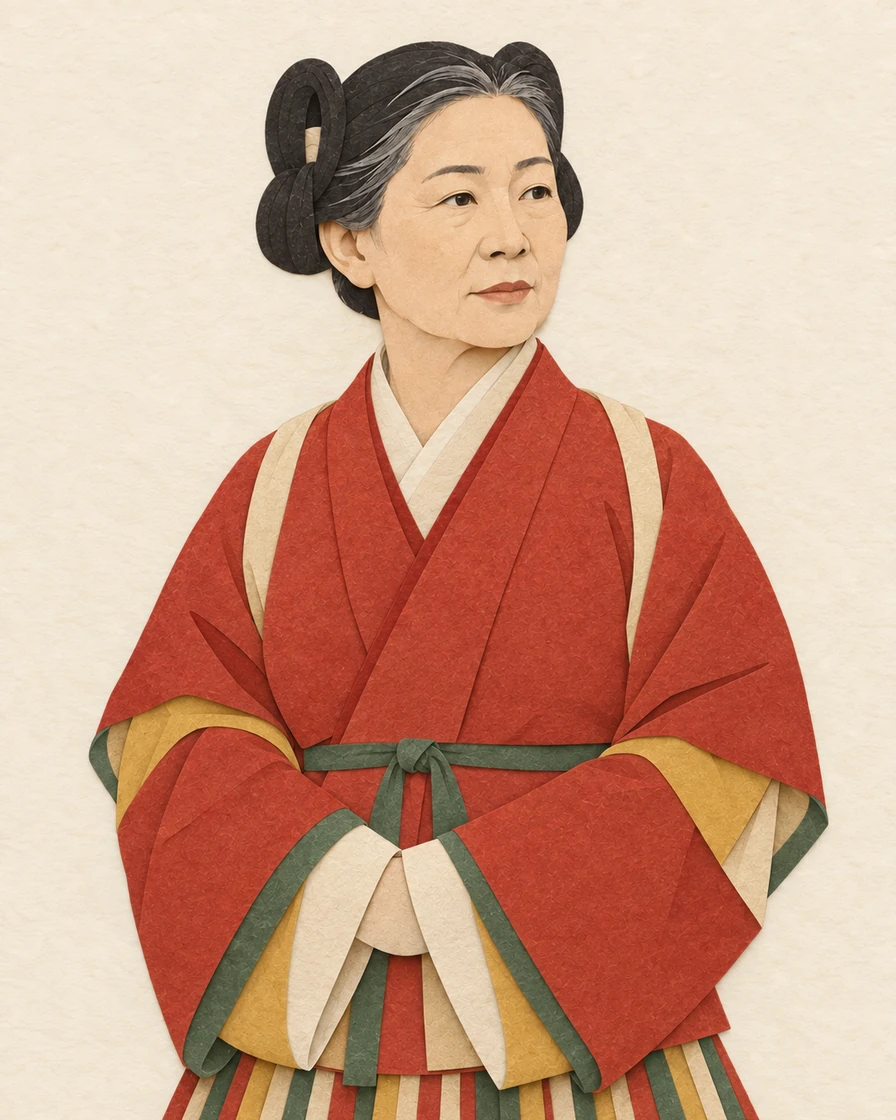
Read the article below. Interactive reading tools are available when scripts load.
Quick
The woman later called Kōgyoku and Saimei was born around 594 and named Takara. Her father was Prince Chinu and her mother Princess Kibihime; the surviving record gives little account of her childhood. An earlier marriage to Prince Takamuku produced a son, Prince Aya, before she became Emperor Jomei’s consort. Her children with Jomei were Naka no Ōe, later Tenji, Princess Hashihito, and Ōama, later Tenmu. When Jomei died in 641, Takara stood within the royal household as an adult consort and mother, and she took the throne in 642. Her first reign began amid powerful Soga ministers and rival royal lines, so her position cannot be understood simply as waiting for one of her sons to rule. [1][3]
During Kōgyoku’s first reign, Soga no Emishi and his son Iruka held powerful positions in government. The Nihon shoki, a court chronicle completed in 720, credits the empress with prayers at the Minabuchi River’s headwaters during a drought in 642, after other rites had failed. Its claim that rain followed presents successful royal ritual, rather than proving a supernatural cause. In 643, Iruka’s forces attacked Prince Yamashiro no Ōe, a son of Prince Shōtoku, and his household died. Two years later Kōgyoku’s son Naka no Ōe and allies including Nakatomi no Kamatari killed Iruka inside her palace. She was present, but her advance knowledge of the plot is not securely established. She abdicated to her brother Kōtoku immediately afterward. [1][3][4]
After abdicating in 645, the former Empress Kōgyoku received the honorific of royal mother while her brother Kōtoku ruled and her son Naka no Ōe became crown prince. The new court included members of the Soga family as well as the men who had helped defeat Iruka. Retirement therefore kept her close to government rather than removing her from its royal household. In 653 Naka no Ōe left Kōtoku’s court at Naniwa, now Osaka, for Asuka in today’s Nara Prefecture, taking his mother and other royals with him; many officials followed. This movement divided the political center between the reigning sovereign and the departing household. Kōtoku died in 654, and she resumed the throne in 655, the reign later called Saimei. [4][5][1]
When Saimei resumed the throne in 655, a palace fire forced the court to use another residence before a new Okamoto Palace was built in 656. The Nihon shoki links her reign to a canal for moving stone, a walled hill and further building at Asuka and Yoshino. It also preserves criticism of the canal as a mad undertaking that consumed excessive labor. Excavations at the Sakafuneishi site near Asuka have revealed a large stone-built hill and water installations, including a turtle-shaped basin. These remains support a richer interpretation of monumental display and ritual, though the precise ceremonies and full canal route are not proven. Saimei’s building made royal power physically impressive, while its workers bore a cost the celebratory view of kingship could obscure. [5][7][8]
In 658–660 Saimei’s court sent Abe no Hirafu by sea toward northern communities called Emishi and a group called Mishihase in the Nihon shoki. Its accounts combine armed expeditions with feasts, gifts, ranks for local leaders and the taking of captives. A leader associated with Akita received court rank, and northern representatives were entertained at the royal center. These acts could make local authority legible to the court and reward cooperation, while force made refusal dangerous. The sources contain variants and possible duplication, and the identity of the Mishihase remains uncertain. The expeditions therefore show an expanding set of relationships, not proof that Saimei conquered and administered the whole north. [2][5][10]
Prince Arima was the son of Emperor Kōtoku, Saimei’s deceased brother, and thus her nephew. In 658, while she was visiting the hot springs of Kii, he was drawn into a rebellion allegation after discussions with Soga no Akae. The Nihon shoki reports that Akae encouraged criticism of the court’s heavy construction, then helped expose the prince. Arima was arrested, taken to Kii, questioned by Crown Prince Naka no Ōe and executed. The affair removed a member of another royal branch, but its different accounts do not securely establish the whole conspiracy or each ruler’s prior instructions. Saimei’s reign includes this coercive outcome without allowing every charge against the prince to be treated as proven guilt. [4][5][11][14]
In 658 Saimei’s young grandson Prince Takeru died. The Nihon shoki says that she mourned him deeply and preserves songs attributed to her. The songs connect her loss to the place of his temporary burial and to the flowing Asuka River. The chronicle also reports her wish that the child eventually be buried with her and her command that the songs be remembered. This gives a rare personal dimension to the sovereign’s surviving record, with grief carried into court memory through poetry. Some verses in the Manyōshū, an early Japanese poetry collection, have a less certain association with her; these mourning songs have a clearer connection to Takeru’s death. [5][1]
In 660 Tang China and Silla conquered the Korean kingdom of Baekje, but restoration forces continued to fight and asked Saimei’s court for help. Their requests included military supplies and the return of the Baekje prince Buyeo Pung, who was in Japan. Saimei’s recorded response authorized preparations for support. She travelled by sea to northern Kyushu in 661, reaching the Hakata Bay area before moving to Asakura. The voyage placed the sovereign near the maritime base from which the intervention could be supplied and directed. She died there in 661. Her son and crown prince Naka no Ōe continued the effort after her death; its decisive defeat at Baekgang in 663 belongs to the continuing campaign. [5][12][13][2]
Saimei’s body returned to Asuka in 661, but the Nihon shoki places her final burial in 667. It records a joint burial with her daughter Hashihito, the former consort of Saimei’s brother Kōtoku. The monumental Kengoshizuka tomb near Asuka is a leading archaeological candidate for that burial, though no inscription proves the occupants’ names. This probable identification should be distinguished from the traditional official designation of her imperial tomb. Her surviving portrait comes from several kinds of record: court history, poetry associated with mourning and the material remains of royal construction. Read together, they show a sovereign whose public actions and family losses cannot be reduced to her sons’ later reigns. [5][6][1][9][2][7][8][3][4]
Classic
Takara, born around 594, came from the royal family that ruled the Yamato region of central Japan. Her received genealogy names Prince Chinu as her father and Princess Kibihime as her mother; her brother Prince Karu would later rule as Kōtoku. Kōgyoku and Saimei are the later names attached to her two reigns, so they do not identify two successive women. The Nihon shoki, a court chronicle completed in 720, records these relationships but gives no continuous account of Takara’s education. Her adult position is clearer than her childhood. She first married Prince Takamuku and bore Prince Aya, then became the consort of Prince Tamura, who ruled as Jomei. The sources do not provide a secure personal story explaining the change between these marriages. [1][3][4][2]
With Jomei she had three children central to the later political history: Naka no Ōe, Hashihito and Ōama. Naka no Ōe became Emperor Tenji; Ōama became Emperor Tenmu; Hashihito married Takara’s brother Kōtoku. These connections brought a wife, mother and sister into several parts of the ruling household. They also explain why her political role continued when one title gave way to another. Royal succession in this period did not follow a fixed line from the eldest son directly to the throne. Jomei’s family and the line associated with Prince Shōtoku supplied other possible claimants, while the Soga ministers possessed resources that could support or destroy a royal candidate. [1][3][4][5]
Jomei died in 641, and Takara took the throne in 642. Her adult status and experience within the royal household gave the court a ruler without immediately settling succession upon either of her sons. It is possible to see this as postponing a contest among male princes, but that interpretation does not exhaust her role. The record that follows attributes public religious acts to her, locates a major coup in her presence and then gives her a second reign after retirement. Her career therefore begins with an important distinction: belonging to a dynastic family supplied her position, but what she did with that position has to be traced through the events themselves. [1][3][4][5]
Kōgyoku began ruling in 642 with Soga no Emishi as a senior minister and Emishi’s son Iruka exercising increasing authority. Here Emishi is one man’s name; it should not be confused with the same English spelling used for northern communities in accounts of her later reign. The court depended on powerful family houses, and the throne operated among them rather than above a fully developed impersonal administration. That dependence did not remove the empress’s own public responsibilities. A drought in 642 brought competing approaches to securing rain: the chronicle describes offerings, Buddhist ritual promoted by Emishi and, finally, Kōgyoku’s prayers at the Minabuchi River’s headwaters. It reports that prolonged rain followed her act and that people praised her virtue. The sequence makes the ruler’s ritual effectiveness part of the political story, although its account cannot demonstrate that her prayers caused the weather to change. [1][3][5][4]
In 643 Kōgyoku moved to the Itabuki Palace at Asuka. Later that year Iruka attacked the household of Prince Yamashiro no Ōe at Ikaruga. Yamashiro was a son of Prince Shōtoku and belonged to a royal line that could compete with Jomei’s descendants. According to the chronicle, Yamashiro escaped temporarily before returning, and he and his family died after the assault. The account’s speeches present their deaths in moral terms, but those reconstructed words are not a transcript from the siege. The destruction mattered because it removed a royal household, not simply because it made Iruka seem wicked in a later narrative. It occurred under Kōgyoku’s sovereignty, yet the surviving account does not establish that she directed the attack. [1][3]
In the sixth month of 645, Naka no Ōe and a coalition including Nakatomi no Kamatari arranged the killing of Iruka during a palace ceremony. The plot required armed participants, control of entrances and coordinated action inside a space where the empress sat.
What did Kōgyoku know about the coup?
Iruka was attacked in her presence, and the narrative has her withdraw into the interior of the palace.
Her presence does not prove consent, surprise or advance knowledge: the chronicle supplies a staged exchange of words, not direct access to her private intentions. [3]
The attack was followed by the collapse of Emishi and Iruka’s branch of the Soga house. Other Soga relatives remained important in the new government. Kōgyoku’s abdication to her brother Prince Karu, now Kōtoku, was a further political act after the killing, not another name for the assassination itself. The throne survived the destruction of its leading ministers, and the former empress remained available within the royal household for what followed. [3][4][5]
The settlement of 645 gave the former Kōgyoku an honored place under Kōtoku, her younger brother. The Nihon shoki honors her as the royal mother and records Naka no Ōe’s appointment as crown prince. Her place was defined by the ruling household, with her son positioned near the center of government. Soon after the change, the new emperor, the former empress and the crown prince jointly summoned ministers for an oath. The text expresses a demand for loyal service to the sovereign after the removal of the men it brands traitors. As a declaration in a later court history it also presents the new arrangement as legitimate, rather than preserving an impartial judgment of the defeated. [4]
Government after the coup was broader than a simple contest between a royal family and every member of the Soga clan. Abe no Uchimaro and Soga no Ishikawamaro received leading ministerial appointments, and Kamatari gained an influential advisory position. Takara’s daughter Hashihito became Kōtoku’s consort. These offices and marriages bound the former sovereign to the new court through several relationships at once. The reforms associated with this government are often gathered under the name Taika, but Takara’s presence does not establish that she personally designed each measure. Her continuing importance can be followed more securely in the movement of the royal household. [4]
In 653 Naka no Ōe asked Kōtoku to move the royal residence from Naniwa, in the area of present-day Osaka, back to Yamato. Kōtoku refused. The prince nevertheless departed for Asuka with his mother, Hashihito and younger royal relatives; ministers and other officials followed them. The chronicle describes Kōtoku’s resentment at being left behind. Whatever private discussions preceded the move, residence now revealed a division in allegiance: many of the people needed to operate the court lived away from its reigning sovereign. Takara was central to the departing group, although the record does not specify an independently documented plan that she imposed on all its members. [4]
The royal group returned to Naniwa when Kōtoku became ill in 654, and he died there that year. Naka no Ōe then returned to Yamato with his mother. In 655 she resumed the throne at Asuka, becoming the ruler remembered as Saimei. This is the first recorded return to the throne within the received sequence of Japanese sovereigns. Naka no Ōe remained crown prince and a major participant in government rather than immediately taking the throne himself. Her renewed rule gave the reunited political center an experienced sovereign, while leaving the exact balance between mother and son difficult to reduce to one person’s command. [4][1][5][2]
Saimei’s second reign began in 655 with the court at Asuka, but its residences were not permanently secure. The Itabuki Palace burned that year, and she moved to the Kawara Palace before a new Okamoto residence was established in 656. The chronicle places further large works in the same year: a canal for transporting stone, a hill enclosed by stonework and another palace at Yoshino. The projects required the mobilization of labor and the movement of heavy material, giving a concrete form to the court’s ability to command resources. Their visibility was part of their importance. A royal center furnished with elaborate buildings, worked stone and controlled water could distinguish itself from the households through which much political power still operated. [5][8][4]
The Sakafuneishi site, east of the palace area, provides physical evidence for substantial construction around this political center. Excavation has revealed a terraced hill faced with stone and a northern water precinct containing shaped stone basins, paving and drains. The best-known basin is shaped like a turtle, with water moving through a carefully arranged installation. Nara Prefecture’s account relates the craftsmanship and auspicious turtle form to continental influences, while interpreting the setting as a place of ritual. Archaeologist Aihara Yoshiyuki emphasizes the stone hill’s monumental display rather than a straightforward defensive function. That interpretation changes the question from how strong a fortress was to what spectators and participants would have encountered at a royal site. It does not identify a single securely documented ceremony or prove that every surviving feature was made for Saimei herself. The precinct was altered and used beyond her lifetime, so its excavated form is also the product of later activity. [7][8]
The canal’s exact course is more difficult to establish than the existence of the stone and water works. Aihara’s abstract proposes relationships among the site, surrounding waterways and the canal described by the chronicle. Such reconstruction joins archaeological observations to a written account; it should not be mistaken for the excavation of an intact canal along its entire reported route. The written account is strikingly critical. It preserves the label “mad canal” and complaints involving tens of thousands of workers, wasted effort and timber left to decay. Those numbers belong to a narrative of grievance, not a verified modern count of individual laborers. Even so, the complaint points to a material cost of the court’s ambition: a project impressive at the center could also be remembered by the work it extracted. [5][8]
Burdened labour and monumental display
Saimei’s building has consequently left two different kinds of evidence. The chronicle transmits judgments about excessive labor, while excavation reveals facilities whose scale and arrangement suggest display and ritual as well as practical handling of water.
Neither requires a portrait of an irrational woman building without purpose, and neither establishes a complete architectural plan conceived in her private mind. The more secure conclusion is that her reign expanded the physical means through which the royal court assembled people, presented itself and used resources. The benefits of that expansion and the burdens of constructing it belonged to different participants in the same undertaking. [5][7][8]
While construction and palace affairs continued at Asuka, Saimei’s court also reached toward the northern coasts. The Nihon shoki describes the commander Abe no Hirafu leading fleets in 658–660, encountering communities around Akita, Nushiro and Tsugaru. These names locate the narrative along the northern part of the Sea of Japan coast and toward the northern end of Honshu. The term Emishi groups people as the court understood them; it does not establish that all the communities formed one unified political body. The account also mentions Mishihase, whose identity and precise relationship to those communities are uncertain. The names do not establish a single population whose territory was conquered in these voyages. [5][10]
The recorded encounters involved negotiation and ceremony as well as weapons. In the 658 account, a leader associated with Akita came forward, gave an explanation of his people’s conduct and received a court rank. Other local leaders were recognized, northern guests were fed at court and gifts included objects expressing military and political status. A court rank could acknowledge a leader while connecting his authority to the distant royal center. A feast supplied a visible setting for that relationship: participants arrived as named groups and were received in an order the court could record. The people involved therefore appear as more than the passive destination of an expedition, even though their explanations survive through the court’s account. Their own interests cannot be recovered simply by repeating the chronicle’s language of submission. [5][10]
Armed force remained part of these relations. The same record reports fighting and captives, and it distinguishes groups that were entertained from groups attacked. Recognition and gifts thus belonged to a system with unequal power and the possibility of violence. At the center, some northern guests were associated with elaborate receptions near models of Mount Sumeru, the cosmic mountain of Buddhist tradition. These spectacles placed people from beyond the court’s immediate region within its ceremonial world. The display could be grand without making the frontier stable or erasing the differences among the groups who appeared there. [5][10]
How far did the northern voyages reach?
The expedition accounts cannot be combined into a confident itinerary merely by adding every listed ship, battle and delegation. Historian Kumagai Kimio’s study begins by emphasizing problems within the chronicle’s descriptions, including regions not fully controlled even in the later Nara period. The surviving versions may repeat or rearrange events, and their geographical terms remain difficult to place precisely.
This limits claims about how far each voyage went and how lasting its results were. The firmer historical contribution of Saimei’s reign is the combination of maritime force, recognition of local leaders and ceremonial reception that the record brings into view. It shows the court trying to extend relationships across distance, with cooperation and coercion both present. [5][10]
Prince Arima belonged to Saimei’s own family. His father was Kōtoku, the brother to whom she had abdicated in 645, and his mother was a consort from the Abe house. After Kōtoku’s death in 654, Arima remained a royal son from a different branch of the household from Saimei’s children with Jomei. That position made his treatment politically consequential without proving that he had a settled plan to seize the throne. In 658 Saimei travelled to the hot springs of Kii, on the peninsula south of Asuka. The prince remained near Asuka when the episode began. [4][5][11][1]
The competing accounts of Arima’s alleged plot
The chronicle has Soga no Akae approach Arima with complaints against the court. These included the accumulation of resources and the large canal and stone works. Akae appears as a provocateur: he encouraged a discontented discussion, then took part in exposing the prince. The written tradition also gives alternative versions containing plans for armed action. Their existence matters because the episode was transmitted through competing narrative details, rather than one independently corroborated record of a conspiracy.
A charge of rebellion supplies the court’s stated ground for punishment, but a historian cannot use that charge alone as proof that every reported plan was Arima’s actual intention. [5][11][14]
In the main narrative, workers associated with palace construction surrounded Arima’s residence and arrested him. Messengers carried news to Saimei, and the prince was sent to Kii. There Naka no Ōe, her son and crown prince, questioned him before his execution. The chronicle gives Arima a compact answer pointing to Heaven and Akae, but this attributed speech is part of the later narrative, not a verified transcript. Arima was killed at Fujishiro, and other participants were killed or exiled. The immediate consequence was the removal of Kōtoku’s son and the punishment of people linked to the affair. The palace labor force that had served building appears here as a means of coercion, though the episode does not show how every worker had been commanded. [5][14]
Responsibility for Arima’s death
The surviving sequence makes Naka no Ōe an active participant in the interrogation and places the affair within Saimei’s governing court. It does not independently establish an advance order by Saimei to manufacture the accusation, nor does it prove that Akae acted without support. Modern accounts consequently ask about the political responsibility of Akae and the crown prince.
The record leaves unanswered how prior instructions passed among the prince, Akae and the empress. [5][11][14]
For Saimei’s life, the secure result is severe enough: her second reign included a royal nephew’s death through the court’s machinery of accusation and punishment. Royal kinship had supplied her enduring position, but it offered no general protection to all members of the same family. [5][11][4][14]
Prince Takeru, a grandson of Saimei, died in 658 while she was ruling for the second time. The Nihon shoki gives his age as eight and places his remains in a temporary burial in the Imaki valley. Its account says the empress had valued the child and describes her grief. The words about her feelings come through a court history compiled later; the more concrete surviving form of the loss is the set of songs it attributes to her. The songs return to the hill and valley associated with the burial and to the movement of the Asuka River. Those places give the mourning a local setting within the landscape occupied by the royal household. [5][1]
The chronicle also gives Saimei a wish that Takeru be buried with her after her own death. This joined the grandmother’s future burial to the child’s death in the recorded story, although a wish in the text does not by itself establish the exact archaeological location of his remains. It then reports that she wanted the songs passed on and remembered. Mourning therefore appears as more than a feeling described by a narrator: the source associates it with poetry, burial and a command to preserve words. The empress’s relationship to the child entered the political community’s memory rather than surviving only as an unnamed family sorrow. [5][9][1]
Which poems can be assigned to Saimei?
Poetic attribution requires care because not every verse associated with an “Okamoto sovereign” can confidently be assigned to Saimei.
Literary historian Sakashita Keihachi notes that some Manyōshū poems may instead belong to Jomei, whose residence also carried the Okamoto name. The mourning poems in the Nihon shoki provide a more specific connection to Takeru’s death. [1][5]
They preserve Saimei’s mourning alongside the palace projects, succession disputes and military decisions of her reign. A royal life could involve commands that burdened others and a loss for which the record preserves no remedy, only words and arrangements for remembrance. [1][5]
The crisis that drew Saimei to Kyushu began across the sea. In 660 the armies of Tang China and the Korean kingdom of Silla defeated Baekje, another Korean kingdom, and captured its king, but surviving Baekje forces organized a restoration movement. Leaders including Boksin and the monk Dochim gathered resistance and sought help from the court in Japan. This was a Korean attempt to restore a fallen kingdom, with Japanese support entering its struggle rather than creating all of its purposes. The Nihon shoki transmits urgent requests for weapons and for the return of Prince Buyeo Pung, a member of Baekje’s royal family then living in Japan. A prince could supply a dynastic center for restoration, while weapons and shipping addressed the immediate material needs of continued war. The court chronicle praises the restoration cause in expansive language; that praise is part of its perspective, not independent proof of every reported military success. [5][12]
Saimei’s response is one of the clearest decisions attributed to her in the surviving narrative. The text has her order the appointment of commanders and the preparation of necessary supplies, while agreeing to the prince’s return. The ceremonial language surrounding the order presents assistance as royal generosity. Its practical content required men, ships, equipment and coordination across a considerable distance. At the end of 660 the court prepared to move west, and ships were ordered from Suruga. The request for Pung’s return and his actual departure should be kept distinct: Korean historical accounts place his return in 661, as the restoration effort continued. Saimei’s commitment began the mobilization, but a single order did not settle how the campaign would unfold. [5][13][12]
Early in 661 Saimei sailed west through the Inland Sea with the royal party. The route included a stop in Iyo before the party reached northern Kyushu. The chronicle places her at Iwase in the Hakata Bay area and records the residence’s new name, Nagatsu. This coast had long served as a point of contact with the continent and a place for gathering resources for overseas expeditions. Moving the sovereign there brought royal authority close to the ports and routes on which support for Baekje depended.
Where was Nagatsu Palace?
The precise site of Nagatsu remains disputed; archaeological signs of international contact around the bay do not by themselves identify one surviving building as her residence. [13]
She later moved inland to Asakura, the palace associated with the final months of her life. [5][13][2]
Saimei died at Asakura on the twenty-fourth day of the seventh month in 661, using the chronicle’s calendar.
The story surrounding Saimei’s death
The record surrounds the palace with stories about trees cut for construction, offended deities and deaths among its people.
These explain the place through a narrative of violated sacred surroundings; they do not establish a medical cause for her death or prove a supernatural attack. [5]
Her body was returned by sea and temporarily placed at Asuka later that year. Naka no Ōe continued directing the intervention, and in 663 the restoration forces and their Japanese allies suffered a decisive defeat at Baekgang. The later defeat gives Saimei’s decision consequences she never witnessed, but it should not be used to make her original commitment appear destined to fail. Her final journey ended a life of repeated returns to the political center by carrying that center toward an unresolved war. [5][12][13][4]
Saimei’s death in 661 did not immediately lead to final burial. The chronicle describes the return of her body by sea, its arrival near the political center and temporary interment at Asuka. Its account then places her joint burial with Princess Hashihito in the second month of 667. Hashihito was Saimei’s daughter and had been the consort of Kōtoku, Saimei’s brother. The funeral thus joined two women whose relationships crossed the royal households involved in the succession of 645 and the court’s later division. The account provides an ending within dynastic history, while the interval between death and burial reminds the reader that royal funerals involved a sequence of arrangements. [5][6][1][4]
Is Kengoshizuka Saimei’s joint burial?
Modern archaeology approaches the burial through material evidence of a different kind. Kengoshizuka, near Asuka, has an unusually monumental chamber with paired burial spaces and a late-seventh-century setting. Its octagonal form, recognized through excavation, strengthens comparison with high-ranking royal tombs. Asuka Village presents Saimei and Hashihito as a leading identification, alongside the history of other proposals. The pairing and date make that interpretation plausible, but they do not amount to a name-bearing inscription.
It should therefore remain a probable archaeological identification, distinguished from the traditional tomb officially assigned to Saimei elsewhere. A written funeral account and an excavated chamber can illuminate each other without becoming the same evidence. [9][6][2]
The surviving Saimei is shaped by a court chronicle that presents royal ritual, condemns burdensome construction, records coercion and preserves mourning poetry. Archaeology adds buildings and water installations that are not exhausted by the chronicle’s moral judgments. Her sons’ later careers supply further dynastic consequence, but her own life ended before the Baekgang defeat and before either son’s formal reign. She had already ruled, retired and ruled again; received distant groups; mobilized work; lost a grandson; and committed the court to an overseas struggle. These actions leave a historical person with consequential authority and limits, rather than merely the mother standing at the entrance to other people’s biographies. [3][5][7][8][1][12][4][2]