Read the article below. Interactive reading tools are available when scripts load.
Quick
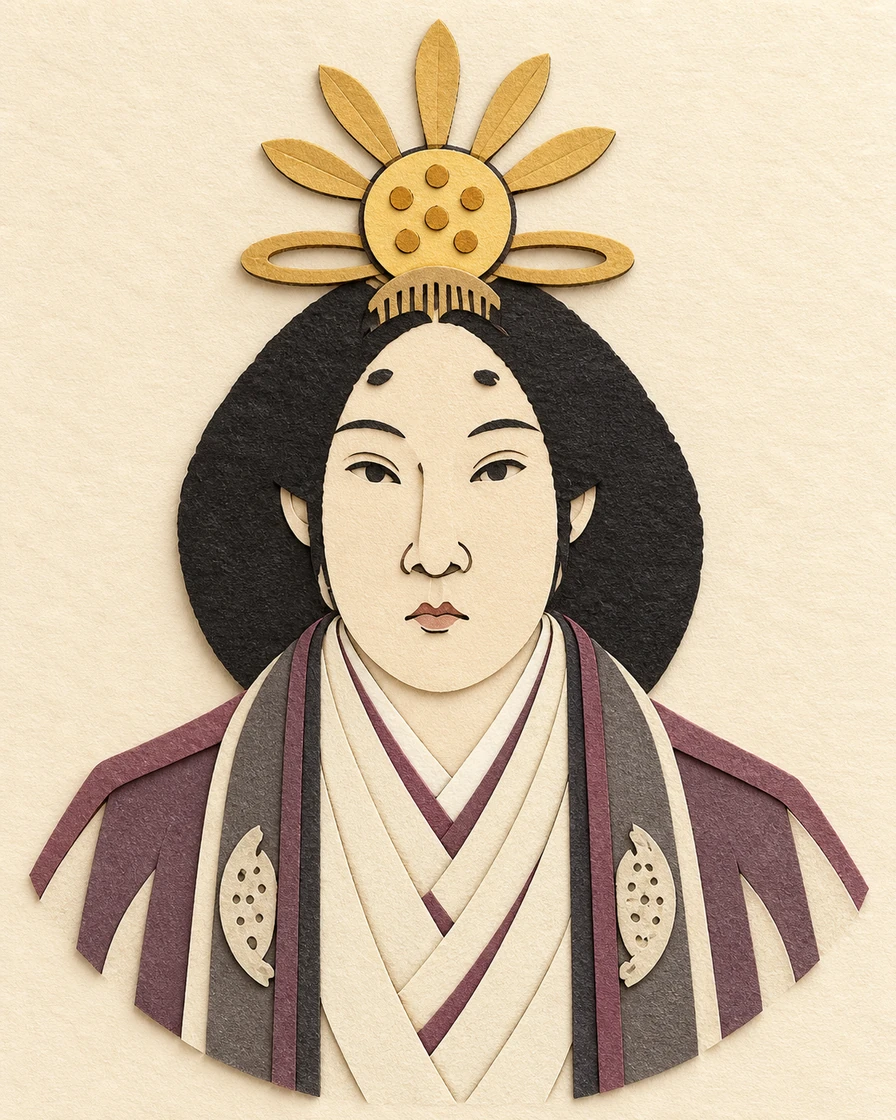
Genmei was born in 661 as Princess Abe, a daughter of Emperor Tenji. She married Prince Kusakabe, whose parents were Emperor Tenmu and Empress Jitō. Their children included Princess Hidaka, later Empress Genshō, and Prince Karu, later Emperor Monmu. Kusakabe died in 689 before becoming emperor, interrupting the expected succession through him. Jitō subsequently protected Karu’s position and abdicated to him in 697. Abe was now the mother of the reigning sovereign, although she had not yet taken the throne. The family’s succession would change again when Monmu died. [1][2][16]
When Emperor Monmu became seriously ill, his mother Princess Abe initially declined his proposal that she take the throne. His death in 707 changed the situation: his son Obito was still too young to succeed, and Abe became Empress Genmei. She ruled in her own name from 707 to 715. Her accession proclamation invoked an unchanging principle attributed to Emperor Tenji. Scholars disagree about its meaning and whether it was an actual earlier enactment or a later attribution. The proclamation used inherited authority to justify a succession from a son to his mother. Genmei took responsibility for government as the court’s administrative projects continued. [1][2][15][3]
Empress Genmei ordered a new capital in 708 and moved the court to Heijō-kyō in 710. The site, in present-day Nara, lay north of Fujiwara and was organized around a street grid and a palace at its northern edge. Its principal avenue linked the southern city entrance with the palace approach. The move did not mean that construction was finished; building continued after the court arrived. Provincial offices mobilized laborers and tax supplies fed them. In 711 the later chronicle Shoku Nihongi records exhausted construction workers fleeing in large numbers despite prohibitions. The new center of government therefore depended on people whose burdens were not erased by the capital’s imposing design. [4][5]
Wadō kaichin coins were issued in 708 during Empress Genmei’s reign. They followed earlier Japanese coin production, including Fuhonsen, and drew on a Tang Chinese coin model. The court sought uses for the new money: part of officials’ pay was made in coins, and workers received coin payments during capital construction. A policy introduced in 711 offered advancement in rank for remitting specified amounts of coins to the government. It was an incentive tied to status, not merely an instruction to hoard money at home. The surviving evidence does not show how extensively the policy was applied. Coinage extended the court’s methods of payment and reward without immediately replacing all taxes or exchange in goods. [6][7][8]
Empress Genmei commissioned Ōno Yasumaro in 711 to put royal traditions into written form; he presented the three-volume Kojiki in 712. Its preface traces the undertaking to Emperor Tenmu and to material memorized by Hieda no Are. This is the work’s received account of its own origins, not independent confirmation of every stage. Yasumaro used Chinese characters both for meaning and for sound to represent Japanese material. The resulting work joins divine origins, royal genealogies and accounts of earlier reigns. Modern interpretations emphasize political genealogy, court education or entertainment in different combinations. Genmei’s commission gave these traditions a particular written form that survived far beyond her reign. [9][10]
In 713 Empress Genmei’s government ordered provinces to report on five kinds of information. The request covered suitable written names for places, resources, the quality of land, the origins of place names and traditions told by local elders. It joined administrative description with stories attached to particular landscapes. Officials probably gathered material through districts before governors organized provincial reports, although that sequence is a modern reconstruction. The surviving works are now called fudoki, a collective name used later. Only five provincial works survive to differing degrees; Izumo’s is conventionally considered complete and dated to 733. The order began a recording process whose surviving results extend beyond Genmei’s reign and lifetime. [11]
Prince Obito, the grandson of Empress Genmei, became crown prince in 714. The following year Genmei abdicated, but the throne passed to her adult daughter Princess Hidaka rather than directly to him. Hidaka became Empress Genshō and ruled until 724. Genmei retained the standing of a retired sovereign. The succession kept the family of Kusakabe and Monmu close to imperial authority while placing government in another reigning woman’s hands. Obito’s later accession as Emperor Shōmu belongs to 724, after Genmei’s death. Crown prince, reigning empress and retired empress were different positions, even when held within one closely connected family. [15][1][2]
Genmei remained a retired empress until her death in 721. After Fujiwara no Fuhito died in 720, she and Empress Genshō directed Prince Nagaya to construct Kōfuku-ji’s North Round Hall for his first anniversary. During her own final illness, Genmei entrusted advisory responsibilities to Fuhito’s son Fusasaki and Prince Nagaya, and gave security instructions. She also ordered a restrained funeral, rejecting elaborate decorated vehicles and directing that the burial hillside should not be reshaped. She was cremated and buried on the eastern Naho hills. The surviving directions show decisions about court business and bodily remains, without revealing every private reason for them. Her death ended her participation; the capital and records she had commissioned continued through others. [1][13][12][9][11][14]
Classic
The woman remembered as Genmei was born in 661 and originally called Princess Abe. Her father was Emperor Tenji, and her mother was Meino Iratsume, a daughter of Soga no Ishikawamaro. She therefore belonged to the royal family through her father and to an important court lineage through her mother. Her husband, Prince Kusakabe, was the son of Emperor Tenmu and the future Empress Jitō. Jitō was also Abe’s paternal half-sister, making the marriage part of a closely connected royal household. The relationships placed Abe near the expected succession while giving her no immediate sovereign office of her own. Her children included Hidaka, Karu and Princess Kibi. The later imperial names of Hidaka and Karu belong to subsequent stages of their lives. [1][2][16]
Kusakabe died in 689 without becoming emperor. For Abe, his death meant widowhood and the loss of the man through whom the family’s immediate claim to the throne had been expected to pass. Their son Karu, born in 683, was still young. His grandmother Jitō governed and worked to establish him as her successor. She made him crown prince in 697 and abdicated later that year. Karu became Emperor Monmu, while Jitō continued to assist his government as a retired sovereign until her death in 702. Succession thus required decisions about a living child and the continued authority of an older ruler. A blood relationship could establish a claim, but it did not put its holder on the throne without political action. [2][16]
Abe’s position changed when her son became emperor. She remained a royal woman and Monmu’s mother, with family connections reaching back to both Tenji and Tenmu. Monmu took Fujiwara no Miyako, the daughter of Fujiwara no Fuhito, as a consort. Their son Obito was born in 701. The child joined the royal descent through Kusakabe and Monmu with Fuhito’s increasingly influential household. Monmu’s reign also produced the Taihō legal codes, completed in 701 and put into effect across 701–702. These codes organized government through laws, offices and obligations modeled in part on continental institutions. Abe’s family was now connected with an administration whose work would continue across another unexpected change of ruler. The decisive change came when Monmu’s health failed. [1][16][15][2]
Monmu’s illness brought Princess Abe to a decision she had not faced during his healthy reign. In 706 he proposed yielding the throne to her, but she refused. That refusal belongs to a situation in which he was still alive; his death in 707 created a different succession problem. Obito, his son by Fujiwara no Miyako, had been born in 701 and remained a child. Abe then accepted the throne and is known as Empress Genmei. Her accession maintained the line of Kusakabe and Monmu through a sovereign who was simultaneously the deceased emperor’s mother and the young prince’s grandmother. She held the imperial office herself rather than acting simply as a regent for a boy already enthroned. The distinction matters because authority and responsibility belonged to the reigning woman. [1][2][15]
Historical disagreement · What was Genmei’s “unchanging norm”?
The accession proclamation appealed to a principle called the unchanging norm and attributed it to Emperor Tenji. Tenji was Genmei’s father, so the appeal joined a remembered royal authority with her own place in the dynasty. Its legal content is uncertain. One interpretation connects it with succession within a direct dynastic line. Other readings emphasize the sovereign’s authority to designate a successor, a broader legal order, or cooperation across generations. Kadowaki Teiji discusses arrangements involving mother and child or grandmother and grandchild rather than an exclusively father-to-son sequence. Scholars also dispute whether the proclamation referred to an actual rule made under Tenji or projected authority backward onto him.
The words helped legitimate Genmei’s accession, but the surviving formula does not settle every later question about imperial inheritance. [2][3][1]
Genmei’s accession also occurred within a court whose leading officials and royal relatives had practical interests in continuity. Fujiwara no Fuhito was the maternal grandfather of Prince Obito and a major participant in the legal and administrative work of Monmu’s reign. Mayuzumi Hiromichi interprets Fuhito’s support as important to Genmei’s succession. This connects her rule with an influential official’s family and work, without making him the sole author of her decisions. The new sovereign inherited an operating government, including the recently implemented Taihō codes. Its officials, records and obligations did not need to be created anew at every accession. At the same time, a new ruler could commission projects that changed where and how that government operated. Genmei’s reign would soon produce decisions about a capital and a new issue of coins. The succession crisis became the beginning of sustained sovereign work. [1][2][16][15][6]
Genmei’s decision to move the court took shape in 708, when a decree ordered the new capital. The actual relocation followed in 710. Heijō-kyō lay about twenty-seven kilometers north of the previous capital at Fujiwara. Its planned urban area measured roughly 4.8 kilometers from north to south and 4.3 from east to west, with an additional district extending eastward. A street grid divided the city, while the palace occupied its northern side. Suzaku Avenue ran from the city’s southern entrance toward the palace’s southern gate. The arrangement made the approach to royal government part of the city’s physical organization. The palace was an administrative and ceremonial center, rather than simply the sovereign’s private residence. [4][1][14][17]
The early western ceremonial compound contained a great audience hall and a court used for enthronements, New Year ceremonies and receptions of foreign envoys. These activities placed imperial authority before assembled officials and visitors. Nara Prefecture’s historical account identifies Fuhito as a probable leading planner, while presenting the attribution as an inference. The undertaking depended on many offices and workers beyond any individual official. Archaeological research shows that construction continued after the move in 710. Relocating the court and finishing its buildings were therefore separate stages. Government could operate in a capital that remained a substantial building site. The visible order of a planned city was created through work spread over time. It required continuing supplies and labor rather than a decree alone. [14][4][5]
Provincial offices compelled people to provide construction labor. Rice and salt drawn from tax obligations helped feed the workers. These arrangements connected the palace project with households outside the capital. The Shoku Nihongi, compiled later in the eighth century, records in 711 that workers exhausted by palace construction escaped in large numbers despite prohibitions. Nabunken quotes the passage in explaining the demands of palace construction. It nevertheless records a conflict between the government’s demand for labor and the ability or willingness of workers to remain. Flight interrupted the cooperation that monumental building required. The capital’s creation thus contains a history of burden alongside its history of royal planning. Coin payments would become another means of supporting some of the work carried out there. [5][7]
The issue of Wadō kaichin in 708 is often associated with the opening of Japan’s coinage history. Earlier coins make that opening more complicated. Fuhonsen had been cast in the late seventh century; finds at the Asukaike site included coins and production materials. Wadō kaichin was therefore a new state issue after earlier Japanese casting, rather than the first money ever produced in Japan. Its model was the Tang dynasty’s Kaiyuan tongbao. Adopting a continental coin form expressed participation in a world where rulers used inscribed currency as a sign and instrument of authority. For Genmei’s government, however, producing coins was only part of the task. People also needed occasions to receive and spend them. [6][7]
The court created such occasions through payments connected with government work. In 711 part of officials’ remuneration was paid in coins. During the winter of 712, a recorded arrangement paid an adult male construction worker one coin per day. The government also arranged opportunities for workers to buy food in markets. Payment and food purchase linked a new monetary medium with the practical needs of the capital project. Compulsory labor and supplies in kind continued alongside these arrangements. Receiving coins did not make all palace work voluntary or turn every tax obligation into a cash payment. Some tax commutation and some salaries used money, while other obligations retained older forms. The change was a developing combination of methods rather than an immediate transformation of the whole economy. [7][5]
Rank for coins: purpose and documented results
Another policy connected coins with advancement in the court’s rank system. Introduced in the tenth traditional month of 711, it offered rank for remitting specified sums to the government. A subsequent extension included people without an existing rank. The crucial action was handing coins over, not simply accumulating a private hoard. The policy made recognized status an inducement to gather and remit money.
Sakaehara Towao notes a recorded grant in 711 but treats the extent of implementation as unclear. That boundary leaves room between the government’s announced purpose and the results actually recoverable from surviving records. Simplified accounts of universal hoarding followed by straightforward failure compress this uncertainty. [8]
Genmei’s coin policies show a court trying several routes from minting to use: payment, purchase, tax arrangements and the attraction of rank. They expanded the instruments available to government without proving that its monetary ambitions were fully realized. [8][6][7]
In 711 Empress Genmei ordered Ōno Yasumaro to compile material that became the Kojiki, or Record of Ancient Matters. He presented three volumes in 712. The preface records both the command and the presentation with traditional calendar dates. Yasumaro describes a project first contemplated under Emperor Tenmu. Its purpose in that account was to correct and establish genealogies and royal traditions considered disordered or mistaken. Tenmu had directed Hieda no Are to memorize the material, but the work did not reach completion during his reign. Genmei’s commission supplied a later occasion for putting it into writing. The preface is an essential source for this history and also a formal statement praising the ruler under whom the work was presented. [9]
The account of Are’s memorization comes through that received preface. Are preserved material that, in the preface’s account, Yasumaro would arrange in writing. Writing itself involved choices. Yasumaro explains that Chinese characters could be used for their meanings or for their sounds, and that neither method alone was always satisfactory. A wholly semantic rendering could obscure Japanese expression, while phonetic writing could become cumbersome. The compilation therefore mixed methods and sometimes added explanation. The written record was shaped through these decisions, rather than being a transparent transfer of spoken tradition onto a page. Its three volumes extend from divine origins to earlier sovereigns, ending with the reign of Suiko. [9][10]
Historical disagreement · Who was the Kojiki written for?
The Kojiki connected royal descent with stories of divine and human beginnings. That structure made genealogy a way of locating the ruling house within a larger account of the world. Scholars differ over how strongly to emphasize political legitimation, instruction or enjoyment within the court. Taniguchi Masahiro discusses education and entertainment alongside the more familiar explanation centered on royal genealogy.
These purposes need not be mutually exclusive, but the surviving work does not establish one exclusive original audience or intention beyond dispute. [9][10]
Its linguistic form also differs from the more regular Chinese prose of the Nihon Shoki, presented under the next reign. Genmei’s commission created one influential royal account, not the only ancient account Japan would possess. Her government’s interest in recording knowledge also extended beyond the royal past. The next major request asked provinces to describe their own places, resources and traditions. [9][10][11]
Genmei’s government issued its provincial reporting order in 713. Its categories combined practical information with local traditions. One category asked for favorable Chinese characters in the names of districts and villages. Others sought information about products, including minerals, plants and animals, and about the quality of agricultural land. The court also wanted explanations of place names and old traditions transmitted by local elders. The categories brought names, economic resources, soils and remembered stories into the same administrative inquiry. A province could therefore appear both as land with usable products and as a landscape already understood through local accounts. The order made those forms of knowledge relevant to the court. [11]
Local traditions had to be collected and presented in a form that could reach central government. The Ibaraki cultural source explains a likely process in which district officials gathered material and provincial governors assembled or edited it. This sequence is a reconstruction of how the work was probably organized, not a complete procedural instruction preserved in the order itself. The order survives more directly than a detailed account of how officials carried it out. Officials stood between local speakers and the resulting written description. Their collection and arrangement could combine practical information with narratives of origins. The reports brought selected local knowledge into a written description for the court. That project broadened the kinds of material the court could ask to have written down. [11]
The works now known as fudoki did not all survive equally. Material remains from Hitachi, Harima, Izumo, Bungo and Hizen, with only Izumo’s account conventionally treated as complete. The surviving Izumo work is dated to 733, twenty years after the original order and twelve years after Genmei’s death. Its date makes clear why the surviving corpus cannot be treated as a set of finished books presented together in 713. The collective label fudoki also belongs to a later stage of reception, with usage traced to the tenth century. Genmei’s contribution was the government’s initiating request, while collection, composition and preservation involved other people across time. The unequal remains place limits on how fully the original project can be reconstructed. They also preserve knowledge that would otherwise be difficult to recover about individual provinces. Recording local worlds became part of the court’s work, even though those worlds reached later readers through incomplete and mediated texts. [11]
In 714 Obito, the son of Emperor Monmu and Fujiwara no Miyako, was designated crown prince. He was Genmei’s grandson through Monmu and Fuhito’s grandson through Miyako. The designation established a recognized position for him within the succession. It did not make him the reigning emperor. When Genmei abdicated in 715, her successor was Princess Hidaka, her daughter by Prince Kusakabe. Hidaka was Monmu’s sister and Obito’s aunt. She took the throne as Empress Genshō and ruled from 715 to 724. The family therefore supplied a reigning empress, a retired empress and a crown prince at the same time. Their close relationship did not erase the differences between those offices. [15][1][2]
What does “bridging sovereign” explain?
Genmei’s abdication transferred sovereign responsibility to another adult woman. Genshō’s reign continued the court’s work while Obito remained the designated heir. Histories often describe both women as bridging sovereigns who preserved the succession until he could rule.
That description identifies a dynastic function, but it can compress the government carried out during their own reigns. Genmei’s capital, coins and documentary commissions had already altered the material and written operation of the court. Those activities were acts of a reigning sovereign, even when succession through Monmu’s son remained important. The transfer to Genshō maintained continuity without making the prince emperor before his actual accession. Obito would become Shōmu in 724, nine years after Genmei’s abdication. [1][2][15][4][6][9][11]
Genmei became a retired sovereign rather than returning simply to an earlier princess’s position. Her standing remained connected with the authority she had exercised on the throne. During her final illness in 721 she still gave instructions concerning advisers and security. Kishi Toshio interprets these acts as evidence that retirement had not emptied her position of practical power. The distinction is important for a court in which present and former sovereigns could remain active together. Jitō’s earlier assistance to Monmu had already provided an example of authority continuing after abdication. Genmei’s retirement belongs to that history of overlapping generations, although the surviving accounts do not establish identical arrangements in every reign. The end of her reign changed her office; it did not immediately end her participation in royal affairs. Her last years would bring both public commemoration and decisions about her own death. [1][16][12][13]
Genmei’s retired years overlapped with the government of her daughter Genshō. Fujiwara no Fuhito, an important official across their reigns, died in 720. Kōfuku-ji’s institutional history records that Genmei and Genshō directed Prince Nagaya to build the North Round Hall for Fuhito’s first death anniversary in 721. The memorial joined the authority of reigning and retired sovereigns with the work of a royal prince. The two empresses and Nagaya made Fuhito’s commemoration a continuing act of court patronage. The hall now standing is a later reconstruction after medieval destruction, not the intact building of 721. Commemoration continued through replacement buildings as well as through transmitted accounts. Genmei herself was approaching the end of her life during the same year. [1][2][13]
During her final illness in 721, Genmei entrusted affairs to Prince Nagaya and Fujiwara no Fusasaki, a son of Fuhito. She also gave directions concerning palace security and access. Kishi reads these instructions as evidence of substantial authority retained after abdication. They locate the retired empress within continuing court business, not solely within a ceremonial memory of her past reign. Her funeral directions addressed a different set of practical responsibilities. She ordered cremation on the eastern Naho hills and specified that her remains should not subsequently be transferred elsewhere. Gold, jade and elaborately painted funeral vehicles were to be excluded. The hillside was not to be cut and reshaped into an imposing burial site. A small cremation kiln, with brush cleared from the immediate area, was to serve the undertaking. [1][12]
These instructions limited what attendants were to build, display and move after her death. Restraint took a practical form in limits on vehicles, construction and the handling of her remains. Genmei died in 721 and was cremated and buried in the eastern Naho hills. Her grandson Obito’s accession as Shōmu came in 724, beyond her lifetime. Provincial recording also continued after her death, as the dated Izumo account of 733 makes clear. The royal past had taken written form in the Kojiki, while Heijō remained a center whose buildings and use would change. Initiation and survival were different achievements, carried by different people. Genmei’s life ended with arrangements for a particular body and hillside, while institutions she had sustained passed into the hands of successors. That distance between a finite life and work continued by others gives her reign much of its historical weight. [12][1][15][11][9][14][13]