Read the article below. Interactive reading tools are available when scripts load.
Quick
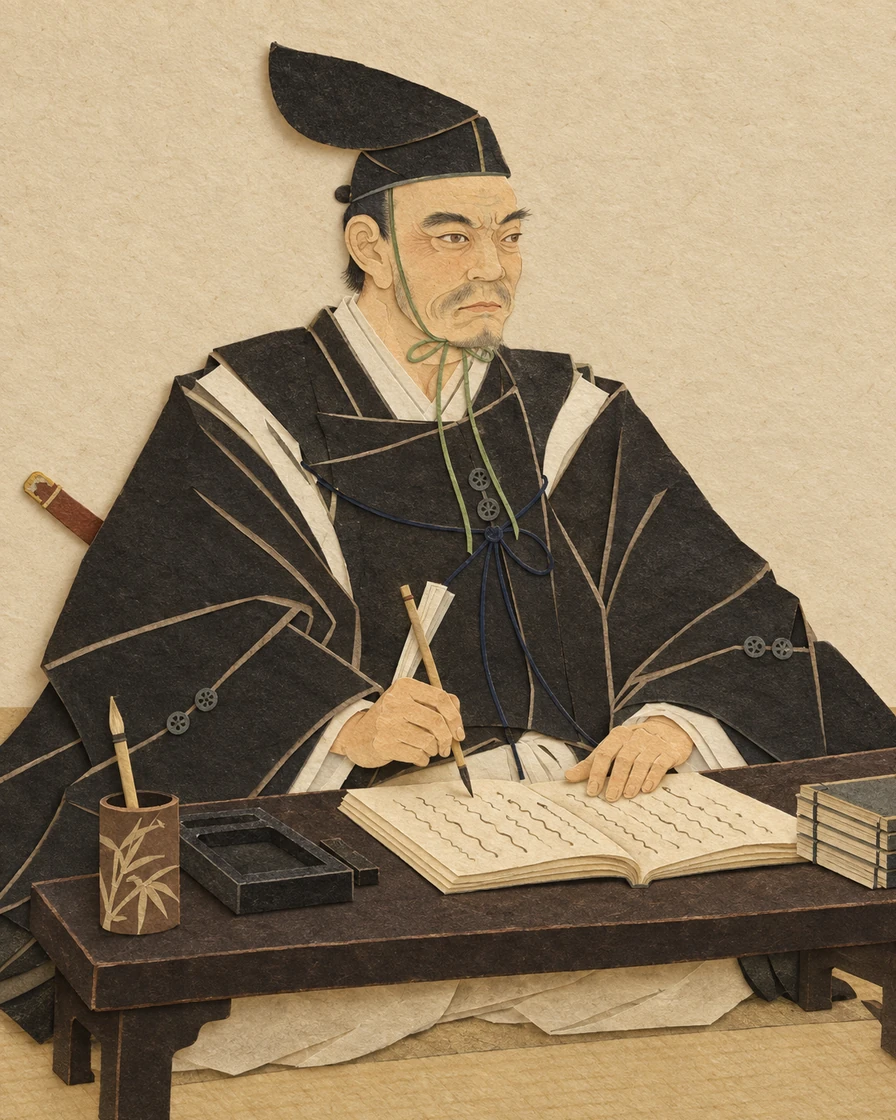
Arai Hakuseki (1657–1725) was born in Edo, now Tokyo, the son of Masanari, a retainer of the Tsuchiya lords of Kururi in present-day Chiba. A household dispute led to father and son being expelled in 1677 and forbidden to enter another lord’s service. The restriction was lifted after the Tsuchiya house ended in 1679. Hakuseki entered Hotta Masatoshi’s service in 1682; Masatoshi was murdered two years later. While still connected to the Hotta house, Hakuseki began studying under Kinoshita Jun’an, a teacher of Confucian texts concerned with conduct and government. He left the household in 1691 and earned a living teaching in Edo. Learning offered another route into service after years of insecure employment. [1][2]
In 1693 Kinoshita Jun’an recommended Hakuseki to Tokugawa Tsunatoyo, lord of Kōfu. Hakuseki taught him Chinese classics and history. The lord became heir to the shogun, head of Japan’s warrior government, in 1704, taking the name Ienobu, and became shogun in 1709. Hakuseki’s scholarship thus moved close to the leadership of the warrior government. His Hankampu, presented in 1702, traced the origins and fortunes of hundreds of warrior houses. He also researched weapons and other subjects. Such work depended on collecting and comparing books, some supplied by his patron. The histories offered examples of service and judgment within a political order whose leading family also supported their author. [1][2][3][14][15]
After Ienobu became shogun in 1709, Hakuseki advised on government alongside Manabe Akifusa, a direct attendant with access to the ruler. Their positions differed: Hakuseki served as a learned lecturer, rather than holding the attendant’s office. His proposals concerned justice, ceremony and public finance. In 1710 the Kan’in imperial-prince house was established for Prince Naohito, a son of Emperor Higashiyama, to help maintain a possible line of imperial succession. Financial examination was strengthened in 1712. Hakuseki received income and court honors, but the title Chikugo no Kami did not make him governor of that province. His influence relied on the ruler’s confidence and on officials carrying decisions into practice. [1][5][12]
The Italian Catholic missionary Giovanni Battista Sidotti landed on Yakushima in 1708 and was taken into custody. In 1709 Hakuseki questioned him at the Christian prison in Edo’s Koishikawa district. The encounter supplied information about places, rulers and religion beyond Japan. Hakuseki recognized a missionary purpose rather than assuming that Sidotti’s presence necessarily demonstrated a plan of territorial conquest, but he continued to criticize Christianity. His Seiyō Kibun brought together the captive’s arrival and interrogation, world geography, and explanations of the faith followed by criticism. A note is dated 1715, although additions continued later. Knowledge expanded through questioning under confinement; the Christian prohibition remained in force. [8][9]
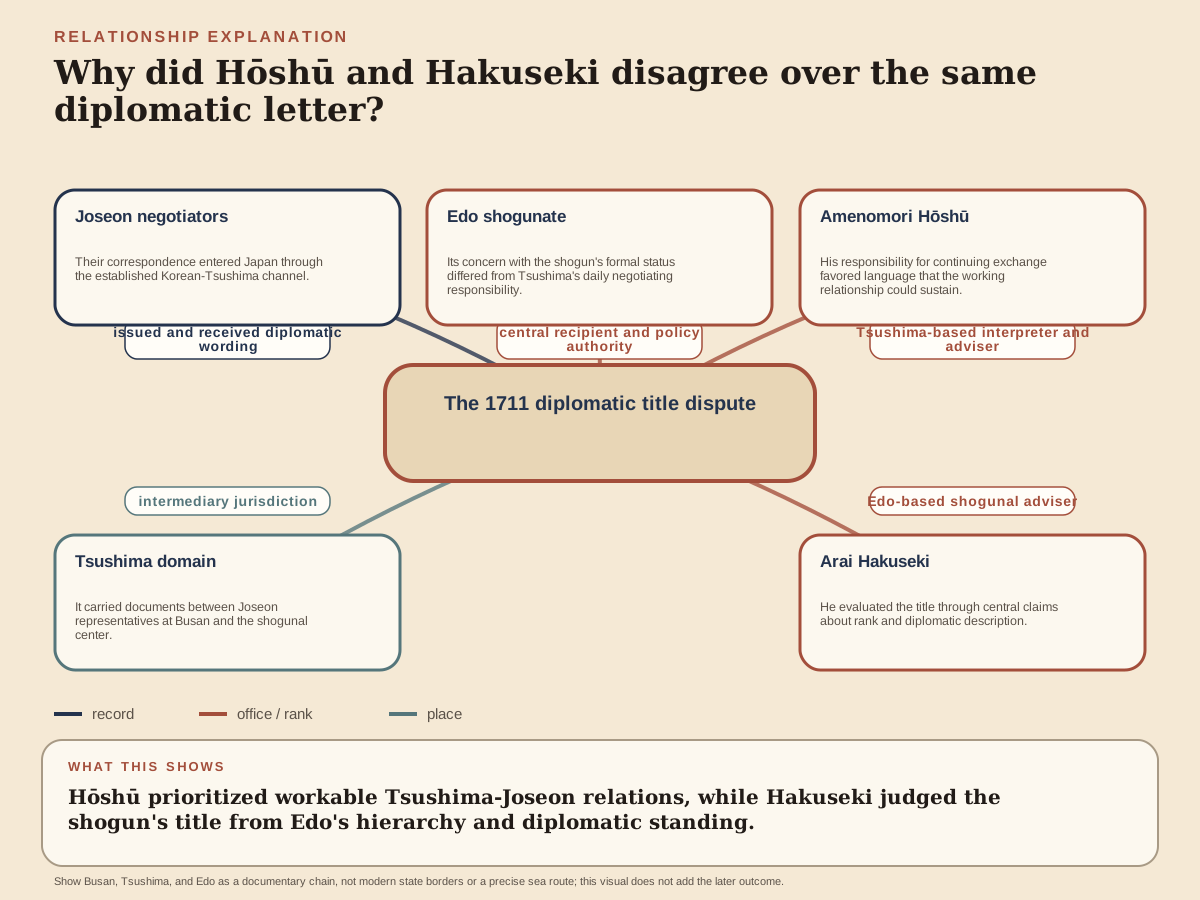
A Korean embassy came to Japan in 1711 during Ienobu’s reign. Hakuseki sought changes in ceremonial arrangements and the diplomatic description of the shogun as Japan’s king. This brought disagreement with Amenomori Hōshū, a scholar serving Tsushima, the domain that managed much of the relationship with Korea. Hōshū objected to title and letter alterations whose effects had to be handled in ongoing diplomacy. Hakuseki’s written exchange with Korean envoys also discussed clothing, civilized conduct and friendship. Formal language could express dignity while creating practical difficulties for the people charged with maintaining the relationship. The dispute involved how authority should be represented across different political and cultural conventions. [5][10][11]
Hakuseki opposed repeated reductions in the precious-metal content of coins. The financial official Ogiwara Shigehide was removed in 1712, and in 1714 the government restored gold and silver coinage toward earlier standards. The work involved the financial examiner Hagiwara Yoshimasa and advice from the Sakai merchant Tani Chōemon; Hakuseki was not the only participant. Older and newer coins continued to coexist while exchange proceeded. Restoring metal content reduced the quantity of money available. The Bank of Japan’s museum account associates the contraction with falling prices and stagnation. A policy intended to repair the currency’s credibility could therefore create difficulties for an economy already using money extensively. [5][6]
In 1715 the government issued new regulations for commerce at Nagasaki. Chinese ships were limited to thirty annually, while the allowance of two Dutch ships largely continued an existing restriction. Shinpai trading permits assigned access among departure regions and helped control which ships could trade. Officials also reshaped price assessment and regulated export goods, especially copper. Hakuseki’s concern over the outflow of precious metals was part of the background, but shortages, illicit commerce and the port’s livelihoods mattered too. Provisions supported Nagasaki residents through a trade-profit allowance and merchants through purchase advances. The regulations became a durable framework for managed foreign commerce, requiring local administration as well as central policy. [7][5]
Ienobu died in 1712. His young son Ietsugu became shogun in 1713, with Hakuseki and Manabe continuing to influence government. Ietsugu’s death in 1716 brought Tokugawa Yoshimune to power and ended Hakuseki’s place near the ruler. Hakuseki began Oritaku Shiba no Ki, an autobiographical account for his family that defended his masters and his own role. His historical Tokushi Yoron had grown from lectures to Ienobu in 1712 and was copied into final form later. It traced changes in court and warrior government as part of an argument about political authority. Both works preserve a participant’s judgments; they also require attention to the position from which he wrote. [1][2][4][5][13]
After 1716 Hakuseki continued research and writing. His inquiries ranged across early Japanese history, words and sounds, Ezo, the northern region including present-day Hokkaido, and the Ryukyu islands to the south. Tōga studied Japanese word origins and change, while other works examined writing and foreign geography. Late requests to borrow or locate books show that this scholarship still depended on access to material held by others. He died in Edo in 1725 and was first buried at Hōon-ji in Asakusa; his grave is now at Kōtoku-ji in Nakano. Much of his work reached wider readers through later copying and publication. Political retirement ended his advisory place, while scholarly work and its transmission continued. [1][2][15][8][13]
Classic
Arai Hakuseki was born in Edo, now Tokyo, in 1657. His father Masanari served the Tsuchiya house, whose territory centered on Kururi in Kazusa, now part of Chiba. A retainer’s employment provided the family’s recognized place and livelihood. In 1677 an internal dispute brought expulsion for both father and son, together with a prohibition on entering another lord’s service. Their difficulty therefore extended beyond the loss of one job. They could not simply transfer the same standing to a new employer. [1][2]
The Tsuchiya house ended in 1679 and the prohibition was lifted. Hakuseki subsequently served Hotta Masatoshi, entering his household in 1682. Masatoshi’s murder in 1684 again changed the conditions of service. Hakuseki remained connected to the Hotta family for several more years before leaving in 1691. These household ruptures repeatedly altered the conditions under which he could pursue employment and learning. [1][2]
In 1686 Hakuseki began studying under Kinoshita Jun’an, a prominent teacher in Edo. Confucian learning joined the interpretation of ancient Chinese writings to questions of personal conduct, history and government. This training overlapped Hakuseki’s remaining years with the Hotta house. After leaving, he supported himself through teaching. Jun’an’s recommendation would later place him with a Tokugawa lord. The scholarly relationship supplied both instruction and an introduction to an employer who could give sustained work to a man whose earlier service had repeatedly been disrupted. [1][2][15]
In 1693 Jun’an recommended Hakuseki to Tokugawa Tsunatoyo, lord of Kōfu. Instruction in Chinese classics and history became a continuing responsibility. When Tsunatoyo became heir to the shogun, head of Japan’s warrior government, in 1704 and took the name Ienobu, the lecturer’s relationship with his patron carried into the central government. Ienobu became sixth shogun in 1709. Repeated instruction over many years gave Hakuseki familiarity and access before he became associated with the policies of that reign. [1][2][14]
Hankampu was drafted in 1701 and presented in 1702, with corrections continuing later. It covered 337 warrior houses, including families whose fortunes had ended. Genealogies, marriages, service and political conduct explained how households obtained or lost their place. Its ordering began with Tokugawa-related families and proceeded through other categories of lords. The book supplied a historical account of the ruling society as well as examples from which a lord might judge conduct and obligation. [3]
Historical interpretation · A Tokugawa-centered history
Hakuseki consulted a large range of historical records and narrative material. Selection and arrangement nevertheless shaped the result. The National Archives illustrates this through his retelling of Shimazu Yoshihiro’s withdrawal from Korea: rewards are presented with Tokugawa Ieyasu in the leading role. The exhibition reads that arrangement as part of a Tokugawa-centered account. Genealogical errors and composed narrative also limit use of Hankampu as an exact register.
Its importance includes the documentary labor and the political perspective through which the material became meaningful. [3][16]
Hakuseki’s learned service extended to Honchō Gunkikō, a study of weapons completed around 1709. It examined structures and histories through documentary inquiry. He did not possess a lavish private library: the National Diet Library’s account points to patron-supplied books, copying and requests to borrow volumes. Access to material was part of the practical basis of scholarship. A lord’s support made investigations possible, while the finished works returned instruction and historical knowledge to the household that employed their author. [14][15]
When Ienobu became shogun in 1709, Hakuseki’s years of teaching gave him an influential voice. Manabe Akifusa served as soba-yōnin, a direct attendant of the ruler. Hakuseki’s function was jikkō, learned lecturer. The two men could bring matters before Ienobu through distinct relationships and responsibilities. Neither title alone describes the whole government. Decisions still required the ruler and the officers who administered finance, justice, territories and ceremonial arrangements. [1][5]
The policies associated with this period included changes in criminal judgment and attempts to reduce arbitrary or excessive punishment. Financial examination was restored in 1712. Examiners could scrutinize revenue, local officials and expenditure, introducing another point of supervision into fiscal administration. Hakuseki’s proposals joined standards of conduct to changes in official work. Their operation depended on records, reports and cooperation from officeholders, making administrative relationships central to what advice could accomplish. [5][17]
Hakuseki also sought to preserve possible imperial successors by limiting the movement of eligible princes into religious life. In 1710 the Kan’in house was founded for Prince Naohito, a son of Emperor Higashiyama. An imperial-prince household could maintain a line available if the reigning branch needed a successor. This was a concrete arrangement within the existing court and warrior-government relationship. It involved questions of family continuity and rank that learned historical and ceremonial argument could bring into government deliberation. [5][12]
Hakuseki became a hatamoto in 1709, a direct retainer of the shogun, with an assessed income of 500 koku, the unit used to express rice-based revenues. In 1711 he received a court rank and the title Chikugo no Kami, along with an income increased to 1,000 koku. The provincial title was an honor, rather than an appointment to govern Chikugo. Advancement recognized his standing near Ienobu, but that position remained bound to a ruler who valued his counsel. His patron’s death in 1712 ended their long relationship. [1][5]
Evidence boundary · Knowledge gathered under confinement
Giovanni Battista Sidotti, an Italian Catholic missionary, reached Yakushima in 1708 and was arrested under Japan’s prohibition of Christianity. He was brought to Edo, where Hakuseki questioned him in 1709 at the Koishikawa Christian prison. The setting was unequal: one man sought information on behalf of the ruling order while the other remained a captive. Hakuseki’s account preserves an inquiry conducted through the institutions that enforced religious exclusion. [8]
Sidotti’s answers gave Hakuseki descriptions of European geography, states and religion. Hakuseki also questioned chiefs of the Dutch trading post, using another channel to supplement what he had learned.
Information arrived through particular informants, languages and purposes, rather than through unrestricted travel of his own. His work assembled and compared reports across those limits. The encounter demonstrated how detailed foreign knowledge could develop within a system that tightly controlled the people allowed to supply it. [8]
Hakuseki distinguished Sidotti’s missionary purpose from a necessary plan for conquest. He nevertheless judged Christian teaching critically and did not abandon the prohibition. Seiyō Kibun’s three volumes cover the captive’s arrival, interrogation and death, then world geography, then Christian explanation and Hakuseki’s criticism. Intellectual attention did not release the informant from confinement. The book preserves both the enlargement of Hakuseki’s knowledge and the governing and religious boundaries within which the inquiry occurred. [8]
Seiyō Kibun bears a dated note from 1715 but received additions into Hakuseki’s later years. It remained privately held because its contents concerned Christianity. The National Archives records its presentation to the government in 1793; the first printed edition followed in 1882. Sairan Igen, another work produced in 1713, organized foreign geographical knowledge in a different form. These histories of composition and circulation separate the experience of questioning Sidotti from the much later readership of Hakuseki’s account. [8][9][1]
The Korean embassy of 1711 entered a relationship managed through the warrior government and Tsushima, the island domain between Japan and Korea. Hakuseki proposed ceremonial changes and use of the title Japan’s king for the shogun. The language would give the ruler a particular standing in diplomatic documents. Its meaning had to be negotiated across governments whose established forms and expectations did not coincide. A change that seemed appropriate in one setting could alter how the other side understood a letter. [5][10]
Amenomori Hōshū, a Tsushima scholar with practical knowledge of Chinese and Korean, disputed Hakuseki’s approach to titles and rewriting diplomatic letters. The Agency for Cultural Affairs describes surviving records of this disagreement in Hōshū’s collection. His work required sustaining communications and handling negotiations through Tsushima. Hakuseki’s concern with the central ruler’s representation encountered the responsibilities of a participant who would have to manage the consequences within a continuing relationship. Their different responsibilities shaped what each saw as a workable form of communication. [10][5]
Evidence boundary · Historical claims in a diplomatic exchange
The received record Kōkan Hitsudan preserves Hakuseki’s written exchange with Korean envoys. They discussed clothing and claims to civilized tradition, comparing practices associated with Chinese dynasties. The conversation also turns toward reciprocal friendship and the damage that ceremonial disagreement could do to peaceful relations.
These were arguments presented by learned participants, not archaeological proof for the ancient origins they invoked. The record reveals how shared literary resources could provide a language for both rivalry and accommodation. [11][18]
Evidence boundary · The allegations against Ogiwara
Earlier governments had reduced the precious-metal content of coins and gained revenue from issuing the new currency. Hakuseki regarded repeated changes as damaging and opposed the financial official Ogiwara Shigehide, who was dismissed in 1712.
His account includes accusations against Ogiwara, but the dismissal does not independently establish every charge. The policy disagreement concerned how government should meet financial need and what gave coins dependable value. [5][6]
Financial examination was restored in 1712. The return toward older coin standards followed in 1714, after Ienobu’s death, under the government of his young successor Ietsugu. The examiner Hagiwara Yoshimasa and the Sakai merchant Tani Chōemon participated in shaping the reform. Hagiwara was a different official from the dismissed Ogiwara. The change proceeded through administrative cooperation and merchant knowledge as well as Hakuseki’s advice. Higher-purity Kyōhō gold coinage followed in 1715. [5][6]
Restoring a coin’s metal content changed how much currency could be made from a given supply of precious metal. The Bank of Japan’s museum explanation describes a rapid reduction in circulating money and associates it with falling prices and stagnation. Older and newer coins did not vanish into one uniform currency overnight: exchange was gradual and varieties coexisted. Hakuseki’s preferred standard had to operate within that mixed monetary world. More precious metal in a coin did not by itself ensure easier transactions or a stable level of economic activity. [5][6]
The reform responded to real problems of revenue, trust and changing coin values, but the effects depended on the amount of money available and the practices of people using it. Tsuji Tatsuya’s policy account also points to the government’s weak command over the merchant interests involved in exchange. The outcome cannot be credited or blamed on one lecturer alone. It shows a government attempting to restore an authoritative standard while confronting relationships and economic consequences that the standard did not settle. [5][6]
Nagasaki’s foreign commerce brought imports, export demand and income to the city. Hakuseki was concerned about the outward movement of gold and silver, but the problems behind the 1715 regulations also included copper availability, illicit trade and local finance. The central government issued rules that Nagasaki officials elaborated and administered. A policy had to control commerce while preserving the mechanisms and livelihoods that made the port work. [7][5]
Chinese ships received an annual limit of thirty. Shinpai trading permits distributed access among departure regions and required ships to follow the assigned arrangement. The Dutch allowance of two ships largely continued an earlier limit rather than creating an entirely new reduction. Ship numbers were accompanied by limits on trade values and export supplies. These measures organized foreign access through recognized documents and categories instead of depending only on the inspection of ships after arrival. [7]
The regulations replaced merchant bidding in price assessment with a negotiated arrangement involving official supervision. Copper exports were assigned limits in a setting where sufficient supply could not be assumed. Rules also addressed the city’s income: Nagasaki residents received a fixed allowance from trade profits, and merchants obtained advances for purchases. The provisions tied restriction to continued operation. Reducing uncontrolled transactions while maintaining trade required decisions about who could buy, at what price, with what resources and with what share of the proceeds. [7]
Evidence boundary · Trade rules and export estimates
The framework continued well beyond Hakuseki’s departure from political influence. Its durability rested in permits, assessments, quotas and local implementation, not simply in his estimates of past metal exports.
Those estimates explain part of his argument but should not be treated as fully verified national accounts. The trade regulations are a major consequence of the period because they organized continuing commerce through procedures that later officials could maintain and adjust. They also show how central concerns and a port city’s economic needs had to be fitted into the same policy. [7][5]
Ienobu died in 1712, leaving a young son who became seventh shogun as Ietsugu in 1713. Hakuseki and Manabe continued to have influence, and major monetary and trade measures followed during this government. Their standing depended on preserving an advisory arrangement around a ruler too young to govern personally. When Ietsugu died in 1716, Tokugawa Yoshimune became shogun and removed the two men from that place. Institutional policies could survive even as the relationships that had carried their authors into decision-making ended. [1][2][5]
Evidence boundary · An adviser’s defense of his service
Hakuseki began Oritaku Shiba no Ki after his displacement in 1716, probably adding to it later. Its three parts move from family origins and his own life into the governments of Ienobu and Ietsugu, including Manabe’s role. He wrote for descendants while defending his masters’ reputations and his conduct in service. The autobiographical voice gives close access to the judgments of an involved participant. It also shapes the selection of incidents and the explanation of conflicts.
Claims against opponents must be read in that setting. [13][5]
Historical interpretation · History as advice to a ruler
Tokushi Yoron developed from lectures to Ienobu in 1712, with a fair copy completed later. Hakuseki identified nine changes in court government and five in warrior rule, ending his stated framework in the Tokugawa age. The categories overlap rather than forming fourteen consecutive eras. They organize a retrospective argument about the movement of governing authority and the legitimacy of warrior rule.
The scheme is evidence for Hakuseki’s historical judgment, rather than proof that the Tokugawa outcome had been inevitable. [4][17]
Terade Michio reads Hakuseki’s criticism of the fifteenth-century shogun Ashikaga Yoshimasa’s extravagance as an indirect warning for Ienobu’s government. Expenditure, depleted resources and political disorder made the historical example relevant to contemporary finance. This modern interpretation places moral admonition within a concrete governing problem, rather than treating it as detached sermonizing. Hakuseki’s histories could instruct, legitimate and criticize through selected past events. The same scholar who helped frame policy also supplied the stories and patterns by which he wanted rulers and descendants to judge it. [17][4][13]
Evidence boundary · Early scholarship and later standards of proof
Hakuseki’s later work continued inquiries begun before his displacement. Koshitsū and its related questions interpreted early Japanese history; Tōga investigated Japanese words, their origins and changes. Tōonpu and Dōbun Tsūkō examined sounds and written characters. He also studied the northern region of Ezo, including present-day Hokkaido, and the Ryukyu islands through available information. These inquiries joined historical and linguistic interpretation to geographical knowledge.
Their conclusions belong to the evidence and scholarly assumptions accessible to him, rather than constituting modern archaeological or linguistic demonstration. [1][2]
The National Diet Library’s account of Hakuseki’s collection emphasizes that he was not the owner of an exceptionally rich library. Late letters ask to borrow books and request help in finding them. Earlier, Ienobu had supplied or lent works that Hakuseki could read and copy. After political access ended, inquiry still required material resources and cooperation. The requests preserve a practical aspect of continued learning: identifying what was needed and turning to other people who might make it available. [15]
Hakuseki died in Edo in 1725 and was originally buried at Hōon-ji in Asakusa. His grave is now at Kōtoku-ji in Nakano. Manuscripts followed different paths after his death. Honchō Gunkikō was printed in 1740, while Seiyō Kibun remained restricted, entered government custody in 1793 and first reached print in 1882. His autobiography later attracted readers for its Japanese prose as well as its account of government. These different histories of readership helped make a retired adviser consequential beyond the rulers he had served. [1][14][8][9][13]