Read the article below. Interactive reading tools are available when scripts load.
Quick
Akechi Mitsuhide rose as a commander under Oda Nobunaga before attacking him in Kyoto in 1582. His early life is much less certain. Traditions give birth years including 1516 and 1528 and connect him with Mino, present-day Gifu Prefecture. A medical text records remedies associated with him at Tanaka Castle in Takashima around 1565, but does not supply a complete training or service history. By 1568 he was active in the circle of Ashikaga Yoshiaki and Nobunaga. [1]
After shogun (the head of a warrior government appointed through a court title) Ashikaga Yoshiteru's killing in 1565, his brother Yoshiaki sought patrons able to restore him. Mitsuhide entered the network around Yoshiaki and Hosokawa Fujitaka. Later accounts also place Mitsuhide in service with the Asakura warrior house in Echizen, now Fukui Prefecture, but the exact office, duration, and route into the shogunal circle remain uncertain. Yoshiaki eventually turned to Oda Nobunaga, who possessed the military capacity to escort him to Kyoto. Mitsuhide was useful in a coalition requiring correspondence, introductions, knowledge of central institutions, and armed service. Later Asakura accounts do not securely establish his rank, salary, or a dramatic first meeting. [1][2][17]
Fujitaka and other intermediaries helped form the alliance. Mitsuhide could work for Yoshiaki's project while receiving tasks through Nobunaga. This gave him access to both households, but would put his position at risk when their interests separated. [2][17]
Nobunaga escorted Yoshiaki into Kyoto in 1568, and Yoshiaki became shogun. Victory did not make the capital self-governing. Court nobles, temples, towns, estates, merchants, military households, and rival claimants carried rights and disputes that required protection orders, hearings, tax decisions, and armed enforcement. Mitsuhide appears in this work, sometimes alongside Hosokawa Fujitaka and other officials. His position linked the shogunal project and Nobunaga's expanding authority. His work required both correspondence and armed backing. [2][3]
Administration was not the peaceful opposite of conquest. A protection order could prevent looting, but also identify who possessed power to judge. Tax collection funded troops. Dispute settlement rewarded allies. Mitsuhide's ability to move between correspondence and military action made him valuable. It also gave him contacts across institutions that would later evaluate his rebellion. Kyoto expanded his authority while keeping it dependent on a difficult partnership above him.
In 1571 Nobunaga's forces devastated Enryakuji, the headquarters of Tendai Buddhism on Mount Hiei northeast of Kyoto, and its surrounding settlements. Monks, fighters, women, children, servants, and residents were caught in the violence; exact totals vary. Mitsuhide participated in the Oda military system around the attack and soon built his territorial base at Sakamoto below the mountain. His later reputation as a cultured administrator cannot be separated from this campaign. Yoshiaki and Nobunaga then moved from tension to open conflict. Mitsuhide ultimately sided with Nobunaga, as did Fujitaka. [4][17]
In 1573, Oda force expelled Yoshiaki from Kyoto, ending his effective shogunate there while the Ashikaga claimant continued political activity elsewhere. Mitsuhide's choice was not proof of timeless loyalty or inevitable betrayal. Nobunaga controlled the expanding structure that could grant castles, land, and military responsibility. Yoshiaki retained office and connections but could no longer secure Mitsuhide's rising position in Kyoto and Ōmi. The decision made Mitsuhide unmistakably an Oda commander and attached him to both the opportunities and violence of that order. [2]
Nobunaga ordered Mitsuhide to build Sakamoto Castle on Lake Biwa after the destruction of Enryakuji. The site controlled water transport and routes between Ōmi and Kyoto while overseeing a religious and urban landscape violently reorganized by Oda power. The castle made Mitsuhide a territorial lord. Storehouses, docks, residences, weapons, fuel, records, and a castle town supported a household able to campaign beyond the capital. The missionary Luís Fróis described its grandeur as second to Nobunaga’s Azuchi Castle. [4]
Construction and provisioning depended on surrounding communities, boat traffic and skilled workers. Mitsuhide's household could entertain visitors and supply campaigns from this base. Later demolition, shoreline change and redevelopment left only fragmentary evidence of the castle, but its strategic position helps explain how he acquired resources near Kyoto. [4]
In 1575 Nobunaga assigned Mitsuhide a leading role in conquering Tanba, the mountain basin west of Kyoto. Tanba was not an empty province awaiting efficient government. Castles, valleys, religious institutions, village communities, and warrior leagues supported authorities whose alliances could change as armies advanced. Mitsuhide first pressed toward Kuroi Castle, associated with Akai Naomasa, while seeking cooperation from the Hatano house at Yagami. The apparent coalition did not hold. Hatano opposition exposed the danger of campaigning through narrow routes where local fortresses and supply knowledge mattered more than a command issued in Kyoto. [5]
The first effort failed to settle the province. Mitsuhide had to combine sieges, negotiations, garrisons, intelligence, and repeated returns rather than win through one decisive encounter. The failure reveals both the reach and limits of Oda delegation: Nobunaga could assign a province, but possession still had to be produced locally. For households and villages, that process meant demands for provisions, transport, hostages, labor, and allegiance from competing sides. [5]
Mitsuhide returned to Tanba while the Oda regime also confronted Araki Murashige's revolt around Arioka. The overlapping campaigns required detachments, communications, and patience. Yagami Castle endured a long blockade before Hatano leaders surrendered and were taken to Nobunaga; they were executed. Kuroi fell after Akai Naomasa's death weakened resistance. Later narratives say Mitsuhide pledged his mother as a hostage for the Hatano surrender and that she was killed when Nobunaga broke the agreement. The tale powerfully supplies a personal revenge motive for Honnōji, but its evidentiary foundation is late and insecure. [5]
What is secure is already severe. Siege reduced choices for combatants and civilians, surrender did not preserve the Hatano leaders, and Oda victory reorganized the province. Mitsuhide gained authority through this conquest, but local auxiliaries, negotiators, laborers, and communities made the result possible and bore much of its cost. His later reputation as a capable governor cannot erase the coercive route by which his government became possible. [5]
After conquest, Mitsuhide had to turn forts, roads, land assignments, and defeated communities into a working domain. Kameyama linked Tanba to Kyoto, while Fukuchiyama helped secure the province's northwestern interior. Surviving letters and military regulations show attention to troop conduct, service obligations, and communication. The government was not Mitsuhide alone. Retainers occupied castles, local intermediaries assessed fields and transmitted orders, religious institutions negotiated their position, and villagers supplied taxes and labor. Some later traditions credit Mitsuhide personally with town planning, flood control, or generous remission. [6]
The town-planning and flood-control claims belong to later local memory and are not equally established as contemporary acts. Mitsuhide nevertheless had castles, officers and routes linking Tanba to Kyoto. More regular protection could benefit exchange after war while taxes and compulsory service supported his armed household. [6]
During the later 1570s Mitsuhide was more than a Tanba commander. He participated in the pressure on Ishiyama Honganji, a fortified Buddhist headquarters in what is now Osaka, the response to Araki Murashige, court and Kyoto business, and the wider coordination of Oda armies. His daughter Tama's marriage to Hosokawa Tadaoki, Fujitaka’s son, linked two important households, while Mitsuhide's relationship with Fujitaka joined military, political, and cultural activity. Mitsuhide also served as an intermediary in relations with Chōsokabe Motochika of Shikoku. Contemporary documents strengthen the case that changing Oda policy toward Chōsokabe placed this network under strain before Honnōji. [12][17]
They do not prove that Shikoku policy alone caused the coup. His position combined distinction with exposure. Nobunaga's expansion created opportunities, reassigned commands, judged failures, and could redirect a retainer's alliances. Later stories of humiliation may reflect genuine hierarchy, but their details vary and often serve a ready-made revenge plot. The secure picture is structural: Mitsuhide possessed exceptional responsibility while remaining subordinate to a lord who could alter the conditions of that power. Cultural refinement, family strategy, religious patronage, and violent campaigning belonged to the same career.
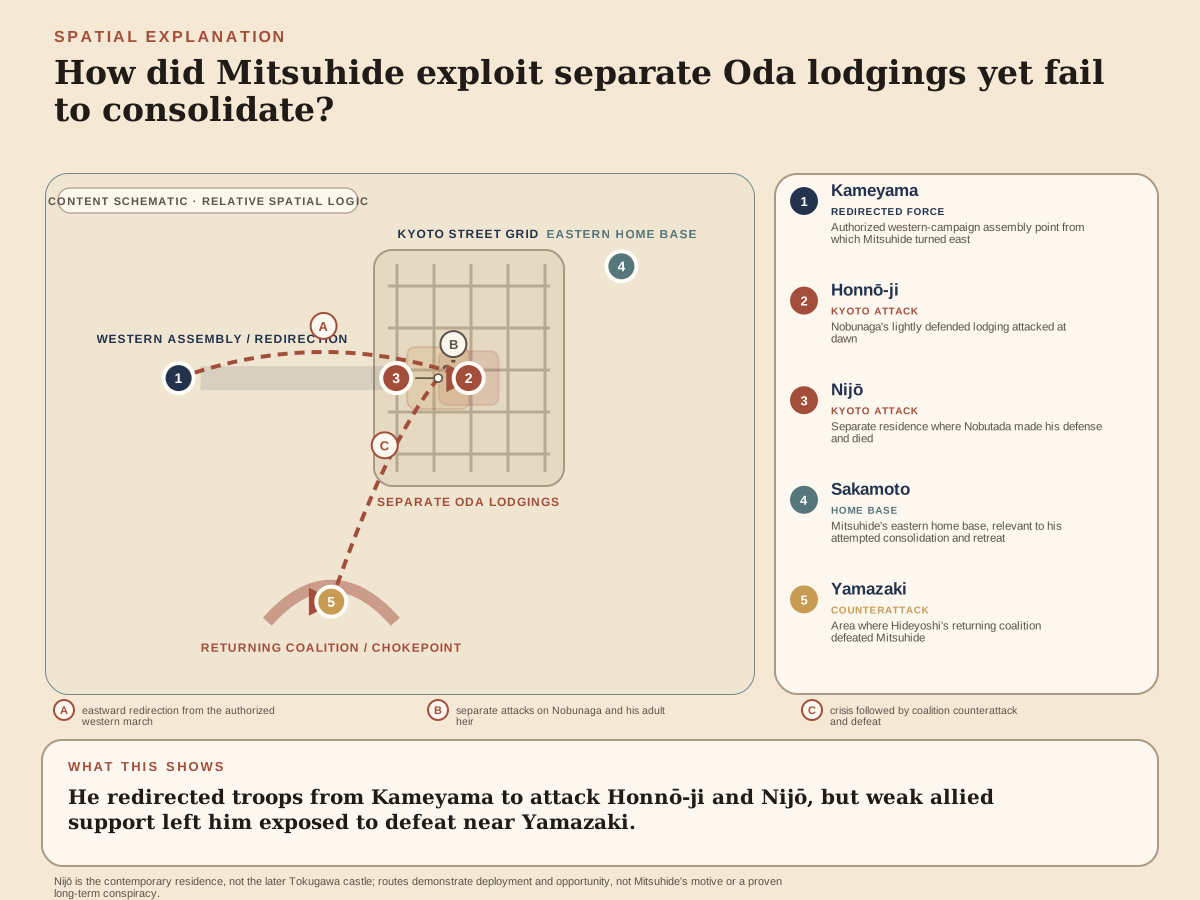
Late in the fifth month of Tenshō 10 (1582) Nobunaga ordered Mitsuhide to lead forces west to support Hashiba Hideyoshi against the Mōri. Mitsuhide gathered troops at Kameyama, a castle whose road system could serve either the assigned western march or a rapid movement toward Kyoto. Before the attack, he attended a linked-verse gathering, where participants took turns composing a shared poem, at Mount Atago. A verse associated with him has long been read as coded foreknowledge, but poetic language, textual transmission, and retrospective interpretation make it unsafe as a transparent confession. [7][11]
The famous declaration that the enemy was at Honnōji likewise comes from later narrative rather than secure contemporary reporting. What can be established is action. Mitsuhide redirected an army entrusted to him and moved toward a capital where Nobunaga had only a limited guard. The decision depended on secrecy, command compliance, roads, timing, and knowledge of Oda dispositions. Whether formed long in advance or under immediate pressure remains unresolved. The opportunity was produced by the very trust and mobility Mitsuhide had earned within Oda service. [11]
Before dawn on the second day of the sixth month of Tenshō 10 (1582), Mitsuhide’s forces attacked Honnōji in Kyoto. Nobunaga’s major armies were away and his small guard could not withstand the attack. Fighting and fire destroyed the compound, and he died. Burned remains support the destruction; accounts differ about his last words and exact manner of death. [13][14]
Nobunaga’s eldest son and designated successor, Nobutada, was elsewhere in Kyoto. He moved to the Nijō residence of Prince Sanehito, the emperor’s heir—not today’s Nijō Castle, built in 1602–1603. Akechi forces attacked there too, and Nobutada died. Mitsuhide had eliminated both the ruler and the most immediate adult successor. Younger Oda heirs survived, but their claims now depended heavily on senior commanders and the armies still in the field. [8][9]
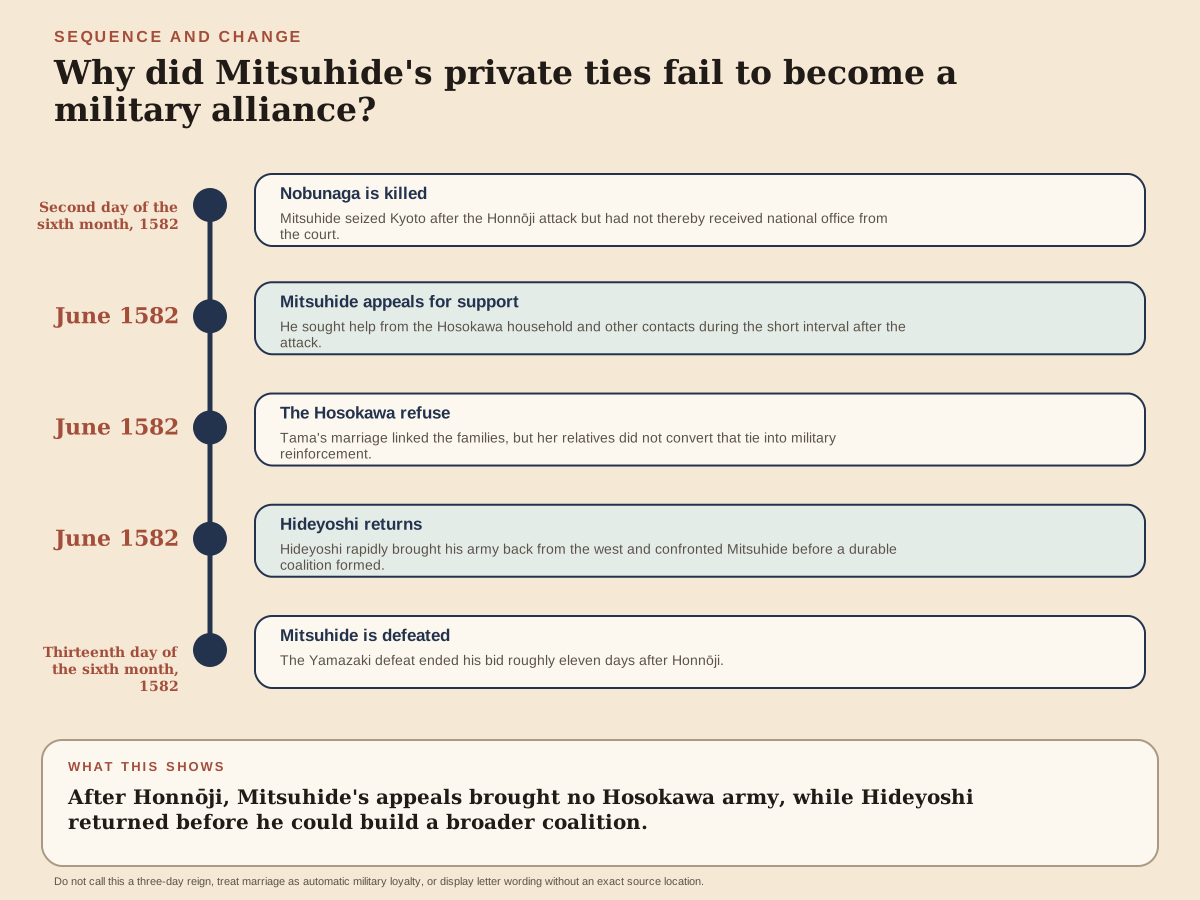
After the attacks, Mitsuhide took control of Kyoto and extended power into Ōmi, including Azuchi. He contacted the court, issued orders, distributed or secured resources, and sent letters asking other houses to support him. These acts show an attempt to convert military seizure into government. Recognition did not follow automatically. Hosokawa Fujitaka and Tadaoki rejected his appeal, adopted visible withdrawal from active service, and placed Tama in isolation rather than bring their house into the coup. [10][16][17]
Other commanders delayed or chose opposing alignments. Kinship, culture, and past cooperation proved weaker than the risk of joining a rebellion whose wider coalition was uncertain. Popular memory sometimes calls Mitsuhide a ruler of only three days, but his control lasted closer to eleven days between Honnōji and defeat. The label is retrospective, not a precise office. A much later compilation credits him with an immediate land-tax remission for Kyoto; the claim lacks the same evidential weight as a contemporary order. His central problem was not a total absence of administrative action. It was the failure to make armed possession, court contact, and written appeals produce enough durable allies before opposing forces returned. [10][19]
Hideyoshi learned of Nobunaga's death while campaigning against the Mōri. He arranged a rapid settlement, concealed or controlled information where useful, and marched east. A surviving letter to Nakagawa Kiyohide used the false claim that Nobunaga and Nobutada were alive as part of the effort to secure allegiance. The future victor was not merely reacting faster; he was actively shaping what other commanders believed. Mitsuhide deployed near Yamazaki, where routes between Kyoto and Osaka narrow between mountains and rivers. [10]
Hideyoshi arrived with a broader coalition, including forces whose leaders had declined to join Mitsuhide. The battle on the thirteenth day of the sixth month ended in Akechi defeat. Exact troop totals vary, and the later idea that control of Tennōzan alone decided everything compresses terrain, numbers, timing, morale, and alliance failure into one slogan. Yamazaki exposed the difference between seizing the center and mobilizing the network. Hideyoshi could claim vengeance for Nobunaga while preserving Oda succession rather than immediately presenting himself as its replacement. Mitsuhide had to defend a new order that few powerful houses had recognized. His tactical position could not compensate for political isolation. The same speed that made Honnōji possible left little time to build legitimacy before distant Oda capacity returned. [10]
After defeat at Yamazaki, Mitsuhide attempted to return toward his bases and died during the collapse of his forces. Accounts differ about the precise route, attackers, wounds, suicide, and treatment of his body. The secure outcome is that he did not reestablish command. Stories that he survived as the later monk Tenkai belong to legend, not demonstrated biography. Hideyoshi used vengeance against the Honnōji rebel to consolidate leadership, while later chronicles, plays, and popular narratives repeatedly supplied Mitsuhide with motives the contemporary record does not settle. [11][17]
Kumada Chihiro’s 2020 study emphasizes Nobunaga’s changes to Shikoku policy, which undermined Mitsuhide’s dealings with Chōsokabe. Owada Tetsuo emphasizes a possible intention to stop Nobunaga’s wrongdoing. Neither is an established sole explanation. In the puppet play Ehon Taikōki, first performed in Osaka in 1799, Mitsuhide became a tragic protagonist with a changed name. That drama helps explain his later image, not his private thoughts in 1582. [5][6][7][11]
Classic
Akechi Mitsuhide became a commander and territorial lord under Oda Nobunaga, then turned his army against that lord in Kyoto in 1582. The beginning of his life is much less certain than its public end. Authorities commonly give 1528 as his birth year, while other traditions include 1516; no contemporary birth register settles the choice. Mino, in present-day Gifu Prefecture, has several places associated with his birth or early residence. His contacts with relatives there support a regional connection, but do not verify every claimed birthplace or the complete Toki-family pedigree later assigned to him. [1]
Later genealogies connect Mitsuhide with the Toki warrior lineage, while stories of wandering and service with the Asakura warrior house in Echizen, now Fukui Prefecture, supply an early career. These accounts do not securely establish his rank or the sequence of his service. The papers that survive become much more informative once he enters central politics. [1]
One early trace is a medical text recording remedies associated with Mitsuhide while he was at Takashima's Tanaka Castle, in present-day Shiga Prefecture, around 1565. It provides a particular setting for his knowledge of medicine, not a complete apprenticeship or service biography. By the later 1560s, documents and central politics make the adult increasingly visible among men who could serve both a warrior patron and the shogunal court.
The first clear turning point is his entry into the circle seeking to restore Ashikaga authority in Kyoto. Mitsuhide brought useful skills and connections; the surviving record cannot reconstruct every household through which he had acquired them.
Ashikaga Yoshiteru, head of the Ashikaga warrior government as shogun, was killed in 1565. His surviving brother Yoshiaki sought a patron strong enough to install him in Kyoto. Hosokawa Fujitaka brought Ashikaga service, military experience and literary contacts to this effort; Mitsuhide entered the same circle. Yoshiaki sought support in Echizen before turning to Nobunaga, whose conquest of Mino and growing military reach offered a way to recover the capital. The precise circumstances of Mitsuhide's earlier Asakura service are less securely documented than his place in the coalition that followed. [1][2][17]
The arrangement required messages, assurances and an army. Mitsuhide's ability to work between Yoshiaki's household and Nobunaga's officers made him useful, alongside Fujitaka and other intermediaries. He could serve the prospective shogun's project while accepting tasks and rewards through Nobunaga. This overlapping allegiance allowed advancement, but would become difficult when the two patrons disagreed. [2][17]
Letters arranged war as well as peace, and cultural contacts brought Mitsuhide into circles where patrons and intermediaries met. He also needed armed followers to carry out orders. His combination of correspondence and military service became increasingly visible after the coalition entered Kyoto. These capacities made him useful without proving that he had already planned to replace either patron.
Office and land offered opportunities for advancement within the coalition. Fujitaka and other intermediaries helped sustain the arrangement; Mitsuhide was not its sole architect. When Yoshiaki and Nobunaga later parted, a man accepting duties from both would have to decide which commands to follow.
In 1568 Nobunaga brought Yoshiaki into Kyoto, and Mitsuhide entered the capital with the coalition. He had found a political position close to both the new shogun and the military patron who had made the return possible. [2]
Yoshiaki became shogun in 1568, but Nobunaga's army did not resolve the capital's accumulated disputes. Temple and neighborhood privileges, land claims and demands to protect property all required answers. Mitsuhide and Fujitaka handled business across the shogunal and Oda households. The new arrangement relied on inherited court procedures and military backing at the same time. A protection order could spare a particular temple or neighborhood from billeting and seizure, while making its security depend on the authority that issued it. [2][3]
Granting a placard did not prove universal tolerance. It marked a specific relationship and could be revoked when political alignment changed. Judicial work was political. Land and debt disputes had accumulated through war. Choosing which document to honor could restore one claimant and dispossess another. Officials needed scribes, messengers, archives, and the threat of enforcement. Fiscal work linked city and army. Taxes, tolls, merchant contributions, and estate income supported government. Remission could win cooperation, while new exactions could finance campaigns. “Good administration” and coercive capacity grew together. Court relations required ritual accuracy. Nobles possessed ranks, offices, diaries, and access to the emperor. Military victors sought titles and ceremonial legitimacy, but could not simply improvise every form. Mitsuhide's cultural participation helped him operate in this environment.
Religious institutions and urban communities had their own land rights and internal organization. Military officials worked through local leaders who could report disputes and collect payments. Mitsuhide shared responsibility with Fujitaka and with Murai Sadakatsu, another Oda official involved in governing Kyoto. After Yoshiaki’s expulsion in 1573, he served under Nobunaga as a Kyoto administrator. His work reached residents through protection orders and demands for resources, while the force behind those decisions remained delegated by his patron. [2][3]
Documents preserved in Kyoto show how this work reached particular communities. A 2019 exhibition at the city’s historical archive showed a copy of correspondence jointly signed by Mitsuhide and Murai, alongside clauses concerning rice sales. Such records show military officials dealing with city business, not simply imposing commands on an undifferentiated capital. Neighborhoods and religious houses retained their own records and relationships, and sought protection through the new authorities.
Kyoto service enlarged Mitsuhide's access to people and information. He helped turn the military entry into recurring decisions, but appointments and armed backing still came from the partnership above him. When that partnership broke, his growing responsibilities would not protect him from having to choose.
Yoshiaki's shogunate had been restored through Nobunaga's force. That origin created dependence but not complete obedience. The shogun issued commands, sought alliances, and tried to preserve an authority not reducible to Oda patronage. Nobunaga increasingly constrained Yoshiaki and expected the central order to support his campaigns. Their conflict involved documents and jurisdictions before it became open war. Officials between them could not remain neutral indefinitely. The Mount Hiei attack demonstrates what serving Nobunaga entailed. Enryakuji, the headquarters of Tendai Buddhism on Mount Hiei northeast of Kyoto, was not simply a monastery of peaceful scholars, nor merely an enemy fortress. Its institutions held land, political ties, armed capacity, ritual authority, and populated settlements. Oda forces attacked across that complex in 1571. Contemporary and later sources differ over casualty figures and details, but large-scale killing and burning are secure.
Collapsing everyone into “warrior monks” erases noncombatants and dependents. Mitsuhide operated in the campaign environment and received the Sakamoto area afterward. Even where one cannot assign every tactical order, his power grew directly from the destruction and reorganization of the Hiei–Sakamoto zone. Records of memorial donations for men killed in later fighting show that Mitsuhide maintained religious relationships. Piety and participation in religious violence were not mutually exclusive. A sixteenth-century commander could patronize temples while attacking institutions defined as enemies. Sakamoto placed him between lake transport, Kyoto approaches, former Enryakuji power, and Ōmi routes. The grant converted delegated service into a territorial household with a castle, stores, subordinates, and revenue. When Yoshiaki built an anti-Nobunaga coalition, Mitsuhide faced concrete risks. [4][17]
Following the shogun could sacrifice the land and command Nobunaga had enabled. Following Nobunaga meant abandoning the authority through which he had entered central politics. Fujitaka made a similar broad choice, though his interests and timing were his own. Their action illustrates how Ashikaga service relationships could be redirected when the shogun could no longer guarantee survival. Nobunaga's 1573 operations forced Yoshiaki out of Kyoto. It is too simple to say the Muromachi order vanished in one day: Yoshiaki continued claiming office and negotiating with powerful houses. What ended was his effective government from the capital. Mitsuhide's loyalty after that point attached to a house whose commands reached through land grants, campaigns, and punishment. It was stronger institutionally than a personal preference. [2]
Later accounts sometimes make Mitsuhide a restraining voice whose warnings were ignored. Such a scene suits the post-Honnōji wish to distinguish him morally from Nobunaga. Without strong contemporary support, it cannot detach his advancement from the campaign or turn later patronage into proof of prior opposition. His responsibility for the system also deepened. The cultivated administrator and the commander benefiting from Hiei's destruction are the same person. [17]
Location came before architecture. Sakamoto sat at the eastern foot of Mount Hiei beside Lake Biwa, close to routes leading toward Kyoto. Control there linked water movement, roads, temple lands, and surveillance of a recently defeated institutional zone. Nobunaga's order to construct the castle followed the 1571 attack. The sequence matters. Sakamoto was not a neutral reward placed on empty lakeshore; it was part of reassigning authority after mass violence and confiscation. A lakeside castle could receive bulk goods more efficiently than overland transport alone. Boats moved rice, timber, fuel, troops, weapons, and messages. Harbors and landing points required personnel who understood seasons, currents, and commercial networks. The stronghold also protected the Kyoto approach from the northeast. A commander based there could answer capital disturbances while supporting campaigns around Ōmi and beyond. [4]
Building and supplying Sakamoto required local labor and lake transport. The Jesuit missionary Luís Fróis described the castle as second in grandeur to Nobunaga’s Azuchi; that comparison survives in Ōtsu’s account of the site. It is not a complete inventory of Mitsuhide’s household. Linked verse, poetry composed through alternating contributions by a group, brought Mitsuhide into contact with warriors, clerics and literary figures. [4]
Cultural activity created trust, status, and information among warriors, clerics, and poets. Saikyōji and other religious institutions received patronage or memorial gifts. These acts helped rebuild relationships after war and embedded the Akechi household in local sacred geography. Patronage could be devout, political, and administrative together. Castle residents included family, senior retainers, guards, scribes, servants, artisans, and laborers. Their work made the lord continuously present even when he campaigned elsewhere. Mitsuhide's authority was a household system rather than a single mind inside a tower. Revenue from assigned lands supported military obligations. Collecting it required local intermediaries and generated disputes. A castle lord became responsible for hearings, road safety, and protection as well as demands for service. Sakamoto also exposed dependence on Nobunaga.
Sakamoto's stores and retainers gave Mitsuhide resources of his own, but the grant remained part of Nobunaga's territorial settlement and could be altered by him. Later demolition, shoreline change and redevelopment fragment the castle's remains. They leave a less complete architectural picture than the written evidence of an active household beside the lake. [4]
In 1575 Nobunaga assigned Mitsuhide a leading role in the conquest of Tanba, the mountain country west of Kyoto. Valleys and narrow approaches gave local castles control over movement. Akai Naomasa resisted from Kuroi, while the Hatano house at Yagami initially appeared willing to cooperate with the advance. In the first month of 1576, the Hatano turned against him. When that cooperation failed, Mitsuhide faced opponents able to threaten routes through ground they knew well. A commission from Nobunaga gave him responsibility for conquest, not possession of an already subdued province. [5]
Local leaders could bargain, delay, change sides, or coordinate against an outside commander when circumstances altered. Calling such changes “betrayal” expresses injured expectation, but it does not explain the Hatano calculation. Their household faced incorporation, dispossession, rival pressure, and uncertain guarantees. Mitsuhide's troops required food, pack animals, road labor, guides, weapons, and replacement men. Sakamoto and wider Oda resources supported them, yet the last stages of supply passed through contested ground. Logistics gave communities leverage even while exposing them to coercion. Siege warfare displaced risk outward. Defenders consumed stored grain; attackers stripped surrounding areas; inhabitants might be confined, recruited, or suspected by both sides. The surviving elite record rarely measures those costs evenly. Intelligence was equally local. Knowledge of paths, water, harvests, and factional disputes could determine whether a march became an encirclement. [5]
The setback at Kuroi did not end Mitsuhide’s career. He continued receiving Oda commands while preparing to return to Tanba. Troops could be supplied from Sakamoto and the wider Oda territories, but bringing provisions through hostile valleys still required local cooperation. The retreat had exposed a practical limit to his commission: Nobunaga could assign the conquest, while Mitsuhide had to obtain the support and supplies needed to accomplish it.
Mitsuhide renewed operations in 1578–1579 while Oda armies also faced Araki Murashige's rebellion and the continuing conflict with Ishiyama Honganji, a fortified Buddhist headquarters in what is now Osaka. A 1578 letter to his retainer Tsuda Kaga-no-kami reports the deployment schedule and seeks Tsutsui Junkei's participation in the Tanba campaign. Yagami's defenders endured a prolonged blockade before Hatano leaders left the castle and were delivered to Nobunaga, who had them executed. At Kuroi, resistance weakened after Akai Naomasa's death. The province was taken through sustained pressure and changing local alignments, not one decisive assault. [5]
Later accounts say Mitsuhide pledged his mother as a hostage for the Hatano surrender and that she was killed after Nobunaga executed their leaders. This familiar revenge story lacks secure contemporary support. The siege and execution are important without adding an unverified family victim: they show how surrender could still end in destruction for a defeated house. [5]
Local participants chose among dangerous options. Some supported the invader, some the defenders, and others adjusted as control changed. Warrior households used hostages to secure agreements, exposing dependants to the consequences of military decisions even where the particular story about Mitsuhide’s mother is doubtful. Nobunaga rewarded the conquest with expanded responsibility, and defeated lands could now support Akechi retainers. [5]
Its burden extended beyond the executed leaders: prolonged siege narrowed access to food and movement for enclosed households. A new administrative order would rest on the redistribution forced by this campaign.
The end of major resistance did not create a unified domain automatically. Fortresses had to be staffed, roads watched, obligations recorded, and former opponents either incorporated, displaced, or restrained. Peace began as an administrative campaign. Kameyama occupied a route from Tanba toward Kyoto. Its value lay in movement as much as defense: troops, messengers, tribute, and information could pass through it. In 1582 that same geography would help the Akechi army turn east. Fukuchiyama anchored another part of the conquered province. The visible castle and town have histories extending beyond Mitsuhide, including later rebuilding and modern reconstruction. The surviving structure cannot represent every phase of Mitsuhide's castle. Documents associated with Mitsuhide include letters to local recipients and rules for military service. [6]
In 1581 Mitsuhide issued military regulations for his retainers, preserved at Goryō Shrine in Fukuchiyama. Castle archaeologist Senda Yoshihiro highlights their provision that military duties should not exceed a retainer’s stipend. This tied service to the resources assigned to support it. The regulations show an effort to organize an armed household; they cannot prove that troops always obeyed or that village burdens were uniformly light. Posts and revenues also had to be distributed among retainers after the conquest. [6]
Later local memory celebrates Mitsuhide as Fukuchiyama’s founder and credits him with flood protection. Researchers interpret the landscape differently. Senda Yoshihiro emphasizes his castle’s role in gathering people and exchange, while Umebayashi Hideyuki argues that the planned castle town probably developed under Hideyoshi or later rulers and that the river embankment dates to around 1700. The city’s own presentation includes both emphases. Castle foundation, subsequent town building and later commemoration should therefore not all be attributed to Mitsuhide’s brief rule. [6]
Administration nevertheless gave Mitsuhide a substantial base for future campaigns. Retainers held forts and transmitted orders; communities furnished revenue and service. Family members and junior officers maintained the household while the commander was away. A castle could protect a merchant’s exchange while imposing labor on a village or displacing a defeated house. These unequal effects belonged to the same territorial settlement.
Senior service was accumulation without sovereignty. Mitsuhide held Tanba and Sakamoto, commanded troops, negotiated with elites, and handled matters near Kyoto. Each success increased both his resources and Nobunaga's expectations. The Ishiyama Honganji conflict demanded sustained coordination rather than one battle. Forts, waterways, allied armies, and negotiated submissions connected commanders across the central region. Mitsuhide's participation placed him within a war against a powerful religious-political network. Araki Murashige's rebellion made the danger of defection immediate. The Oda response included siege, pressure on relatives and associates, and exemplary punishment. Every retainer could see what the regime did when confidence collapsed. Fujitaka remained an important associate from the Yoshiaki years. Their connection combined shared campaigns, literary activity, and family alliance. It was durable enough to matter greatly in 1582, but not equivalent to guaranteed obedience. [12]
The marriage between Mitsuhide's daughter Tama and Fujitaka's son Tadaoki embedded that relationship in kinship. Women in such marriages carried political ties without controlling the decisions made by fathers and husbands. Tama's later fame must not erase her position within this earlier alliance system. Linked verse and courtly competence gave commanders access to networks beyond the battlefield. Cultural participation could build credit, transmit news, and demonstrate fitness for central affairs. It did not form an ethical alternative to warfare. Mitsuhide's contacts with Chōsokabe Motochika concerned Oda relations with Shikoku. Newly recognized documentary context shows that these negotiations were not an invention of later storytellers. Policy changed as Nobunaga prepared a more coercive intervention. That change may have threatened Mitsuhide's credibility and his connections. [17]
Yet a contextual pressure is not a demonstrated trigger. No surviving confession ranks Shikoku policy against fear, ambition, grievance, opportunity, or concern for the political order. Later anecdotes present Nobunaga insulting Mitsuhide, striking him, replacing his lands, or mocking his service. Some may preserve a hierarchy capable of harshness. Their varying provenance prevents them from being assembled into a factual diary of accumulating abuse. The safer inference concerns institutional vulnerability. Nobunaga could allocate territories and commands because the Oda hierarchy remained the recognized source of Mitsuhide's office. Expansion repeatedly unsettled what any one retainer could expect to keep. At the same time, Mitsuhide was no passive victim. He profited from confiscation, directed campaigns, accepted family advantage, and exercised coercive authority.
By 1582 Mitsuhide therefore stood at a dangerous intersection: trusted with armed mobility near the capital, connected across houses, and capable of interpreting policy changes as threats. His seniority explains why the coup could be attempted. The surviving evidence cannot by itself explain why he attempted it at that particular moment.
Hideyoshi's campaign against the Mōri created a demand for reinforcement. Nobunaga's order placed Mitsuhide inside a familiar pattern: a senior commander was expected to move his own organized force across regional theaters. Kameyama was an operational hinge. From the Tanba side, roads could carry the army toward western service; another movement brought it toward Kyoto. Geography did not cause rebellion, but it made redirection feasible. Gathering troops required ordinary procedures. Officers notified units, provisions were prepared, weapons checked, and men assembled under an assignment they could recognize. A coup could hide inside the machinery of authorized deployment. Nobunaga's location mattered. He was at Honnōji with a comparatively small entourage while Nobunaga’s eldest son and designated successor, Nobutada, was elsewhere in Kyoto and major armies operated at distance. [7]
Mitsuhide's knowledge of central movements transformed access into opportunity. The Atago gathering is attractive to later interpretation because linked verse rewards layered meaning. Mitsuhide's opening line has been connected to rule, weather, and the coming action. Wordplay permits association; it does not establish a single intended political message. Texts also have transmission histories. Wording, copying, later commentary, and knowledge of the coup influence how readers hear a line. A poem preserved after an event is not the same evidentiary object as a dated operational order. Participants at the gathering may have perceived anxiety or nothing unusual. Retrospective testimony tends to convert ordinary gestures into omens. The often repeated command naming Honnōji as the enemy gives the march a perfect dramatic instant. [11]
The army’s changed direction establishes that new commands were issued. Orders passed through officers to units whose men need not have known the goal when they first assembled. Compliance turned Mitsuhide’s decision into a collective attack, exposing his retainers and their families to the consequences of failure. No surviving account securely traces every stage of his private calculation.
From that point, Mitsuhide became responsible not only for dissent or fear but for directing an attack on his lord. The western order therefore explains the coup's mechanism better than its motive. Oda expansion had given Mitsuhide an army, a road, and credible reason to mobilize. He converted delegated capacity into rebellion.
Before dawn on the second day of the sixth month of Tenshō 10 (1582), Mitsuhide's forces attacked Nobunaga at Honnōji in Kyoto. The temple compound stood at a different site from the later Honnōji. Nobunaga had a small entourage while major Oda armies were campaigning elsewhere. Akechi units could close approaches and attack before those forces answered. The men and command procedures that had served Nobunaga's campaigns now worked against his lightly guarded residence.
The Kyoto site has yielded burned tiles and soil associated with the temple’s destruction and subsequent clearance. Such remains support the burning, not Nobunaga’s reported last words or an exact reconstruction of his death. News also carried errors. Matsudaira Ietada, a Tokugawa retainer writing away from the scene, initially recorded a report implicating Nobunaga’s nephew Nobuzumi alongside Mitsuhide; his entry for the fourth day of the sixth month corrected that report. The diary preserves the shock of the attack and the uncertainty spreading with its news. [13][14]
Mitsuhide’s exact physical location during the attack is less secure than his responsibility for directing it. Nobunaga died, although reports disagree about his final words and manner of death. The loss of the ruler did not transfer his command automatically to Mitsuhide. Other Oda armies remained in the field, and his eldest son Nobutada was still in Kyoto. [13][14]
Nobutada had already received substantial command and represented the adult continuation of Nobunaga’s house. After news of Honnōji reached him, he moved to the Nijō residence of Prince Sanehito, the emperor’s heir, where his companions prepared resistance. This was not the present Nijō Castle, built by the Tokugawa in 1602–1603. Later accounts suggest that he could have escaped. They cannot establish which routes appeared safe amid incomplete reports of the attack and his father’s fate. [8][9]
His retainers prepared resistance despite unfavorable numbers. Their presence made the defense collective. Lists of elite deaths preserve only part of the human field that included attendants, messengers, workers, and nearby residents. Mitsuhide could not safely ignore Nobutada. An adult successor outside his control could send orders bearing legitimate Oda authority, unite dispersed armies, and define the Honnōji attack as a contained rebellion. The assault on Nijō therefore reveals strategic purpose beyond rage against Nobunaga. Whatever the original motives, the operation adapted to eliminate a political alternative. That does not prove a complete blueprint for government. Nobutada's death severed the clearest immediate command chain. Younger Oda claimants remained, but their ages, locations, and household alignments made succession depend heavily on senior retainers. [8]
The morning's success gave Mitsuhide the capital but not the country. Kyoto offered symbolic centrality, administrative personnel, communications, and proximity to the court. It also concentrated observers waiting to see whether his rule would last. Moving into Ōmi secured routes and struck at Nobunaga's material center. Azuchi contained arms, wealth, documents, and household facilities. Seizing resources could provision Akechi troops and reward support, yet also advertise appropriation. Mitsuhide communicated with court figures. Contact was necessary because court rank and authorization could help translate victory into legitimate order. The surviving evidence does not justify saying the imperial court simply appointed or endorsed him as a new national ruler. Political letters reveal urgency. They named relationships, offered arguments, requested action, and sometimes promised reward. [10]
A letter is evidence of an appeal; it is not evidence that the recipient accepted its account. Fujitaka's refusal was devastating because their association had survived earlier regime change. The Hosokawa men cut their hair or withdrew in mourning and did not provide the military support Mitsuhide needed. Their conduct framed loyalty to the dead Nobunaga as safer or more legitimate than kinship with the rebel. Tama, Mitsuhide's daughter and Tadaoki's wife, bore the consequences without choosing the coup. Her isolation protected Hosokawa political positioning while marking her as attached to a condemned natal house. Family alliance did not distribute agency equally. Tsutsui Junkei and other regional actors also assessed timing, military balance, reputation, and competing obligations. Delay itself could be a political decision. [16][17]
Mitsuhide needed rapid commitments because each uncommitted force increased the value of waiting for Hideyoshi. Mitsuhide issued instructions and attempted to stabilize the area. Such acts prevent the period from being reduced to chaotic flight after murder. He possessed trained administrators and knew central government practice. But administrative competence could not solve the legitimacy problem alone. Orders obeyed under nearby force might vanish once that force moved. Durable authority required other armed houses to risk themselves on his settlement. The famous label often translated as a three-day rule compresses a period of roughly eleven days and does not correspond neatly to a formally secured shogunate or kingship. It belongs to reception history and popular moral arithmetic. Likewise, the Kyoto tax-remission claim appears attractively consistent with a benevolent reformer. [10][19]
The story that Mitsuhide granted Kyoto a tax remission survives prominently through a compilation made about two centuries later. It cannot establish a complete contemporary reform program. Court figures and townspeople still had to deal with armed control: officials continued necessary work and merchants adjusted under risk. Such practical compliance did not provide the military commitments he urgently needed.
Mitsuhide's control also remained geographically uneven. Holding Kyoto, Sakamoto, and routes in Ōmi did not erase Oda garrisons or distant armies. Space controlled on one day could change with news. The coalition failure reveals a central asymmetry. Nobunaga's death created uncertainty, but his relationships survived in heirs, commanders, dependants, and a powerful claim to vengeance. Mitsuhide held the capital while those relationships reorganized outside it.
Hideyoshi's western army was far away, but distance did not make it irrelevant. Negotiation with the Mōri released him from the current front. March discipline and supply converted a political decision into rapid movement. Information management accompanied the return. Hideyoshi had reason to keep Nobunaga's death from immediately strengthening the enemy before a settlement. He then communicated eastward to secure commanders and define himself as the effective avenger. The letter to Nakagawa Kiyohide is especially revealing because it used false reassurance that Nobunaga and Nobutada survived. It was an instrument designed to influence a recipient under uncertainty, not a transparent report of the writer's beliefs. That deception weakens any simple moral contrast between an honorable avenger and a dishonest rebel. [10]
It also demonstrates Hideyoshi's strategic advantage: he could organize support around the Oda name before every fact was commonly fixed. Mitsuhide sent his own appeals, but the Hosokawa refusal deprived him of expected strength and reputation. Other leaders waited or joined the opposing concentration. Battlefield numbers were produced by political choices made beforehand. Yamazaki's terrain mattered. The route between Kyoto basin and Osaka area is constrained by Mount Tennōzan and river systems. Positions on heights and along approaches influenced observation, deployment, and movement. Later tradition made possession of Tennōzan synonymous with possession of the realm. The phrase is memorable because Hideyoshi's victory proved consequential. A ridge did not mechanically determine the battle apart from troops, routes, decisions, and timing. Exact army totals differ among accounts.
On the thirteenth day of the sixth month, Mitsuhide’s army was defeated at Yamazaki. Estimates can indicate that Hideyoshi assembled superior strength without pretending that one precise number is certain. Numerical inflation often magnifies the victor or the defeated hero. Mitsuhide's men had already marched, occupied, guarded, and fought during the preceding days. Hideyoshi's force had conducted its own exhausting return. Fatigue mattered on both sides, but its distribution cannot be reconstructed soldier by soldier. The Akechi position needed to stop the approaching coalition before it reached the capital. Delay favored Hideyoshi because additional actors could interpret his arrival as proof of momentum. Once formations broke, defeat became more than loss of ground. Retainers faced the collapse of the household's political future, while local people encountered fugitives and pursuing forces. [10]
Mitsuhide’s possession of Kyoto had not secured allies strong enough to survive the military reversal. Hideyoshi’s negotiated peace in the west freed his army to return, and his appeals brought other commanders into the coalition. Yamazaki settled the struggle through combat, but the opposing alignments had already enlarged the force Mitsuhide had to face.
Defeat dissolved the Akechi command faster than it had been assembled. A lord's ability to issue orders depended on officers, messengers, protected roads, and expectation of survival. Yamazaki damaged all four. Mitsuhide moved away from the battlefield toward territory associated with his household. Sources and local traditions place his last movement and death differently. The variations are part of the evidence problem, not details to be combined into one cinematic route. Some versions describe attack by local men, a wound from a spear, assisted death, or self-killing. Others emphasize the discovery or display of remains. The outcome is secure enough to end his political action; the mechanism is not secure enough for verbatim final thoughts. Local participation in the aftermath reflects the danger and opportunity created by a defeated army. [11][17]
Fugitives could be armed, wounded, valuable, or threatening. Calling every local attacker a mere bandit imports the defeated elite's viewpoint. At Sakamoto, Akechi Hidemitsu and the household's remaining people faced destruction. Stories of a spectacular lake crossing and deliberate preservation of cultural objects developed around the end. Broad collapse should be separated from embellished heroic detail. Hideyoshi converted victory into narrative authority. Punishing the rebel allowed him to act in the name of Nobunaga's house while emerging as its most effective commander. Mitsuhide's failed settlement became the moral contrast against which a new coalition formed. The search for motive began early because an unexplained reversal at the center of power invites retrospective order. Chroniclers and dramatists selected grievances that made action emotionally legible to their own audiences.
Japanese historians differ over the motive. In a 2020 study, Kumada Chihiro argues that Nobunaga’s two unilateral changes of policy toward Chōsokabe Motochika undermined Mitsuhide’s negotiations and helped form his decision to rebel. Historian Owada Tetsuo instead emphasizes the possibility that Mitsuhide intended to stop Nobunaga’s wrongdoing, drawing on a surviving copy of a statement attributed to Mitsuhide after the attacks. Personal grievance and ambition also remain familiar explanations, but the mother-hostage story cannot securely establish revenge. The Shikoku documents offer firmer contemporary context than that tale; they do not by themselves record Mitsuhide’s private decision. No single explanation can be presented as an established consensus. [5][6][7][11]
The puppet play Ehon Taikōki, first performed in Osaka in 1799, made Mitsuhide a tragic protagonist under the altered name Takechi Mitsuhide. Its authors turned the coup into a drama of divided loyalties and family suffering. This was a theatrical interpretation, not testimony about his thoughts in 1582. Local remembrance could select a different relationship: Fukuchiyama revered him as a founder, although some features attributed to his town planning and flood control belong to later construction. These memories explain why the same man could appear as a rebel in one setting and a benefactor in another.
The identification of Mitsuhide with the later Buddhist monk Tenkai is a survival legend, not a comparably supported account of his life after Yamazaki. His motive remains disputed; responsibility for directing the attacks does not. The documents place his rise and fall inside the Oda order, while later theatre made the conflict an intimate tragedy. [11]