Read the article below. Interactive reading tools are available when scripts load.
Quick
Victory in 1600 gave Ieyasu the decisive voice in territorial rewards and punishments. Allied lords received or retained provinces, while defeated houses lost land. Hideyoshi’s son Hideyori still lived at Osaka, and the imperial court remained in Kyoto. Ieyasu’s supremacy rested on a settlement containing these surviving institutions and households.
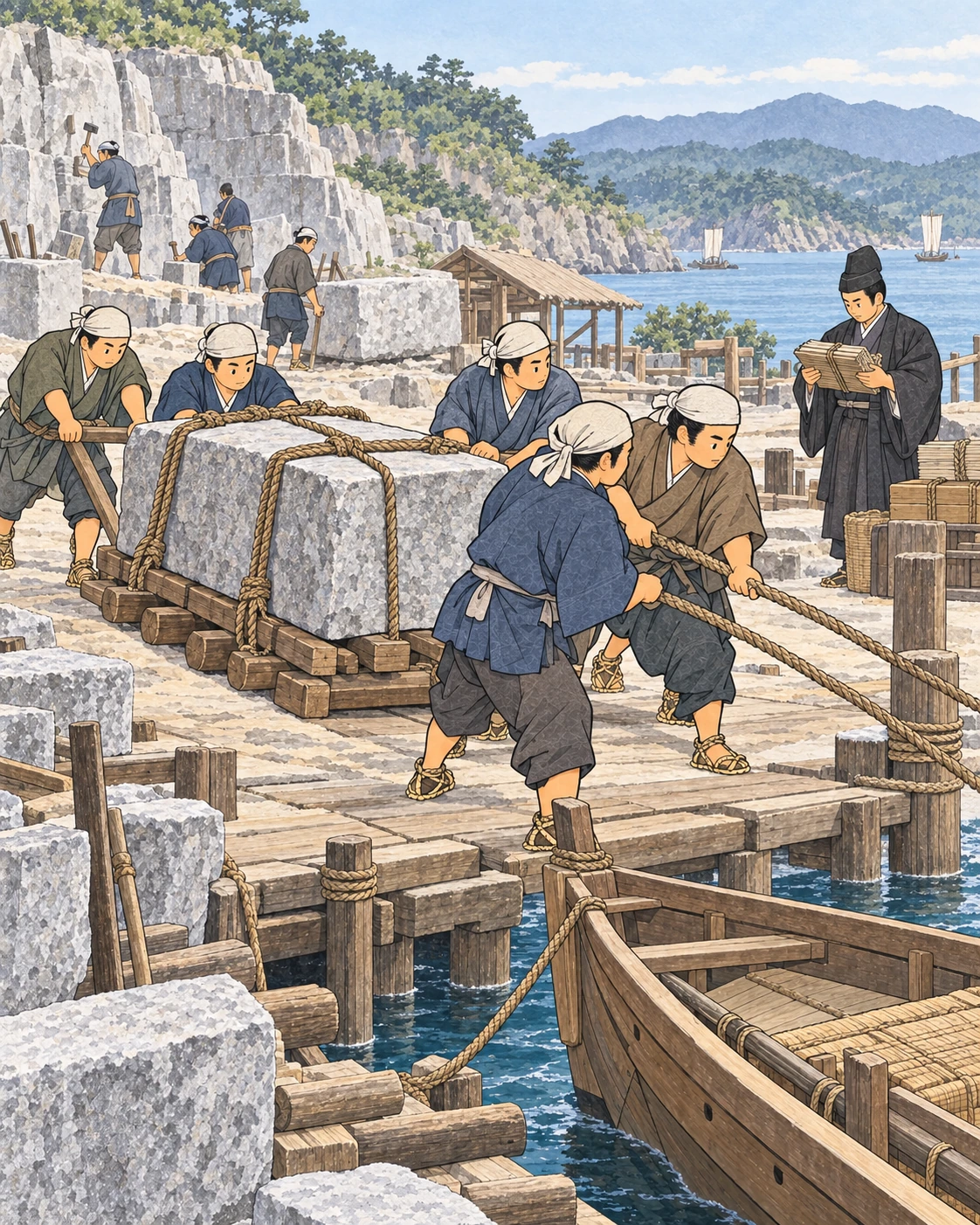
In 1603 the court appointed him shogun at Fushimi Castle. His family had held Edo since the 1590 transfer to the Kantō. Government there expanded through town and castle construction, with the shogun ordering lords to supply resources. Major castle work followed in 1604–1607; stone came by sea from quarries in Izu.
A 1606 letter shows how an assignment reached an individual lord. Katō Yoshiaki told Katagiri Katsumoto that Ikeda Terumasa and Asano Yoshinaga were sending fifty stoneboats each. He proposed sending thirty at first. The letter links western lords who had served Hideyoshi to construction of the Tokugawa headquarters, with Katsumoto, a Toyotomi official, serving as a point of communication.
Ieyasu passed the shogunate to Hidetada in 1605 and later established his retired government at Sunpu, moving into its rebuilt castle in 1607. He continued to exercise authority while his son held the title and governed from Edo. The succession made the office hereditary within the Tokugawa house during Ieyasu’s lifetime.
The new government’s regulations developed afterward. In 1615, following the Osaka campaigns, laws addressed military houses and the court. They regulated castle construction, marriages, appointments and other conduct. The appointment of 1603 began the Tokugawa shogunate; those later enactments and the removal of the Osaka Toyotomi belonged to its further consolidation.
Classic
Ieyasu’s victory at Sekigahara in 1600 was followed by decisions over confiscation, confirmation and reward. Houses supporting him received territories, while defeated lords suffered losses. The resulting distribution gave him supremacy among rulers who still administered their own domains.
Many supporters had served Hideyoshi. Their continued lordship tied the new settlement to existing households and retainer corps. A change in the leading ruler therefore brought new obligations to men who already possessed provincial governments.
Hideyori remained at Osaka with the Toyotomi household. Ieyasu occupied Fushimi as well as his eastern base at Edo, and the court remained in Kyoto. The settlement left several prominent residences and institutions in place after the military victory.
The court appointed Ieyasu shogun at Fushimi in 1603. That act supplied an established warrior office to the man already directing territorial settlements. Edo, held by his family since 1590, became the headquarters of the hereditary government that followed.
Territorial power and court office supplied different kinds of authority. Provincial lords retained their own followers and governments, while the emperor continued to confer rank and appointments. Recognition as shogun could organize warrior allegiance around Ieyasu's house, but it could neither recruit his army retrospectively nor settle every relationship with Osaka and the domains. The marriage and correspondence networks used before Sekigahara continued into this process: appointment made a supremacy assembled over several years publicly recognizable.
The shogunal appointment took place at Fushimi Castle in 1603. Ieyasu’s political position had been established by the 1600 victory and the subsequent territorial settlement; the court now conferred the title through which the Tokugawa house would govern.
Construction expanded the headquarters in Edo. Town works were ordered in 1603, followed by substantial work on the main castle and Ninomaru in 1604–1607. Larger outer works continued under later shoguns, so the city and fortifications grew beyond this first appointment period.
Stone for the castle walls was quarried in Izu and transported by sea. The quarry remains include cutting surfaces and spaces for handling blocks before shipment. Lords supplied ships and resources for the works, connecting their provincial establishments to construction in Edo.
Katō Yoshiaki’s 1606 letter to Katagiri Katsumoto discusses this obligation directly. With Ikeda and Asano dispatching fifty stoneboats apiece, he proposed an initial thirty. The correspondence records the practical scale of one lord’s response and communication across Tokugawa and Toyotomi service networks.
In 1605 Hidetada received the shogunal title and court appointments. His father remained active after handing over the office. Their concurrent authority placed an adult successor in the recognized position while the founder continued to direct major affairs.
Ieyasu planned the enlargement of Sunpu Castle after the transfer and moved into the rebuilt residence in 1607. That year Korean envoys met Hidetada in Edo and Ieyasu near Sunpu. Their separate audiences show both the serving shogun and the retired ruler participating in relations beyond Japan.
The quarry work had its own sequence. Workers split and shaped stone, held blocks at temporary storage areas, moved them down hauling tracks and loaded them at ports for the journey to Edo. The abandoned blocks and working surfaces preserve different stages of that supply chain. An instruction to a lord therefore required labor and transport beyond the finished castle wall. Construction also moved through successive projects rather than ending with the appointment ceremony.
Succession and geography were equally deliberate parts of the transition. Hidetada received the office while Ieyasu was still alive, allowing lords to deal with a recognized successor and an active founder. Fushimi provided access to the Kyoto court, Edo housed the serving shogun and Sunpu later supported the retired ruler. Their separate audiences with the Korean mission make this distribution of authority visible in an actual diplomatic encounter.
Hidetada’s appointment established a father-to-son succession within the Tokugawa house. The founder survived the transfer and continued to govern. Officeholding in Edo and Ieyasu’s retired authority at Sunpu operated together during these years.
The territorial settlement remained the basis of provincial rule. Lords governed the domains confirmed or granted to them, assigned holdings to retainers and maintained their own households. Their obligations to the shogun included contributions to large construction projects.
Edo gained the residences and fortifications needed for the expanding headquarters. The demands for quarrying and sea transport involved men and resources outside the city itself. The surviving stoneboat correspondence records an obligation extending to a western lord’s establishment.
Hideyori’s household still occupied Osaka, and the court retained its institutions in Kyoto. The appointment and succession strengthened the Tokugawa position, while relations with these surviving centers continued to require negotiation and, in the Toyotomi case, later war.
The new order combined the shogun's own possessions and direct retainers with the domains of other military houses. Sado's mines came under Tokugawa administration in the early 1600s, with Ōkubo Nagayasu as the island's administrator in 1603. The direct retainers later identified as hatamoto and gokenin served the shogun, while daimyō commanded separate retainer corps. These relationships supported layered rule rather than one body of officials administering every province identically. Their later ranks and offices continued to develop after the foundation.
Construction demanded resources even as large campaigns diminished. Yoshiaki's request to begin with thirty stoneboats records negotiation over an assigned contribution. The museum account also records forty-six of his boats damaged in a storm three months later, while cautiously leaving open whether they included the initial thirty. A completed wall represents work and losses along the transport route as well as an increase in the ruler's prestige.
The hereditary office outlasted Ieyasu and Hidetada. Later shoguns continued enlarging Edo’s fortifications and administering the territorial order. The initial appointment was a foundation for government whose buildings, regulations and offices accumulated across generations.
After the Osaka campaigns ended in 1615, the Laws for the Military Houses prescribed conduct for lords. Castle repairs required reporting, new construction was prohibited, and private marriages were restricted. Its attendance clause regulated visits and retinues; the later alternate-attendance arrangements developed through subsequent enactments.
The 1615 laws for the emperor and court nobles carried signatures from Ieyasu, Hidetada and Nijō Akizane. Their seventeen clauses addressed rank, appointments, clothing and religious offices as well as imperial study. They imposed a defined framework on court society after the first shogunal appointment.
These later rules gave particular form to authority over military and court households. They followed further political work and the destruction of the Osaka Toyotomi. The early transfer of the title secured succession; later laws specified obligations that the appointment itself had not laid out.
Owari gives a concrete example of that later territorial government. Ieyasu's son Yoshinao entered the domain in 1607; construction at Nagoya began in 1610, and the move from Kiyosu transferred warriors, townspeople and religious institutions to the new castle town. Separate spaces for residences, shops and temples organized the town. Village officials collected land taxes, and obligations included labor on embankments and transport support. These arrangements made order visible in households and villages, not just in succession at Edo.
The later road system also carried continuing movement. Owari's post stations supplied men and horses for official traffic, with different lodging facilities for lords and ordinary travelers. Written rules constrained alliances and castle building while domains continued to administer their own populations. The resulting peace depended on these recurring relations and obligations; neither a fully developed alternate-attendance system nor the later maritime restrictions appeared complete in 1603.