Read the article below. Interactive reading tools are available when scripts load.
Quick
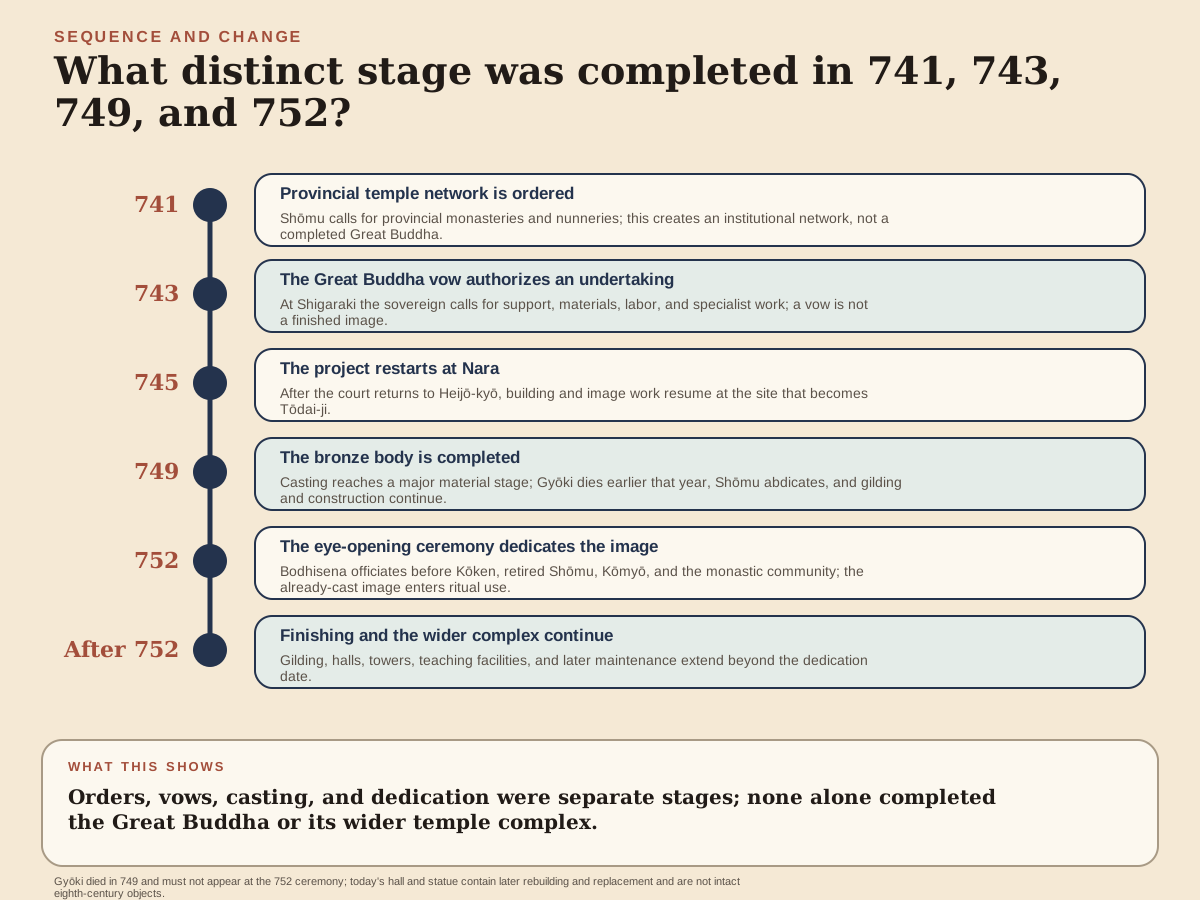
In 743, Emperor Shōmu issued a vow to make a colossal image of Vairocana, a Buddha whose universal presence is central to the Flower Garland teaching. The project began at Shigaraki while the court was moving among several capitals. It followed the provincial-temple edict of 741, but was a distinct undertaking with its own construction sequence.
Shōmu invited contributions as well as committing the court to the work. The monk Gyōki helped gather supporters; Rōben played a central role in the religious community from which Tōdai-ji developed. After the court returned to Heijō-kyō in 745, the project was restarted at Nara, with a government office directing the work.
Making the statue required models, molds, furnaces, metal, and repeated casting operations. The body was cast in successive sections over three years, with eight casting stages recorded in Tōdai-ji's history, and was completed in 749. Craftspeople included the image master Kuninaka no Kimimaro and specialist casting masters. A source of gold in Mutsu contributed to the gilding, but the completion of the bronze body did not finish all surface work or temple buildings.
Gyōki died in 749 before the bronze body was complete. Shōmu abdicated that year to his daughter Kōken. Both sovereigns and Kōmyō attended the eye-opening ceremony in 752, when the Indian monk Bodhisena officiated. The vow, the casting, and the ceremony were separate milestones.
The result was an institution for worship and Buddhist learning as well as an immense statue. The image and hall seen today contain later repairs and reconstruction. Fires in 1180 and 1567 destroyed much of the complex; subsequent restorations included a renewed dedication of the statue in 1692 and the completion of the present Great Buddha Hall in 1709.
Classic
The 743 vow arose during Emperor Shōmu's unsettled years of government. Epidemic illness, the deaths of leading ministers, and the rebellion of Fujiwara no Hirotsugu had preceded repeated moves of the court. Shōmu was then using Shigaraki as a place for religious building as well as royal residence.
In 741 he had ordered provincial monasteries and nunneries. The Great Buddha project was related to this effort to secure the realm through Buddhist practice, but did not simply duplicate a provincial temple. It proposed an immense image of Vairocana, associated with the Flower Garland teaching of an all-embracing Buddhist world.
Shōmu's declaration called for support from a broad circle of contributors. Gyōki had connections among religious communities and lay supporters, while Rōben belonged to the monastic setting from which Tōdai-ji emerged. These roles differed from the court's authority to organize offices and obtain resources.
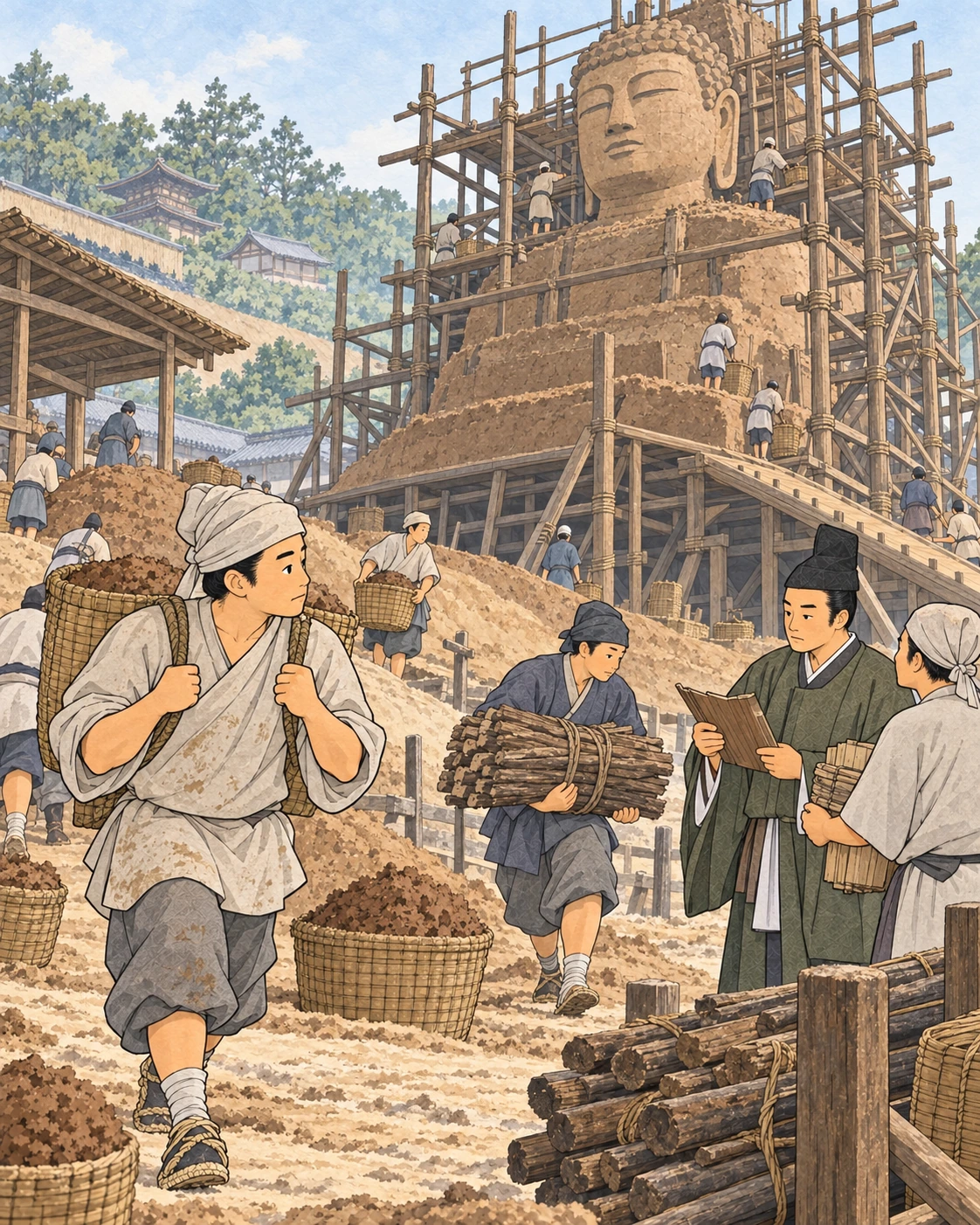
The scale of the image made continued labor, fuel, metal, timber, and specialist knowledge necessary. A vow could authorize and attract support for such work, but could not itself cast the statue or house it. The practical undertaking would continue across a change of site and a royal abdication.
The declaration offered shared Buddhist merit while acknowledging the difference between an image made with sovereign wealth and one supported by sincere contributors. It instructed provincial and district officials not to use the undertaking to force collections from the people. This was a stated constraint on mobilization, not evidence that every work assignment or contribution later complied with it. The transmitted declaration establishes what the court proclaimed; it cannot reveal every donor’s private motive.
Kōmyō’s place in the project likewise differed from the monks’ and craftspeople’s roles. Her patronage connected the undertaking to the royal household, Gyōki’s appeals reached wider supporters, and Rōben helped sustain the religious community. The vast work also depended on less individually recorded suppliers, carriers and laborers. Those different relationships made the project possible without making all participants one community with identical obligations.
Shōmu issued the Great Buddha vow in 743 at Shigaraki. The undertaking began there before the definitive return of the court to Nara in 745. When government returned to Heijō-kyō, the statue project was restarted at the temple site that became Tōdai-ji. The court's building and image-making offices supplied continuing organization through the move.
Gyōki gathered support for the project, while the court's officers coordinated construction and resources. Image-making required specialists with different responsibilities. Kuninaka no Kimimaro is associated with the overall direction of the image; casting masters such as Takaichi no Sanekuni are separately named in the temple's records.
A colossal bronze image had to be cast in sections. Tōdai-ji's account records three years and eight successive casting operations, with the body completed in 749. Molds contained the molten metal, and the work had to progress upward through the image. Completion depended on successive stages rather than one enormous pour. In the technical reconstruction presented by Tōdai-ji, a wooden framework, rope and clay established the image’s form. An outer clay mold enclosed a space for the metal. Earth was raised around the work as casting progressed from the lower sections toward the head; removing the surrounding earth and mold exposed the bronze. Further work on the pedestal and surface followed. This explains an inferred production method, rather than supplying a surviving daily log of the eighth-century workshop.
Gold obtained from Mutsu in 749 supported gilding, a further task after casting. Gyōki died earlier that year and did not see the finished bronze body. Shōmu abdicated to Kōken, but the work continued under the new sovereign. Construction and finishing therefore crossed both a death among its leading supporters and a transfer of the throne.
In 752, the court and monastic community held the eye-opening ceremony. Bodhisena, an Indian monk in Japan, served as officiant, with Kōken, the retired Shōmu, and Kōmyō present. The ritual dedicated an already-cast image; it did not mark the moment when molten bronze first became the statue.
The 749 gold report also joined procurement to public ritual. The Shoku Nihongi records Mutsu’s offering and offerings to shrines; at Tōdai-ji the sovereign’s declaration attributed the discovery to Buddhist and divine aid. The court celebrated it in the change to Tenpyō Kanpō. The later name Tenpyō Shōhō followed Kōken’s accession in the same year. The northeast supplied a needed material, while official celebration made that supply a sign of protected rule. Neither celebration proves that gilding was already finished.
The bronze body completed in 749 fulfilled a major stage of the 743 undertaking. The hall and the 752 dedication gave the image an architectural and ritual setting. These achievements occurred over several years, with Shōmu's original vow providing continuity rather than a single day's completion.
Finishing and building continued after the ceremony. The Shōsōin chronology records gold withdrawn for the statue's gilding in 757. The temple's towers, lecture hall, and residential facilities also developed through later work. A dedication could take place before every part of the wider complex was finished.
The project established Tōdai-ji as a major court-supported religious institution. Rōben and other monks sustained worship and teaching there. Its place within the provincial-temple program joined the capital's religious establishment to temples elsewhere, without demonstrating that every province had already built an equivalent complex.
Large quantities of material and labor had been committed to the work. The surviving accounts do not provide an equal record of each worker or donor, and cumulative contribution figures cannot safely be treated as a count of distinct individuals. The monument demonstrates collective effort more securely than it preserves every participant's experience.
Temple remembrance preserves more than the four prominent figures of Shōmu, Gyōki, Rōben and Bodhisena. The memorial list also names Kōmyō and Kōken, image makers, casting masters and carpenters such as Inabe no Momoyo. Its occupational distinctions matter: designing and directing an image, melting and pouring metal, and erecting a timber hall required different expertise. A list read in later ritual honors the contributors; it does not recover the conditions or intentions of the anonymous workforce.
Coordination continued after the casting through an office that obtained and directed resources, alongside the monastic community that used the buildings. The 757 withdrawal of gold for gilding is one dated example of that continuing material work. It prevents a finished-body date or dedication ceremony from absorbing later procurement and maintenance into an imagined single completion. Tōdai-ji’s place in the provincial-monastery network depended on institutions elsewhere, rather than the presence of one giant statue making every provincial temple complete.
Tōdai-ji's importance extended through its work as a center of Buddhist study and ritual. Teaching institutions within the temple continued alongside worship of the Great Buddha. The 743 undertaking had created an image and a durable setting for religious activity, not just an isolated object.
That setting repeatedly required rebuilding. In 1180, forces led by Taira no Shigehira burned much of the complex. Chōgen then organized restoration with religious appeals, contributions, and political support. With the Song caster Chen Heqing, Chōgen restored parts including the head and left hand. The statue was dedicated in 1185, before the hall’s dedication in 1195. Provision for timber and construction included resources assigned from Suō and Bizen. The rebuilding again required craft expertise, procurement and patronage rather than continuity of sacred identity alone.
Another fire in 1567 left the temple severely damaged. Restoration was difficult during the wars of the sixteenth century. In the Edo period, the monk Kōkei secured support for renewed work; the restored statue was dedicated in 1692 and the Great Buddha Hall completed in 1709. The restored head and eighteen lotus petals were among the parts recast in the Edo campaign. Financial constraints also reduced the hall’s east–west span from eleven bays to seven. The current building therefore preserves the monument through a changed scale as well as a later date.
The surviving complex therefore contains both continuity and replacement. Portions of the image preserve early material, while later repairs and buildings carry the history of restoration. Its connection to the 743 vow is institutional and ritual as well as material; the present hall is not the eighth-century building.
These changes also explain how the original undertaking became a remembered collective achievement. The temple’s expression “founded by four saints” distinguishes the sovereign’s vow, Gyōki’s appeal, Rōben’s community and Bodhisena’s dedication. It is a commemorative grouping across different years; Gyōki, who died in 749, could not join them at the 752 ceremony. The same care is needed with today’s bronze and timber: surviving early portions, recast parts and rebuilt buildings carry different material histories within continuing worship.