Read the article below. Interactive reading tools are available when scripts load.
Quick
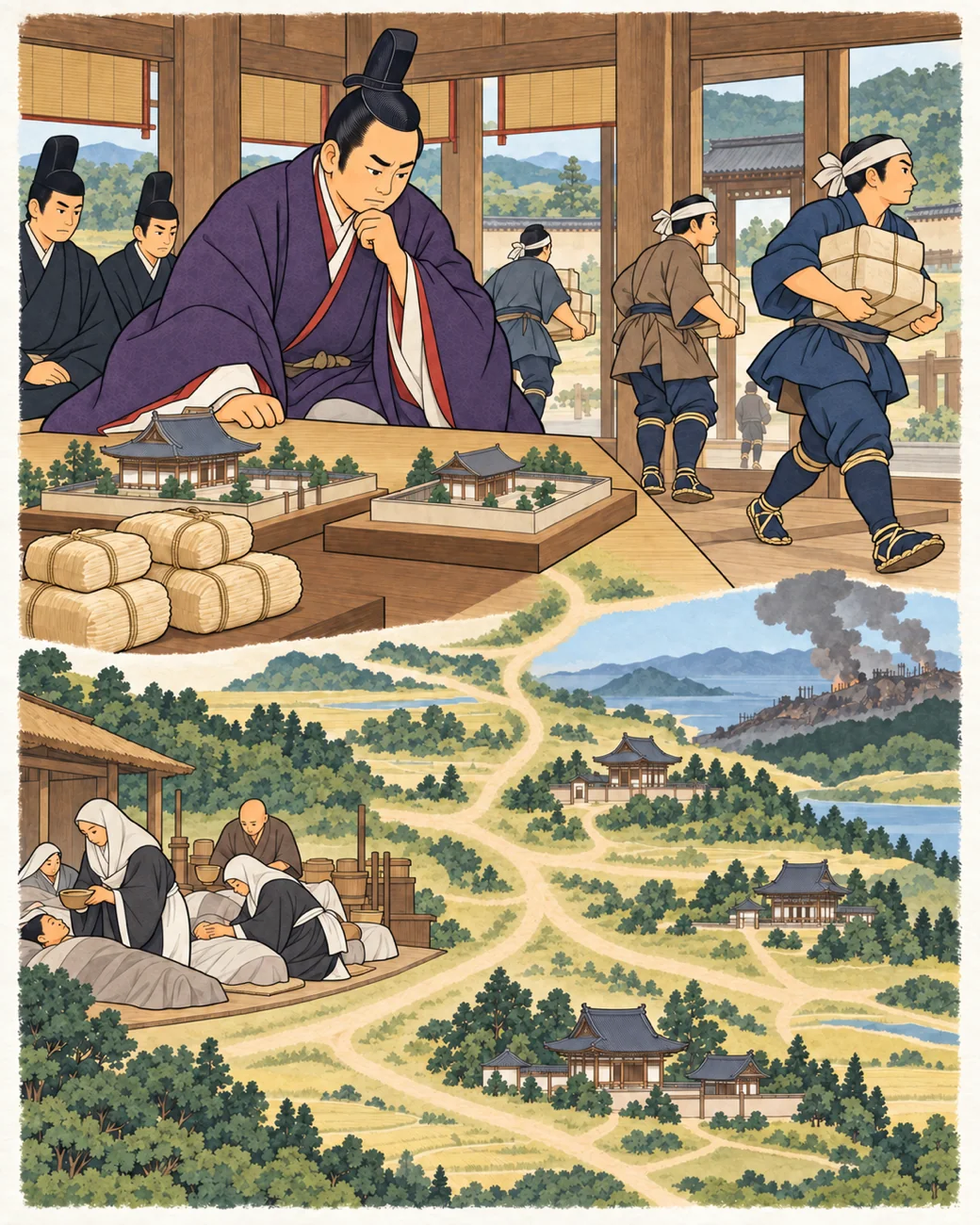
In 741, Emperor Shōmu ordered a Buddhist monastery and a nunnery in each province. Recent epidemics and political unrest formed the immediate setting. In the edict, Shōmu acknowledged poor harvests and disease and invoked Buddhist protection for the country and its people.
The order went beyond building temples. Each monastery was to house twenty monks and each nunnery ten nuns. Rice-land grants would support both; the monasteries also received tax income from designated households. Each monastery’s seven-story pagoda would hold a gold-lettered copy of the Golden Light Sutra, a scripture associated with protection of rulers and their realms. Regular recitation and observance of monastic rules would sustain that protection after construction.
Provincial governors had to put the program into practice. The Musashi temples, in what is now western Tokyo, were placed near the provincial government and a road linking the region to the capital. The nunnery stood west of that road. These locations brought religious foundations into an existing administrative landscape.
The edict did not produce a completed network in 741. In 747, the court complained that building work remained unfinished, sent inspectors and called on provincial and district officials to complete the pagodas, main halls and monks’ quarters within three years. In Shimōsa, near present-day Ichikawa, construction proceeded in stages into the later eighth century.
The result was a lasting provincial framework for state-sponsored Buddhism, unevenly realized through local construction and continuing support. Tōdai-ji’s Great Buddha project followed a separate edict in 743; its consecration in 752 was another event. The significance of 741 lies in the paired provincial institutions and the obligations needed to keep them operating.
Classic
The 741 edict emerged from a troubled reign. Epidemics had struck in the later 730s, and Fujiwara no Hirotsugu’s rebellion in Kyushu in 740 added a military crisis. Emperor Shōmu moved his court away from Nara and issued the temple order from Kuni, one of his successive seats of government. Disorder at the center and losses in the provinces gave his appeal for protection an immediate setting.
Buddhist temples already existed in Japan. Shōmu’s proposal gave provincial worship a common form and continuing public support. The edict, preserved in the court chronicle Shoku Nihongi, begins with the emperor’s acknowledgment of shortcomings in his government and recent failures of harvests and health. It invokes the Golden Light Sutra’s promise of protection for a realm where the scripture is honored. The promise of protection supplied the religious basis for institutions that provincial officials would support.
The provinces were administrative territories governed by officials appointed from the court. A program covering each province therefore required cooperation between central instructions and people who could allocate land, organize building work and support clergy locally. The emperor could prescribe institutions, but their operation would depend on resources outside his immediate household.
Nunneries were integral to the proposal. The order established a paired foundation in each province, with separate communities of monks and nuns. Both communities had prescribed numbers, income provisions and recurring religious duties.
The scriptures and territorial arrangement had continental precedents. The Golden Light text used by the court had been translated into Chinese by Yijing in Tang China. A provincial temple program also had a Tang precedent, although Japan's paired foundations had their own prescribed communities and support. In his edict Shōmu referred to earlier repairs of shrines, the ordering of Śākyamuni images and the copying of the Great Perfection of Wisdom Sutra. Buddhist foundations extended an existing combination of ritual measures; they did not replace practical responses such as relief and tax remissions.
Empress Kōmyō's patronage helped give women's religious institutions a place in this court-sponsored order. Her palace on the former estate of Fujiwara no Fuhito became Hokke-ji. The temple served as the central nunnery alongside Tōdai-ji's role as the central monastery. The national order came from Shōmu, while the ruling household's patronage created institutions through which both monks and nuns participated.
The 741 edict set out what the provincial foundations should contain and do. It prescribed twenty monks for a monastery and ten nuns for a nunnery, with vacancies to be filled. Rice-land grants would support both institutions, while the monasteries additionally received tax income from designated households. Clergy were to recite the Golden Light Sutra regularly and observe monastic discipline. Governors were charged with supervision.
The monastery’s seven-story pagoda would house a gold-lettered scripture. The edict also required copying the Golden Light and Lotus sutras. Building, copying and worship belonged to the same program: the tower protected a sacred text, and the resident community gave its promises a recurring ritual expression. The order provided for the foundations’ maintenance as well as their establishment.
Sites had to be chosen. In Musashi, officials selected ground near the provincial government at present-day Fuchū, alongside the Tōsandō Musashi road and close to springs. The nunnery was built west of the road. In Shimōsa, the temple complex developed near the provincial administrative center at present-day Ichikawa. Construction there began with the pagoda and proceeded to halls, residential buildings and the nunnery over an extended period.
Six years after the first edict, the court still faced unfinished work. Its 747 follow-up blamed governors’ neglect, dispatched inspectors and ordered governors and district officials to cooperate in finishing pagodas, main halls and monks’ quarters within three years. The order records the court’s complaint and its attempt to accelerate local construction.
The foundations' full names made their purposes explicit. The monastery was the Temple for Protection of the Realm by the Four Heavenly Kings of Golden Light; the nunnery was the Lotus Temple for the Eradication of Transgressions. The institutions were to stand apart so their communities could receive instruction and maintain discipline separately. On the eighth day of each month, monks and nuns were required to perform scripture recitation; at mid-month they were to recite rules and procedures governing the community. The order also prohibited fishing, hunting and killing on six observance days each month.
Site selection and continuing inspection were written into the same instruction. A foundation should be enduring, kept clean and accessible without making those who came travel an excessive distance. Grants of rice land to both communities and revenue from fifty designated households to the monastery supported permanent residents, rather than a congregation assembled only for a ceremony. Governors had to maintain the prescribed numbers when vacancies occurred and inspect the institutions. In 747, district officials were brought explicitly into the effort to finish buildings, adding local administrative cooperation to the original provincial responsibility.
The immediate result of 741 was a prescribed provincial system, with named religious communities, sources of income and official responsibilities. Completed buildings followed at different speeds. The 747 intervention shows that issuing the order and realizing it were separate stages; its three-year deadline was a further demand, rather than a record that all work was finished by that date.
Musashi preserves evidence of both foundations. The monastery’s pagoda site and the separate nunnery grounds allow the paired arrangement to be followed on the ground. Shimōsa’s staged construction similarly shows how a single imperial order generated a long local building program.
Once buildings existed, support still had to continue. Land and assigned household taxes maintained clergy who were expected to perform repeated rites. Governors were responsible for supervision, and vacancies in the religious communities were to be filled. The decree therefore prescribed continuing operation as well as the initial building work.
The work also drew on provincial resources for construction and maintenance. The surviving orders make these obligations clear, but do not give a complete account of the experience of every builder or supporting household. They establish the demands imposed by the court more securely than the distribution of their costs.
The central institutions developed on their own schedules within this wider program. Tōdai-ji's Great Buddha was consecrated in 752, while Hokke-ji's great precinct reached completion around 782, after Kōmyō's death. Their central roles did not mean that every provincial building was copied from a simultaneously completed capital model. At Shimōsa, the pagoda came before the main hall, lecture hall, residential facilities and nunnery. The institutional pair could therefore be prescribed before all the spaces needed for its full operation existed.
The paired design also assigned women recurring roles rather than simply admitting them to a single male community. Nunneries had resident nuns, rice-land support and duties of recitation and discipline. Musashi's separate nunnery grounds preserve that distinction in foundations and precinct layout. The smaller number of nuns specified by the court did not remove their institution from the provincial system.
The edict extended state-sponsored Buddhist worship through provincial institutions. A governor’s responsibilities now included supporting and inspecting a religious community expected to protect the realm through scripture and observance. The network joined worship to the same territorial units through which the court governed.
Its paired design also matters. Monks and nuns had different prescribed numbers and financial provisions, but both had assigned religious duties. The nunnery at Musashi makes that participation visible even where later accounts concentrate on a monastery’s pagoda. The physical remains help recover an institution that can disappear from a shorthand account of the policy.
Later temples bearing the name Kokubun-ji preserve the memory of provincial foundations, although their present buildings and religious affiliations need not reproduce those of 741. At Musashi, archaeological sites mark the ancient complexes, while the nearby living temple contains buildings rebuilt in later periods. These are related layers of history rather than one unchanged eighth-century establishment.
The Great Buddha at Tōdai-ji belongs to the broader history of Shōmu’s patronage, but its construction was announced in 743 and its eye-opening ceremony took place in 752. The distinct achievement of the earlier edict was the provincial system: paired communities, recurring rites, allocated revenues and officials responsible for putting a central order into local practice. Its remains and its follow-up orders preserve both the program’s reach and the work needed to sustain it.
Musashi illustrates how the original institutions and their later memory could diverge. The medieval conflict at Bubaigawara destroyed the temple complex. A Yakushi hall was rebuilt in 1335 with Nitta Yoshisada's support and rebuilt at its present location around 1755. The living temple's main hall is much later still. Meanwhile, the ancient precincts became protected historical sites in 1922. Today's marked foundations and reconstructed platforms belong to archaeological preservation; the operating temple has its own history of patronage and rebuilding.
Hokke-ji likewise underwent decline and restoration, including medieval work associated with Chōgen and Eison and reconstruction under Toyotomi patronage in 1601–02. The continued names of these institutions link later worship and local memory to the Nara program, while their buildings record subsequent changes. Provincial ruins, a restored nunnery and a living monastery consequently preserve different parts of the order's long consequences: its original territorial design, its dependence on support and the choices made by later patrons and communities.