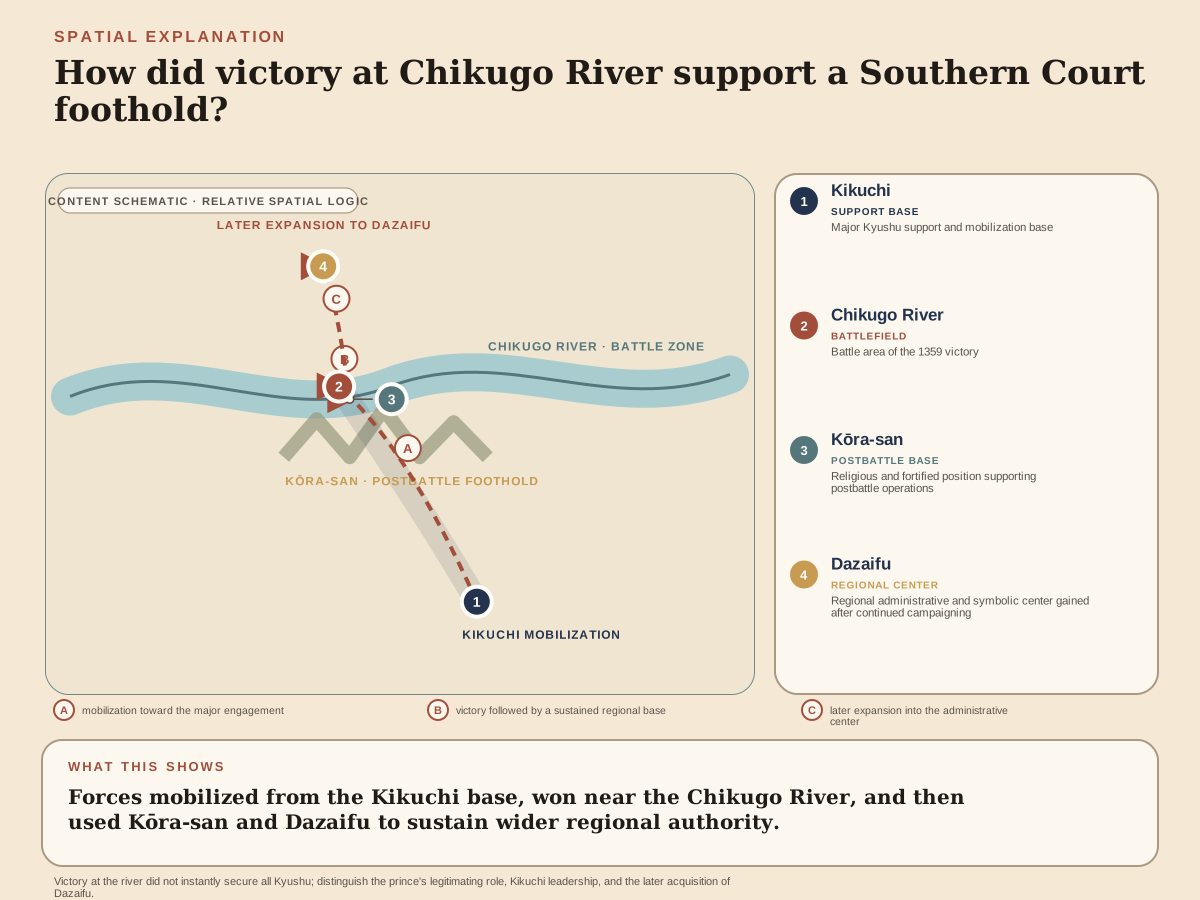
After rival courts formed in Kyoto and Yoshino, both sides sent princes and commanders to secure distant regions. In Kyushu, Kaneyoshi's title gave the Southern Court a dynastic center, while Kikuchi Takemitsu supplied land, fighters and regional knowledge.
Prince Kaneyoshi had been sent west as the Southern Court's military prince. Supported by the Kikuchi house, he spent years building a Kyushu coalition against Northern Court forces led by Shōni Yorihisa. The Chikugo River front protected approaches between southern Kyushu and Dazaifu.
Kaneyoshi was a son of Go-Daigo, the emperor who overthrew the Kamakura regime but lost control of the restored government to the Ashikaga. His birth year is uncertain, and the name is read both Kaneyoshi and Kanenaga. His mother is identified as Sanmi no Tsubone, a daughter of Tamemichi of the Mikohidari family. Go-Daigo’s Southern Court, based at Yoshino in opposition to the Ashikaga-backed Northern Court in Kyoto, sent royal sons to build support outside the capital region. Kaneyoshi’s western military commission made him one of those dispersed representatives. A commission conveyed the authority to lead and recognize service, but it did not supply the local forces needed to establish a base.
Gojō Yorimoto, an experienced court official, traveled with the young prince and was responsible for his protection and education. The route passed through the Inland Sea, including the Kutsuna islands in Iyo, in present-day Ehime. The prince then stayed at Taniyama in Satsuma, the southern Kyushu province corresponding broadly to present-day Kagoshima. His arrival is conventionally dated to 1342, several years after the westward mission had been conceived. Yorimoto’s continued service connected the mobile princely household with the administrative practices of the court. His later role in issuing documents gave that connection a practical expression.
Kaneyoshi began moving north in 1347 and established his base with Kikuchi Takemitsu in Higo by 1348. Higo lay in present-day Kumamoto, where the Kikuchi had land, followers and connections to other warrior families. Support also came from Aso-linked forces. The prince could give those warriors imperial recognition and a common regional leadership, while their forces made his authority defensible. Yorimoto worked with Takemitsu and issued many commands on Kaneyoshi’s behalf.
Shōni forces advanced toward the Chikugo River and Kōra-san front. The confrontation at Ōhobaru on 6 August 1359 brought the rival coalitions into a large field battle. Command was distributed: Kaneyoshi embodied the political cause, while Kikuchi leaders directed much of its military force.
In 1359 the armies met around the river crossing and Ōhobaru, in present-day Ogōri. The battle was severe. Later traditions supply very large force and casualty totals that cannot be accepted without qualification; the secure result is a Southern Court victory achieved by Kaneyoshi's coalition and Kikuchi military leadership.
The victory enabled the Southern Court side to take Dazaifu and dominate much of Kyushu for roughly eleven years. Kaneyoshi's authority was real but rested on regional allies. The episode was a high point within a civil war, not a permanent reunification of the island or the realm.
The conflict between Ashikaga Takauji and his brother Tadayoshi divided the shogunate and reshaped Kyushu’s alliances. Ashikaga Tadafuyu, whom Tadayoshi had adopted, was Takauji’s biological son. He was welcomed by Shōni Yorihisa in northern Kyushu and gathered supporters by confirming warriors’ and religious institutions’ rights. His following competed with the shogunate’s Kyushu representatives and with Kaneyoshi’s Southern Court coalition. The prince’s alliance therefore operated amid competing sources of military leadership and documentary recognition. The Kikuchi and Aso-linked forces supplied a regional base from which he could contend with them.
Northern Court resistance was pushed back, and the Southern coalition captured Dazaifu. The victory created an administrative center from which Kaneyoshi and his allies could claim authority across Kyushu.
In 1359 Shōni Yorihisa sought to cooperate with Ōtomo Ujitoki and catch the southern forces between them. Takemitsu mobilized from the Kikuchi base with Kaneyoshi and crossed the Chikugo River to attack Yorihisa’s position. Fighting continued around Ōhobaru, in the vicinity of present-day Ogori. Kikuchi Takemasa and other warriors participated in the campaign. Yorihisa’s son Tadasuke died in the battle, and both sides sustained serious losses. The defeated forces withdrew toward Mount Hōman near Dazaifu. Takemitsu’s army lacked the strength for immediate pursuit and returned to Higo.
The loss did not immediately erase the Shōni position or transfer Dazaifu to the prince. It did alter the balance in favor of the Southern Court’s coalition. In 1361 Kaneyoshi and Takemitsu moved their headquarters to Dazaifu and established the region’s strongest Southern Court center. Their achievement came while southern fortunes were weakening in other parts of Japan. The prince’s commission gave the coalition a court-backed leadership; Takemitsu and other commanders had supplied the forces through which it reached that seat.
Southern Court influence lasted about eleven years before new northern coalitions reversed it. The battle's importance lies in that regional regime and in the evidence that national dynastic conflict depended on local alliances, roads, river crossings and fortified landscapes.
The battle made Kyushu a major theater of the Northern and Southern Courts rather than a distant extension of conflict around Kyoto.
Kaneyoshi's success shows how a royal claim became effective only through alliances with local warrior houses. The later reversal of Southern Court power also exposes the limits of that coalition.
The Seiseifu was the prince’s western-command headquarters, established at successive places as his position changed. Its political authority traveled with the princely household and the officers serving it. Gojō Yorimoto issued commands in Kaneyoshi’s name and worked with Takemitsu, joining court expertise to warrior support. The occupation of Dazaifu in 1361 placed that administration at a traditional center of Kyushu government and overseas contact. Recognition of holdings and offices gave institutions reasons to seek its decisions. Complaints over rice revenues brought the household’s authority into the material affairs of temple administrators and local holders.