Read the article below. Interactive reading tools are available when scripts load.
Classic
The Ashikaga civil wars required troops to remain in the provinces and around Kyoto. Estate income already supported aristocratic households, temple services and local management. Assigning it to an army transferred a claim on production that was already committed elsewhere.
Military commanders had established provision estates during the fighting. Proprietors sought restraints on these incursions. The government needed both continuing military service and a workable limit on appropriation.
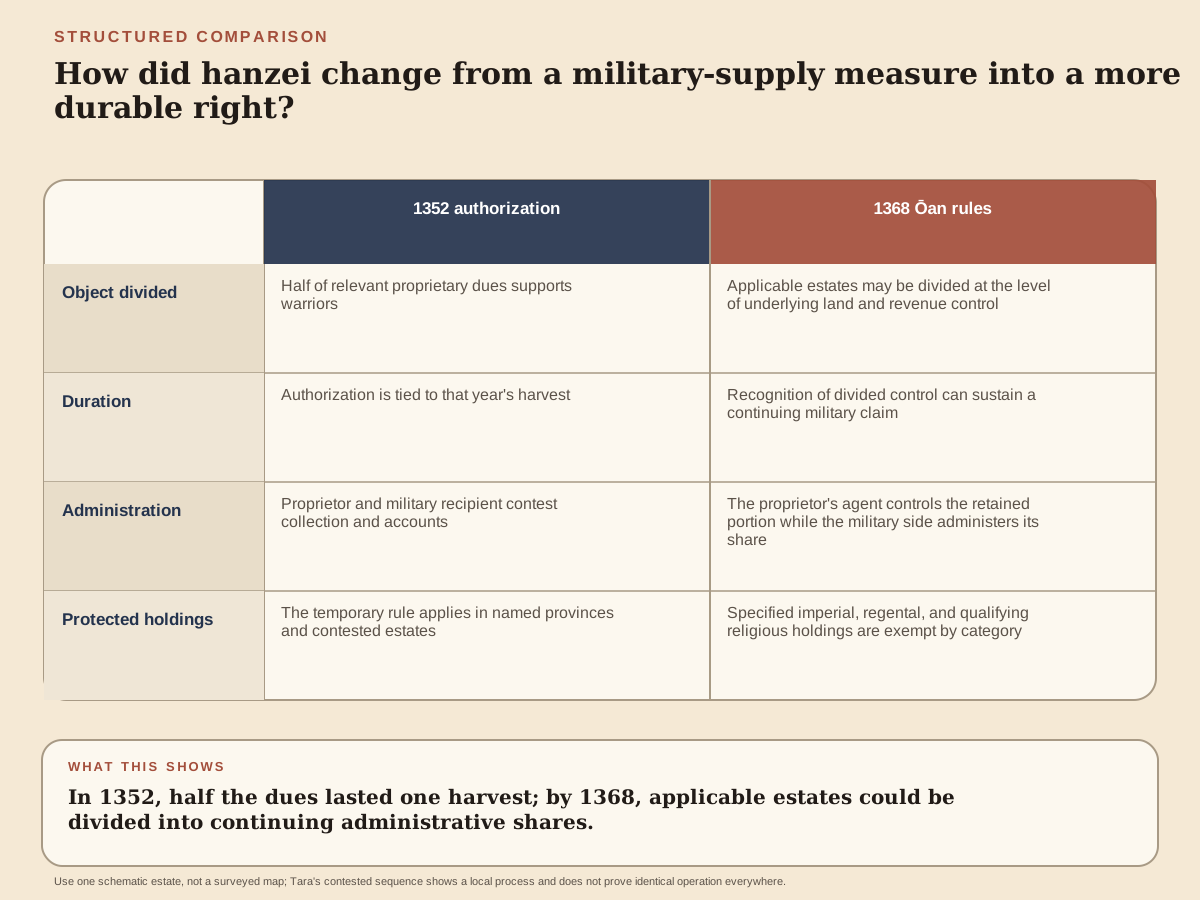
The 1352 authorization addressed that conflict in Ōmi, Mino and Owari: half the relevant proprietary dues could support warriors for that year’s harvest. Provincial military leaders distributed the assigned shares to their followers.
The one-harvest limit mattered. Authorization gave a recipient a specified fiscal claim, with a portion remaining to the proprietor. Continuing war made both observance of the limit and repayment difficult.
The share concerned a layered estate economy. A court household or temple could hold the right to receive dues while local officials managed cultivation and collection. The shugo, a provincial military governor, stood outside some of those relationships. Giving him authority to allocate an estate's revenue brought his recipients into dealings with managers and cultivators who had previously answered to other claimants. An authorization to take half the dues therefore raised questions about who collected them and whose accounts fixed the amount.
The harvest limit also connected the arrangement to an agricultural calendar. Income for military use had to be collected from a crop and delivered, although the same payments supported a proprietor's expenses and religious observances. At Tara, a later recipient would demand rice and cash in advance against the following year. That documented demand shows how an army's immediate requirements could collide with the timetable for producing and remitting estate income.
An assignment issued in 1353 by the deputy of Ōmi’s Rokkaku governor illustrates a shift within the temporary system. It allocated 40 koku, measured by rice volume, from Ichiko estate in Ōmi to the heirs of a warrior who had died in battle. The document specified that year’s harvest and described the grant as a reward for death in service.
Revenue assignment could therefore sustain a commander’s following as well as feed troops presently fighting. The recipient’s claim depended on the assigning officer and the recorded service.
At Tara estate in Wakasa, in 1354, half of the 56-plus koku collected by Tōji was taken as the governor’s hanzei share. The recipient, a son of a former governor, exceeded the half-share the next year, and Hosokawa Kiyouji ordered him to keep to the limit.
After a suspension, a military recipient entered again late in 1361 and demanded rice and cash in advance against the next year’s payments. Tōji appealed to the Ashikaga government. The governor ordered hanzei stopped in 1362, but another recipient entered in March and requested the documents needed for collection in May.
Tōji eventually responded by dividing the land with the newcomer. Its authority no longer reached the allocated military half. The settlement changed the object being shared from collected dues to the estate’s underlying land control.
These steps were recorded through accounts, orders, requests and agreements. An order stopping collection was consequential, but did not by itself remove all local military claims. The successive entries show why a proprietor could choose partition after repeated appeals.
The two cases show different uses of military assignments. At Ichiko, the surviving order joined a one-crop term to compensation for a warrior killed in the Kyoto fighting. The deputy could use estate income to recognize service through the dead man's household. At Tara, accounts and letters instead reveal the proprietor's efforts to restrict collection. Excess payment prompted an order; renewed entry prompted an appeal; a further recipient sought the paperwork for collecting his share. Access to documents accompanied armed access to the estate.
Tara's partition was a negotiated response to that sequence, rather than an automatic consequence of the original order. An institution that could obtain a suspension still faced a newcomer able to assert a military claim. Giving up administration over part of the land offered a different way to protect the retained portion. The record establishes this local settlement; it does not show that every temple, estate manager or village adopted the same solution.
The 1368 Ōan rules established further distinctions. Specified imperial revenue lands, designated regental holdings and religious lands under exclusive institutional control were protected against hanzei. The exemption was defined by category; it was not a blanket protection for everything owned by a temple.
In other proprietary estates, the rules permitted division of the underlying land. The proprietor’s agent was to receive control of the portion retained on that side. Recognizing a protected half could also confirm the military recipient’s continuing claim to the other half.
For Tōji at Tara, the difference was concrete. A share of collected dues had become a portion where the temple no longer administered cultivation and payments. The local history also demonstrates that central safeguards required implementation on the ground.
The settlement preserved part of the proprietorial system while accommodating military occupation elsewhere. It provided a framework for distinguishing retained institutional rights from military shares, with continuing disputes over which category applied.
These distinctions changed what a proprietor needed to defend. An annual revenue share could be contested through accounts and the amount collected. A division reaching the underlying land also concerned which side administered a portion of the estate. Exemption claims required an institution to establish that its holding belonged to a protected category, while a divided estate required recognition of the rights left to each side. Neither task could be settled by assuming that all religious property was exempt or all provincial land subject to an identical division.
A military-provision estate likewise needs to be followed through its particular assignments and subsequent orders. The term could describe an income set aside for wartime support; later allocation and division could make that claim more durable. The transition from the 1352 harvest measure to the 1368 framework explains a direction of change. Tara's intervening appeals and agreements supply the steps that a statement about growing shugo power would otherwise leave unexplained.
Military governors gained influence through their role in allocation. An assigned share could give a warrior reason to maintain a connection with the provincial authority that allocated or defended it. Revenue and service could reinforce each other over successive campaigns.
For proprietors, documents establishing protected status or a retained share became essential resources. For cultivators, the identity of the collector and the portion of income due to each authority could change as military recipients entered.
Tara’s orders and accounts expose this process over time: excess collection, appeal, suspension, re-entry and partition. They preserve a contested local relationship rather than evidence that the original half-share rule operated identically everywhere.
Hanzei formed part of the wider growth of provincial military power. Mobilization, appointments and other revenue agreements also mattered. The particular contribution of half-share assignments was to connect military followings with estates that commanders had not previously controlled.
Wakasa also places a limit on that explanation. The prefectural history finds no warriors already rooted there since the Kamakura period among the named hanzei recipients, and no confirmed examples of locally based provincial warriors receiving such shares under the later Isshiki governors. It therefore cautions against treating Wakasa's assignments as proof that the native warrior population was systematically converted into the governor's vassals. The income could support provincial military power without establishing that particular recruitment pattern.
Other arrangements enlarged a governor's involvement in estate management. Under shugo-uke, a proprietor entrusted collection and administration to a governor or his deputy in return for a contracted annual payment. The attraction was a more dependable remittance despite incursions and unpaid dues. The promise could fail: at Kōyasan's Ōta estate in Bingo, a contract for 1,000 koku annually accumulated more than 20,000 koku in arrears over thirty-seven years. Such contracts were a distinct mechanism from taking a wartime half-share, even when both increased military participation in collection.
The central government had authorized local resources to sustain forces it needed. Continuing assignments gave provincial agents a reason to retain access to land, accounts and collections after the initial harvest term. Proprietors defended their income through orders, exemptions and settlements, while cultivators faced recipients demanding a share or an advance payment. Regional power grew through those repeated transactions and disputes. A single decree did not determine which governor would consolidate a province, which local warriors would follow him, or which institutional rights would survive.