Read the article below. Interactive reading tools are available when scripts load.
Quick
The conscription rules issued in January 1873 sought a national army whose recruitment would extend beyond hereditary warrior households. The preceding government announcement criticized the separation of soldiers from farmers and tradespeople and called military service a duty to the state.
Local officers had to identify men aged 20, determine eligibility, conduct examination and organize selection. Those selected entered three years of active service, followed by obligations to return in an emergency. Officials, specified students and household heads could be exempt, and a 270-yen payment provided another route out of active duty. Broad language about national service coexisted with rules that spared particular households and people with money.
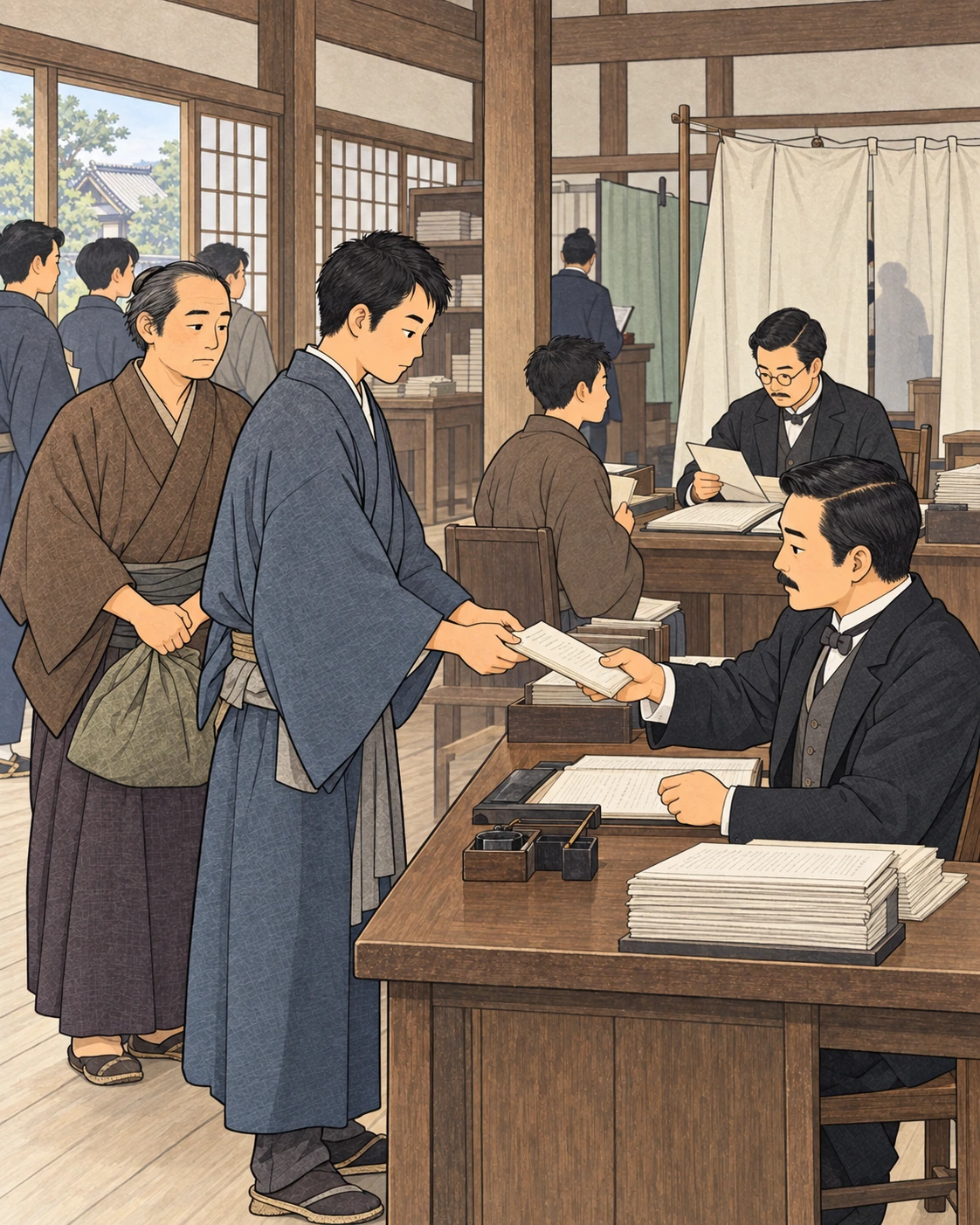
The process depended on local records. At Imabo village in 1874, a parent’s form reported a son’s birth date and age to deputy village heads. Army officials and local officers worked with lists of candidates and exemptions. Recruitment did not begin everywhere simultaneously: Osaka’s district started taking infantry and artillery recruits in 1874, after preparing records in 1873.
Resistance had different causes. The announcement’s “blood tax” metaphor encouraged fears of literal blood-taking in some places. At Kōnouchi village in March 1873, however, surviving depositions point to suspicion that officials accepting exemption payments were fraudsters. District leaders in Hida produced a plainer explanation that the government would pay service expenses and enlistment did not mean immediate dispatch to war.
Conscription required men to prove age, health and family position to officials, and could take a worker away from home. National military service developed through these decisions and repeated revisions. The system supplied recruits and records to a central army, while its initial exemptions and regional timing made the burden uneven.
Classic
After abolition of domains, the government sought troops recruited and commanded through national institutions. The imperial guard still drew heavily on forces from particular domains. Recruitment beyond warrior households required a different means of identifying and enrolling soldiers.
The government’s preliminary announcement invoked ancient military arrangements and foreign examples. It criticized the inherited division between warriors and people who farmed or traded, presenting service as a duty owed more broadly to the state. This was the government’s justification for changing recruitment.
Local administration supplied the necessary records. Officials needed ages, residence and household position before selecting recruits. Enrollment could therefore make family status relevant to a military decision: who headed a household, who was its heir and whether a listed man qualified for exemption.
The new demand also had to be explained. Official language was difficult for some readers, and the term “blood tax” acquired alarming interpretations. Hida district heads responded by producing an explanation in plainer language. Communication and household eligibility became part of recruitment alongside the army’s need for trained men.
Yamagata Aritomo's role connected this problem to military planning abroad. After returning from Europe, he and colleagues including Saigō Tsugumichi submitted proposals to strengthen Japan's forces in comparison with European and American powers. His later contribution to the ordinance did not mean importing a finished foreign system unchanged. Recruitment still had to be organized through Japanese local offices and household categories.
For a farming or trading household, the change introduced a demand beyond taxation: an eligible son might have to leave for military service. The official criticism of the warrior–commoner division thus had two audiences. It justified a broader source of soldiers to the government, while requiring families accustomed to civilian occupations to establish whether their members would be taken. Explaining the obligation and proving eligibility were practical parts of the reform.
The ordinance was issued on January 10, 1873. Eligible men aged 20 underwent examination and selection, including a lottery. Active service lasted three years. The rules also registered men aged 17 to 40 for a broader national military obligation, which did not mean that every registered man immediately entered a barracks.
Exemptions protected specified officials and students, household heads and other family categories. Payment of 270 yen could also secure release from active duty. Whether a man actually served therefore depended on the eligibility rules and selection, as well as the general proclamation.
Recruitment officers and medical personnel worked with local officers to establish temporary recruiting offices. Candidate and exemption lists were prepared, examination and selection results recorded, and the information sent to the Army Ministry and the garrison authority. Selected men were then escorted toward their units.
The timetable differed by region. Osaka’s district prepared lists in 1873 and began infantry and artillery recruitment in 1874. The 1873 instruction to investigate eligible men explicitly stated that this registration was not an immediate summons. Preparatory paperwork and entry into service were separate steps.
Imabo’s 1874 form gives a household’s part in that work. A parent reported a son’s birth date and calculated age, affixing a seal and submitting the information to named deputy village heads. Such records linked a household member to the officials administering national service.
Compliance was contested. At Kōnouchi, villagers mobilized against officials they suspected of fraudulent exemption-fee collection. In Hida, Ōmae Kurō and fellow district heads explained government payment of service costs and distinguished enlistment from immediate war. Resistance and explanation addressed particular anxieties, which differed between communities.
The household categories offered ways to contest or avoid service. In the Tondabayashi records, a proposed adoption produced disagreement over whether the receiving man was really a household head; recognition of a previously inherited separate household eventually allowed the name to enter the exemption list. Later revisions tightened the rules, prompting renewed checks against household registers. Adoption or household division could affect eligibility, but a particular recorded arrangement does not establish that every adoption was military evasion.
Selection also had to be followed by movement to a unit. Local heads escorted men designated for active service, and completion of that term placed them under further reserve obligations. The initial scheme divided four reserve years into successive two-year categories. Service therefore meant both a first absence from home and the possibility of later recall; the register of men aged seventeen to forty covered a wider obligation than immediate enlistment.
The government acquired a route to recruit ordinary households through prefectural and village offices. Names on a register were filtered through eligibility decisions, medical examination and selection before becoming soldiers. The army’s personnel depended on this sequence of administrative acts.
The initial exemptions limited that route. Family position could decide whether a son remained at home, while money could provide an alternative to active duty. A national obligation thus operated through categories that distributed service unevenly.
Village records reveal how households presented those categories. An 1873 report from Ebitani described two twenty-year-olds as heirs, explaining that one younger son occupied that position after his brother established a separate household. This was a local report of eligibility, not evidence that every family used the same strategy.
The rules also changed the relationship between employment and armed service. In the original provisions, recruits received pay and other support, and capable men could be selected for further training or promotion. Military employment was organized under state regulations instead of being defined solely by a hereditary place in a lord’s retinue.
The outcome was a means of obtaining soldiers, rather than an immediately complete army or an equal distribution of service. A local name could be entered on a list yet never result in active duty because of exemption, failed examination or selection. Conversely, an eligible man chosen for three years' service could not remain at home simply because his household preferred his labor. Pay and rations met specified military needs; they did not make the decision voluntary or establish that every family's loss was compensated.
The removal of warrior distinctions continued through separate measures. In 1876 stipend commutation replaced inherited allowances with bonds, and the sword-wearing prohibition restricted a public sign of warrior standing while making exceptions for prescribed dress and uniformed service. Neither measure was a clause in the 1873 ordinance. Together they separated hereditary status, income and the right to bear arms in public from employment under state military rules. This affected people who had supported the Restoration as well as former opponents.
Local offices continued to mediate military eligibility after 1873. A village clerk’s later diary complained of repeated queries about adoption, separate households and payments while insisting that the regulations could not be bent. Conscription created recurring work in matching household information to military rules.
Absence and illness affected families as well as units. In 1878 a soldier from Tondabayashi, Tatsujirō, died after hospital treatment for beriberi. The unit asked his relatives whether they wished to receive the body, and his father’s petition requested its return for a funeral at home. This record shows a family dealing with the consequences of service beyond enlistment.
The system expanded and its rules changed. Recruiting registers, exemption decisions and later call-up obligations connected local offices to the army over time. The first ordinance’s exemptions and regional timetable cannot stand for all later military service, still less the separate arrangements subsequently applied in colonial territories.
The reform’s lasting administrative effect was the ability to turn household records into military claims on named men. Parents reported ages, officials decided eligibility and army offices received candidates. That process broadened recruitment across inherited status while placing a new obligation on households whose access to exemptions differed.
The records show the cost of service without requiring an imagined account of every barracks. Tatsujirō's illness, hospital death and his father's request for the body joined army administration to a family's funeral arrangements. The military notice and petition record relatives and local officers dealing with absence and death after recruitment. They do not tell us which women or older relatives performed each task during his absence, or prove that his experience was typical of all recruits.
Repeated eligibility inquiries gave village officers another form of authority. A family needed its account of birth, succession or adoption to be accepted within military categories; officers compared those claims with registers and later regulations. This produced files and disputes alongside soldiers. The state's broader recruiting reach depended on that work, while the options attached to money and household position made encounters with the same national obligation unequal. Uniform training and command were objectives of the army; the surviving local evidence here is strongest on enrollment, exemptions and family consequences, rather than on a claim that soldiers everywhere carried identical habits home.